12 October 2026 · Comparison
Naoma vs Drift: Live AI Demos vs Legacy Chat
The short answer
if you want live interactive AI product demos and pay-per-engaged-demo pricing.
if you need legacy enterprise chat routing within the Salesloft ecosystem.
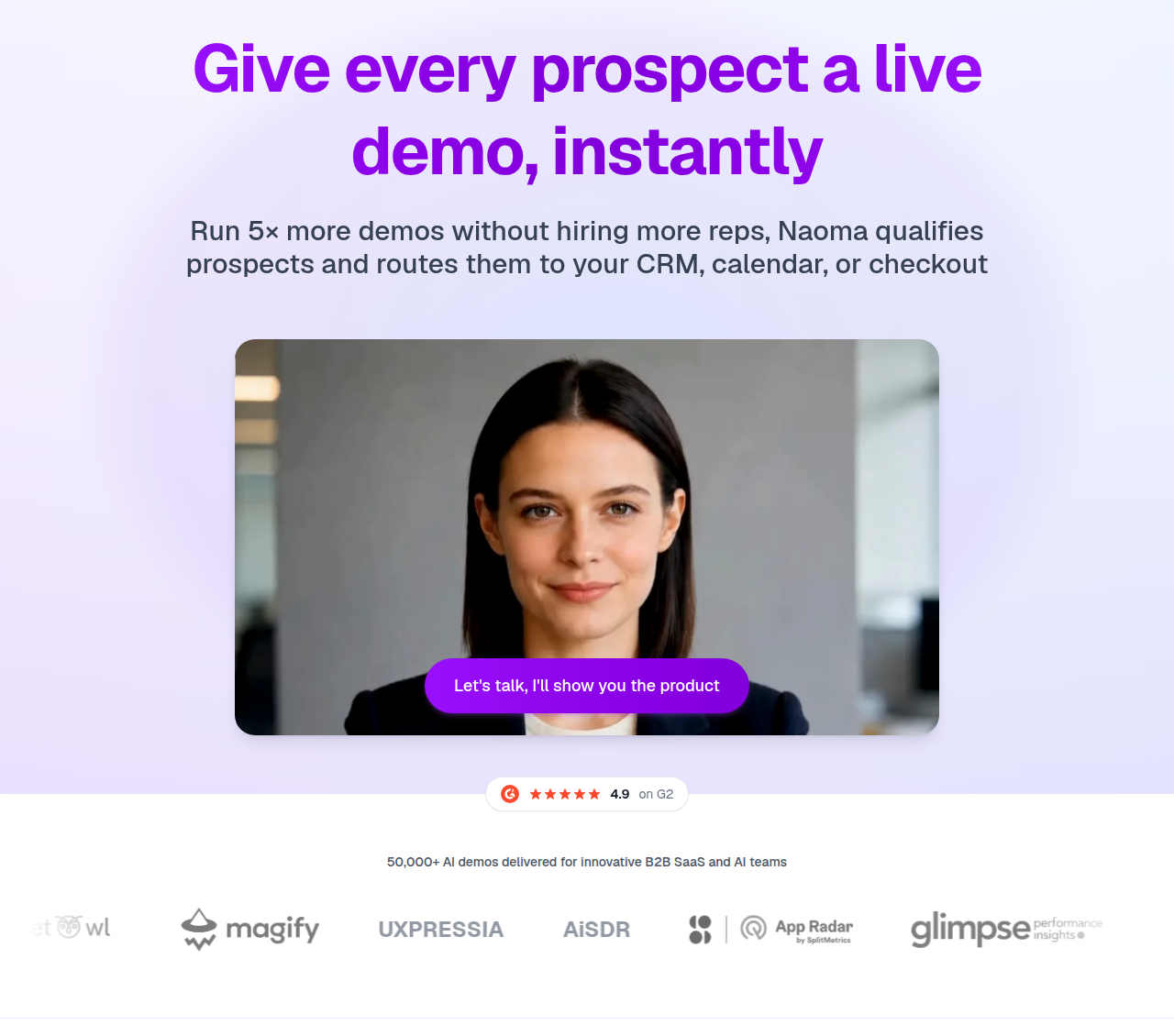
Pick Naoma if your buyers need to see the product work, not read about it: an AI demo agent that runs a live, spoken walkthrough on your site 24/7, qualifies the visitor mid-demo, and bills only for engaged sessions of 3+ minutes, with published plans from $249/mo billed annually. Pick Drift (now inside Salesloft) if you are an enterprise account team already living in the Salesloft or Clari revenue suite, you need audited SOC 2 Type 2 and ISO 27001 today, and your model is ABM routing to named reps rather than self-serve discovery. They are not two versions of the same widget. One drives your real product live; the other qualifies a chat visitor and books a call for later.
Commercial disclosure
Neither Naoma nor Drift currently has a confirmed self-serve affiliate program, and Drift is no longer sold as a standalone product at all. This post uses no affiliate links for either vendor, so we earn nothing if you buy one. We may earn commissions through other partner programs linked elsewhere on this site. That does not tilt the analysis: both platforms get an honest “where it loses” section below, and every price, limit, and metric is marked for live re-verification before publishing.
The category shifted while you were not looking
Drift invented “conversational marketing” in the late 2010s: a website chat widget that greeted a visitor, asked three to five qualifying questions, and dropped a calendar link for a sales call a few days out. It worked, in the sense that it captured intent. Then it handed that intent to a delay. In B2B SaaS, the gap between “interested now” and “meeting on Thursday” is where deals cool off. Momentum decays between the click and the calendar invite, and by the time the call happens the prospect has often already started a competitor’s free trial.
Naoma attacks the delay itself. Instead of booking a conversation for next week, its agent conducts the discovery, answers objections, and immediately runs an interactive walkthrough of the actual product. The buyer who was curious ten seconds ago is watching the software work ten seconds from now.
That is the whole decision: schedule the conversation, or have the conversation now.
What Naoma actually is
Naoma is a full-cycle inbound demo agent, closer to an AI account executive that demonstrates than to a chat widget with better copy. It runs on your site or inside your app, holds two-way spoken and text conversation, handles a prospect interrupting it mid-sentence, and adapts the flow to the visitor’s role and industry. Inside the demo it asks qualification questions, extracts intent, objections, and competitor mentions, then routes the enriched lead to a booked meeting, your CRM, Slack, Sheets, or self-serve checkout depending on the outcome.
The important architectural line is where the demo content comes from. On Naoma’s Starter tier the demo is built from slides and screenshots. The live-product walkthrough, where the agent logs into a dedicated sandbox you provide and clicks through the real software in a real browser, starts on Growth. Setup is a lightweight SDK snippet, and the vendor says the agent is delivered around your existing playbooks, FAQs, and ideal demo journey.
Naoma also publishes conversion claims: 6% to 20% visitor-to-demo conversion against roughly 1% to 2% for a standard “Book a demo” button, “50,000+ AI demos delivered,” and in its AiSDR case study, 53% of demos running past three minutes with an average of 7m 50s. Treat all of these as vendor-published claims, not independent benchmarks. They are directionally plausible for a live demo offer and worthless as proof of your own funnel. The honest signal is that the vendor publishes them at all and lets prospects run the demo themselves.
What Drift is now
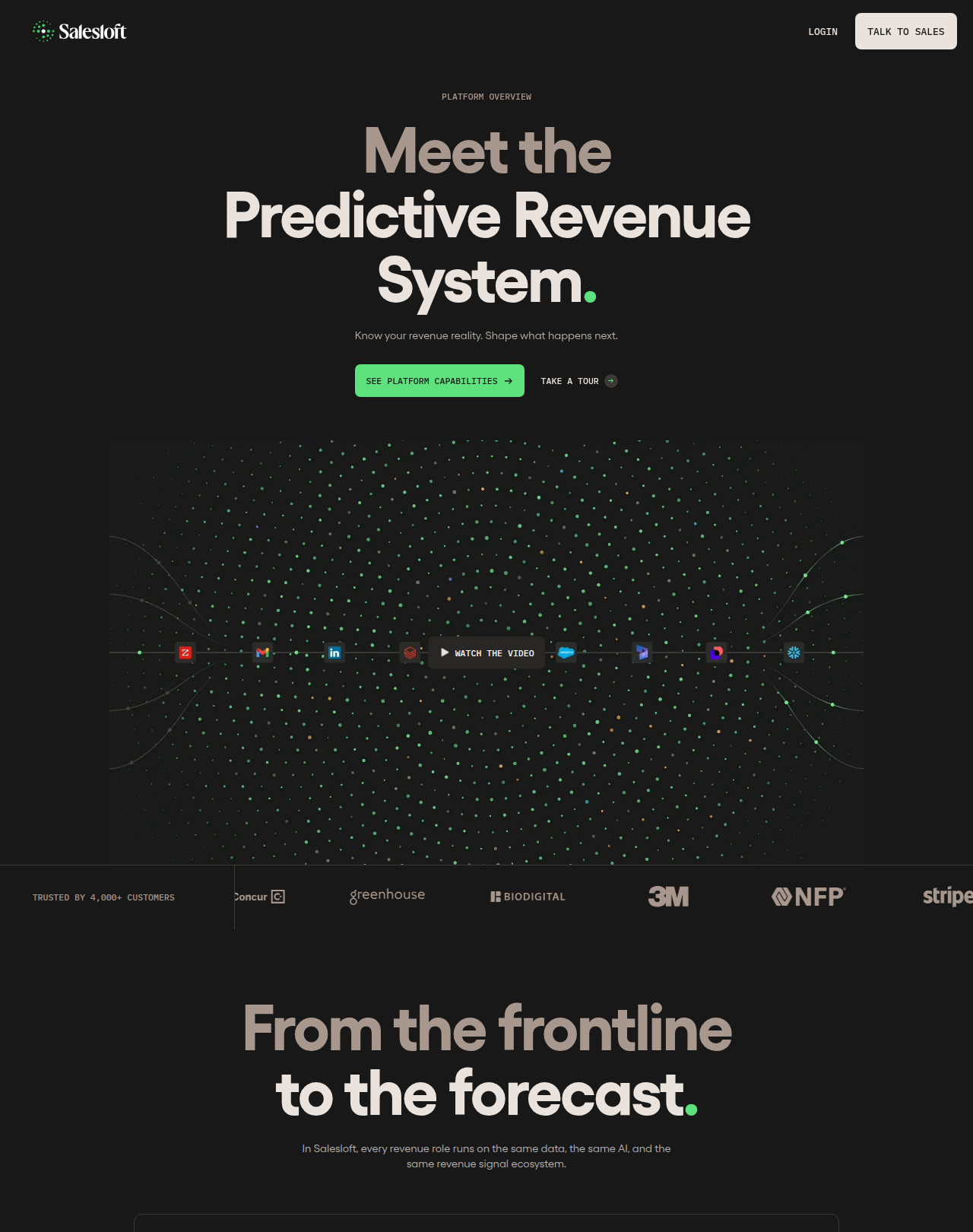
Drift, as a standalone product, is gone. Navigating to drift.com redirects to Salesloft’s chat agents page, where the current copy says the quiet part out loud: “We’ve transitioned from Drift to 1mind”. Legacy customers can still log in at the old Drift login, but a new buyer cannot purchase standalone Drift. They are steered into the Salesloft platform or the 1Mind partnership.
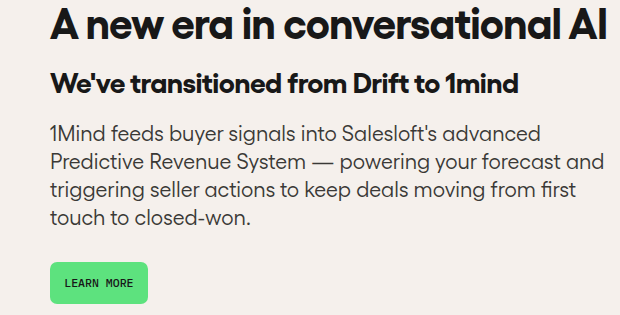
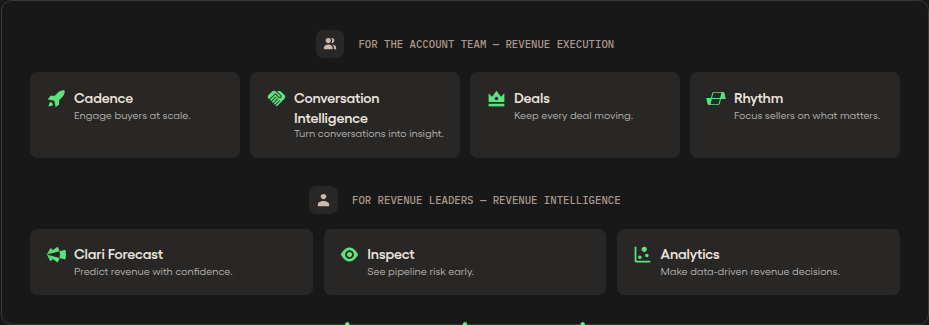
That matters because “naoma vs drift” is really a question about what replaced Drift, and the answer splits in two. Salesloft replaced the enterprise account motion with a broader predictive revenue platform. 1Mind replaced the conversational layer with an AI chat agent that feeds buyer signals into that platform. Neither of them demonstrates your software. Salesloft’s own page describes the job as capturing intent, personalizing the chat, and piping it into a seller’s Rhythm workflow and forecast, not walking a prospect through the product.
Pricing: pay-per-engaged-demo vs enterprise contracts
This is where the two business models diverge hardest, and it is where the “which is cheaper” question actually lives.
Naoma meters by engaged demos. A demo counts only when a prospect interacts for 3+ minutes; bounces, misclicks, and quick exits are free, and demos pause at your monthly cap rather than generating an overage bill. The published tiers are Starter, Growth, and Scale:
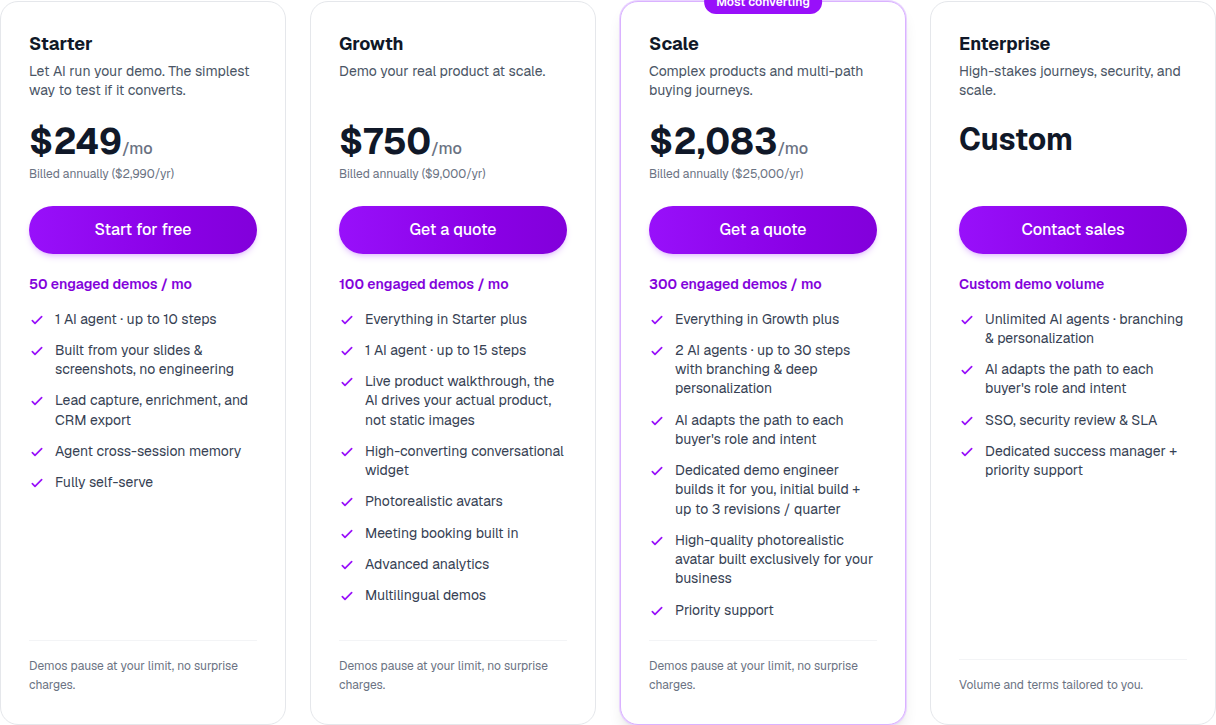
- Starter - $249/mo billed annually ($2,990/yr); 50 engaged demos/mo, 1 agent, up to 10 steps, built from slides and screenshots.
- Growth - $750/mo billed annually ($9,000/yr); 100 engaged demos/mo, live product walkthrough, conversational widget, photorealistic avatars, meeting booking, multilingual demos.
- Scale - $2,083/mo billed annually ($25,000/yr); 300 engaged demos/mo, 2 agents, up to 30 branching steps, dedicated demo engineer.
- Enterprise - custom quote with unlimited agents, SSO, security review, and an SLA.
Salesloft and Drift are the opposite. There is no published price and no self-serve checkout. Pricing is quote-gated: you negotiate an annual enterprise contract with a sales team, and the number is scoped to your organization rather than to any meter you can watch. That is a normal way to buy a revenue platform at scale, and a real drawback if you just want to try something this afternoon.
Prices accurate as of October 2026; check vendor sites for current rates.
| Dimension | Naoma | Drift / Salesloft |
|---|---|---|
| Core job | Run a live, interactive product demo on arrival | Qualify chat visitors and route or book them |
| Demo of your product | Real product driven live (Growth+); slides on Starter | None; text chat and FAQ deflection |
| Pricing model | Pay per engaged demo (3+ min threshold) | Quote-gated annual enterprise contract |
| Published entry price | $249/mo billed annually (Starter) | None published; quote required |
| Voice | Bidirectional spoken dialogue with interruption handling | Text only |
| Languages | 80+ auto-detected | Multilingual text chat, count unlisted |
| Compliance | GDPR active; SOC 2 and ISO 27001 in progress | SOC 2 Type 2, ISO 27001, ISO 27701 |
| Company stage | Launched 2026, $440k pre-seed | Established suite, 4,000+ customers |
| Best for | Products that must be shown, explained, and qualified live | Enterprise account teams already in the Salesloft/Clari ecosystem |
Compliance is the real enterprise gate
If your info-sec team runs a third-party review, this section is the one that decides the deal.
Salesloft states that the Salesloft and Drift platform services undergo annual SOC 2 Type 2 examinations, that its information security program is aligned with and re-certified against ISO 27001, and that it also holds ISO 27701, with GDPR and CCPA/CPRA commitments. For a regulated enterprise buyer, that is a checked box, and it is the strongest card Salesloft holds in this comparison.
Naoma’s posture is early-stage and, to its credit, honest about it. Its FAQ says it is GDPR-compliant and that SOC 2 and ISO 27001 are “in progress”.
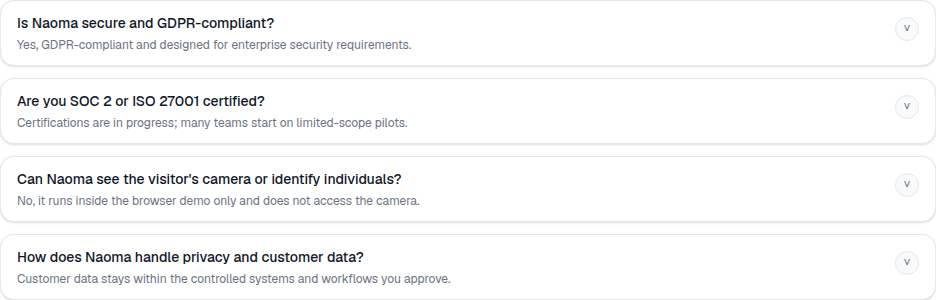
For a startup or a mid-market team that runs a lightweight security review, “SOC 2 in progress” is normal and often fine. For a buyer whose procurement cannot clear a vendor without an audited SOC 2 Type 2 report today, it is a blocker, not a checkbox. That single line will decide more deals in this comparison than any feature list.
Where Naoma loses
- The defining feature is paywalled. Starter is slides and screenshots. Live-product driving, the thing that makes Naoma Naoma, starts at Growth: $750/mo billed annually ($9,000/yr). If your budget only reaches Starter, you are buying a slideshow agent, not a live demo.
- No audited SOC 2 or ISO 27001 yet. Only GDPR is active today; both certifications are in progress. Strict enterprise vendor reviews will bounce it.
- You own the sandbox. Live demos mean you provision, seed with realistic data, and maintain a dedicated demo environment the agent logs into. That is ongoing operational work a text chatbot never asks of you.
- Hard monthly caps. Engaged demos are capped at 50, 100, or 300 by tier, so a viral traffic week burns the meter and forces a top-up or upgrade.
- Young company, short track record. Launched in 2026 on a $440k pre-seed. The G2 rating is high but the review base is small and recent, and the headline conversion numbers are self-published.
- Two official stories on self-serve. The pricing page markets Starter as fully self-serve, while the FAQ still describes setup as hands-on with the Naoma team and says there is no self-serve UI yet. One of those is stale; a buyer should ask which.
Where Drift (Salesloft) loses
- Standalone Drift is over. You cannot buy the product that the comparison is named after. New buyers are routed into the Salesloft platform or the 1Mind partnership. If you wanted Drift specifically, it no longer exists as a standalone SKU.
- The cost floor is enterprise-only. There is no published price and no self-serve plan; you negotiate an annual contract through a sales process built for large organizations. This is structurally out of reach for a startup or a lean SMB that wants to swipe a card and start today.
- It is a calendar relay, not a demo. The inbound experience qualifies a visitor and hands them to a booked call or a seller workflow. It cannot show, drive, or explain your software live.
- Committed spend, not metered use. A negotiated annual contract costs what it costs whether your chat traffic is heavy or quiet; nothing about the model scales down to a slow quarter the way Naoma’s per-demo meter does.
- You inherit a platform, not a widget. Choosing Salesloft for chat means adopting (and operating) a much larger revenue suite with cadences, forecasting, and analytics around it. That is leverage if you are already in the ecosystem and overhead if you are not.
Bottom line
Buy Naoma if the thing that closes your deals is watching the product work, and you want that experience delivered on demand instead of scheduled days out. Its live-product driver is a genuinely different interaction model, pay-per-engaged-demo metering is the fairest pricing in this category, and starting near $249/mo is a fraction of an enterprise chat contract. Take Growth or Scale if you need the live sandbox, and go in knowing you own the demo environment.
Do not buy Naoma if your security review requires an audited SOC 2 Type 2 today, if you cannot provision and maintain a demo sandbox, or if your budget only reaches Starter, where you lose the live product entirely.
Buy Drift’s successor at Salesloft if you are an enterprise account team already invested in Salesloft or Clari, need audited compliance now, and want chat that routes named accounts to the reps who own them. It is the safe, certified, ecosystem-native choice, and it is the wrong pick for a startup that wants a transparent price and a demo, not a platform contract.
If your real problem is the chat-to-meeting playbook at the budget end, our Widgo vs Intercom Fin breakdown covers the flat-rate widgets that do exactly that. If it is outbound AI reps rather than inbound demos, see AiSDR vs Artisan vs 11x. The interactive-demo alternative at the cheap end is covered in Mirage vs Navattic, the CRM routing layer in Lightfield vs HubSpot, and the data that feeds these funnels in Cleanlist vs Apollo.