20 July 2026 · Comparison
Mirage vs Navattic (2026): Which Demo Platform Wins?
The short answer
Mirage wins for solo founders at $17/mo with a free plan that converts. Navattic wins for GTM teams of 5+ who need CRM and SSO, at $500/mo.
Verdict: Mirage wins for 90% of SaaS teams. Navattic wins for the other 10%.
Pick Mirage if you are a solo founder, a bootstrapped startup, or a small team that wants a clickable product demo on your landing page without a sales call, a $500 invoice, or a 5-seat commitment. Your first demo is free forever with full analytics and lead capture. Pick Navattic if you have a GTM team of 5+ people who need CRM integrations (HubSpot, Salesforce, Marketo), AI-generated demos with voiceovers and avatars, or enterprise security like SSO and audit logs. The 25x price gap is real: Mirage Pro costs $17/mo (billed annually); Navattic Base costs $500/mo billed annually with a 5-seat minimum.
Affiliate disclosure: SaaSpicious may earn a commission from signups through links to Mirage in this post. Navattic links are not affiliate links. See our about page for how we research and compare tools.
The 30-second comparison
Both tools do the same core job: capture your SaaS product via a Chrome extension, turn it into an interactive click-through demo with hotspots and tooltips, and embed it on your landing page. The difference is what happens before and after the demo.
| Mirage | Navattic | |
|---|---|---|
| Entry paid price | $17/mo (billed $200/yr) | $500/mo, billed annually, 5-seat minimum |
| Free plan | 1 published demo, full editor, analytics, lead capture | 1 demo, 1 seat, default theme only |
| Capture method | DOM snapshots via Chrome extension | HTML/CSS via Chrome extension |
| Self-serve signup | Yes, all plans | Free tier only; paid requires a sales call |
| Lead capture on free | Yes (with CSV export) | No |
| Per-step analytics | Yes, on free plan | Basic only on Starter; advanced on Growth+ |
| CRM integrations | None | HubSpot, Salesforce, Marketo, 25+ more (Base+) |
| AI features | None | AI Copilot (generate, voiceover, avatars, review) |
| A/B testing | No | Yes (Base+) |
| SSO / audit logs | No | Yes (Growth/Enterprise) |
| Agent demos | No | Yes (Growth+) |
| Mobile optimization | Basic responsive | 3 dedicated modes (Zoom, Swipe, Alert) |
| Time to first demo | ~90 seconds | Minutes to hours (deeper feature set) |
Prices accurate as of July 2026; check vendor sites for current rates.
Mirage: the $20/mo demo tool that ships the part that converts
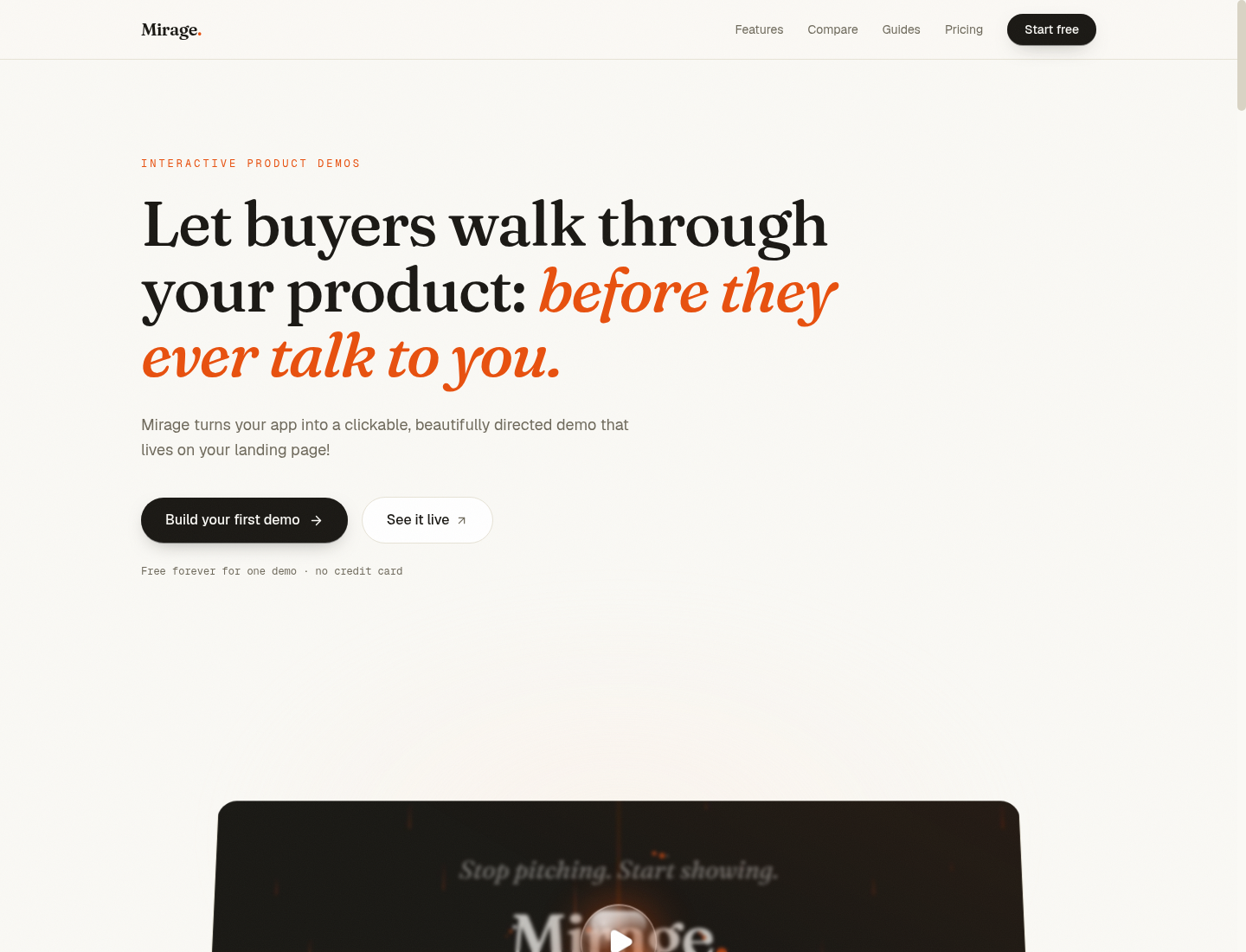
Mirage launched on Product Hunt in July 2026 and hit #4 Product of the Day with 248 upvotes. The pitch is simple: “Turn your SaaS into a clickable demo in 90 seconds.” It was built by a solo founder (Anukar) who was building a landing page, needed a product demo, and found his only options were recording another video nobody watches or paying $500/mo.
What Mirage does well
Speed. You install the Chrome extension, click through your app once, and Mirage captures every screen as an interactive DOM snapshot. Hotspots auto-place. You tune the flow, hit publish, and you have a demo link or embed snippet in under two minutes.
The free plan is genuinely useful. You get the full editor, live views, per-step drop-off analytics, and lead capture with CSV export - all on the free tier. The only limits are one published demo, one hotspot per step, and a small Mirage badge. If you are testing whether interactive demos move the needle at all, you can do it for $0.
No sales call. You sign up, capture your demo, and go. Paid plans are self-serve with a 3-day free trial and a Dodo Payments checkout. No demo-of-the-demo-tool required.
Frozen replay approach. Mirage captures static DOM snapshots, not a live app embed. This means your demo stays stable even when your backend changes, and there is zero risk of exposing real customer data or authentication states during playback.
Where Mirage loses
- No integrations of any kind. If your team needs demo engagement data flowing into HubSpot, Salesforce, or Slack, Mirage cannot do it. You will be exporting CSVs by hand.
- No AI. No AI-generated demos, no voiceovers, no avatars, no copy assistance. Every demo is hand-built, step by step.
- No team features beyond workspaces. The Scale plan ($29/mo billed annually) adds team workspaces and branching demos but no roles, permissions, or approval workflows.
- Very new, single-founder project. Launched roughly 9 days before this post. There is no track record, no SOC 2, no published uptime SLA. If stability risk scares you, look elsewhere.
- Cannot replace individual screens. If you change one step of your product, you have to recapture the entire flow. This is on the roadmap but not shipped yet.
- No demo translation, no A/B testing, no personalization. These are table-stakes for enterprise GTM teams with multi-language audiences.
Navattic: the enterprise demo platform with AI and CRM depth
Navattic was founded in 2020 and serves 1,000+ customers including Coupa, Ramp, Notion, and Lattice. It publishes the annual “State of the Interactive Product Demo” report and produces the Revenue on the Rocks podcast. The platform covers the full demo lifecycle: capture, AI-assisted editing, embedding, analytics, and CRM sync.
What Navattic does well
AI Copilot. Navattic’s Copilot generates demos from clicks, writes copy, adds AI voiceovers, and even creates AI avatars. On the Growth plan, it can clone your own avatar. The Copilot Review feature assesses demo quality, clarity, and tone with one-click fix suggestions.
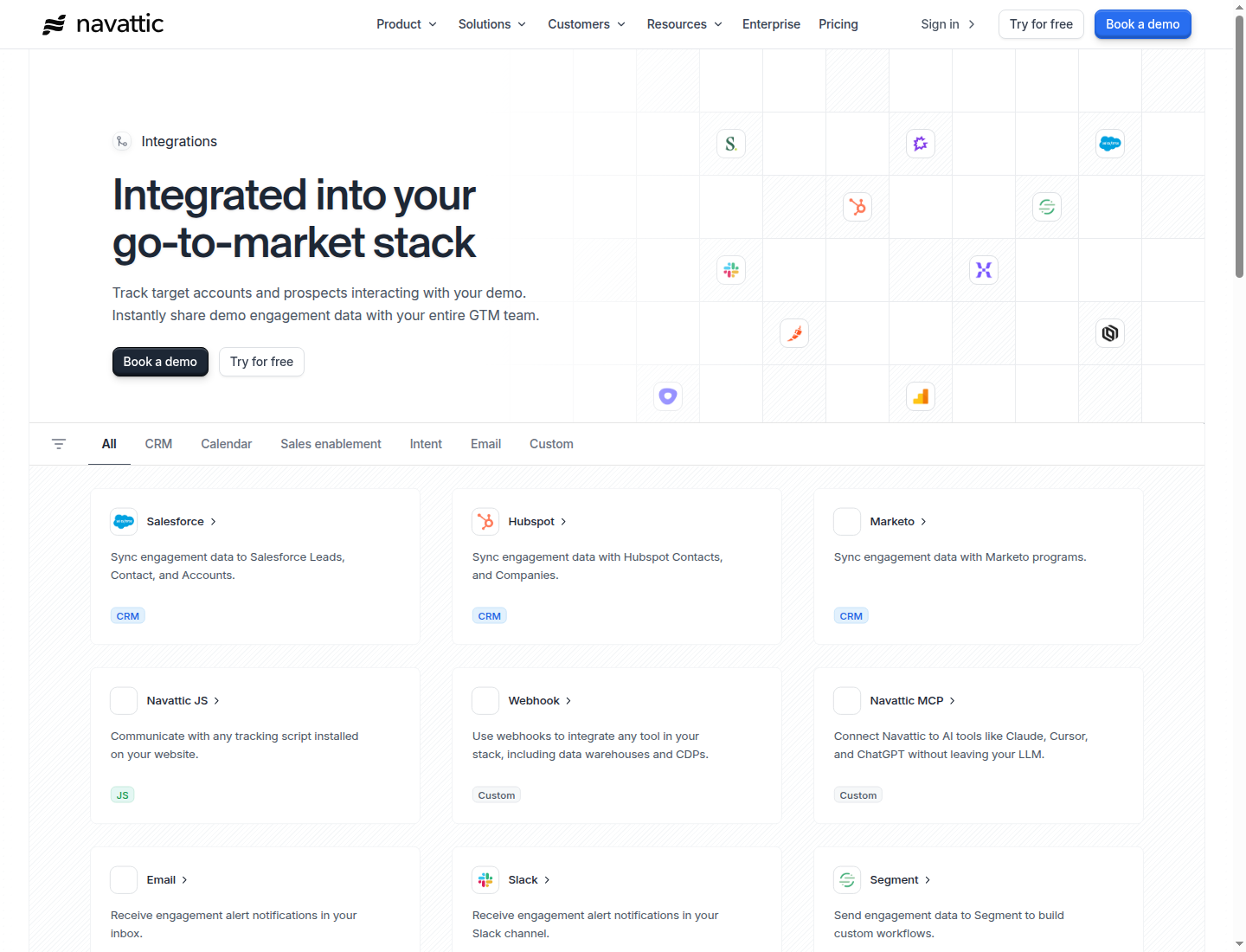
CRM depth. Navattic syncs demo engagement data to HubSpot, Salesforce, and Marketo - and 25+ other tools including Slack, Gong, Outreach, Salesloft, Segment, and Google Analytics. Demo views, completions, and drop-offs flow into your existing GTM stack without manual CSV wrangling.
Agent demos and Launchpad. Growth-tier features include AI agents that run autonomous conversational demos (Agent Demos) and Launchpad, which automates demo creation and distribution for sales teams. These are not things Mirage competes on.
Enterprise security. SSO, directory sync, audit logs, approval workflows, custom permissions, and offline demos are available on Growth or Enterprise. If your security review demands SOC 2 or equivalent, Navattic is the only choice in this comparison.
Mobile modes. Navattic offers three dedicated mobile viewing modes (Zoom, Swipe, Alert) so demos do not break on phones. Mirage relies on basic responsive rendering.
MCP server. Navattic exposes an MCP server so you can connect it to Claude, ChatGPT, or Cursor and edit demos, query analytics, and share custom links from inside your LLM. This is genuinely unique in the category.
Where Navattic loses
- Price. The Base plan is $500/mo billed annually with a 5-seat minimum. The Growth plan is $1,000/mo billed annually with 10 seats. That is 25x Mirage Pro, and you cannot start with one seat for $100/mo - the 5-seat minimum makes the entry point $6,000+/yr. For a solo founder or two-person startup, this is a non-starter.
- Sales-led purchasing. You cannot buy a paid Navattic plan online. Every paid tier requires a demo call. If you want to put a product demo on your landing page today, you wait for a sales conversation first.
- Free tier is bare-bones. One demo, one seat, basic analytics, default theme only. No branding, no lead capture, no integrations. It exists so you can test the capture experience, not so you can actually run a buyer-facing demo.
- Feature complexity. The depth that makes Navattic powerful also means onboarding takes hours or days. Per G2 reviews, managing a growing library of demos and tours can get unwieldy.
- Live demo limitations. Navattic focuses on HTML capture replays. If you want live-app overlays or click-anywhere sandbox environments, other tools (Reprise, Walnut) specialize in those.
Head-to-head: where Navattic justifies the premium (and where it does not)
Features your buyers never see
Navattic’s CRM integrations, AI avatar cloning, Launchpad automation, audit logs, and approval workflows are all internal GTM infrastructure. They make your sales and marketing team more effective - but your buyer, clicking through a demo on your landing page, experiences none of them. Mirage ships exactly the buyer-facing experience for 1/25th the cost.
This is the core decision: if the demo itself is what converts, Mirage is enough. If you need the demo’s engagement data to trigger Salesforce workflows, Slack alerts, and personalized outreach sequences, Navattic is the only option in this pair.
The analytics gap
Both tools track views and completions. Mirage includes per-step drop-off tracking - showing exactly which hotspot or step caused people to bail - even on the free plan. Navattic gates advanced analytics (including account identification and deanonymization) behind the Growth plan. If your primary need is “tell me where my demo leaks,” Mirage gives you that for $0. Navattic gives you basic views for free and charges you to see the drop-off.
The integration gap
Mirage has zero integrations. Navattic has 25+. If your team lives in HubSpot and Slack, and demo engagement data needs to flow automatically into contact records and channel alerts, Navattic is the only choice. You cannot bridge this gap with Zapier or Make - Mirage has no webhooks, no API, nothing to connect to.
The AI gap
Navattic’s Copilot can generate a demo from clicks, write tooltip copy, add AI voiceover, and even drop in an AI avatar to narrate your demo. Mirage has nothing like this. If you produce demos at scale - different use cases, different buyer personas, different languages - Navattic’s AI saves hours per demo. For one or two demos, the AI premium is hard to justify.
Pricing breakdown
Mirage pricing
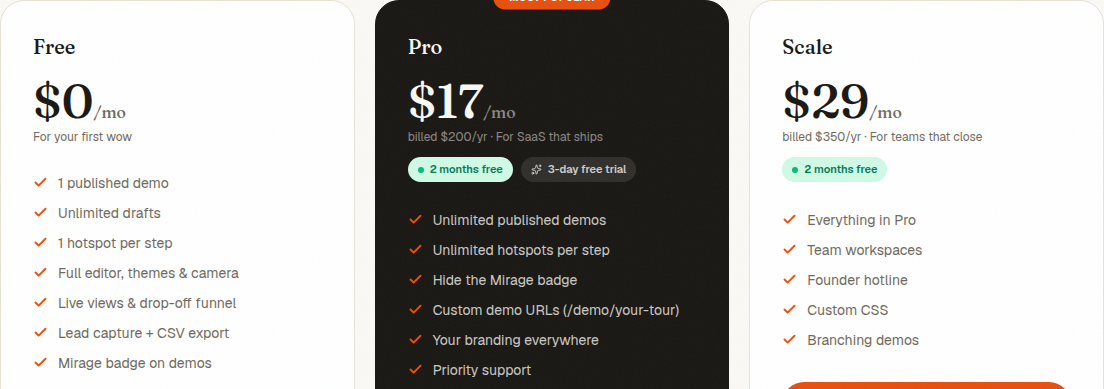
| Plan | Monthly Price | Annual Price | Key Features |
|---|---|---|---|
| Free | $0 | $0 | 1 demo, 1 hotspot/step, full editor, analytics, lead capture + CSV, Mirage badge |
| Pro | $20/mo | $200/yr ($17/mo) | Unlimited demos, unlimited hotspots, no badge, custom URLs, branding, priority support |
| Scale | $35/mo | $350/yr ($29/mo) | Everything in Pro + team workspaces, branching demos, custom CSS, founder hotline |
All paid plans include a 3-day free trial. Cancel anytime; your demos, analytics, and leads stay yours. Mirage uses Dodo Payments.
Navattic pricing
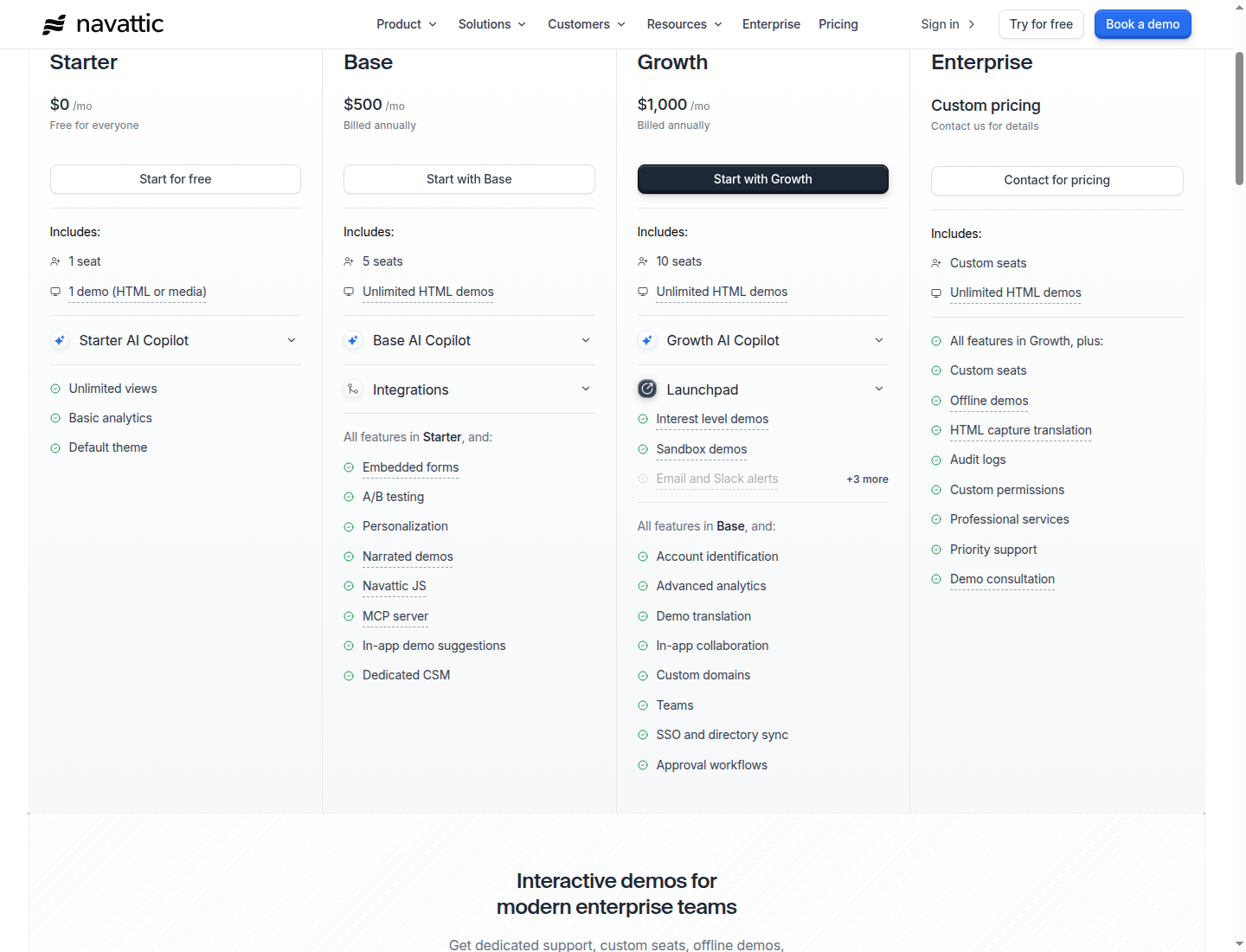
| Plan | Price | Seats | Key Features |
|---|---|---|---|
| Starter | Free | 1 | 1 demo, Starter AI Copilot (generate + default use cases), basic analytics, default theme |
| Base | $500/mo billed annually | 5 (minimum) | Unlimited HTML demos, Base AI Copilot (voiceover, avatars, review, prompt), HubSpot/Salesforce/Marketo + 25+ integrations, embedded forms, A/B testing, personalization, dedicated CSM |
| Growth | $1,000/mo billed annually | 10 | Growth AI Copilot (avatar cloning, custom use cases), Launchpad, Agent Demos, account identification, advanced analytics, demo translation, SSO, approval workflows |
| Enterprise | Custom | Custom | All features + offline demos, audit logs, custom permissions, professional services |
Prices for Base and Growth were visible on the live Navattic pricing page as of July 2026 (Annual billing toggle only; monthly pricing was not shown). All paid plans require a demo call to purchase.
Bottom line
Pick Mirage if:
- You are a solo founder or small SaaS team (1-4 people)
- You want a clickable demo on your landing page today, not after a sales cycle
- You care more about the demo itself than about CRM workflows around the demo
- You want lead capture and per-step analytics without paying for them
- You are price-sensitive and $500/mo is not in the budget
Pick Navattic if:
- You have a GTM team of 5+ with an established CRM (HubSpot/Salesforce)
- You need AI to generate, localize, or personalize demos at scale
- You require SSO, audit logs, or enterprise security compliance
- You want demo engagement data to trigger automated sales workflows
- Your budget for demo software is $6,000+/yr and that number makes sense for your team size
Who Mirage is wrong for:
- Teams that need CRM integrations - there are none, and there is no workaround
- Teams producing demos in multiple languages - no translation, no localization
- Large organizations with security review requirements - no SOC 2, no audit logs, single-founder project
- Teams that want AI to handle demo creation - Mirage is fully manual
Who Navattic is wrong for:
- Solo founders or teams under 5 people - the 5-seat minimum makes it uneconomical
- Anyone who wants to self-serve and start today - paid plans require a sales call
- Budget-conscious teams who only need 1-3 demos - Mirage Free/Pro covers this for $0-$20/mo
- Teams that just want a demo on a landing page with analytics - Mirage does it for less
For more honest SaaS tool comparisons like this one, browse our full comparison library.