16 October 2026 · Comparison
Spira AI vs Arcads: Organic Social vs Paid AI Video Ads
The short answer
if you want autonomous organic social channels that script, render, and publish on a schedule.
if you need high-polish AI actor UGC ads and campaign cloning for paid Meta and TikTok campaigns.

Verdict: Pick Spira AI if you are a solo founder, DTC brand, or lean creator who wants an autonomous organic social presence that writes scripts, generates videos, and publishes straight to your own channels on a scheduled calendar, starting free or at $15/mo for Creator (1,200 credits). Pick Arcads if you are a media buyer, performance marketer, or agency running paid Meta or TikTok campaigns, where actor realism, 1,000+ AI actors, emotion control, competitor research from the Meta Ad Library, and batch workflows justify a ~$110/mo (third-party reported) floor.
Who picks what: Both tools take a script or a brief and hand back an AI-generated video with a talking actor. That overlap hides the real difference, which is where the output goes. Spira manages a channel: a series that scripts, renders, and posts to organic social feeds on a schedule, with a calendar and follower analytics attached. Arcads manages an ad creative: a high-polish UGC spot built for a paid Meta or TikTok campaign, plus an agent that can clone winning competitor ads and publish them back into your ad account. One automates the organic feed. The other automates the paid campaign. Pick the finish line you actually need.
Affiliate disclosure: This post contains affiliate links. If you click through and make a purchase, we may earn a commission at no extra cost to you. This does not affect our verdict. Arcads runs a 25% recurring affiliate program, and Spira AI has no publicly confirmed affiliate program.
The Correction Most Comparisons Still Get Wrong
A lot of older write-ups frame this as “Arcads stops at the export button while Spira publishes for you.” That was true once. It is not true now.
Arcads now ships Mark, an AI ad agent that can analyze a Meta campaign, clone a winning competitor ad, generate variants, and publish a new Meta ad on a schedule. It also ships node-based Workflows that turn one script and one product image into a batch of UGC videos across multiple actors and languages. So “Arcads is export-only” is stale and should not be repeated.
The correction does not erase the difference, it sharpens it. Arcads automates paid Meta and TikTok ad campaigns. Spira automates organic multi-channel social media, posting natively to connected channels with a calendar and audience analytics attached (though Spira’s own supported platform list is inconsistent across pages: its pricing card lists TikTok, X, and LinkedIn, while the navbar lists TikTok, Instagram, and YouTube). Arcads does not run organic social channels for you the way Spira does, and Spira does not manage your Meta ad account the way Mark does.
What Each Tool Actually Is
Spira AI is an autonomous social media agent. You hand it a brand profile from a URL, then define an automation series: a script source (a prompt, a trending topic, or a reference account whose style it studies), a posting schedule, and a connected account. Each run writes a fresh script, renders the video, and publishes natively, with an optional approval step. Its unit of management is the channel, and the same dashboard carries a content calendar and per-post analytics (views, likes, comments, shares, followers) that feed proven topics back into the next run. Spira also bundles an AI Influencer builder, a shared brand knowledge base, and a broad model catalogue.
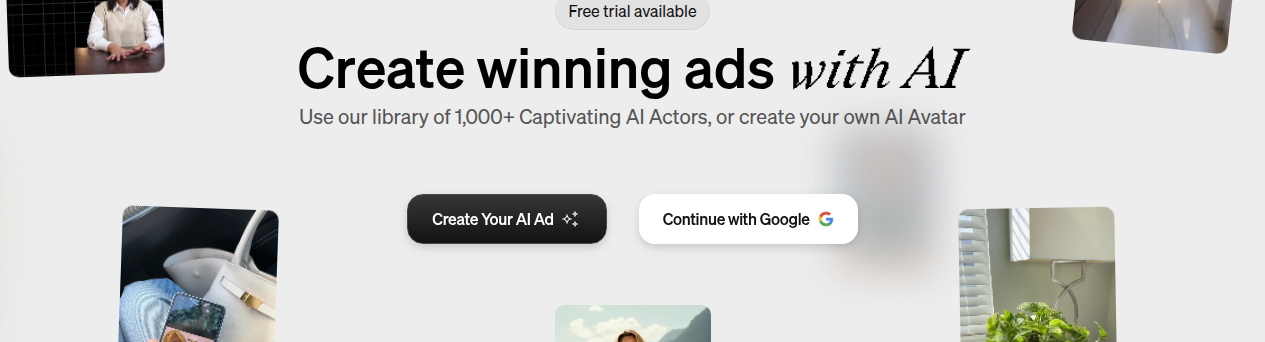
Arcads is a paid-ad creative studio, now increasingly agent-led. Its centre of gravity is the AI actor: a library of AI likenesses of real, consenting actors, three talking-actor models (Arcads 1.0, Audio-Driven, and OmniHuman 1.5 for full-body motion and gestures), emotion steering, custom actors built from a single headshot, and a self-cloning option. Around that it wraps a deep model catalogue, a one-click editing toolkit, competitor-ad research from the Meta Ad Library, Mark, and Workflows. It is built for people whose job is making ads that convert in a Meta or TikTok ad account.
Actors and Creative Depth
This is the clearest place where Arcads wins, and no honest comparison should pretend otherwise.
Arcads’ whole brand is actor realism. The vendor markets a library of 1,000+ AI actors (though some third-party reviews report 300+, possibly tier-dependent), and independent reviews repeatedly name its actor quality the best in the category. Emotion control lets you direct a performance in words. You can generate a custom actor, or clone yourself, or swap one actor for another after the fact. For a performance marketer testing hook variants across many faces, that depth is the product.
Spira generates video with talking-actor and avatar tools too, and it resells many of the same frontier video models. But its actor roster, emotion steering, and facial-rigging depth are not the point of the product, and they show it. If your entire reason for buying is “which AI human looks realest on camera,” Spira is not the answer. Spira’s answer to that is different: it would rather have the right video post itself on time than have the most lifelike face in the file.
Distribution: The Channel vs The Campaign
This is the fork that matters, and both sides are real.
Spira’s loop runs create, publish, grow. The automation ties together the script engine, video generation, native scheduled publishing, a content calendar, and analytics. You define a series once and it keeps producing and posting. Spira also sells an add-on Arcads has no counterpart for at all: pre-warmed TikTok accounts and a fully managed hosted service, run by real people on real phones with dedicated US residential IPs. We cover that offer, and its risks, below.
Arcads’ loop runs research, create, clone, launch. Mark reads a Meta campaign, finds a winning ad, clones its structure, generates variants, and can publish a new ad back to the ad account. Workflows batch-produce twenty UGC videos from one script. Competitor Ad Research syncs ads from the Meta Ad Library so you can see what is already spending and clone it. That is a serious paid-advertising machine, and it is the reason many buyers choose Arcads. What it is not is an organic channel system: there is no follower-growth calendar, no native posting to your TikTok organic feed, no audience analytics for a channel you are trying to grow without ad spend.
If you live in an ad account, Arcads’ distribution story is the stronger one. If you live in a content calendar, Spira’s is.
Pricing and the Credit Math
Prices accurate as of October 2026; check vendor sites for current rates.
The pricing models could not be more different, and that difference is itself the story. Spira publishes its plans on a public page. Arcads publishes none of it: its public pricing page at arcads.ai/pricing returns a 404 Not Found, and every Arcads dollar figure below is third-party reported or visible only after signup, not vendor-published.
| Spira AI | Arcads | |
|---|---|---|
| Public pricing page | Yes, self-serve | No, returns 404 |
| Free tier | Free ($0, up to 50 credits, no card required) | 72-hour trial (1,000 credits, all features unlocked, card required) |
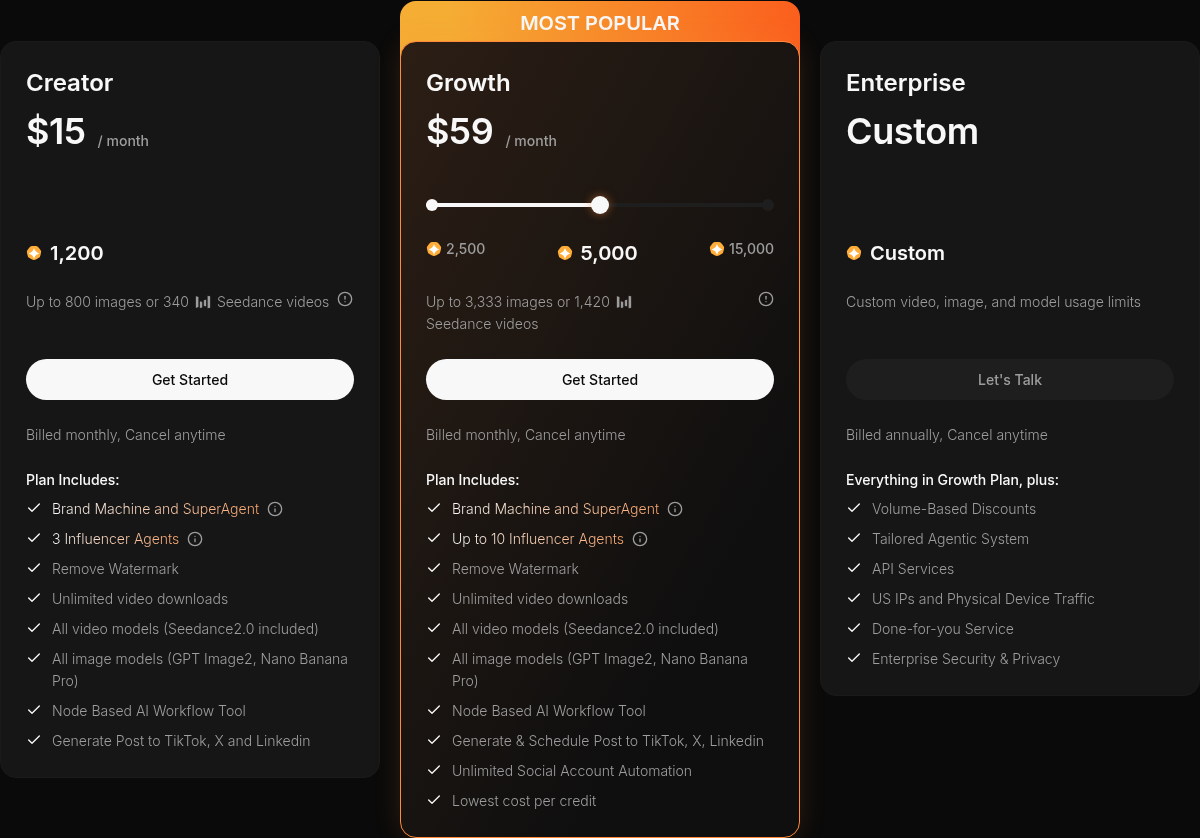
| Entry paid plan | Creator ($15/mo, 1,200 credits) | Starter (~$110/mo third-party reported, 8,000 credits/mo) |
| Mid plan | Growth ($59/mo monthly or $39/mo yearly, save $240, 5,000 credits) | Creator (~$220/mo third-party reported, 16,000 credits/mo) |
| Credit rollover | No rollover (credits expire each cycle) | Pro and above roll over in full; Starter and Creator reset each cycle |
| Publishing | Native organic scheduling + calendar (platform list inconsistent across Spira’s own pages) | Ad-agent publishing (Mark) to Meta ad accounts |

Two honest caveats on the Arcads numbers. First, the trial terms: Arcads’ help center documents a 72-hour trial with 1,000 credits that auto-converts to the Starter monthly plan unless cancelled. Spira’s own comparison page still claims Arcads has no free tier or trial. That claim is now wrong, and we are not repeating it. Second, the credit round-up. Arcads charges 800 credits per started minute for Audio-Driven and OmniHuman 1.5 talking-actor videos, which means a fifteen-second hook video bills as a full minute. For short-form ad testing, that rounding penalty is real money and it does not appear on any marketing page.
The Spira side has its own inconsistency worth flagging: its pricing page lists Creator at $15/month monthly ($12/month billed yearly), its compare table lists Growth “From $29/mo”, and some third-party directories cite $19/month (the annual rate for 2,500 credits). We are treating the pricing page as authoritative and flagging the discrepancy rather than quietly picking the flattering number.
There is also a real “why pay a reseller” question in this category: both tools resell access to frontier video models you can reach through other front ends. You are paying for the workflow around the model, not the model itself. That is fine if the workflow is what you need, and a waste if it is not.
The Warmed Accounts Grey Zone
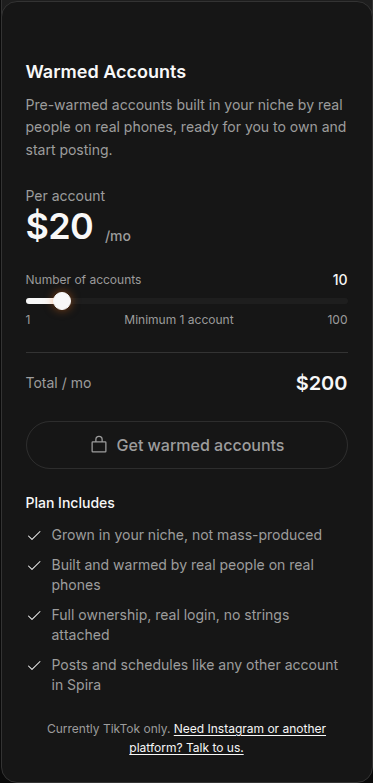
Spira sells something genuinely unusual: pre-warmed TikTok accounts at $20/mo per account, and a managed hosted service from $200/mo where a human team runs the accounts on real iPhones with dedicated US IPs. The pitch is that you skip the cold-start grind and start on an account that already looks established in your niche.
It is a real capability Arcads has nothing like. It is also the part of this comparison where we would urge the most caution, because it sits in a platform terms-of-service grey zone. Buying managed or pre-warmed accounts, and running them through residential-proxy infrastructure, is exactly the pattern platform detection systems look for. The honest risks are algorithmic reach throttling, shadowbans, and outright account termination, any of which can wipe the audience you were paying to build. Spira is explicit that the accounts are built by real people on real phones and that posted content is AI-labelled, but the account-provenance and platform-compliance question is on you to weigh. Treat this as a growth tactic with real downside, not a free lunch.
Where Spira AI Loses
- Early-stage roughness. Spira is a young product. Its homepage FAQ still ships unreplaced developer placeholder copy (“Placeholder: a minute a day to approve…”, “Placeholder: list the supported platforms here”), and Ecommerce Mode is still marked “Soon” rather than shipped. A live public site carrying internal placeholders is a signal, not a scandal: worth knowing before you build a workflow on it.
- Actors and creative depth. It does not match Arcads’ actor roster, emotion steering, or facial rigging. If realism is the buying criterion, Spira loses that category.
- Platform-ToS risk on warmed accounts. As above: the pre-warmed account offer carries genuine shadowban and termination risk.
- Self-reported proof. Customer metrics like Cookiy “3x demo requests in five weeks” and Copyless “18,000 installs” are vendor or founder claims with no independent verification.
- No public affiliate program. For creators and partners who want to monetise a recommendation, Spira offers nothing self-serve (/affiliate, /affiliates, and /partners return only an error app shell).
Where Arcads Loses
- Zero pricing transparency. Arcads hides pricing completely behind signup. Its public pricing page (arcads.ai/pricing) returns a 404 Not Found, so you cannot compare costs before creating an account.
- High cost floor and punitive credit billing. Entry pricing starts around ~$110/mo (third-party reported) and the 800 credits per started minute rule punishes exactly the short-form hook ads this audience makes. A fifteen-second spot bills a full minute.
- No rollover on the entry plans. Starter and Creator credits reset monthly with no rollover; uncapped rollover begins on Pro and above.
- Card required for the trial. The 72-hour trial is not cardless, and it auto-converts to a paid Starter plan unless you cancel before 72 hours elapse.
- No organic channel management. Mark automates Meta ad campaigns. Arcads offers no native organic social scheduling, no multi-platform content calendar, and no organic audience analytics, so it cannot do the job Spira was built for.
- Reported lip-sync artifacts and billing complaints. Independent reviews cite occasional lip-sync drift on long or wide-angle talking-actor shots and disputes over trial auto-conversions. Worth reading the review corpus before a long commitment.
Bottom Line
Pick Spira AI if you want an organic channel that scripts, renders, and posts itself on a schedule, you value public self-serve pricing that starts free, and you are comfortable with an early-stage tool still smoothing out rough edges (placeholders, unshipped Ecommerce Mode, unverified case studies). Spira is wrong for anyone whose whole reason for buying is the most lifelike AI actor on camera, and wrong for anyone unwilling to carry the account-termination risk that comes with warmed accounts.
Pick Arcads if you are buying ad creative for live paid campaigns, you need actor realism, emotion control, competitor-ad cloning, and an agent that can publish into Meta, and a ~$110/mo (third-party reported) floor plus round-up billing is acceptable for the output quality. Arcads is wrong for anyone on a tight budget running short hook tests, and wrong for anyone who wants the organic feed handled: it will not post to your channels or grow an audience for you.
If you are weighing other options in this category, we compared the agentic ad-creative challengers in AdAnt AI vs Creatify and covered the cross-platform static and video suites in Adomate vs AdCreative.ai and Goose Ads Remixer vs AdCreative.ai. Arcads has already been named as the actor-quality, higher-price alternative in our UGC Maker vs Creatify comparison, which is the right place to start if your shortlist is UGC studios rather than channel automation.
Prices accurate as of October 2026; check the vendor’s site for current rates.