25 September 2026 · Comparison
Creem vs Lemon Squeezy: 3.9% Fees vs Stripe Migration
The short answer
if you want flat 3.9% + 40¢ fees, usage billing, and revenue splits.
if you prefer Stripe-backed stability and free US bank payouts.
Affiliate disclosure: Some links on this page are affiliate links. If you sign up for Creem through one, we may earn a commission at no extra cost to you. Creem is an affiliate partner; Lemon Squeezy is not. The comparison below is independent - we tell you where each platform loses.
Verdict: Pick Creem if you sell AI tools, developer SaaS, or anything with usage-based billing and want one flat 3.9% + 40¢ rate with no international-card or subscription surcharges. Pick Lemon Squeezy if you want a battle-tested, Stripe-backed merchant of record, rely on free US bank payouts, or plan to wait for the native Stripe Managed Payments migration path. The decision is really about risk tolerance: Creem is a one-week-old 2.0 relaunch from a 16-person Estonian startup that charges less, and Lemon Squeezy is a Stripe-owned product that dates itself to 2019, now in maintenance mode under Stripe, that charges more.
The state of play: Lemon Squeezy is not dead
First, kill the rumor you may have heard: Lemon Squeezy is not shut down. It is live, accepting new sellers, and actively competing for them. Stripe acquired the company in July 2024, and every page of the site now carries the footer “©2026 Sold through Link, LLC f/k/a Lemon Squeezy LLC.” Your buyers do not see that yet: Lemon Squeezy’s own docs still say a purchase lands on a card statement as LEMSQZY*STORE. Hold that thought: the successor product bills as LINK.COM*, and we come back to it below.
Stripe is not forcing anyone off today. Lemon Squeezy is running a migration offer right now - 0% fees for your first 30 days, up to $10,000 in sales, for anyone switching over. Migrations are handled manually off a form, and the help docs carry step-by-step guides for moving from Gumroad, Stripe and Paddle:
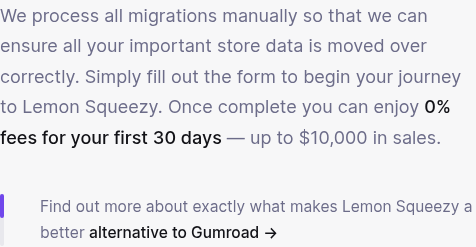
A dead platform does not run a switcher promotion. What is true: Lemon Squeezy is in maintenance mode. CEO JR Farr confirmed in January 2026 that the core team has shifted to building Stripe Managed Payments (Stripe’s own merchant-of-record product, built inside Stripe by the same team), that support responses have slowed, and that the goal is “to provide Lemon Squeezy users an easy way to migrate to Stripe Managed Payments.” The public changelog backs the velocity claim: the last entry is Checkout localization, dated August 18, 2025. Sellers are not being forced out, but the roadmap points one direction.
That single fact re-frames the whole comparison. You are not choosing “which checkout to keep.” You are choosing whether to stay on a platform whose stated end-state is a migration you did not ask for, or to move to a younger platform that is actively building. That makes fee math and trust the two things that actually matter.
Fee math: Creem’s flat rate vs Lemon Squeezy’s stacking
Both are merchants of record, meaning they are the legal seller, remit sales tax / VAT, handle invoicing, and take chargebacks. Both charge per transaction with no monthly fee. That is where the similarity ends.
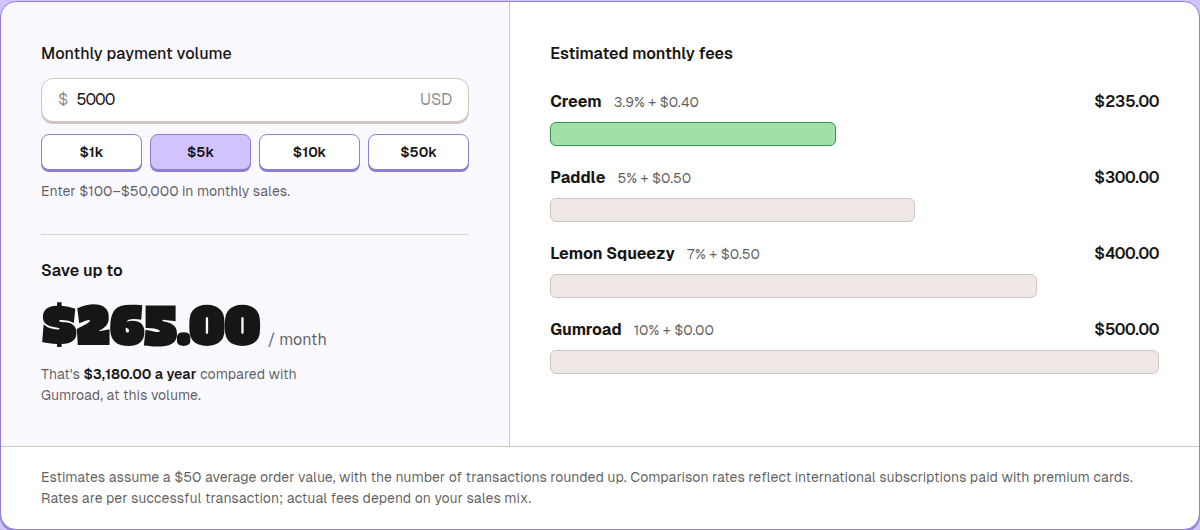
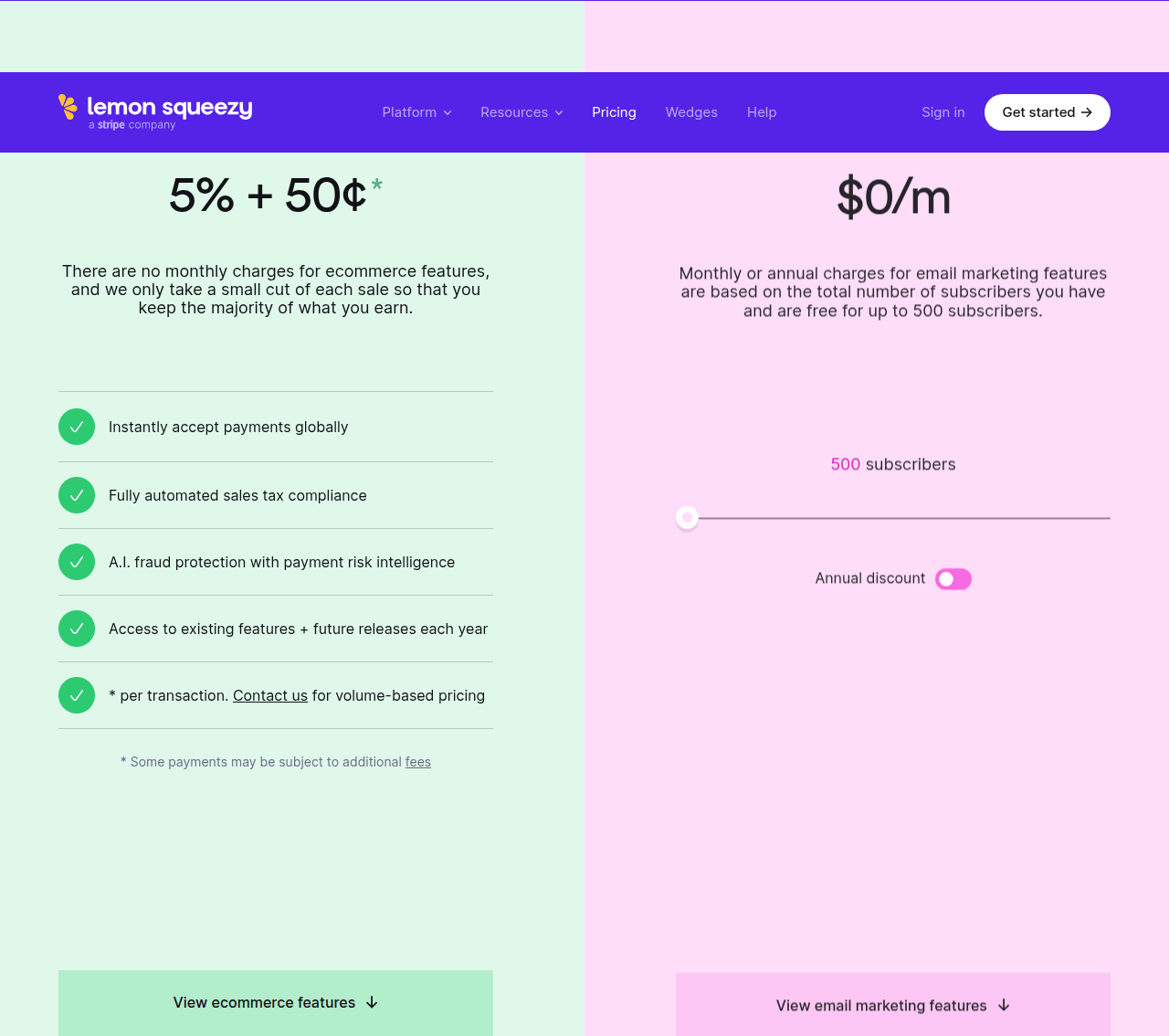
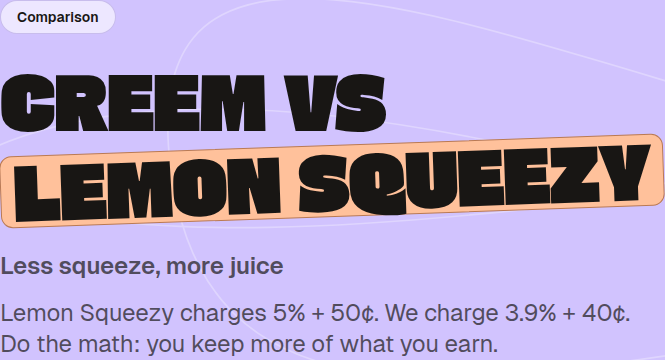
Creem charges one flat rate: 3.9% + $0.40 per successful transaction, and its pricing page lists “No international card fees” among what is built in - no surcharge for card origin or for billing on a subscription:
Lemon Squeezy charges a 5% + 50¢ base platform fee, then stacks add-ons: +1.5% on non-US cards, +0.5% on subscription payments, and +1.5% on PayPal:
| Creem | Lemon Squeezy | |
|---|---|---|
| Base transaction fee | 3.9% + $0.40 | 5% + $0.50 |
| Monthly fee | $0 | $0 |
| International (non-US) cards | +0% | +1.5% |
| Subscription payments | +0% | +0.5% |
| PayPal | No separate rate published | +1.5% |
| Realistic all-in, international subscription | ~3.9% + 40¢ | ~7% + 50¢ |
| Chargeback / dispute fee | 25 USD/EUR | $15, published |
| Payout fee, US bank | 7 USD/EUR or 1%, whichever is higher | Free |
| Payout fee, non-US bank | 7 USD/EUR or 1%, whichever is higher | 1% |
| Funds held before payout | 7-12 days | ~13 days |
| Payout schedule | 1st and 15th | 14th and 28th |
Prices accurate as of September 2026; check the vendor sites for current rates.
The $49 international subscription math
Run a $49/month international subscription renewal through both:
- Creem: 3.9% + $0.40 = about $2.31
- Lemon Squeezy: 5% + 1.5% (non-US card) + 0.5% (subscription) = 7.0% + $0.50 = about $3.93
That is a ~41% saving per renewal for Creem. At scale it compounds: on $10,000/month of international subscription volume, the difference is roughly $3,960 a year in fees.
The catch for US sellers
Creem’s payout fee is 7 USD/EUR or 1% of the payout amount, whichever is higher. Lemon Squeezy pays US bank accounts for free. For a small creator withdrawing $500/month, Creem’s $7 floor is a 1.4% drag on revenue on top of the checkout fee. The checkout saving narrows but does not disappear; for a $49-sub seller the annual fee gap is still clearly in Creem’s favor. And if you are already on Stripe plus a tax tool like Quaderno, you may not need either merchant of record at all.
Where Creem wins
Flat, predictable fees. No fee calculator needed. Same rate on every card, country, and billing cycle. Lemon Squeezy’s math changes with every card origin and payment method.
Revenue splits built in. Creem splits revenue between co-founders, agencies, and partners natively. Lemon Squeezy has no multi-party payout and no revenue-share automation at all - a genuine feature gap, not a pricing difference. Note the asterisk: Creem’s payout docs add a flat +2% fee to any transaction that runs through splits, taken before commissions are distributed.
AI-native tooling. Creem ships an MCP server (its docs advertise 77 tools that call the Creem API directly, from creating products to issuing refunds) plus a CLI and skill files an agent reads to learn the platform. Lemon Squeezy has an API, webhooks and SDKs; it has nothing aimed at agents. If your own workflow is agent-assisted, that is a real differentiator.
Built for usage-based billing. Credit wallets, prepaid packs, and usage meters for tokens, API calls, compute, and seats. This is the billing model of 2026 AI products, and it is Creem’s native mode.
Faster, human support. Creem advertises “24/7 live chat & Discord” on its own Lemon Squeezy comparison page, and its docs route you to Discord or support@creem.io. Lemon Squeezy’s help centre states the alternative plainly: email, and “Response time is 24-48 hours.” Neither queue is something we have stress-tested.
Stablecoin and international payout options. USDC on Polygon at 2% of payout volume, plus local bank transfer in all 87 supported countries through its transfer partner, Wise.
Where Lemon Squeezy wins
A real production track record. Lemon Squeezy’s About page dates the company to 2019 and puts 15k+ merchants on the platform. It has a well-documented API, and it now sits on Stripe’s balance sheet. Creem 2.0 launched on Product Hunt on September 17, 2026 - roughly a week before this post was drafted. Handing your revenue pipeline to a 16-person startup’s week-old 2.0 release is a risk tolerance decision, full stop.
Free US bank payouts. As covered above, this claws back part of Creem’s fee advantage for small US sellers.
More ways to get the money out. Lemon Squeezy pays out to a bank account or to PayPal, and its help centre claims payout support in more than 200 countries. Creem’s payout rails are a local bank transfer (87 countries) or USDC on Polygon - there is no PayPal option. If banking is the awkward part of where you live, that difference decides this on its own.
Email marketing and lead magnets. Lemon Squeezy bundles email marketing (free up to 500 subscribers), lead magnets, and pay-what-you-want pricing into the platform. Creem does not ship an email tool; you would bolt one on.
Checkout and storefront polish. Hosted checkouts, custom domains, checkout overlays, and a store builder have had years in production. Creem’s checkout is new and clean but unproven at Lemon Squeezy’s scale.
Institutional trust. If a buyer googles your checkout provider, “owned by Stripe” reads differently than “16-person startup in Tallinn.” That matters for enterprise-adjacent sales.
Where Creem loses
Be clear-eyed about Creem’s downsides, because they are real:
-
Extreme platform youth. CREEM 2.0 is a week old as of this writing. The marketing says “Join thousands of businesses using Creem”, but the 2.0 product is brand new. There is no multi-year uptime record, no large-scale chargeback history, and no track record of surviving Stripe- or Paddle-style incidents. Mission-critical revenue on a week-old relaunch is a bet, not a safe harbor.
-
Higher dispute fee. While not listed on its main pricing page, Creem’s documentation specifies a dispute fee of 25 USD/EUR per chargeback, compared to Lemon Squeezy’s published $15 fee. If chargebacks are a meaningful cost for your business, Creem’s dispute penalty is 67% higher.
-
Payout fee floor. The 7 USD/EUR-or-1% payout fee is a real tax on small sellers, as covered in the fee math above.
-
“One flat rate” has add-ons of its own. The 3.9% + $0.40 is the checkout fee. Creem’s payout docs then add +2% on any transaction that goes through revenue splits, +2% on transactions processed through its affiliate platform, and +5% on anything recovered by an abandoned-cart email. Lemon Squeezy’s equivalents are +3% for affiliate referrals and +5% for abandoned-cart recovery, so this is not a Creem-only habit - but “no surcharges” is a claim about card types, not about features.
-
Inconsistent coverage numbers. Creem’s pricing page says tax is handled in 50+ countries, its About page says 100+, and its home page says 190+. Its supported-countries doc opens with “We support merchants in 87 countries” and then heads the table “Supported Countries (86)”. A merchant of record’s whole job is tax compliance; fuzzy numbers on exactly that are a yellow flag.
-
Manual store review before going live. New stores undergo a manual review that typically takes 24-48 hours and can stretch to 72. You cannot flip a checkout on instantly.
Where Lemon Squeezy loses
-
Maintenance mode. The product is not getting built. Zero major feature releases since August 2025. The team’s energy is inside Stripe on Managed Payments. If you are a builder, you are renting a house the landlord has moved out of.
-
Fee stacking. 5% + 50¢ is a top-tier base in the indie merchant-of-record space, and the surcharges routinely push real global subscription volume to ~7% + 50¢.
-
Degraded support SLA. Email-only, 24-48 hour acknowledged response times. If money is stuck, waiting two days for a reply is the wrong default.
-
No revenue splits. No multi-party payouts, no automated revenue sharing. If you have a co-founder or partners, you are doing manual payout math.
-
Proceeds held ~13 days. One of the longest fund holds in the tier. Creem’s 7-12 days is better.
-
A payment-method claim its own docs do not back. The pricing page says “Out of the box, you will have 16 different payment methods, including PayPal.” The help docs list cards (Visa, Mastercard, American Express, Discover, Diners Club, JCB, China UnionPay), PayPal, Apple Pay and Google Pay - and for subscriptions, only those same four. Creem’s public list is the same shape: cards, PayPal, Apple Pay, Google Pay. On checkout methods these two are a wash, whatever the pricing page implies.
-
The successor may not accept you at all. Stripe’s Managed Payments eligibility docs support digital products only - not physical goods, not “professional services, such as consulting, marketing, design, development, or tech support,” not live in-person events - and say a product involving human intervention, “such as live 1-1 coaching,” does not qualify. Agencies, consultants and coaches selling happily on Lemon Squeezy today do not have a seat on the product it is being folded into.
The migration reality check
Creem’s pitch is a one-command import. The CLI command creem migrate lemon-squeezy pulls your product catalog, prices, and assets in minutes:
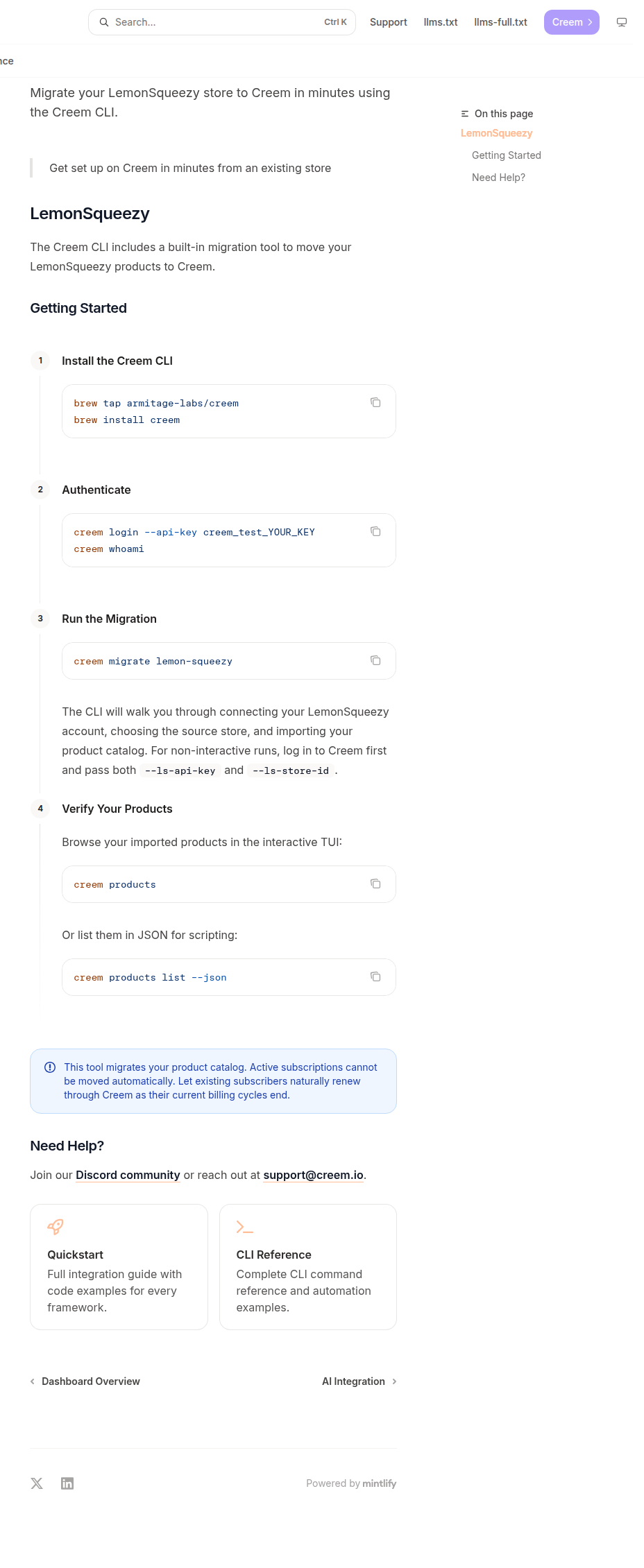
Here is what the small print says: active recurring subscriptions cannot be moved automatically. Sellers migrating must either run both platforms until existing cohorts churn, or ask customers to re-authenticate their payment methods. So “migrate in 10 minutes” means “your product catalog migrates in 10 minutes; your revenue does not.” Budget for a dual-checkout transition if you have a real subscription base. (If you are weighing a move off an all-in-one checkout more broadly, our best Gumroad alternatives roundup covers the merchant-of-record-versus-marketplace fee structures, and the Zolt vs Gumroad fee math in Zolt vs Gumroad shows how platform fees hide processing costs.)
The end state: Stripe Managed Payments
Stripe Managed Payments is the reason this comparison exists. It is Stripe’s own merchant-of-record product, built inside Stripe by the Lemon Squeezy team, and it is no longer a rumour - Stripe documents it publicly and sells it off its own pricing page:
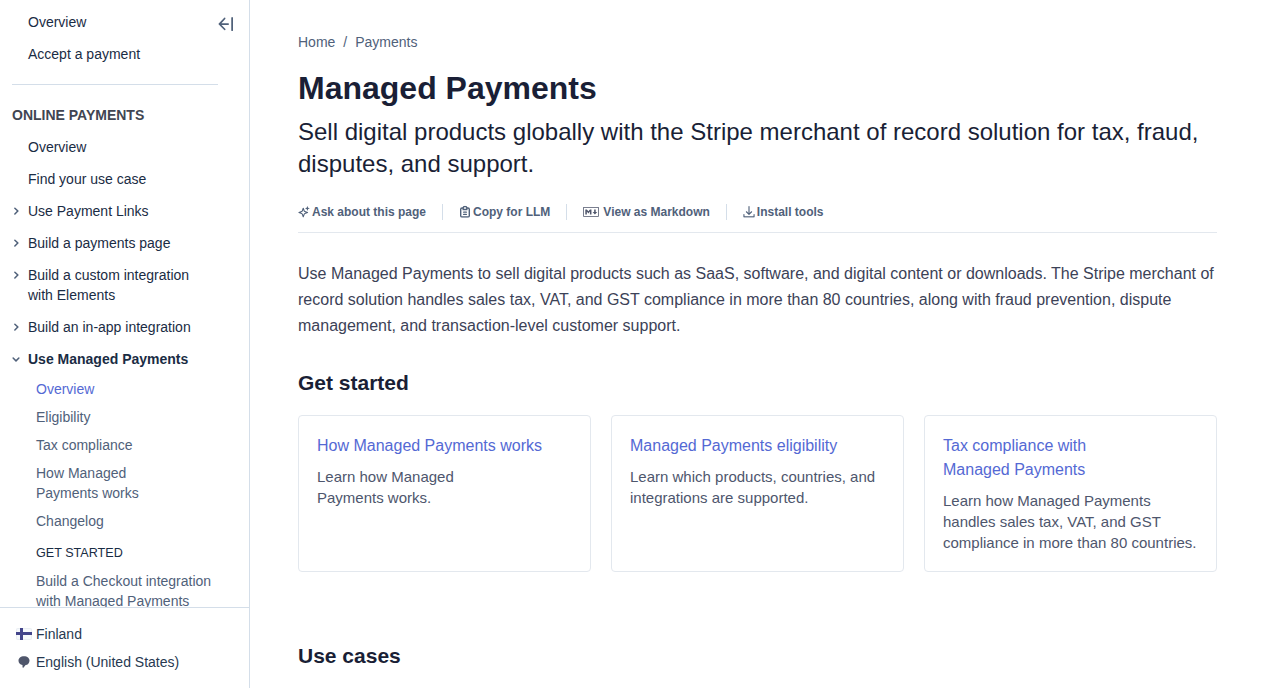
You do not need a leaked rate card to price it. Stripe publishes the number: Managed Payments is a 3.5% merchant-of-record fee, charged “per successful Managed Payments transaction in addition to Payments fees.”
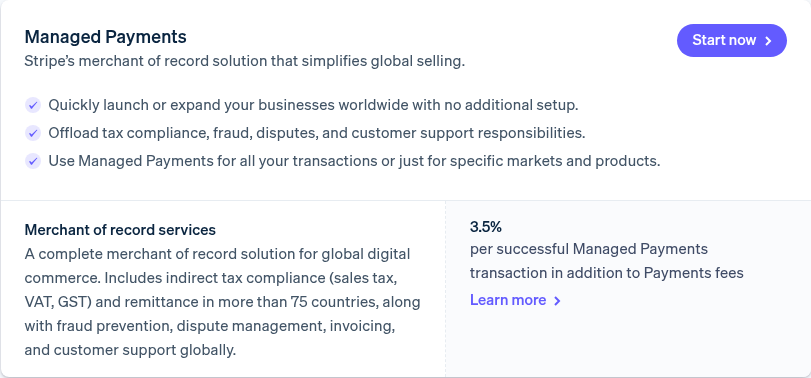
And “Payments fees” on that same page are 2.9% + 30¢ for domestic cards, +1.5% for international cards, and +1% where currency conversion is required:

Stack them and Managed Payments comes out at 6.4% + 30¢ on a domestic card, 7.9% + 30¢ on an international one, and 8.9% + 30¢ when that international sale also needs converting. Known trade-offs: custom checkout domains are not supported on Managed Payments checkouts; it does not support Stripe Connect or platform sub-merchants; and transaction support runs through Link - if Stripe asks you for input on a case and you do not reply within 48 hours, its docs say Stripe may refund the customer without your approval.
So the honest long-run comparison is:
- Creem today: 3.9% + 40¢, every card, every country
- Lemon Squeezy today: ~5-7% + 50¢ depending on card and billing mix
- Lemon Squeezy’s successor: 6.4% + 30¢ domestic, 7.9-8.9% + 30¢ international
In other words, the price gap between Creem and the Stripe-owned end-state grows over time. That is the strongest honest argument for an early exit: not that Lemon Squeezy is broken today, but that its trajectory is a more expensive checkout with less of your data.
Bottom line
Pick Creem if you are launching an AI tool, developer SaaS, or modern digital product; if you want flat 3.9% + 40¢ with no international-card or subscription surcharges; if you need usage metering, credit wallets, or built-in revenue splits; or if you want a team that is shipping weekly instead of maintaining. Accept that you are betting on a very young company.
Pick Lemon Squeezy if you need Stripe-level institutional backing right now, if free US bank payouts matter more than checkout-fee savings, if you sell traditional digital downloads or courses and use the built-in email marketing and lead magnets, or if you would rather be migrated into Stripe Managed Payments on Stripe’s schedule than move yourself today. Accept that you are paying more and that the roadmap is out of your hands.
And who is this comparison wrong for? Sellers who do not need a merchant of record at all - if you already run Stripe and a tax tool, neither platform saves you anything. And sellers with heavy Asian or European local payment-method volume should wait: Creem’s local methods are still “coming soon,” and Lemon Squeezy’s are on the migration path to a product that may not carry them all.
Whatever you pick, know the fee you are actually paying: run your own cards, your own countries, and your own subscription mix through both platforms’ published pricing before you move revenue. Affiliate management and tracking come into play on whichever side of this you land, and the digital-downloads fee trade-offs are spelled out for a related pair in Sellfy vs Gumroad.