19 September 2026 · Comparison
AiSDR vs Artisan vs 11x: Which AI SDR Wins in 2026?
The short answer
Compare AiSDR, Artisan, and 11x. See how Ami AI, Ava, and Alice stack up on pricing, phone calling, deliverability guardrails, and enterprise contracts.
Verdict: Pick AiSDR (Ami AI) if you are a founder or lean sales team that wants a transparent month-to-month price, self-serve onboarding, and deliverability guardrails that will not burn your domain - and you do not need an AI phone agent. Pick Artisan (Ava) if you want one consolidated outbound stack with a built-in dialer for your human reps, native B2B data, and large-scale A/B message testing with human-in-the-loop review. Pick 11x (Alice + Julian) if you are an enterprise team with serious budget that needs an inbound AI phone agent, multi-channel outbound (SMS, WhatsApp, voice), and deep compliance certifications - and you can live with a demo gate and annual contracts.
Affiliate disclosure: Some links in this post are affiliate links. If you buy through them, SaaSpicious may earn a commission at no extra cost to you. AiSDR is the affiliate partner here; Artisan and 11x are covered editorially. That does not change the verdict: this comparison is built from the vendors’ own live pages, and all three tools get their honest downsides below. We did not hold paid accounts inside these products for this write-up, so treat every feature claim as the vendor’s own until you test it.
Why This Comparison Exists
All three platforms are “AI SDRs”: agents that find leads, research them, write and send personalized email and LinkedIn outreach, handle replies, and book meetings. The category exploded in 2025, and with it a reputation problem - early products were essentially spam cannons that burned domains and booked low-quality calls.
That trust problem is exactly where these three split apart:
- AiSDR positions itself against the spam-cannon crowd. Its agent, Ami AI, markets “meetings, not activity”: human approval before the first campaign launches, suppression lists, mailbox health tracking, and automatic volume pull-back when response rates stall. The hook is delivered through publishable, monthly pricing and no annual lock-in.
- Artisan sells “AI employees,” with Ava the AI BDR consolidating data, enrichment, sequencing, deliverability, intent signals, and a human dialer into one platform. It leans on human-in-the-loop controls and message testing at scale.
- 11x sells enterprise “digital workers”: Alice for outbound, Julian for inbound phone calls - the only platform of the three with a real AI voice agent. It is demo-gated, enterprise-priced, and carries real credibility baggage from 2025 (more below).
If you are weighing these against older lead-gen and outreach stacks rather than against each other, our Apollo.io vs Clay vs Lev8 comparison covers the data-platform side of that decision.
Comparison at a Glance
| AiSDR (Ami AI) | Artisan (Ava) | 11x (Alice + Julian) | |
|---|---|---|---|
| Positioning | Guardrails-first AI SDR, “meetings, not activity” | All-in-one “AI employee” / AI BDR | Enterprise digital workers (outbound + phone) |
| Entry price | $250/mo Solo, month-to-month, self-serve | Not published; Team/Scale/Enterprise scoped via sales | From $3,750/mo Growth (billed annually); Pro/Enterprise scoped via sales |
| Published contact volume | 200/mo (Solo) | Not published; ~2,500 leads/mo Team (sales-scoped) | Not published |
| Contract | Solo monthly; Explore/Scale quarterly | Not published; scoped via sales | Annual, pay up front (per competitors + reporting) |
| Channels | Email, LinkedIn; Aircall integration for manual calls | Email, LinkedIn; human dialer built in | Email, LinkedIn, SMS, WhatsApp, consented AI voice |
| Native AI phone agent | No | No | Yes (Julian) |
| Lead database | 300M+ (vendor claim) | 250M+ (vendor claim) | 400M+ (vendor claim) |
| Inbound handling | List processing, inbound-focused workflows | No (outbound BDR only) | Yes - Julian qualifies, routes, answers in seconds |
| CRM sync | HubSpot native (all plans); Salesforce on Scale | Salesforce and HubSpot sync (all plans) | Salesforce, HubSpot, Pipedrive |
| Compliance | SOC 2 Type II (site claim) | SOC 2 Type II, GDPR, SSO/SAML (Enterprise) | CASA Tier 3, SOC 2 Type II, GDPR, CCPA |
| Biggest risk | Volume caps on every plan; no native phone | No phone/SMS/WhatsApp; tier pricing opaque | 2025 fake-customer scandal; no pricing transparency |
Prices accurate as of September 2026; check vendor sites for current rates. Database sizes and contract terms marked “vendor claim” are the vendors’ own numbers, not independently verified.
AiSDR (Ami AI): The Guardrails-First Option
AiSDR’s whole pitch is that the AI SDR market has a trust problem, and that most platforms earned it. Ami AI is built around guardrails: the first campaign stays in draft until a human approves it, suppression lists are enforced, unsubscribes are cleaned, and the agent watches mailbox health and pulls volume back if positive response rates stall. The positioning is “meetings, not activity” - the metric it optimizes is booked meetings, not messages sent.
Ami AI also behaves like an agent that remembers. It keeps cross-campaign GTM memory - your ICP, positioning, exclusions, and past decisions - so you do not re-brief it for every campaign. The first campaign is built from a website URL in roughly 15-20 minutes. When a sequence stalls under a 1% positive response rate, Ami diagnoses the problem and proposes fixes, with an auto mode that applies them overnight. Site claims put reply rates at 5-8.5% and 1-3 demos per 100 leads - numbers to treat as vendor marketing until you test your own list.
Where AiSDR loses
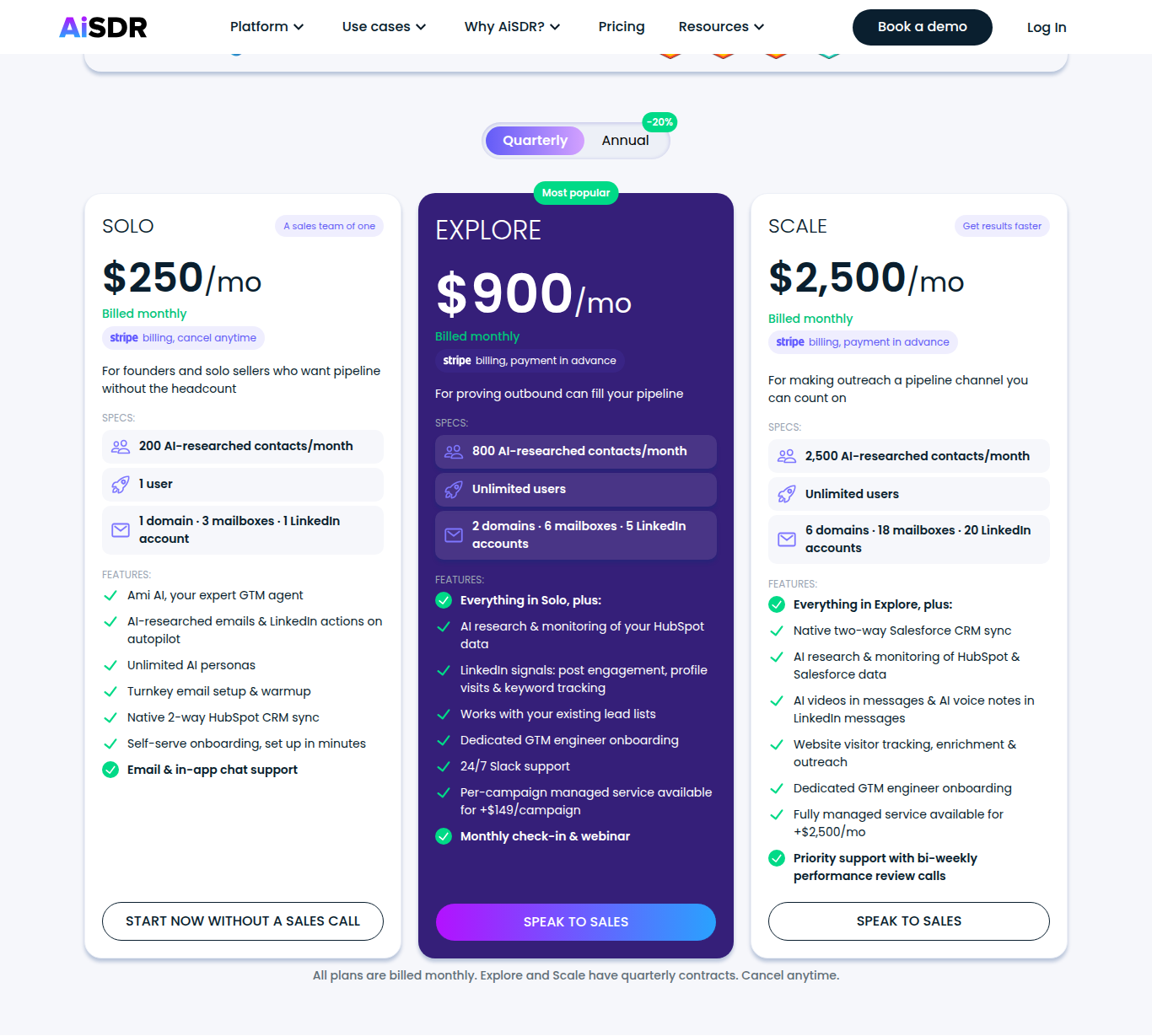
Hard contact volume caps. Solo includes 200 AI-researched contacts per month, and Explore caps at 800 per month. You do not choose the cap; you pay your way past it. High-volume outbound gets expensive fast: the ceiling comes in at 2,500 contacts per month on Scale.
No native AI phone calling. Phone is an Aircall integration: call steps in sequences with scripts, and follow-ups based on call outcome. A human rep makes the call. There is no agent that dials, qualifies, and holds a conversation the way 11x’s Julian does.
Quarterly contracts above Solo. Solo is month-to-month, but Explore ($900/mo) and Scale ($2,500/mo) require quarterly commitments. The pure month-to-month story only covers the cheapest tier. Annual plans exist at about 20% off, which is a real saving if you know you are staying.
Channel limits. Email and LinkedIn only. No SMS, no WhatsApp. The claimed 300M+ lead database is also smaller than 11x’s claimed 400M+.
No free trial. AiSDR’s own FAQ says it does not offer a free trial. Artisan’s comparison page claims AiSDR gives “a one-day trial, then asks you to commit” - we found no such trial on AiSDR’s site, and its FAQ contradicts the claim; treat Artisan’s chart as a vendor-vs-vendor shot.
Artisan (Ava): The “AI Employee” All-in-One
Artisan sells Ava as an AI BDR employee, and the “hiring” framing runs through the whole site: you hire an AI BDR instead of assembling a stack. That stack consolidation is real - Ava includes B2B data (250M+ verified contacts claimed), multi-source waterfall enrichment (22+ providers), email sequencing, deliverability warmup, intent signals (funding rounds, leadership hires), and a native parallel dialer for human reps.
The autonomy dial is the interesting part. Most teams are expected to start in approval mode and expand autonomy as they trust the agent. Controls include escalation rules, banned phrases, manual takeover, tone and CTA locks. For message testing, Artisan claims it runs dozens of variations per campaign and shifts volume toward the winners - a genuinely useful feature for teams that want to A/B subject lines, structure, CTAs, and tone at scale.
Where Artisan loses
No autonomous voice, at all. The dialer is a tool for human reps: click-to-call, live transcription, talking points. Ava does not place calls, qualify calls, or hold conversations. Compared with 11x’s Julian, this is a category gap, not a feature gap.
Opaque tier pricing. Artisan does not publish entry prices. The tiers - Team, Scale, Enterprise - are scoped through sales calls, with “Talk to sales” CTAs on every plan card. The dialer is a per-seat add-on on Team rather than included. If your budget meeting starts with “we need pricing,” you are scheduling a sales call.
Channel limits. Email and LinkedIn only. No SMS, no WhatsApp, no AI voice. There is no self-serve free trial on the pricing page either - every plan card routes to “Talk to sales,” so you cannot test Ava without a sales conversation. (Artisan’s comparison chart does claim AiSDR offers a “one-day trial”; as covered above, we found no such trial on AiSDR’s site.)
CRM integrations. Salesforce and HubSpot sync are included on all tiers, though there is no native Pipedrive integration. For a Pipedrive shop, that is a blocker.
No inbound engine. Ava is outbound only - it does not qualify inbound leads or answer your website’s “book a demo” traffic in real time.
11x (Alice + Julian): The Enterprise Digital Worker
11x is the heaviest platform here and the one built for enterprise GTM consolidation. Alice handles outbound: prospecting across 400M+ claimed verified B2B profiles, multi-channel sequencing across email, LinkedIn, SMS, WhatsApp, and consented AI voice, in 105+ languages. The platform carries deep research agents, personalization waterfalls, a knowledge base you can upload materials to, and hallucination guardrails with citations.
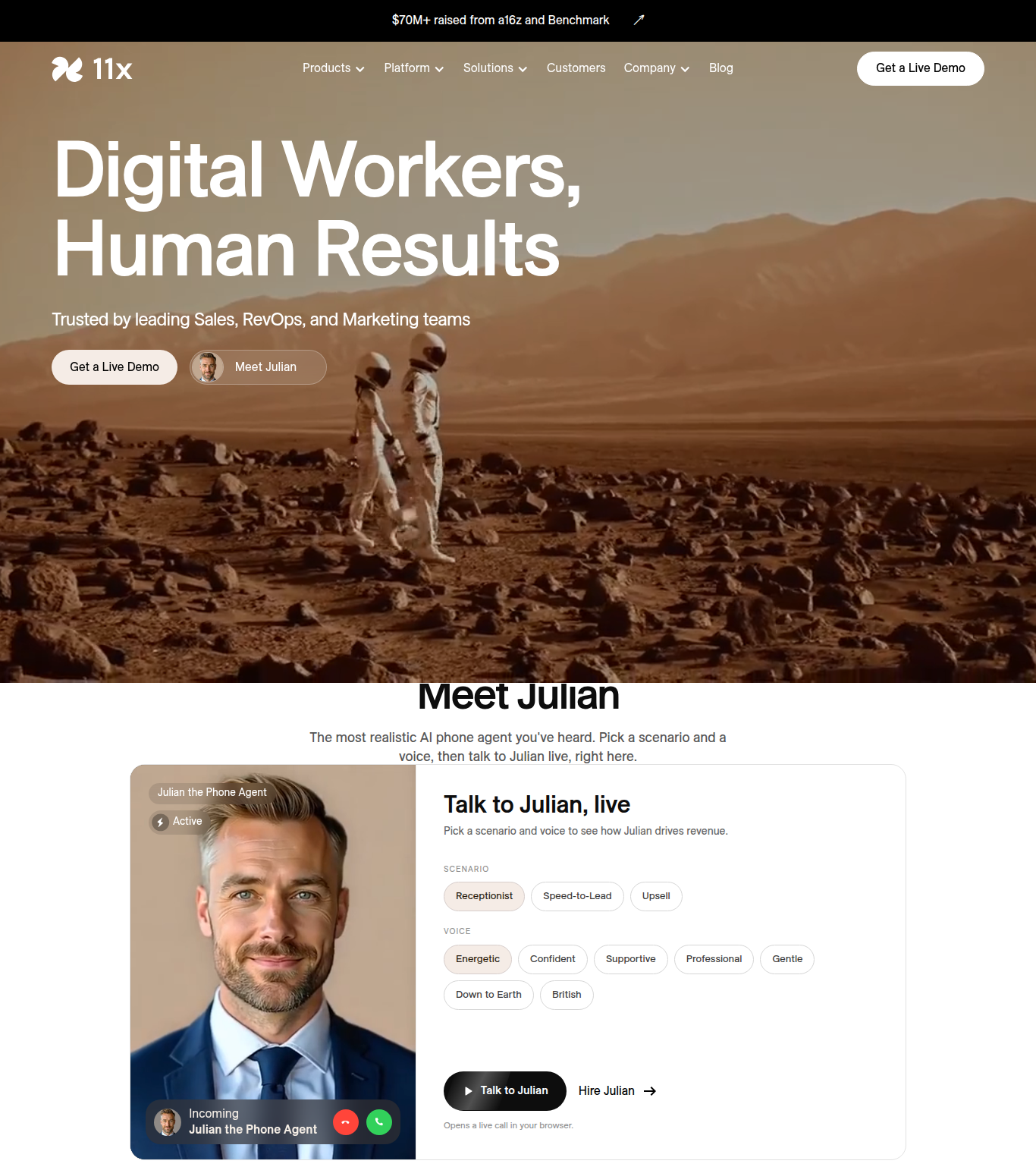
Julian is the differentiator: a native inbound AI phone agent that answers calls in seconds, qualifies the caller, routes intelligently, and books meetings - true speed-to-lead that neither AiSDR nor Artisan can match. If inbound call-handling is a requirement, this is a one-platform answer. 11x also has the deepest compliance stack of the three: CASA Tier 3, SOC 2 Type II, GDPR, CCPA - and full Salesforce, HubSpot, and Pipedrive sync.
Where 11x loses
High entry threshold and annual commitments. While 11x publishes pricing for its entry Growth plan starting at $3,750/mo ($36,000/yr, billed annually), higher Pro and Enterprise tiers require sales scoping, and contracts default to annual commitments - per competitors’ charts and TechCrunch’s reporting, enterprise deals have run 12-month terms with a 3-month opt-out. For a startup or a team that wants a $250 experiment, this is not an entry point.
The 2025 credibility controversy - which has to be part of the diligence. In March 2025, TechCrunch reported that 11x had been claiming customers it did not have: multiple company logos on its website (including ZoomInfo and Airtable) were not customers, with ZoomInfo publicly denying any relationship. TechCrunch also reported employee and investor accounts of high trial churn - one employee cited “70-80% customer churn through the door” - and of product issues ranging from malfunctioning email to double billing. 11x responded that it removed logos when asked, that it reports contracted ARR, and that its retention rate “is currently 79%.” In May 2025, founder and CEO Hasan Sukkar stepped down to non-executive chairman, and CTO Prabhav Jain took over as CEO. This is reported history, not our finding - read the TechCrunch pieces yourself (March 2025 investigation and May 2025 CEO change). At minimum, it means enterprise buyers should verify any customer reference list independently before signing.
Overkill for SMBs. It is designed, priced, and demoed for enterprise GTM teams. The phone agent, SMS/WhatsApp channels, and CASA compliance are wasted on a solo founder who needs 200 contacts a month. If the account is not going to hit enterprise volume, the demo-to-contract treadmill is disproportionate.
Pricing Head-to-Head
AiSDR is the only one of the three with publishable, self-serve pricing. Solo is $250/mo, billed monthly, cancel anytime, in-app signup with no sales call. Explore is $900/mo and Scale is $2,500/mo, both on quarterly contracts. Annual billing takes about 20% off. No free trial.
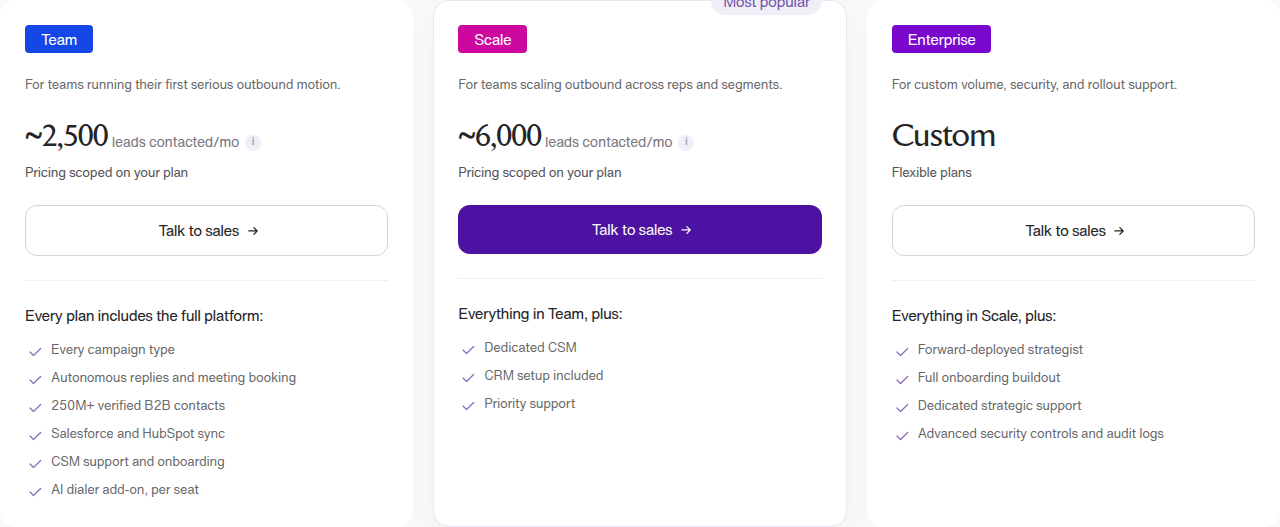
Artisan does not publish entry prices, and the pricing page offers no self-serve free trial. The Team, Scale, and Enterprise tiers are all scoped through sales calls - every card says “Pricing scoped on your plan” with a “Talk to sales” CTA, so you can see the structure and per-tier lead allowances (Team ~2,500 leads/mo, Scale ~6,000 leads/mo), but not dollar numbers. The dialer is a per-seat add-on on Team.
11x publishes pricing for its entry Growth tier ($3,750/mo billed annually, or $36,000/yr), while Pro and Enterprise require a demo and custom quote. Per competitors and TechCrunch reporting, that demo leads to annual, paid-up-front, enterprise-scale contracts.
Ami AI: Why AiSDR’s Agent Is More Than a Sender
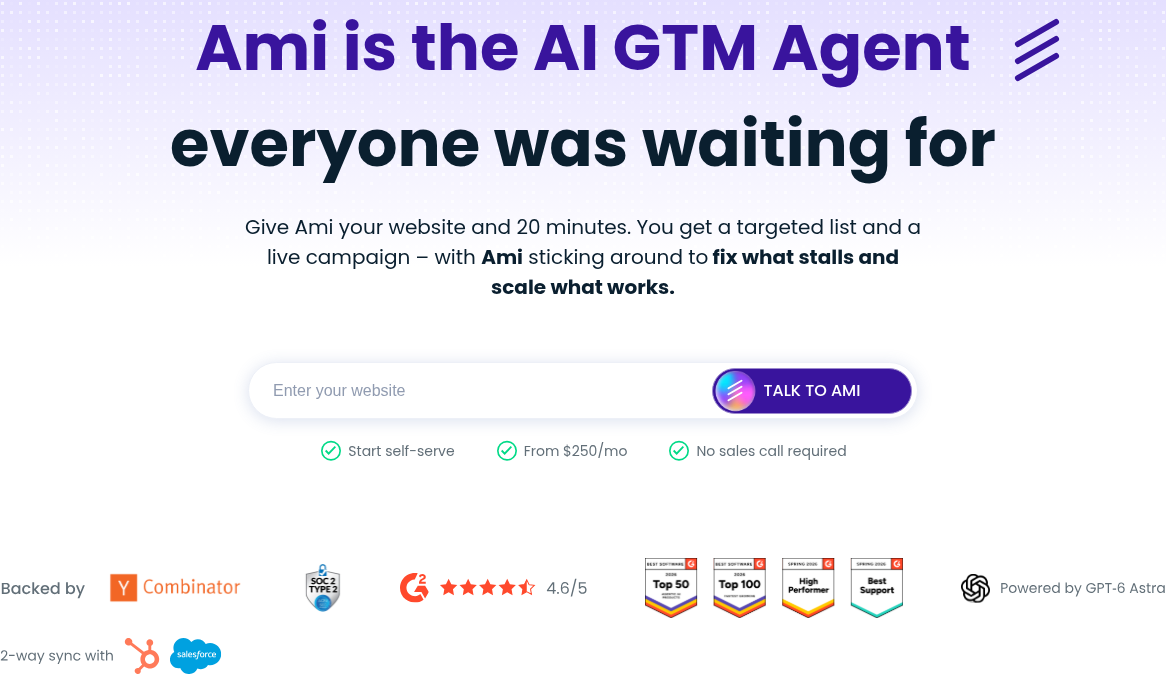
The reason this post exists is Ami AI, which AiSDR positions as beyond “just another AI SDR.” The core is the improvement loop: Ami does not just send and respond, it watches the campaign, spots the stall, and fixes it. It monitors deliverability score and positive response rate, flags campaigns stuck under 1% response after 21+ days, and - in auto mode - fixes issues overnight while keeping your guardrails (suppression lists, send limits) intact. It also remembers your GTM context across campaigns, so the agent you briefed in March is still the agent you have in September. On the list of things Ami says it will never do: launch before you approve the first campaign, invent facts, ignore suppression lists, trade deliverability for volume, use unapproved data, or trap you in an annual contract.
The Phone Gap, in One Line
If an AI that answers your inbound calls is a requirement, buy 11x - Julian is the only native phone agent among the three. If your reps dial out and you want a built-in dialer with live transcription in the same platform as your sequencing, Artisan covers that. If you are fine with a manual Aircall integration for calls, AiSDR covers it. No tool here does everything.
The Wider Field
None of these is your only option. For deliverability-focused cold-email infrastructure, see our BrandJet vs Instantly comparison and the Mailwarm vs Warmy deep dive on warmup approaches. For lead-data depth - including whether a static database or live-web research is the right model - our Cleanlist AI vs Apollo.io and Youkti vs ZoomInfo comparisons cover the data layer these AI SDRs sit on top of.
Who Should Pick What
Pick AiSDR (Ami AI) if you are a founder, a lean sales team, or an agency that wants transparent monthly pricing from $250, self-serve onboarding, month-to-month terms on the entry tier, and deliverability guardrails that keep your secondary domains alive. It is the only one of the three you can start this afternoon without a sales call. It is wrong for you if you need high contact volume (the caps get expensive), need native AI phone calling, or intend to run SMS/WhatsApp.
Pick Artisan (Ava) if you want a consolidated outbound stack - data, enrichment, sequencing, warmup, intent, and a dialer for your human reps - with granular human-in-the-loop control and large-scale message testing. It is wrong for you if you need AI voice calling, inbound qualification, SMS/WhatsApp channels, or a Pipedrive sync you can actually buy.
Pick 11x (Alice + Julian) if you are an enterprise sales org with a real budget, need an inbound AI phone agent plus multi-channel outbound (SMS, WhatsApp, voice) and deep compliance (CASA Tier 3), and can commit to a demo-gated annual contract. It is wrong for you if you are a startup, a solo operator, or anyone who needs to see a price before a sales call - and if past customer claims matter to you, do the diligence above before you sign.