22 July 2026 · Comparison
Apollo.io vs Clay vs Lev8 (2026): Which B2B Data Tool Wins?
The short answer
Static database vs waterfall enrichment vs live-web crawling: three fundamentally different approaches to finding and reaching B2B buyers.
Verdict: Pick Apollo.io if you want one tool that does everything (database, sequences, dialer, CRM) and you need to be up and running today. Pick Clay if your team lives in spreadsheets, needs the deepest enrichment coverage, and has the patience to build workflows. Pick Lev8 if you want to describe your ideal prospect in plain English and have AI crawl the live web to find them, but accept that the product is months old and unproven.
Affiliate disclosure: SaaSpicious may earn a commission if you buy through links in this post. Apollo.io and Clay have affiliate/partner programs (Apollo pays 15% on monthly plans and 20% on annual plans for the referral’s first 12 months; Clay’s Creators program is still under construction and does not publicly disclose a commission rate); Lev8 does not as of July 2026. This does not affect our verdict. Every tool gets its honest downsides.
Comparison at a Glance
| Apollo.io | Clay | Lev8 | |
|---|---|---|---|
| Data source | Owned static database (refreshed periodically) | Waterfall across 150+ data providers | Live web crawl with AI agents |
| Starting price | Free (900 credits/yr); Basic $49/seat/mo | Free (500 actions/mo); Launch $167/mo | Free (500 credits/mo); Starter $49/mo |
| Mid-tier price | Professional $79/seat/mo | Growth $446/mo | Pro $199/mo |
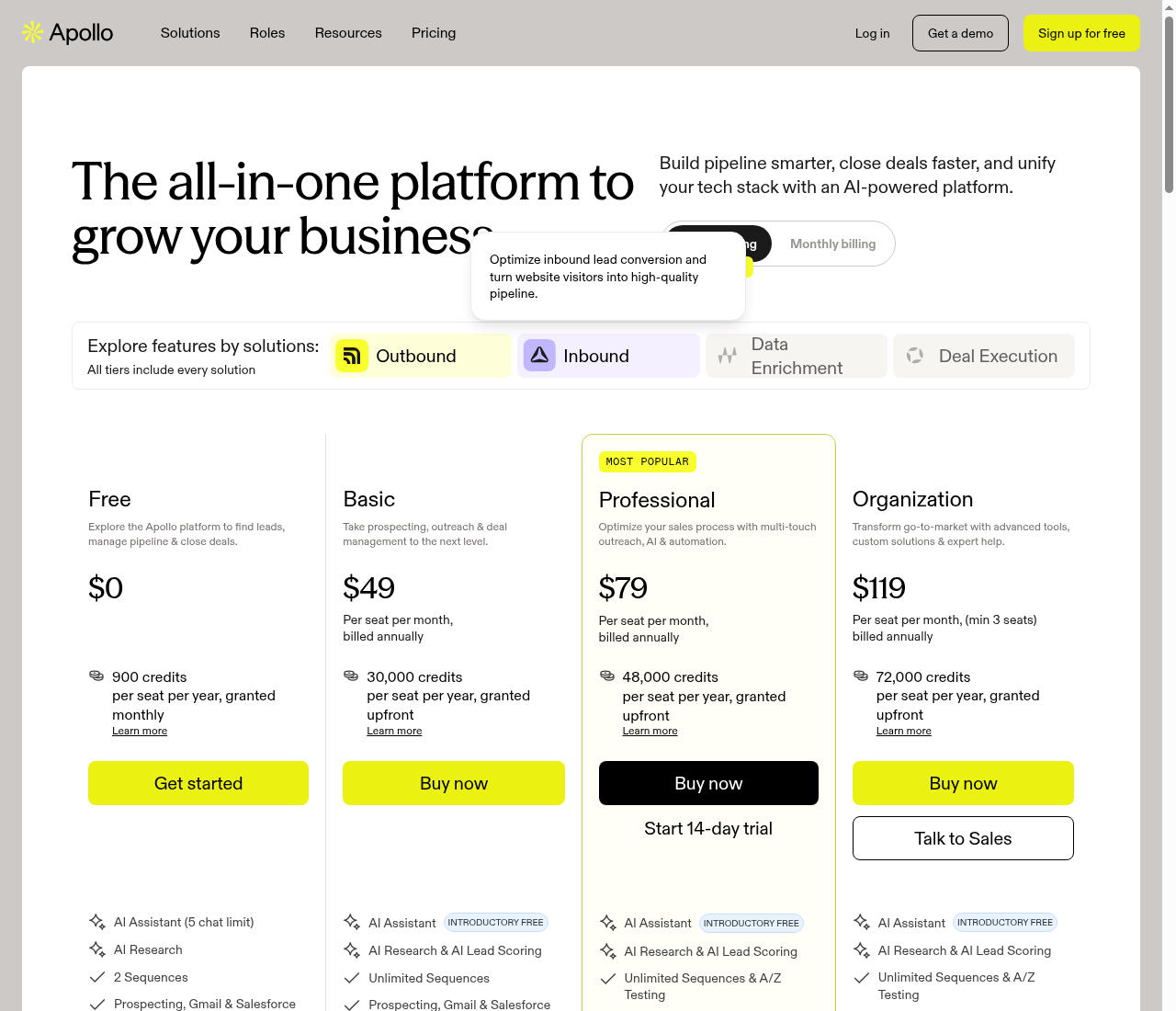
| Top published plan | Organization $119/seat/mo (min 3 seats) | Enterprise custom | Scale $499/mo |
| Outreach channels | Email + dialer (US/international add-ons) | Email (native sequencer + integrations) | Email + LinkedIn + WhatsApp + Instagram + X + Telegram |
| Built-in dialer | Yes (US included, international add-on) | No | No |
| CRM | Built-in deal management | No (integrates with CRMs) | No |
| Best for | SMB sales teams wanting one tool | Data-heavy GTM ops teams | Early adopters wanting AI-native search |
| Maturity | 10+ years, 600K+ companies | 8+ years, $5B valuation | <1 year, no enterprise track record |
Prices accurate as of July 2026; check each vendor’s site for current rates.
Apollo.io: The All-in-One Workhorse
Apollo.io is the most established platform in this comparison. It combines a B2B contact database (240M+ contacts, 30M+ companies) with email sequences, a built-in dialer, conversation intelligence, and deal management. For a sales team that wants to replace five tools with one, Apollo is the obvious choice. If you’re weighing Apollo.io against a LinkedIn-native social selling approach, see our Fuzzy AI vs Apollo.io comparison for that head-to-head.
What Apollo does well
Genuinely free forever. The Free plan gives you 900 credits per seat per year (granted monthly). That gets you real email addresses and basic prospecting at zero cost. No other tool in this comparison matches that.
All-in-one execution. Search for contacts, drop them into sequences, dial them directly from the platform, log calls, track deals. All without leaving Apollo. The Chrome extension surfaces contact data while you browse LinkedIn or company websites.
Massive adoption means reliability. Over 600,000 companies use Apollo. The database gets regular updates. Integrations with Salesforce, HubSpot, and Gmail are battle-tested.
Built-in dialer. Apollo includes a US dialer on all paid plans (credits apply). An international dialer and power dialer are available as $119/mo add-ons. Neither Clay nor Lev8 can make phone calls.
Where Apollo loses
Data freshness. Apollo’s database is large but periodically refreshed, not real-time. Contacts can be 30-90 days stale. If someone changed jobs last week, Apollo might not know yet.
Credit-based pricing with complexity. Basic is $49/seat/mo (annual) for 30,000 credits/seat/year, Professional is $79/seat/mo for 48,000 credits, and Organization is $119/seat/mo (min 3 seats) for 72,000 credits. Every email lookup, phone number reveal, and data enrichment costs credits. Budgeting requires upfront calculation.
Linear sequences only. Apollo’s outreach sequences are straightforward but inflexible. No branching logic, no waterfall enrichment, no spreadsheet-style workflows. For complex GTM motions, Clay’s canvas model is far more powerful.
Enrichment from one source. Apollo enriches from its own database only. If it doesn’t have a contact, you don’t get the data. Clay’s waterfall model (try provider A, fall through to B and C) produces higher coverage rates.
Clay: The Data Powerhouse
Clay is a GTM orchestration platform built on a spreadsheet-like canvas. It connects to 150+ data providers via “waterfall enrichment” and lets you build branching workflows that would be impossible in a traditional sequence builder. With a $5B valuation (per a January 2026 employee tender offer reported by the New York Times) and customers like OpenAI, Anthropic, and Canva, Clay is the infrastructure layer for data-heavy GTM teams.
What Clay does well
Waterfall enrichment across 150+ providers. If Provider A doesn’t have a contact’s email, Clay automatically tries Provider B, then C. This produces the highest enrichment coverage in the market. Anthropic reported a 3x enrichment rate improvement after switching to Clay.
Spreadsheet-native flexibility. Clay tables work like a spreadsheet with superpowers. Write formulas, chain enrichment steps, and pull from APIs. You can build workflows that Apollo’s rigid sequence builder can’t touch.
Claygent AI research agents. Clay’s AI agents research custom data points from the live web: scraping websites, checking hiring pages, reading LinkedIn posts. No pre-existing database needed.
Ads audience sync. Build prospect lists in Clay and push them directly to LinkedIn, Meta, and Google Ads as custom audiences. Neither Apollo nor Lev8 can do this.
Built-in sequencer. Clay now includes its own email sequencer, so you don’t need a separate outreach tool. It also integrates with Smartlead, Outreach, and other sequencers.
Where Clay loses
Steep learning curve. Clay’s flexibility means complexity. New users face a real climb. Apollo’s interface is immediate by comparison.
No built-in database. Clay does not own a proprietary contact database. You must bring your own leads or enrich from third-party providers. If you want to “find all marketing VPs in SF and get their emails,” Apollo does it in one click; Clay requires building a table, adding enrichments, and configuring waterfalls.
Higher starting price. The first usable paid tier (Launch) starts at $167/mo (180K actions + 30K data credits annually). Free is capped at 200 rows per table. Apollo’s Basic at $49/seat/mo is much cheaper for small teams.
No dialer. Clay has no calling capability. Teams that cold-call must use a separate tool.
Dual-currency credit system. Clay separates “actions” (platform usage) and “data credits” (vendor data), each with its own pricing slider. Budgeting is genuinely confusing at first.
Lev8: The Live-Web Challenger
Lev8 is the newest entrant, launched in 2026 by Simplex AI. It takes a fundamentally different approach: instead of a static database or third-party enrichment, Lev8 crawls the live web in real time using parallel AI agents. You describe your ideal prospect in plain English, and Lev8 interprets the request, searches the web, verifies results, and gives you contacts with multi-channel outreach built in.
What Lev8 does well
Live-web crawling. Lev8 searches TechCrunch, Axios, YC, GitHub, LinkedIn, community forums, and more in real time. It can find startups that launched last week or contacts that haven’t made it into any database yet. Apollo and Clay cannot do this.
Natural language search. “Find CTOs at SaaS startups with 10-50 employees that are actively hiring engineers and using Salesforce.” No filters, no dropdowns, no spreadsheet formulas. You describe who you need and Lev8 interprets it.
3-layer verification. Noise filter → identity validation → reachability score. Lev8 claims higher-quality contacts by filtering before surfacing. It only charges credits on successful results.
Proactive intent signals. Lev8 monitors hiring spikes, funding events, tech-stack changes, and competitor moves. It tells you not just who to contact, but why now.
Multi-channel outreach built in. Email, LinkedIn, WhatsApp, Instagram, X (Twitter), Telegram, all from one platform. No need for separate LinkedIn automation or WhatsApp tools.
Per-action credit model with success-only billing. You pay credits only when Lev8 delivers a correct result. If a lookup fails or data is stale, no credit is deducted. Apollo and Clay charge per search regardless of outcome.
Where Lev8 loses
Extremely new. Launched in 2026. No enterprise track record. No named customer logos beyond demo data. No G2 reviews. Enterprise buyers should wait for proof points.
Unknown real-world coverage. Lev8 claims 50+ providers and 1B+ contacts, but this is unverified. Live-web crawling sounds impressive, but actual coverage for niche industries or regions is unknown until tested at scale.
No dialer, no CRM. Lev8 cannot make phone calls and does not manage deals. Teams that need full sales execution will still need separate tools.
Credit costs add up fast. At ~20 credits per lead, the $49/mo Starter plan (5,000 credits) gets you about 250 leads. The $199/mo Pro (25,000 credits) gets about 1,250 leads. The Lead Generator Agent costs an additional $0.25 per lead on top of plan credits. Apollo’s unlimited email access at a fixed seat price may be cheaper for high-volume teams.
LinkedIn automation risk. LinkedIn aggressively enforces its ToS against automation. Lev8 offers LinkedIn automation, which puts users at risk of account restrictions.
Small team, single product. Simplex AI is an early-stage startup with Lev8 as its only product, and has not disclosed its funding status publicly. No SOC 2 compliance confirmed. No enterprise support infrastructure.
Pricing Head-to-Head
Apollo.io charges per seat with annual billing discounts. Credits are consumed per action (1 credit = email access, 8 credits = phone number).
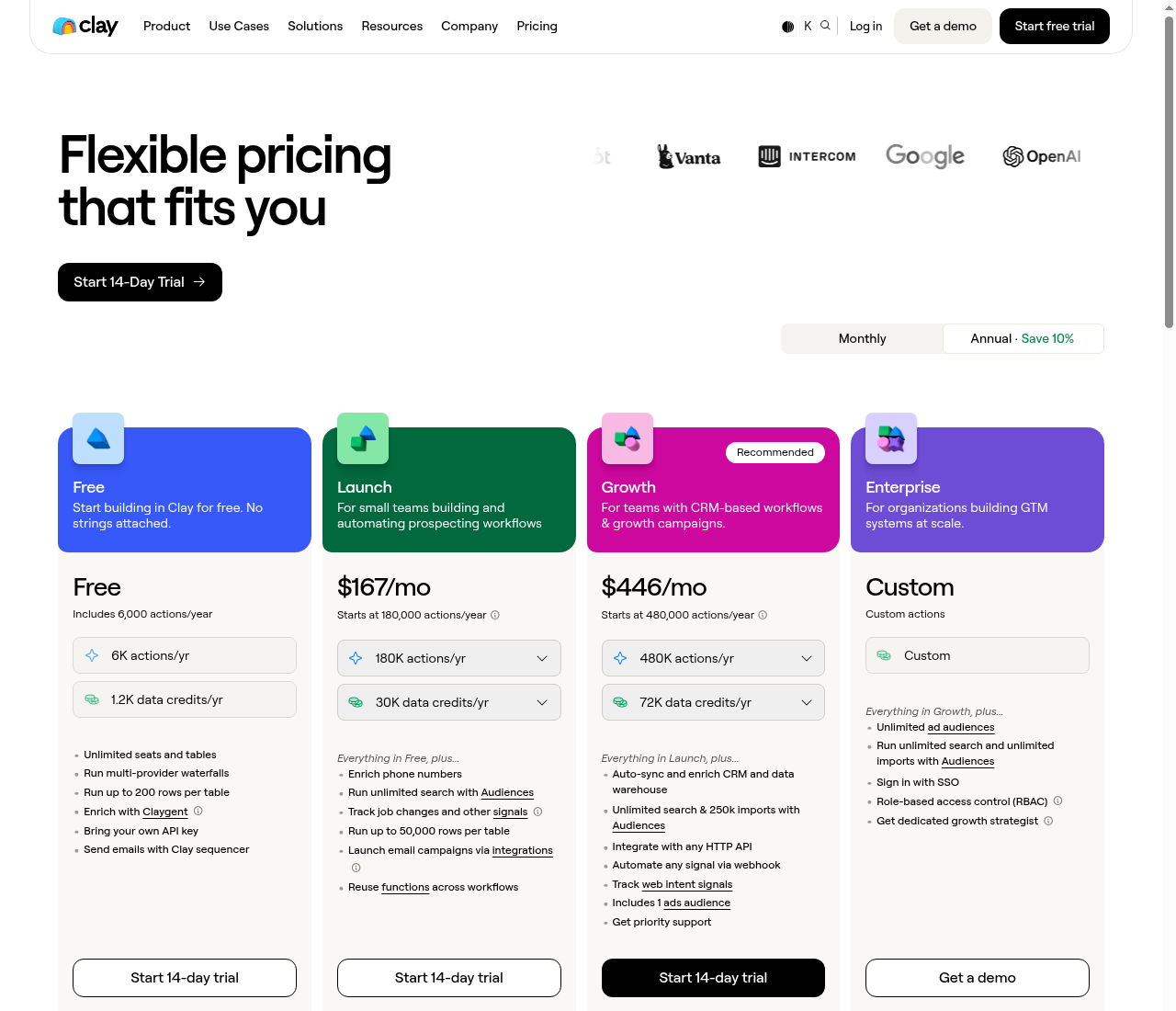
Clay separates “actions” (platform usage) from “data credits” (vendor data). Launch starts at $167/mo with action and data credit sliders that adjust the price up.
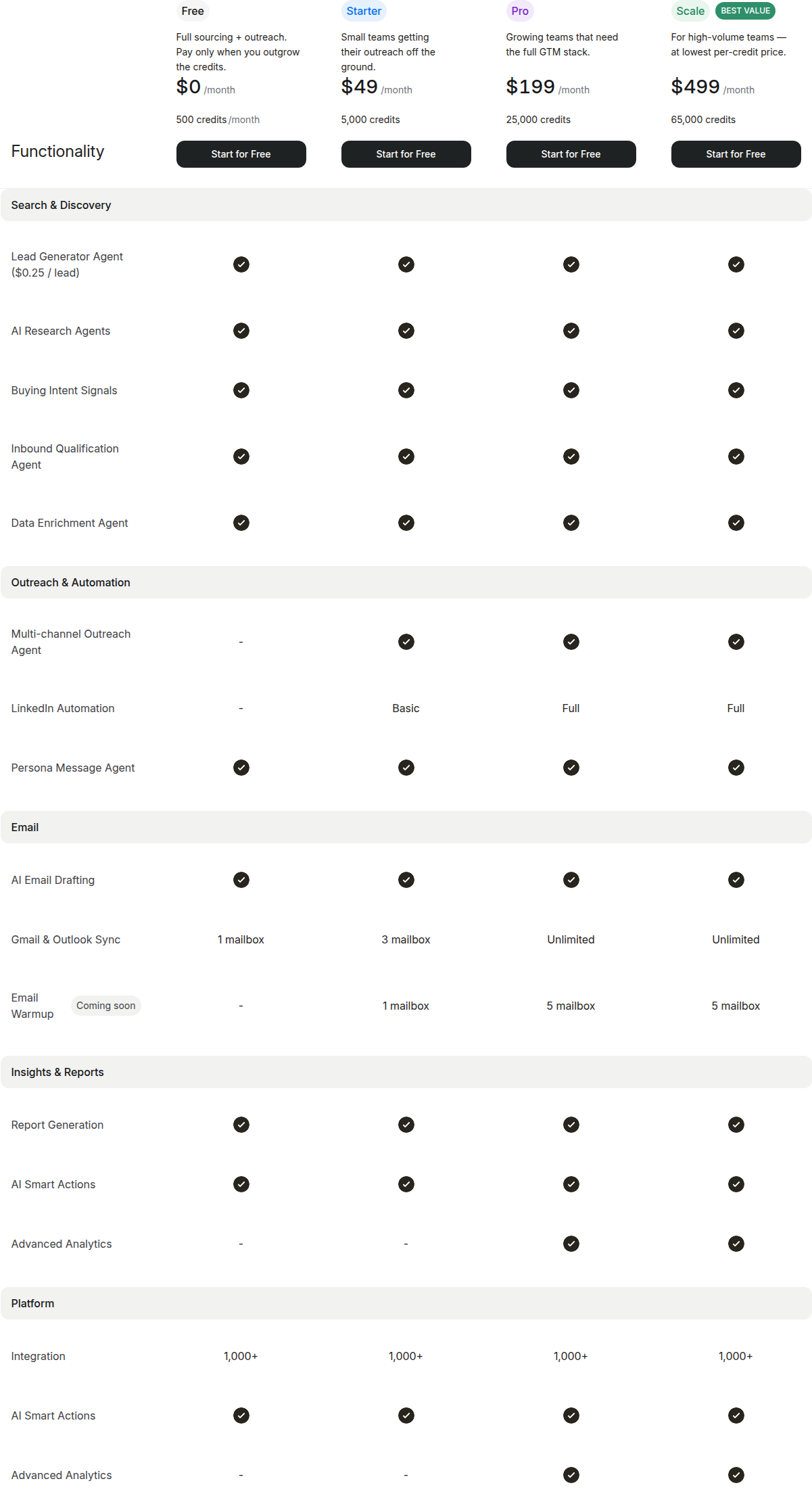
Lev8 uses a flat per-account model with monthly credit pools. Credits roll over up to 2x the monthly allowance.
Which pricing model fits which team
- 1-3 person sales team on a budget: Apollo Basic at $49/seat/mo gives the most capability per dollar. You get unlimited sequences, the Chrome extension, and a real contact database.
- Data-heavy ops team of 3-10: Clay Launch at $167+/mo justifies its cost through waterfall enrichment depth. The spreadsheet interface saves hours of manual data work.
- Founder or early-stage team wanting AI-native search: Lev8 Starter at $49/mo is the cheapest way to test live-web crawling. But expect to outgrow the 5,000 credit limit quickly.
- Enterprise with 10+ seats and compliance needs: Apollo Organization ($119/seat/mo, min 3) or Clay Enterprise (custom). Lev8 is not enterprise-ready.
The Technical Deep-Dive: Data Freshness
The core difference between these tools is how they source data, and that determines everything about what you can find.
Apollo.io maintains its own database of 240M+ contacts and 30M+ companies. It crawls and updates periodically, but the refresh cycle means data can be weeks or months old. For established companies and common roles, Apollo’s data is sufficient. For rapidly changing startups or niche roles, gaps appear.
Clay doesn’t own data. It aggregates from 150+ providers. Each enrichment request cascades through providers until it finds a match. This waterfall approach produces the highest coverage rate, but it depends entirely on third-party data quality. Claygent (the AI research agent) can fill gaps by scraping the web, but this consumes credits.
Lev8 skips databases entirely and searches the live web in real time. When you run a search, parallel AI agents crawl news sites, job boards, GitHub, LinkedIn, and community forums. This means Lev8 can find companies and contacts that haven’t appeared in any database yet. But the trade-off is consistency: what the live web returns varies by search, and coverage in less-digitized industries or regions is unproven.
Which Tool Should You Pick?
Pick Apollo.io if:
- You want one tool that replaces your data provider, sequencer, dialer, and CRM
- You need to be productive on day one without learning a new interface paradigm
- Your team cold-calls and needs a built-in dialer
- You’re price-sensitive and want a genuinely useful free tier
- You value stability over bleeding-edge features
Pick Clay if:
- Your team lives in spreadsheets and wants formula-driven GTM workflows
- You need the deepest possible enrichment coverage (waterfall across 150+ providers)
- You’re building complex prospecting logic that linear sequences can’t handle
- You run ads and want to sync audiences directly from your prospect lists
- You have the budget and patience to learn a powerful but complex tool
Pick Lev8 if:
- You want to find people by describing them in plain English rather than building filters
- You prospect in fast-moving industries where databases are always stale
- You need multi-channel outreach beyond just email (LinkedIn, WhatsApp, Instagram included)
- You value live-web freshness over database size
- You’re willing to accept the risk of an unproven, months-old product
Don’t pick Lev8 if you need enterprise compliance (SOC 2, SSO), a built-in dialer, or predictable pricing at high volume. Don’t pick Clay if you need to get started in an afternoon without a learning curve. Don’t pick Apollo if you need data on companies that launched last month or custom enrichment that goes beyond what a single database can provide.
Many teams run two of these tools together: Apollo for day-to-day prospecting and sequences, Clay (or eventually Lev8) for enrichment and custom GTM workflows. They’re complementary more than they are direct replacements.
Further reading: For a closer look at how Apollo stacks up against a LinkedIn warm-engagement platform, read our Fuzzy AI vs Apollo.io comparison. And for where those leads land afterwards, our Lightfield vs HubSpot comparison covers the AI-native CRM against the default. If you want the same waterfall enrichment without Clay’s build-it-yourself workflow, see Cleanlist AI vs Clay and Cleanlist AI vs Apollo.io. And if you’re weighing whether a five-figure data contract is still worth it, our Youkti vs ZoomInfo comparison pits free, unmetered contact data against ZoomInfo’s roughly $15K entry price.