2 August 2026 · Comparison
Cleanlist AI vs Apollo.io: Which B2B Data Tool Wins in 2026?
The short answer
if you already have an email sequencer and want pay-per-match waterfall enrichment with flat team pricing.
if you want an all-in-one prospecting database, cold email sequences, and a dialer in a single platform.
Verdict: Pick Cleanlist AI if you already run a sequencer (Instantly, Smartlead, Outreach) and your bottleneck is data quality - you want pay-per-match waterfall enrichment with flat team pricing instead of per-seat fees. Pick Apollo.io if you want one platform for the whole motion: a massive contact database, built-in cold email sequences, a dialer, and a usable free tier under a single subscription.
Both tools now claim 98% email accuracy and both run multi-provider waterfalls. The real difference is scope: Cleanlist is a pure data-quality engine that owns no static database, while Apollo bundles data, sequencing, calling, and deal management into one per-seat subscription. Neither is a bad pick - but the wrong one wastes money.
Affiliate disclosure: SaaSpicious may earn a commission if you buy through links in this post. Apollo.io runs a public affiliate program (up to 20% commission - 15% on monthly referrals, 20% on annual, for the referral’s first 12 months, via PartnerStack); Cleanlist AI has no public affiliate program as of August 2026. This does not affect our verdict - every tool gets its honest downsides below.
At a Glance
| Cleanlist AI | Apollo.io | |
|---|---|---|
| Core model | Live waterfall enrichment across 15+ providers, pay per verified match | Owned database (240M+ contacts) + enrichment + sequences + dialer |
| Email accuracy claim | 98% verified (self-published 500-lead benchmark) | 98% (self-published, 7-step verification) |
| Owned database | No - queries providers live per lookup | Yes - massive on-hand database for discovery |
| Sequences / dialer | None (enrichment only) | Built-in sequences, US dialer on paid plans |
| Free tier | 30 credits/mo sample | Usable forever-free plan with 900 credits/mo |
| Pricing model | Credit-based, flat across team | Per-seat, escalates with headcount |
| Entry paid plan | Starter $59/mo (annual) | Basic $49/seat/mo (annual) |
| CRM sync / API | Gated to Pro plan | CRM integrations on paid plans; API on Custom |
| Compliance | No public SOC 2 / ISO 27001 | SOC 2 Type II, ISO 27001, GDPR |
Prices accurate as of August 2026; check each vendor’s site for current rates.
Why This Comparison Changed in 2026
The old story was simple: Cleanlist = multi-source waterfall, Apollo = one stale database. That story is no longer true. Apollo launched its own Waterfall Enrichment product, which checks across dozens of data providers one after another and lets users control which sources are included and in what order. It ships on Basic, Professional, and Organization plans.
That matters because a chunk of Cleanlist’s marketing still frames Apollo as a single static database with 70-80% accuracy. Apollo now publishes its own 98% email accuracy claim, backed by a 7-step verification process and real-time number checks. Both accuracy figures are self-published and directly contradict each other - treat both as contested, not as settled fact.
What has not changed: Cleanlist still owns no database and charges only for verified matches, while Apollo bundles the whole prospecting stack. That is the decision, and the rest of this post works through it.
Cleanlist AI: Data Quality as the Whole Product
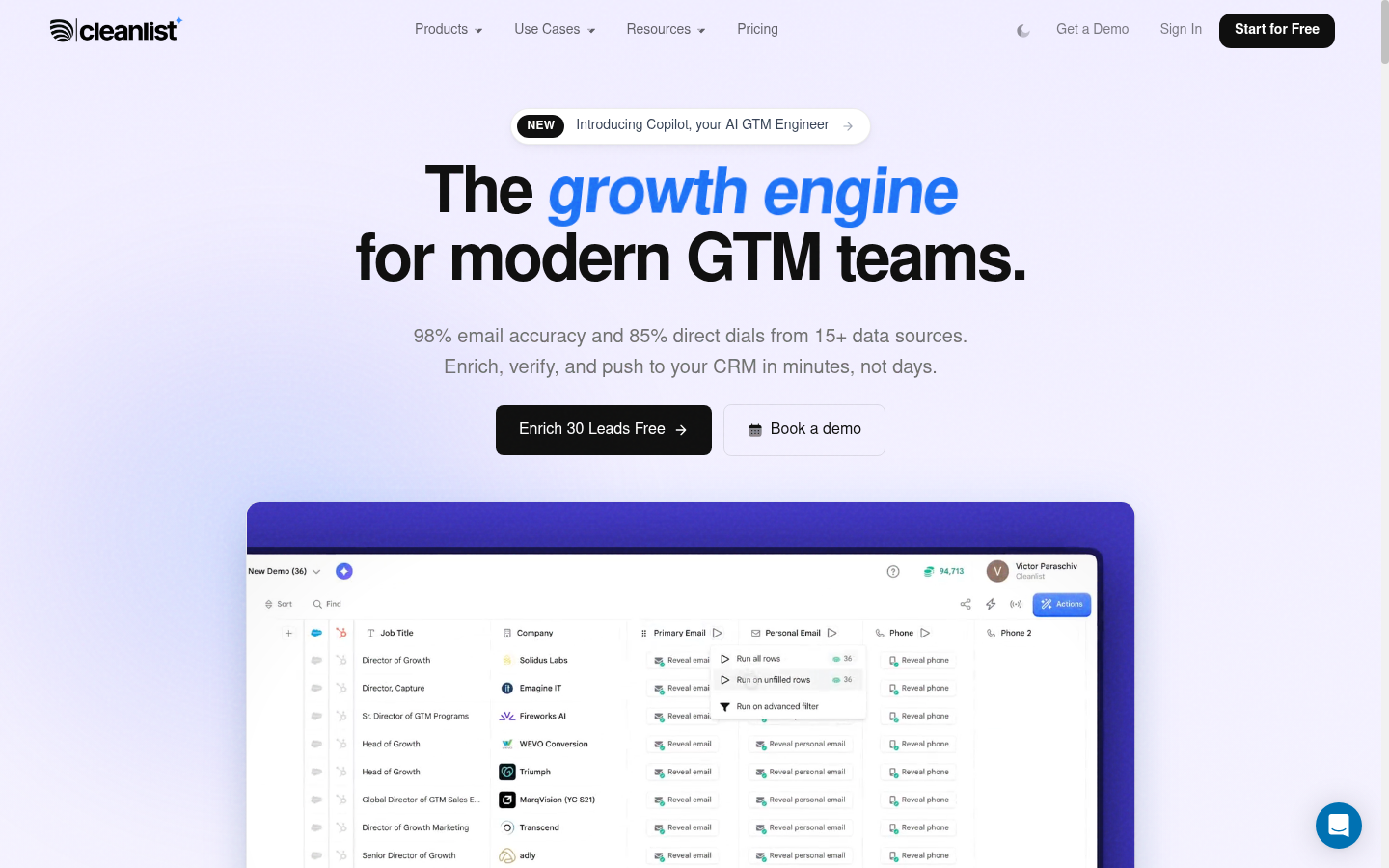
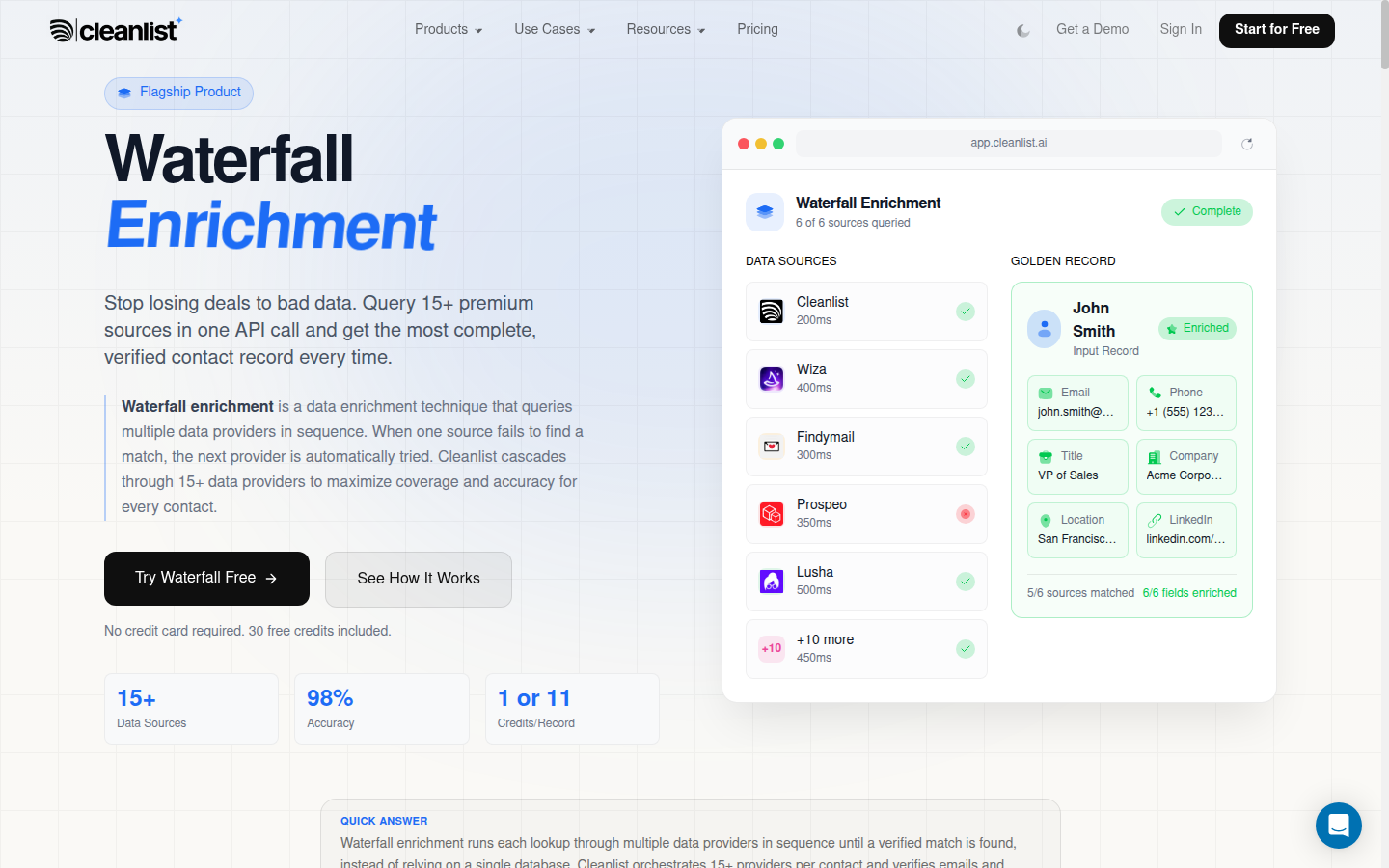
Cleanlist AI (founded 2024, Toronto) positions itself as the AI-native orchestration layer for B2B go-to-market workflows. It is not a database and not an outreach tool. It takes any input - a name, email, domain, LinkedIn URL, CSV, or CRM record - and enriches it through a 15+ provider waterfall: Wiza, Findymail, Prospeo, Lusha, and others are queried in sequence until a verified result returns, with SMTP verification (syntax, DNS/MX, mailbox handshake) before delivery. The headline claims are 98% verified email accuracy and 85% direct-dial phone coverage, based on a self-published 500-lead benchmark.
The credit model is the part people either love or bounce off: 1 credit for an email-only enrich or verify, 11 credits for a full contact record (email + phone + firmographics). Failed lookups do not consume credits - you pay only for verified matches, which is the fairest structure in this category per the independent MakerStack review (7.5/10, Aug 2026).
Cleanlist AI Pricing
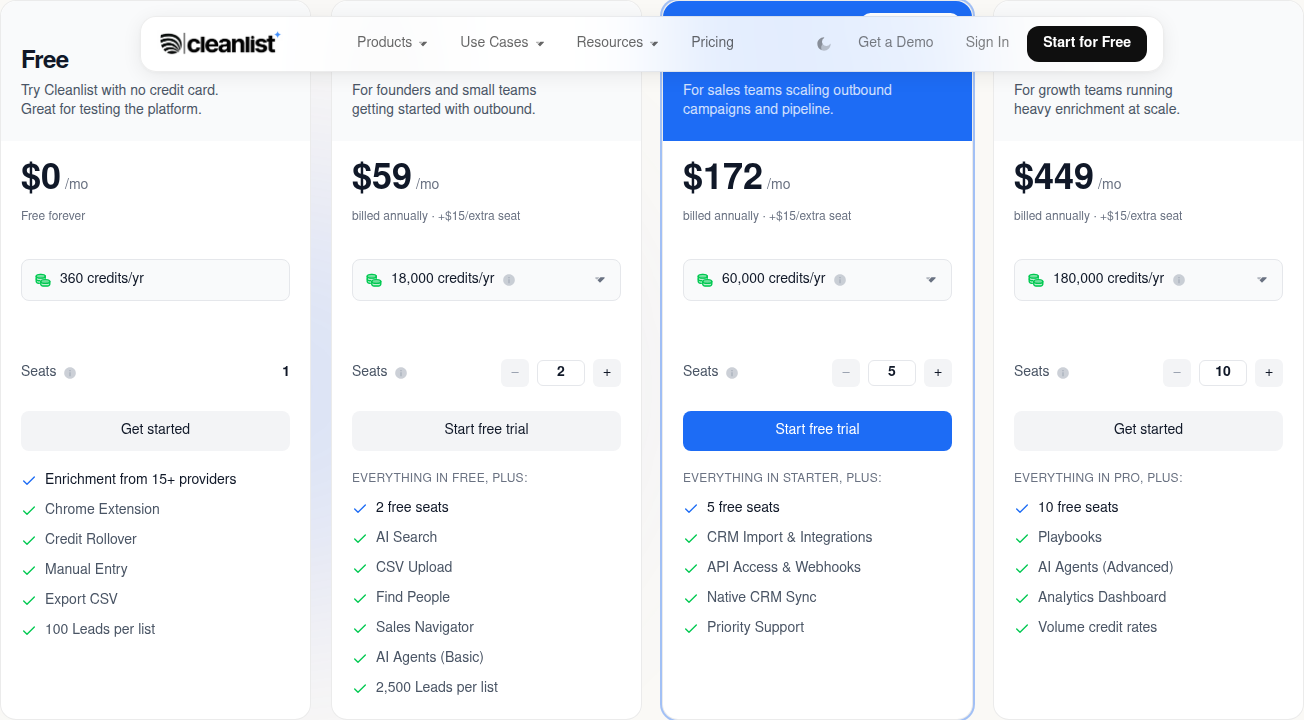
| Plan | Monthly | Annual (billed yearly) | Credits | Seats | Leads/list cap |
|---|---|---|---|---|---|
| Free | $0 | $0 | 360/yr (30/mo) | 1 | 100 |
| Starter | $79 | $59/mo | 18,000/yr (1,500/mo) | 2 | 2,500 |
| Pro | $229 | $172/mo | 60,000/yr (5,000/mo) | 5 | 2,500 |
| Scale | $599 | $449/mo | 180,000/yr (15,000/mo) | 10 | Unlimited |
| Two caveats the marketing page will not tell you. First, the “$59/mo Starter” headline is the annual-billing price - monthly billing is $79/mo, a 25% penalty. Second, credits are quoted per year (18,000/yr for Starter) which flatters the monthly figure; the real monthly allocation is 1,500. A “SUMMER25 - 25% off forever” promo banner was still live on the pricing page at capture time despite its “Ends July 31” label - worth checking whether it still applies when you buy. |
Where Cleanlist AI Wins
- Data quality is the entire product, not a side feature. The waterfall, verification, catch-all/spam-trap detection, and field-level cross-referencing are the core engine - not an add-on bolted onto a database.
- Pay-per-match economics. No credits burned on failed lookups. Teams that enrich in bursts get value single-source tools can’t match.
- Flat team pricing. One shared credit pool for the whole team - no per-seat fee escalation. A 5-person team on Starter pays the same as a solo founder.
- Native Sales Navigator bulk extraction. Up to 2,500 leads per Sales Nav search with auto-enrichment, versus Apollo’s Chrome-extension-only model.
- Pre-built playbooks and Copilot. Plain-English prompts (“find me 100 founders in NY at companies with 50-200 employees”) chain search, enrichment, and verification in one pass - the direct shot at Clay’s workflow builder, without needing a GTM engineer.
Where Cleanlist AI Loses
- No sequences, dialer, or warmup at all. It enriches; you still need Instantly, Smartlead, or Outreach to actually send. Cleanlist’s own compare page says to pair it with a sequencer.
- No owned database. Discovery depends entirely on the live provider cascade and cache. You cannot browse millions of on-hand contacts the way you can in Apollo.
- API access and native CRM sync are gated to Pro ($172/mo annual). Starter teams that want HubSpot/Salesforce sync or the REST API face a steep jump with nothing between.
- The 2,500-lead cap applies to Pro, not just Starter. Only Scale unlocks unlimited leads per list.
- Accuracy claims are self-published. No independent third-party benchmark exists; the 98% figure is Cleanlist’s own test. Apollo publishes a directly contradicting 98% claim.
- Young startup, no compliance page. Founded 2024; no public SOC 2 Type II or ISO 27001 certification page found. Enterprise security teams will struggle to sign off.
- The free tier is a sample, not a plan. 30 credits/mo (360/yr) is enough to test, not enough to run real outbound.
Apollo.io: The All-in-One Platform
Apollo.io (founded 2015, San Francisco) is the established all-in-one GTM platform: a B2B contact database with 240M+ contacts, email sequences, a built-in dialer, conversation intelligence, deal management, and workflow automation, used by “millions of sellers at over 600,000 companies.” It ships a genuinely usable forever-free plan, which is why it is the default first tool for most solo founders and small teams.
Its data network is the moat: a 2M-strong contributor network, engagement-suite signals, public web crawling, and third-party providers add 5.3M new contacts monthly and refresh 150M contacts monthly. Apollo also claims 98% email accuracy via a 7-step verification process and “less than 1% invalid direct phone numbers” - the same number Cleanlist publishes, from the opposite architecture.
Apollo.io Pricing
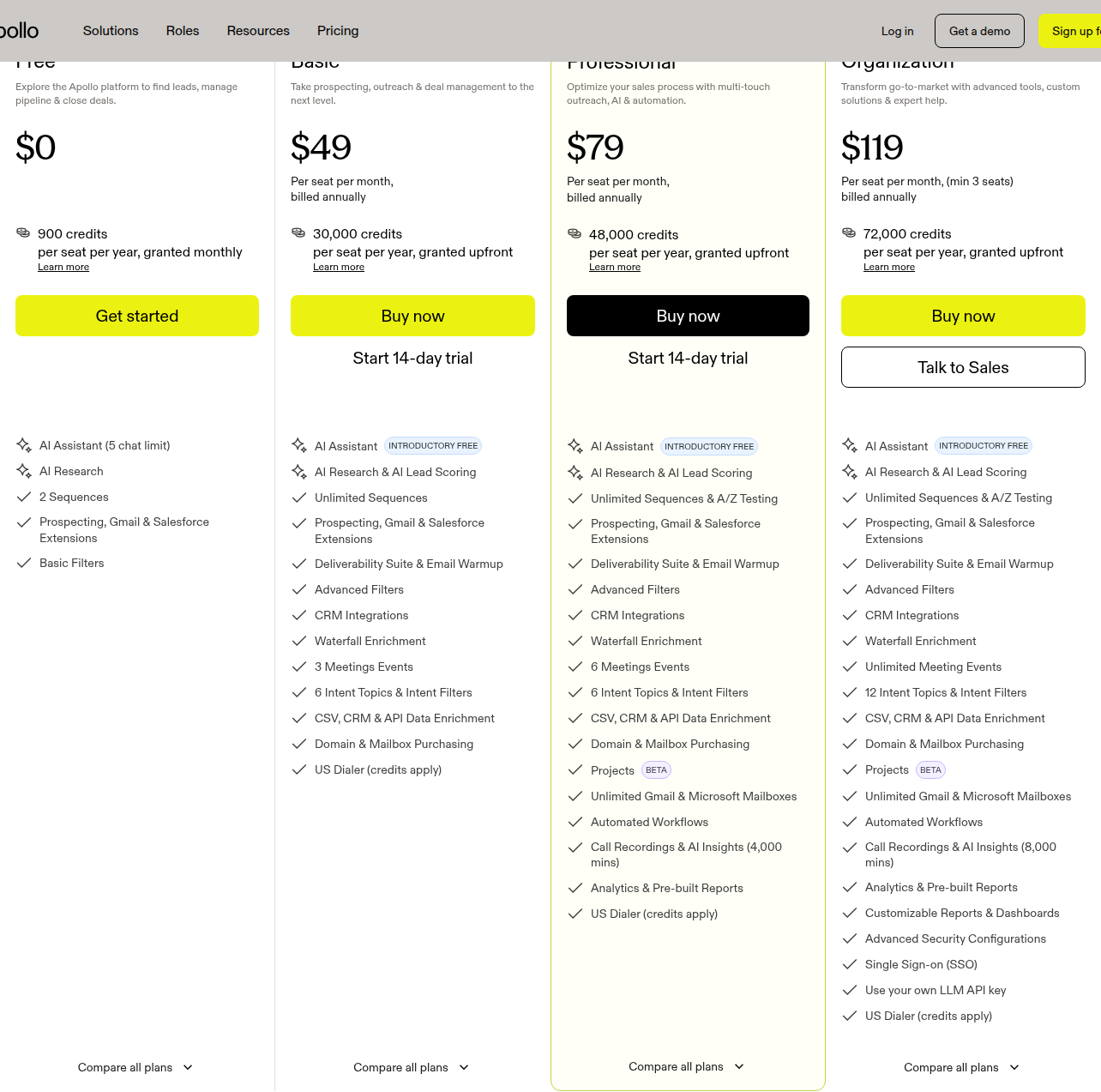
| Plan | Price/seat/mo (annual) | Credits/seat/yr | Key limits |
|---|---|---|---|
| Free | $0 | 900 granted monthly | 25-record selection limit, 250 emails/day, 2 sequences |
| Basic | $49 | 30,000 | Waterfall Enrichment, US dialer, unlimited sequences |
| Professional | $79 | 48,000 | A/Z testing, 50 workflows, 4,000 call mins, 6 intent topics |
| Organization | $119 (min 3 seats) | 72,000 | 12 intent topics, 500 workflows, SSO, 8,000 call mins |
| Add-ons: Inbound (website visitor ID) $119/team/mo; Advanced Dialer $119/team/mo. Record selection limits are the quiet friction point - 25 records at a time on Free means saving 10,000 leads means clicking “select 25” two thousand times. Credits burn on exports: “you consume export credits whenever you export a contact outside Apollo,” per Apollo’s own FAQ. |
Apollo.io Waterfall Enrichment
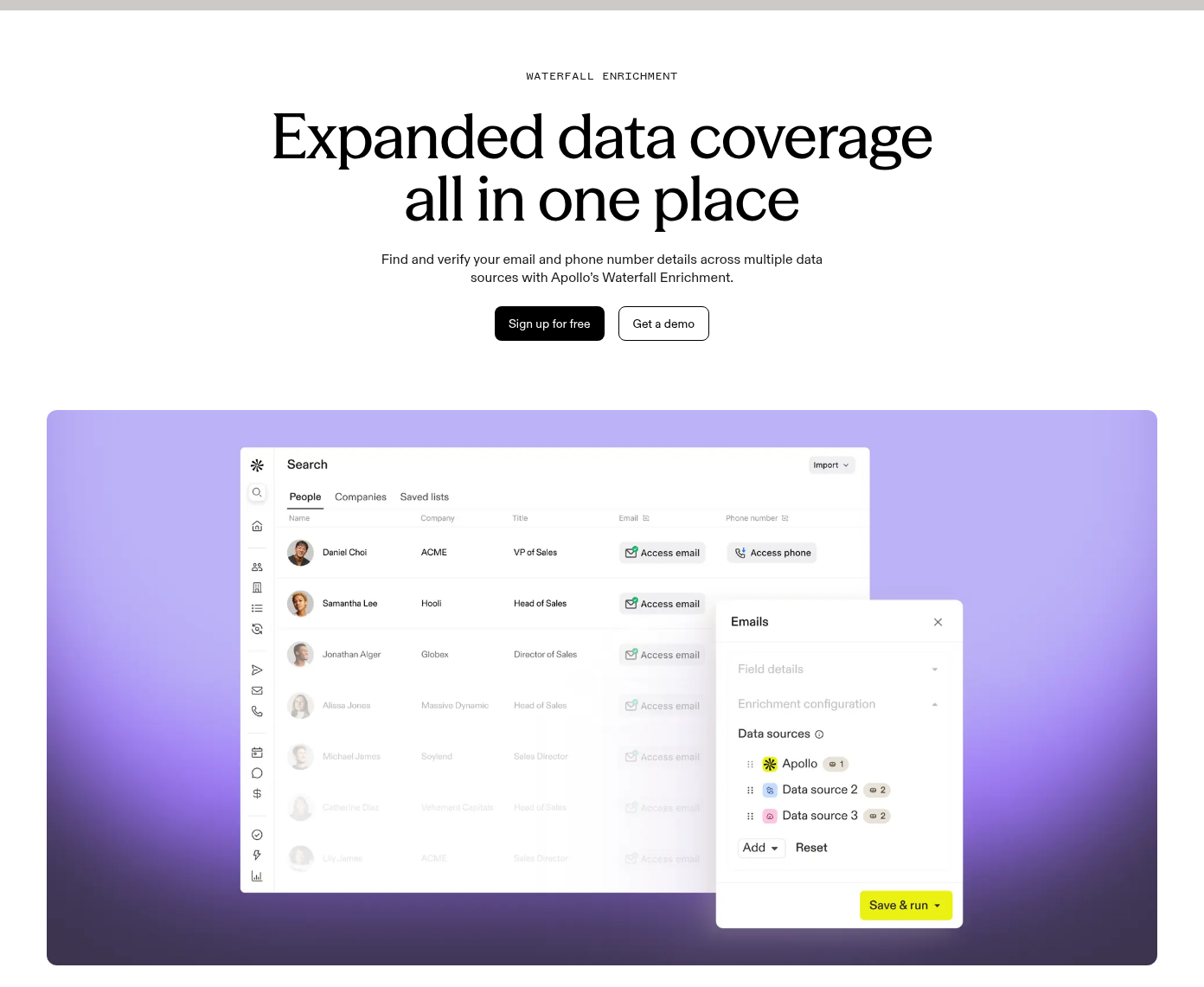
Apollo’s Waterfall Enrichment page claims 5% more email coverage, 7% more phone numbers, and a 45% lower email bounce rate (based on 2 months of beta-customer usage data), by checking “across dozens of data providers one after another.” Users control which sources are included and their order. The partner list overlaps heavily with Cleanlist’s cascade - Wiza, Findymail, Dropcontact, ZeroBounce, and others appear in both products.
This is the honest tension in this comparison: the two tools are no longer different architectures, they are the same architecture with different surrounding products.
Where Apollo.io Wins
- All-in-one consolidation. Database, sequences, dialer, deal tracking, and enrichment under one subscription - a genuine replacement for a 5-tool stack.
- Massive on-hand database. 240M+ contacts for ad-hoc discovery without waiting on provider cascades. Cleanlist’s search hits the waterfall live; Apollo’s is already sitting there.
- Usable free tier. 900 credits/mo forever-free is enough to run real (if volume-capped) prospecting. Cleanlist’s 30-credit sample is not comparable.
- Enterprise maturity. SOC 2 Type II, ISO 27001, GDPR, SSO - Apollo can pass a security review today. Cleanlist cannot show a compliance page yet.
- Intent data. Apollo ships buying-intent signals on paid tiers; Cleanlist has no intent layer at all.
- Affiliate/partner program. Apollo runs a public program (up to 20% commission, first 12 months, via PartnerStack). Cleanlist has no public affiliate program.
Where Apollo.io Loses
- Per-seat pricing escalates fast. Five reps on Professional is $395/mo before add-ons. Cleanlist’s flat pool does not multiply with headcount.
- Credit burn on exports. Moving contacts outside Apollo - CSV, CRM, or Person API sync to Outreach or Salesloft - consumes export credits. The lock-in is real and priced.
- Record selection limits. 25 records at a time on Free; even paid tiers cap selections (1,000 on Basic, 2,500 on Pro) while Cleanlist’s bulk import is unrestricted at 2,500 leads/list.
- Dialer depth costs extra. The advanced dialer is a $119/mo add-on on top of your per-seat bill.
- Platform bloat. The Swiss-army-knife effect: hundreds of features, weeks to configure well. If you only need enrichment, you are paying for a lot of platform you will not use.
- Static database decay history. Apollo’s owned database has a long paper trail of data-decay complaints; its defense is the new waterfall and real-time refresh signals, but the complaints are why the comparison exists.
Head-to-Head: The Dimensions That Matter
The Waterfall Showdown
Cleanlist: 15+ providers in a managed cascade, field-level cross-referencing, SMTP verification before delivery, pay only on verified matches. Apollo: “dozens” of providers, user-controlled source order, built-in validation, included on paid tiers but credits still apply per lookup. Both claim 98%. Cleanlist’s version is provider-managed (set it and forget it); Apollo’s is user-configured (more control, more setup). Neither claim is independently verified.
Pricing Math for a 5-Person Team
- Cleanlist Pro: $172/mo annual, flat, 5 seats included, 5,000 credits/mo shared pool.
- Apollo Professional: $395/mo for 5 seats ($79 x 5), plus 48,000 credits/seat/yr, plus add-ons if you want the advanced dialer or inbound.
For a data-heavy team that already owns a sequencer, Cleanlist wins on cost by a wide margin. For a team that needs the sequencer, dialer, and deal management too, Apollo’s all-in-one price is cheaper than buying Cleanlist + Instantly + a dialer separately - roughly, since Instantly/Smartlead run $30-100/mo on their own.
Database: Own It vs Query It
Apollo’s 240M+ contacts are discoverable in seconds - build a list of every VP of Sales in your region and export it (credits apply). Cleanlist has no such browsing surface; every search is a live cascade. If you prospect broad from cold, Apollo’s database is the advantage. If you already know your target accounts and need verified contacts for them, Cleanlist’s waterfall is built for exactly that.
Accuracy: Two Self-Published 98s
Cleanlist publishes a 500-lead benchmark vs “70-80% email / 30-60% phone” for single-source databases. Apollo publishes a 7-step verification process and its own 98% claim. Both are vendor marketing. The only honest reading: both tools are more accurate than a static database alone, and neither number has been independently confirmed. If accuracy is a make-or-break, test both on your own list before committing.
The Stack Question
Cleanlist is one layer - enrichment - that assumes you already have (or will buy) a sequencer. Apollo is the whole stack. If your stack is already built and only the data is weak, Cleanlist slots in. If you are building from zero, Apollo removes four vendor relationships at once.
Who Should Pick Cleanlist AI?
Pick Cleanlist AI if you already run an email sequencer and the problem is deliverability: bounced lists, stale contacts, low reply rates. The pay-per-match credit model and flat team pricing beat Apollo’s per-seat math for multi-person teams, and the Sales Nav bulk extraction plus pre-built playbooks get you from list to campaign without a GTM engineer. If you have been eyeing Clay but do not want the learning curve, Cleanlist is the same waterfall philosophy at a fraction of the price.
Who Should Pick Apollo.io?
Pick Apollo.io if you are starting from zero and want one platform that finds, enriches, sequences, and dials - or if you need enterprise compliance (SOC 2, ISO 27001) to get procurement to sign. The forever-free tier means you can test real prospecting before paying anything. Teams that prospect broadly from a cold database, or that want intent data and deal management alongside outreach, get more from Apollo’s bundle than from any enrichment-only tool.
Bottom Line
This is a scope decision, not a quality decision. If data quality is your bottleneck and the rest of your stack is in place, Cleanlist AI’s waterfall enrichment at flat, pay-per-match pricing is the better buy - and it is meaningfully cheaper than Apollo for multi-seat teams. If you need the whole motion in one place - database, sequences, dialer, deals - or you need compliance paperwork, Apollo.io is the platform, and its new Waterfall Enrichment closes most of the data-quality gap Cleanlist was built to exploit.
Cleanlist AI is wrong for you if: you have no sequencer yet, you prospect broad from a cold database, you need SOC 2/ISO 27001 for procurement, or you want intent data. You will end up buying Apollo’s features anyway from other vendors.
Apollo.io is wrong for you if: you already own a sequencer and CRM, your team is 3+ reps (per-seat costs multiply), or your only problem is bounce rates and stale data - you would pay for a platform you do not need to fix a problem Cleanlist solves for less.
For the wider landscape, see our Apollo.io vs Clay vs Lev8 comparison and the Fuzzy AI vs Apollo.io head-to-head. If Clay is the one you are actually weighing Cleanlist against, we compare them directly in Cleanlist AI vs Clay. If you want to try Apollo on its free tier, start here (affiliate link). Cleanlist has no affiliate program, so sign up directly if you want to test its 30-credit free tier.