3 August 2026 · Comparison
Cleanlist AI vs Clay: Which GTM Data Tool Wins in 2026?
The short answer
if you want fast, zero-config waterfall enrichment with flat team pricing and no GTM engineer required.
if you need advanced multi-source orchestration, intent signals, custom Claygent research, and a built-in email sequencer.
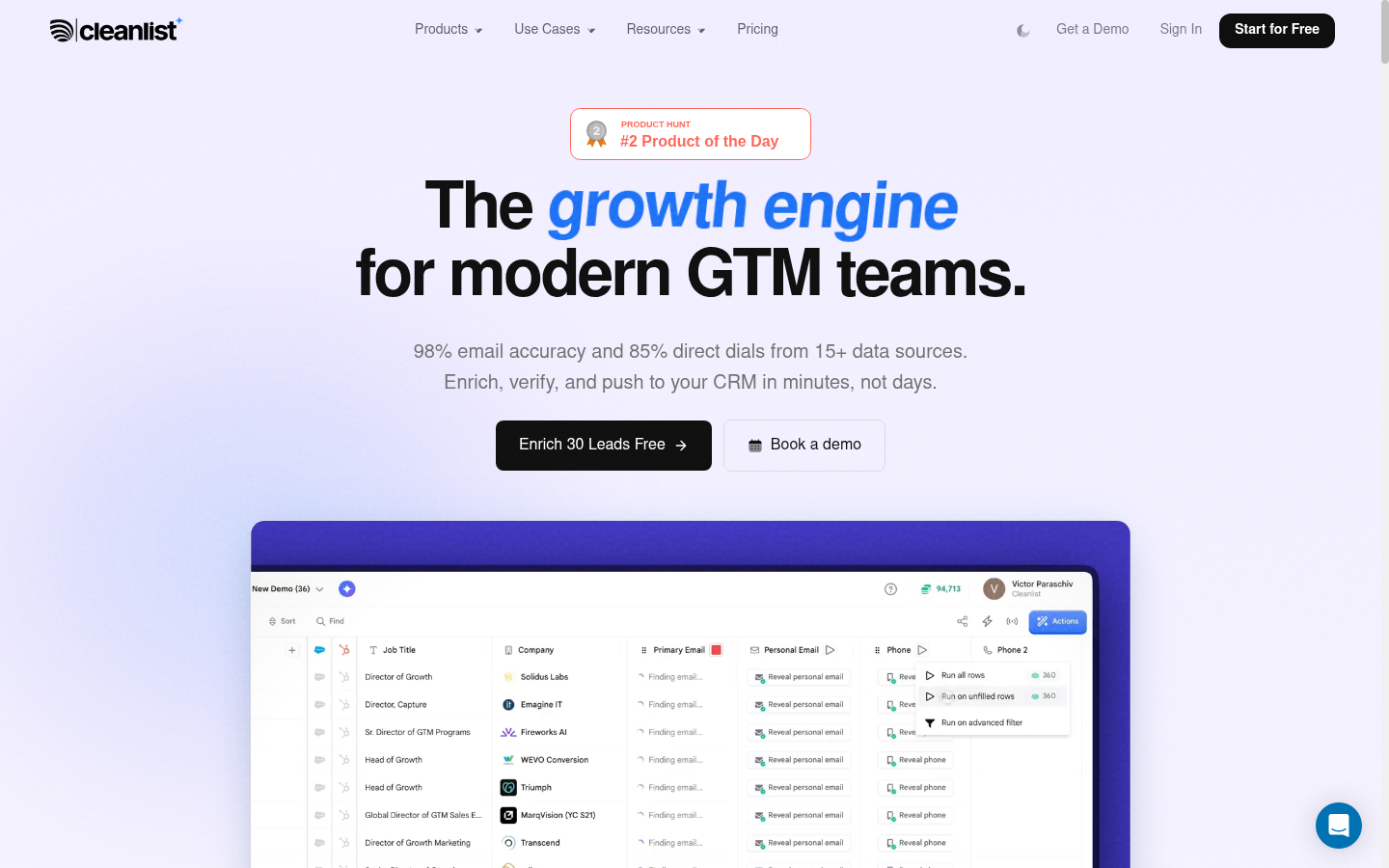
Verdict: Pick Cleanlist AI if you are a founder, SDR, or small team that wants verified emails from a zero-config waterfall in under 10 minutes, already runs a sequencer (Instantly, Smartlead, Outreach), and wants flat pooled pricing where failed lookups cost nothing. Pick Clay if you need complex multi-source orchestration - intent signals, Claygent research, warehouse reverse-ETL, ad audiences - and have the technical bandwidth or a GTM engineer to build and maintain custom tables.
The two tools have converged on the surface: both run multi-provider waterfalls, both ship AI research agents, both gate CRM sync and API access to their upper tiers. The real difference is who operates the data. Cleanlist pre-configures the cascade and charges per verified match; Clay gives you the machinery and expects you to build. Neither is a bad pick, but the wrong one costs you either weeks of setup or a GTM engineer’s salary.
Affiliate disclosure: SaaSpicious may earn a commission if you buy through links in this post. Clay runs a public affiliate program (Clay Creators/Partners, which mentions affiliate revenue on its own partners page); Cleanlist AI has no public affiliate program as of August 2026. This does not affect our verdict - both tools get their honest downsides below.
At a Glance
| Cleanlist AI | Clay | |
|---|---|---|
| Core model | Zero-config waterfall across 15+ providers, pay per verified match | User-built orchestration: tables, waterfalls, agents, execution |
| Email accuracy claim | 98% verified (self-published; docs say 70-85% success rates) | No single accuracy figure - “varies by source” |
| Setup | Pre-built cascade, first list in ~10 minutes (self-reported) | Weeks to master; often needs a GTM engineer |
| Native cold email | No (AI templates only, no sending) | Yes - native Sequencer with warmup, included on Free plan |
| Intent / signals data | None | Job change, company news, social, web intent (Launch/Growth+) |
| Pricing model | Flat credit pool, 1 credit per verified email, $0 on misses | Dual-bucket Actions + Data credits |
| Entry paid plan | Starter $59/mo (annual) | Launch $167/mo (annual) |
| CRM sync / API | Gated to Pro | CRM sync, HTTP API gated to Growth |
| Compliance | No public SOC 2 / ISO 27001 | SOC 2 Type II, ISO 27001, GDPR, CCPA pages |
Prices accurate as of August 2026; check each vendor’s site for current rates.
Why This Comparison Is Tricky in 2026
Clay is the $5B-valuation GTM darling (per NYT DealBook) with a huge community and an ecosystem of agencies, templates, and University courses. Cleanlist AI launched on Product Hunt in late 2025 and positions itself as “Clay without the GTM engineer” - a phrase its own Product Hunt thread validated when buyers asked “is it like a simpler version of Clay?”
But the marketing war has produced some dishonest ammunition. Cleanlist’s own /compare/cleanlist-vs-clay page claims Clay “cannot send cold emails natively.” That is false as of this writing: Clay ships a native Sequencer with mailbox warmup, alias management, domain rotation, and AI copy - and it is listed even on Clay’s Free plan. That fact-check shapes the whole decision below: Cleanlist is a data layer that pairs with a separate sequencer; Clay is a data layer that can also send.
There is also a citation problem worth knowing before you read any “review” of Clay quoted on Cleanlist’s pages. The G2 review of Clay that Cleanlist presents inside a “What Review Sites Say” section was not written by an independent customer - it was authored by Victor Paraschiv, Cleanlist’s own co-founder and COO. Treat any third-party framing on a vendor’s comparison page the way you would treat the vendor’s own marketing, because that is often exactly what it is.
Cleanlist AI: Data Quality as the Whole Product
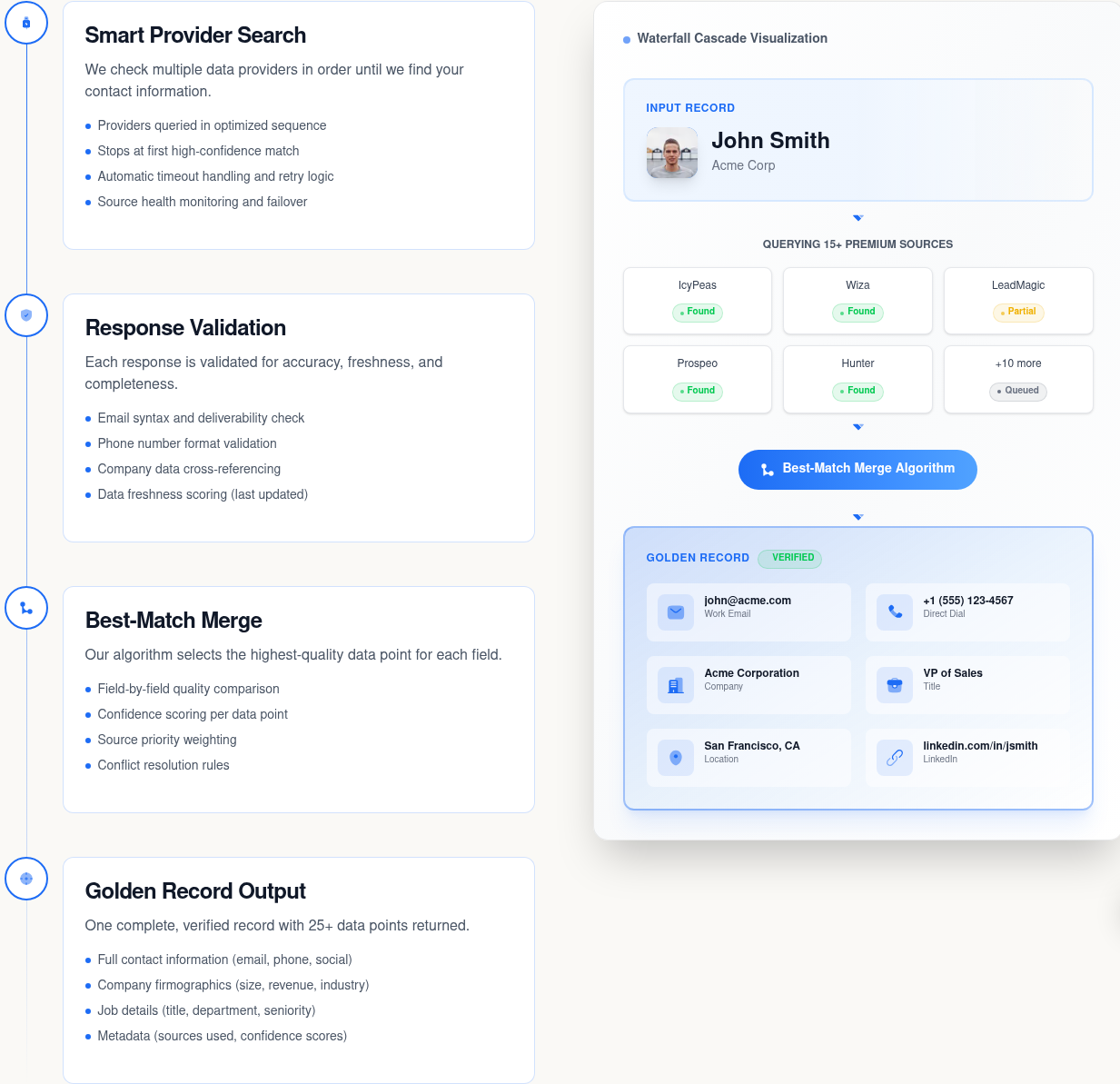
Cleanlist AI (Toronto, founded 2024) is a data-quality engine, not a database and not an outreach tool. Every lookup cascades through 15+ providers (Wiza, Findymail, Prospeo, Lusha, and others) in sequence until a verified result returns, then runs SMTP-level verification before you see the email. The headline claims are 98% verified email accuracy and 85% direct-dial phone coverage, though its own docs state 70-85% email success rates and no independent benchmark exists - three different numbers on the company’s own pages.
The credit model is the differentiator: 1 credit per verified email, 10 credits per verified phone, and $0 charged on failed lookups. You pay for matches, not attempts - the fairest structure in this category, and the reason teams doing burst enrichment get value single-source databases cannot match.
Cleanlist AI Pricing
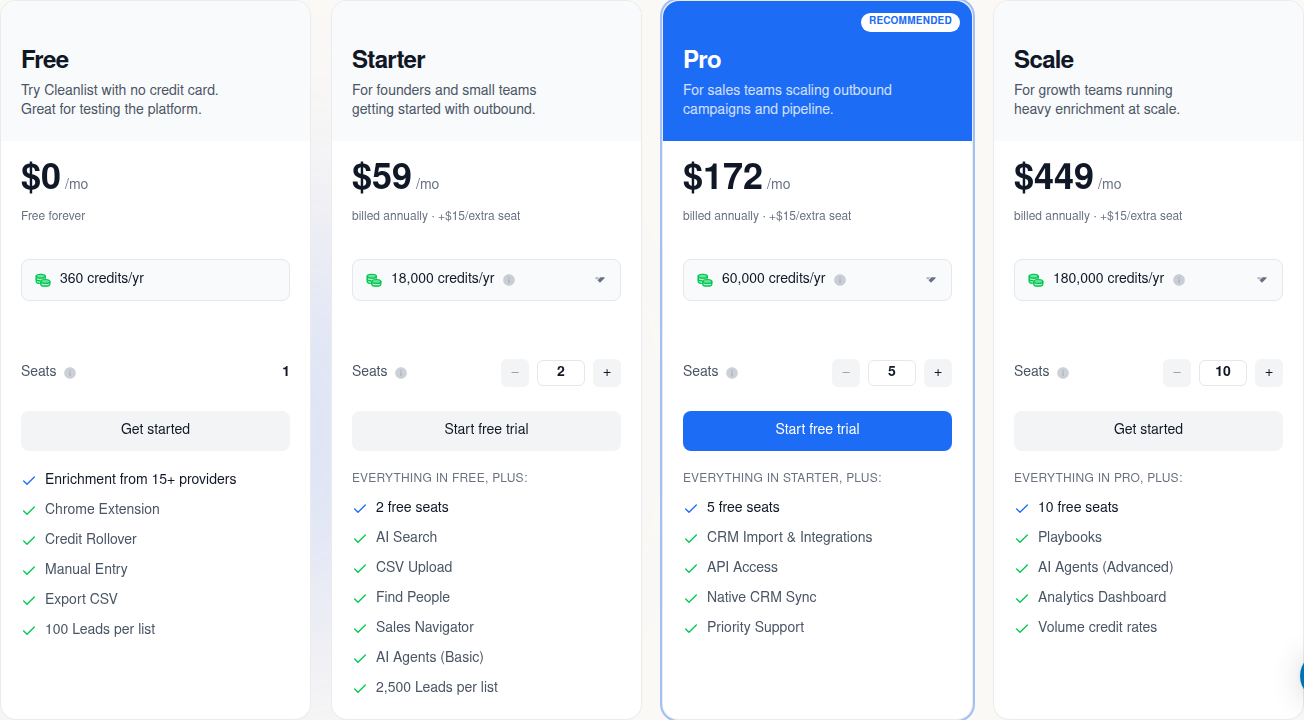
| Plan | Monthly | Annual (billed yearly) | Credits/yr (per mo) | Seats incl. | Leads/list cap |
|---|---|---|---|---|---|
| Free | $0 | $0 | 360 (30/mo) | 1 | 100 |
| Starter | $79 | $59/mo | 18,000 (1,500/mo) | 2 | 2,500 |
| Pro | $229 | $172/mo | 60,000 (5,000/mo) | 5 | 2,500 |
| Scale | $599 | $449/mo | 180,000 (15,000/mo) | 10 | Unlimited |
Two things the pricing page will not tell you. First, the “$59/mo Starter” headline is the annual-billing price - monthly billing is $79/mo, a 25% penalty. Second, credits are quoted per year (18,000/yr) which flatters the monthly reality of 1,500/mo. The plan cards say extra seats cost $15/mo (on annual billing) while the feature-comparison table on the same page says $20/mo (monthly). A “SUMMER25 - 25% off forever” promo banner was still live on the page at capture time despite its “Ends July 31” label.
Where Cleanlist AI Wins
- Zero-config waterfall. The cascade is pre-built and ordered by hit rate and cost. You get a verified list in minutes, not weeks of table setup - and you never see raw function-call XML or provider configuration.
- Pay-per-match economics. 1 credit for a verified email whether it took one provider or nine. Failed lookups cost nothing, which makes burst enrichment predictable.
- Flat team pricing. One shared credit pool, no per-seat escalation. A 5-person team on Starter pays what a solo founder pays.
- Copilot and Smart Agents. Plain-English prompts (“find me 100 founders in NY at companies with 50-200 employees”) chain search, enrichment, and verification - the direct answer to “do I need a GTM engineer?”
- Native Sales Navigator bulk extraction. Up to 2,500 leads per Sales Nav search, versus Clay’s integration-only model.
- Triple-layer email verification (syntax, DNS/MX, SMTP handshake with catch-all and spam-trap detection) on every result, with verification status returned per email.
Where Cleanlist AI Loses
- It cannot send email at all. No sequences, no warmup, no dialer - only AI-generated email templates. You must pair it with Instantly, Smartlead, or Outreach, which is another subscription and another tool to wire up. Clay’s Sequencer makes this pairing unnecessary.
- No owned database. Everything comes from the live provider cascade and cache. You cannot browse an on-hand contact universe the way you can in a database platform.
- Young startup, no enterprise compliance. No public SOC 2 Type II or ISO 27001 certification found on the site or docs. Procurement and security teams will struggle to sign off.
- Accuracy claims are self-published and inconsistent. 98% on the marketing headline, 95%+ in the Product Hunt thread, 70-85% in the docs. No independent third-party benchmark exists.
- Compliance gaps in its own docs. Manual data removal only, no automated prospect-level do-not-enrich suppression, and data provenance is not surfaced in the self-serve UI.
- API and native CRM sync are gated to Pro - a steep jump from Starter for teams that only want HubSpot/Salesforce sync.
- The 2,500-lead cap applies to Pro, not just Starter. Only Scale unlocks unlimited leads per list.
- The free tier is a sample. 30 credits/mo (360/yr) is enough to test, not to run outbound.
Clay: The GTM Infrastructure Platform
Clay is “infrastructure to get any data, run agentic workflows, and launch GTM plays” - the no-code platform trusted by “more than 500,000 GTM teams” (vendor claim) and valued at $5B per the NYT DealBook (2026-01-28). It is a spreadsheet-based workbench: tables hold your data, waterfalls pull from providers you configure, Claygent does web research, and Functions and workflows orchestrate the rest. On top of that sits the execution layer: a native Sequencer and ad-audience syncs.
Clay’s Native Sequencer (The Fact-Check)
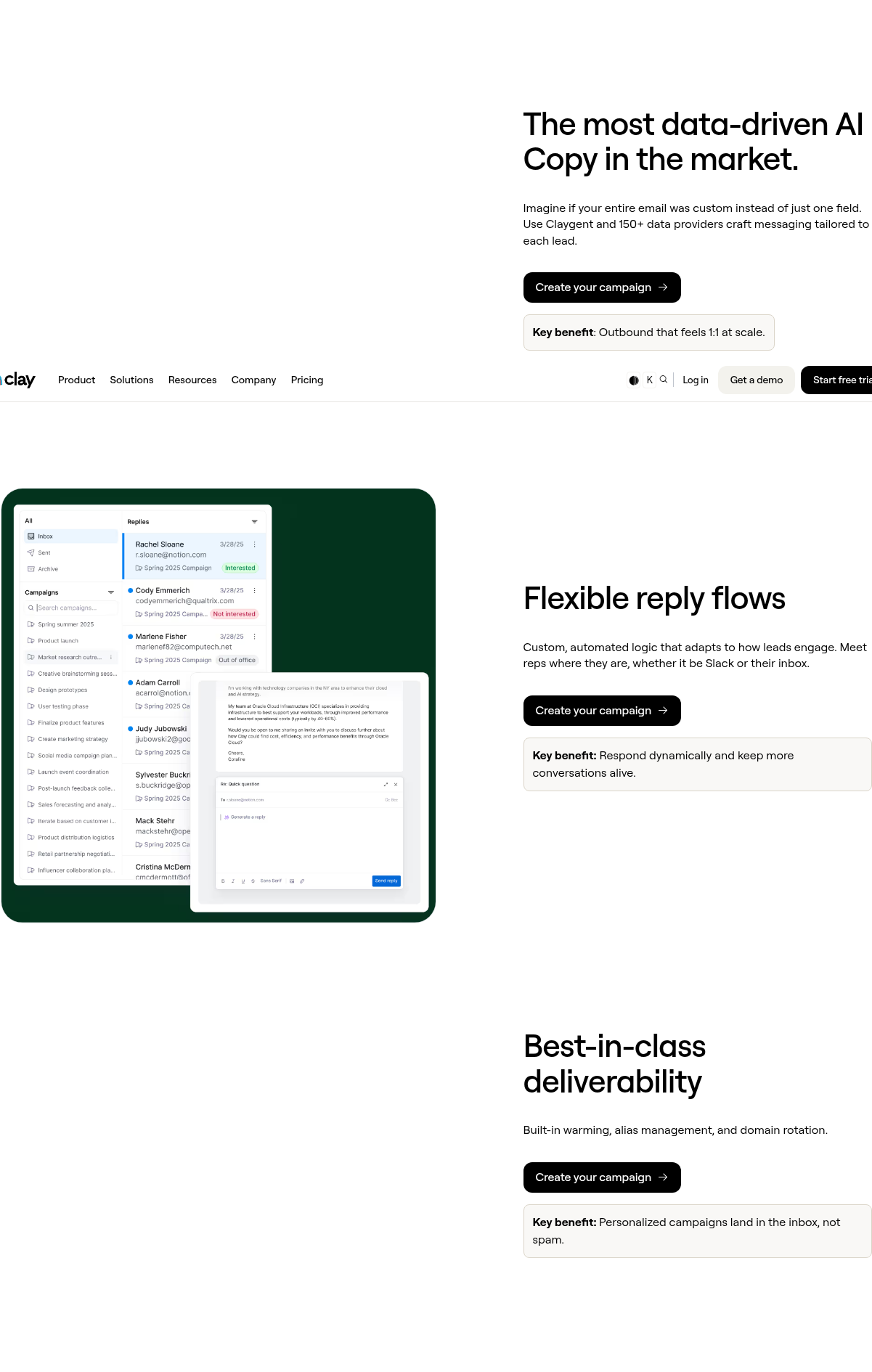
The single most important correction to Cleanlist’s marketing: Clay does send cold email natively. The Sequencer is “the native campaign engine inside Clay” - AI copy via Claygent across 150+ providers, flexible reply flows, and built-in warming, alias management, and domain rotation (“best-in-class deliverability”). It is listed even on Clay’s Free plan: “Send emails with Clay sequencer”. Cleanlist’s own compare page saying Clay “cannot send cold emails natively” is outdated - which matters, because it is the core of Cleanlist’s differentiation claim.
Clay Pricing
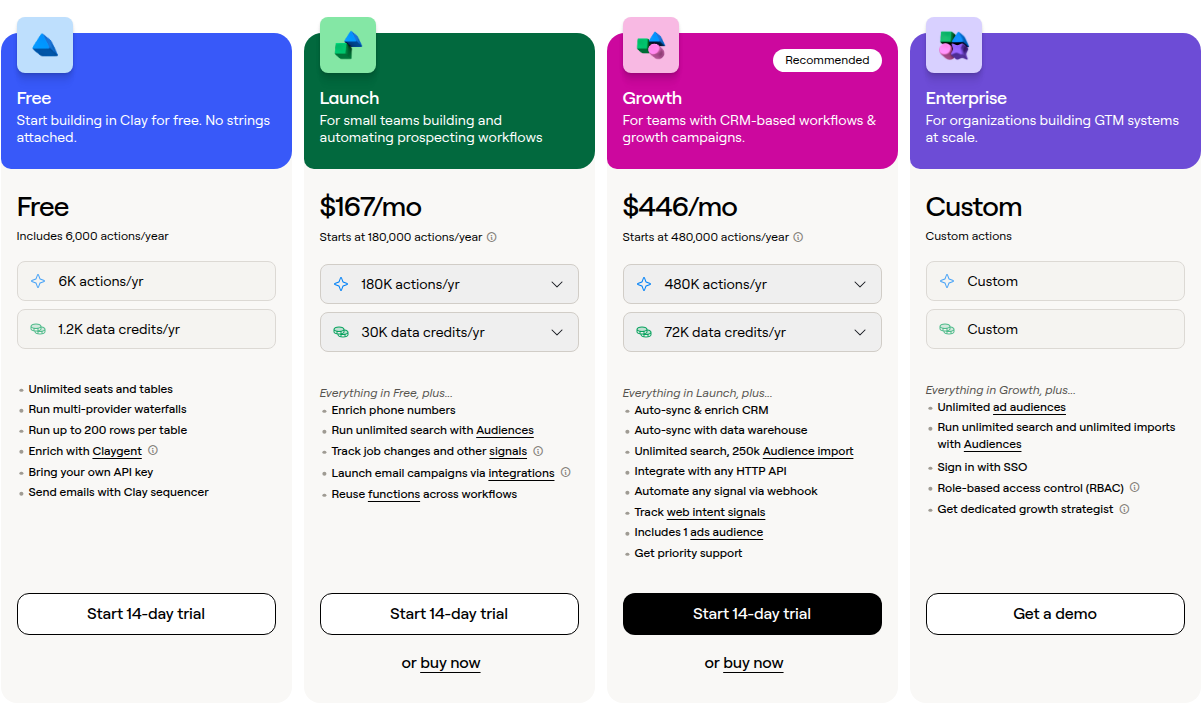
Clay prices in two buckets: Actions (platform/AI/run consumption) and Data credits (third-party provider data). Headline card prices are the annual-billing sum of the base Action pack plus the base Data-credit pack:
| Plan | Headline (annual) | Actions | Data credits | Monthly-billed equivalent |
|---|---|---|---|---|
| Free | $0 | 500/mo (6K/yr) | 100/mo (1.2K/yr) | - |
| Launch | $167/mo | 15K/mo (180K/yr) | 3K/mo (30K/yr) | $185/mo |
| Growth | $446/mo | 40K/mo (480K/yr) | 6K/mo (72K/yr) | $495/mo |
| Enterprise | Custom | Custom | Custom | Custom |
The reconciliation matters: third-party reviews that cite “Clay at $185/mo” or “$495/mo” are quoting monthly billing. The live clay.com page defaults to annual ($167/mo Launch, $446/mo Growth) and shows the monthly equivalents as $185/mo and $495/mo - the sum of the monthly Action pack ($60/$205) and monthly Data pack ($125/$290). No price change is needed to explain the gap; the billing toggle does.
Feature gating is aggressive: phone enrichment sits at Launch ($167/mo annual), while CRM sync, HTTP API integrations, webhooks, web intent signals, warehouse sync, and even a single ads audience all sit at Growth ($446/mo annual). Bulk enrichment over 50K records, unlimited ad audiences, SSO, and RBAC are Enterprise-only. A 14-day free trial exists with no credit card required.
Where Clay Wins
- Provider breadth and marketplace. 150+ enrichment providers and a 200+ provider data marketplace, all under one contract, with the operator choosing the waterfall order and mixing in first-party data, warehouses, and any HTTP API.
- Native Sequencer with a deliverability suite. Warming, alias management, domain rotation, reply flows, and AI copy in one place - Cleanlist cannot send at all and must bolt on a third tool.
- Signals and intent data. Job-change, promotions, new-hire, company news, social listening, and web intent - Cleanlist has no intent layer whatsoever.
- Claygent custom research. Build agents that research companies, fill forms, and pull web data - deeper than Cleanlist’s agents for non-database research.
- Execution layer beyond email. Ads audience syncs to LinkedIn/Meta/Google, reverse-ETL to warehouses (Snowflake, Fivetran, Postgres, Databricks, BigQuery), Functions, and MCP for reps.
- Maturity and trust. $5B valuation, 500K+ teams, deep case-study roster (OpenAI, Anthropic, Rippling, Intercom, Figma), a massive community and University ecosystem - and SOC 2 Type II, ISO 27001, GDPR, and CCPA pages for procurement.
- A genuine free plan. Free tier includes unlimited seats and tables, waterfalls, Claygent, BYO API key, and Sequencer sending - a real sandbox, not a credit sample.
Where Clay Loses
- Steep learning curve. Spreadsheet-based orchestration takes weeks to master and often demands a dedicated GTM engineer or technical operator. The “simpler version of Clay?” question on Cleanlist’s PH thread is the exact buyer pain this comparison answers.
- Cost unpredictability. The dual-bucket Action + Data credit system burns credits fast while building, testing, and debugging workflows. Reviews consistently flag that credit-based pricing “can become expensive at scale, especially for heavy AI agent usage.”
- Aggressive feature gating. Phone enrichment requires Launch ($167/mo annual); CRM sync, HTTP API, webhooks, web intent, Ads, and warehouse sync require Growth ($446/mo annual); bulk enrichment and RBAC require Enterprise. The useful stuff is expensive.
- No accuracy guarantee. Clay publishes no single accuracy figure - quality depends entirely on which providers you configure and in what order. That is Cleanlist’s attack vector, and it is fair.
- High entry price. $167/mo annual ($185 monthly) for Launch is steep for solo founders and early-stage SDR teams - Cleanlist’s Starter is $59/mo annual ($79 monthly).
- Setup burden is on you. Waterfalls, columns, and dedup logic are user-built. Get the configuration wrong and your data quality is wrong with it.
Head-to-Head: The Dimensions That Matter
Waterfall: Managed vs Self-Built
Both tools run waterfalls. Cleanlist’s is pre-configured, ordered by hit rate and cost, and stops at the first confident match - you pay 1 credit for a verified email whether it took one provider or nine. Clay’s waterfall is user-configured: you choose providers and order, which gives control and also gives you the failure mode - data quality depends on your setup. If you want the data without the engineering, Cleanlist’s model wins. If you want to control exactly which sources feed your pipeline, Clay’s does.
Execution: Can You Send?
This is where the marketing gets dishonest and the tools diverge most. Clay ships a native Sequencer (Free plan and up) with warmup, alias management, and domain rotation, plus ad-audience syncs and reverse-ETL. Cleanlist ships AI email templates - it cannot send a campaign. A Cleanlist buyer needs Instantly/Smartlead/Outreach on top, which is another bill and another integration. The honest version of the “Clay without the GTM engineer” pitch is: “Cleanlist is the data layer, you still bring the sequencer.”
Intent Data
Clay has signals and intent: job changes, promotions, new hires, company news, social listening (Launch+) and web intent (Growth+). Cleanlist has no intent data at all. If trigger-based outbound is your motion, Clay is the only one of these two that can do it.
Pricing Math for a 3-Person Team
- Cleanlist Starter: $59/mo annual, flat, 2 seats included, 1,500 credits/mo shared pool, $15-20 per extra seat.
- Clay Launch: $167/mo annual, 15K actions/mo + 3K data credits/mo. Adding CRM sync, HTTP API, or web intent pushes you to Growth at $446/mo annual.
For a data-only workflow with a sequencer already in place, Cleanlist wins on price by a wide margin. For a team that wants data + sending + intent in one platform, Clay’s Launch plus Growth features is a different budget conversation - but so is buying Cleanlist plus Instantly plus a separate intent tool.
Accuracy: One Self-Published Claim vs None
Cleanlist publishes 98% (marketing), 95%+ (PH thread), 70-85% (docs) - three numbers, no independent benchmark. Clay publishes no single figure at all, which is honest about the aggregation model but means the operator owns the outcome. Neither number should be taken on faith; test both against your own list before committing.
Who Should Pick Cleanlist AI?
Pick Cleanlist AI if you already run a sequencer and your bottleneck is data quality - you want verified emails without configuring providers, and flat pooled pricing where misses cost nothing. It is the pick for founders and SDR teams that looked at Clay, saw the learning curve, and decided they do not want to hire a GTM engineer. You get from CSV to a verified list in minutes, with triple-layer email verification and Sales Nav bulk extraction, at roughly a third of Clay’s entry price.
Who Should Pick Clay?
Pick Clay if you are building GTM infrastructure, not just fixing a data problem. If you need intent signals, custom Claygent research, warehouse reverse-ETL, ad audiences, or an all-in-one platform with a native Sequencer - or if procurement needs SOC 2 paperwork - Clay is the platform, and its 500K+ team ecosystem means templates and agencies exist for everything you cannot build yourself. Budget for the learning curve: plan a week of setup, not an afternoon.
Bottom Line
This is an architecture decision: managed pay-per-match data (Cleanlist) versus self-built orchestration plus execution (Clay). Cleanlist AI is the better buy for small teams that already own a sequencer and want zero-config waterfall enrichment with flat team pricing - and it is roughly a third of Clay’s entry price. Clay is the better buy when the motion needs sending, intent, agents, or warehouse integration in one platform, and when you have the operator bandwidth to run it.
Cleanlist AI is wrong for you if: you have no sequencer yet, you want intent signals, you need to send campaigns from the same tool, or your procurement requires SOC 2/ISO 27001 - you will end up buying Clay’s features from other vendors anyway.
Clay is wrong for you if: you are a solo founder or small SDR team that just needs verified emails fast, you already run Instantly or Smartlead, and you do not have someone to own a spreadsheet-based platform - you will pay for machinery you do not have time to operate.
For the wider landscape, see our Cleanlist AI vs Apollo.io comparison, the Apollo.io vs Clay vs Lev8 head-to-head, and the Fuzzy AI vs Apollo.io comparison. One more note: the two tools are not strictly rivals - Cleanlist markets its own API/MCP server for use inside Clay tables, so Clay power users can bolt Cleanlist’s pay-per-match cascade onto their existing workflows. If you want to try Clay, start with its 14-day trial (affiliate link). Cleanlist has no affiliate program, so sign up directly if you want to test its 30-credit free tier.