13 October 2026 · Comparison
GenPage vs Unbounce: 1:1 AI Pages vs Dedicated CRO
The short answer
if you need to generate personalized landing pages at scale for outbound or ads.
if you need pixel-perfect design control and mature A/B testing on a single page.

Pick GenPage if your bottleneck is the number of pages, not the quality of one. It generates a separate landing page for every account, lead, keyword, or ad group, pulls from lead lists or ad accounts, and tracks visits at the lead level. Pick Unbounce if your bottleneck is converting the traffic you already have to one page. It is a 15-year-old CRO platform with a precise builder, server-side A/B testing, and AI traffic routing, and it is the safer bet for a team that needs design control and proven experimentation.
They are not two versions of the same product. One multiplies pages. The other perfects one. If you do not run outbound, ABM, or granular paid campaigns, GenPage’s whole pitch is mostly academic, and Unbounce is the tool that does more per page.
Affiliate disclosure: Some links in this post are affiliate links. If you click through and buy, we may earn a commission at no extra cost to you. GenPage runs a 30% recurring affiliate program; Unbounce offers partner options. This does not change the analysis. Both tools get a full “Where It Loses” section below, and every price, cap, and limit here is marked for verification against the live vendor pages before publishing.
GenPage vs Unbounce At a Glance
Prices, caps, and limits below are the figures we read off both vendors’ public pricing pages on 2026-10-13. Each is tagged for a final check before publish.
| GenPage | Unbounce | |
|---|---|---|
| Core job | Generate one page per account, lead, keyword, or ad | Build and optimize one page for incoming traffic |
| Build model | AI generation from a prompt, URL, or lead list | Pixel-precise drag-and-drop builder |
| Personalization | Account/lead/ad-level AI, full-page copy and layout | Dynamic Text Replacement (swaps a word or phrase) |
| Lead list / outbound | CSV, Clay, Apollo, HeyReach, Smartlead, Sheets, CRM import | Not supported |
| Experimentation | Autopilot in private beta | Server-side A/B tests + Smart Traffic AI |
| Analytics granularity | Per-lead visits, heatmaps, session replays, real-time alerts | Aggregate page and conversion stats |
| Seats | Unlimited from Pro | 1 to 5 on standard tiers |
| Pricing meter | Credits (generation, publishing, enrichment) | Monthly unique visitors, with overage |
| Free plan | Free: $0, 100 credits/mo | No free tier; 14-day trial |
| Entry paid plan | Pro: $79/mo | Starter: $29/mo ($22/mo annual) |
| Visitor caps | None; pages stay live after credits run out | 500 to 50,000 visitors/mo by tier |
| Template library | Built around AI generation from prompts and URLs rather than a deep pre-built catalog | 100+ native templates |
| Company | Founded July 2024, pre-seed | Founded 2009, acquired Insightly July 2024 |
The Real Difference Is the Job, Not the Feature List
Unbounce is built around a single destination. You design one page, drive paid search or social traffic to it, split the traffic across variants, and let Smart Traffic push each visitor toward the version most likely to convert them. Everything the product does assumes one URL doing the heavy lifting.
GenPage inverts that. Instead of one page, it generates many: one per named account, one per ad group, one per keyword, one per imported prospect. The homepage headline is literally “Launch Marketing Landing Pages at AI Speed,” and the supporting copy says it builds “dedicated pages for every ad, keyword, or target prospect.” You feed it a prompt, your website URL, an ad account, or a lead list, and it produces page variants with tailored copy, proof points, and CTAs.
That difference decides most of the rest of this comparison. The two products only overlap on the surface, where both let you build a landing page and see how it converts.
GenPage: Generation at the Account Level
GenPage is best understood as an outbound and paid-campaign tool that happens to output landing pages. The core loop is import, enrich, generate, track. You bring lead lists through CSV, Clay, Apollo, HeyReach, Smartlead, Google Sheets, or a CRM integration, or you connect Google Ads and LinkedIn Ads (Meta is on the roadmap). It enriches those accounts with live signals, then generates a page per record.
The personalization is not keyword swapping. It is full-page adaptation: different copy, layout, proof points, and CTAs per account or audience. A Research Agent and AI Variables Agent create reusable variables from things like funding news, hiring, or tech stack, so each page reflects something real about the target. On the analytics side, it tracks per-prospect visits and engagement, and can fire real-time alerts into Slack, Gmail, or Microsoft Teams when a named account shows up.
Generation is metered in credits rather than traffic. Publishing a variant costs 1 credit, 10 AI enrichments cost 1, and generating a page varies with the model and complexity. Published pages stay live indefinitely, and running out of credits does not take them down. You can top up at any time: 100 credits for $25, 500 for $99, 1,000 for $179, or 3,000 for $479. Seats stop being a constraint early, since Pro and above include unlimited user seats.
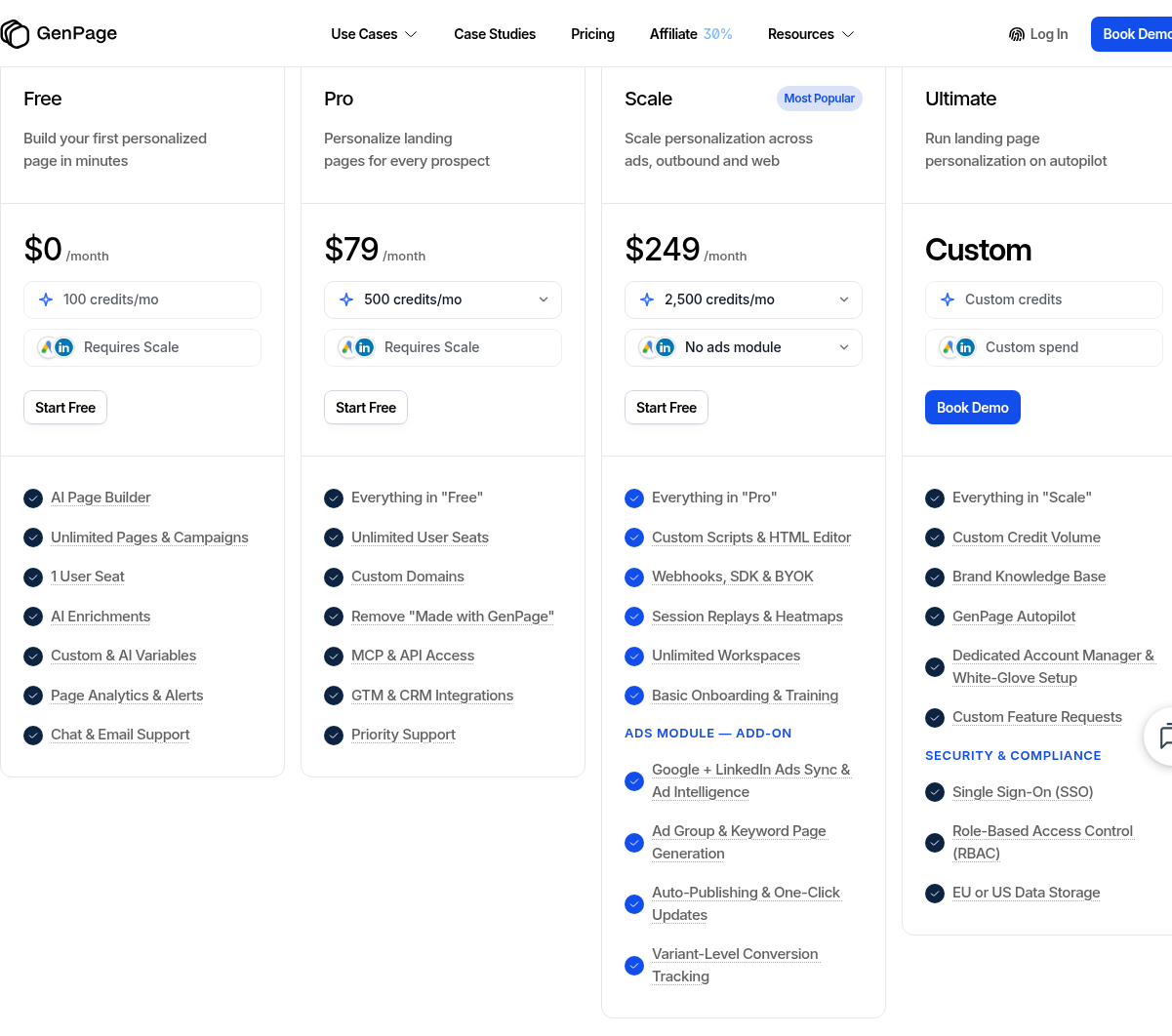
The plans run Free at $0 with 100 credits a month, Pro at $79 a month with 500 credits, and Scale at $249 a month with 2,500 credits, with custom credit volumes on Ultimate. Billed yearly, the site advertises “2 Months Free”. There is also an Ads module sold as a Scale-tier add-on; get a current quote from the vendor, since its public pages do not state a clear price.
GenPage publishes scale and outcome claims: “3,400+ teams,” “200K+ pages created,” “30%+ conversion lift,” and a case study citing “$550K pipeline generated.” These are vendor-reported marketing numbers, not independent benchmarks, and the team counts differ across the vendor’s own pages. We repeat them as claims, not results.
Where GenPage Loses
- It is a young, pre-seed company. GenPage was founded in July 2024 and lists a team of 1 to 10 people. Against a competitor founded in 2009, that is a real durability and support-depth risk, not a formality. You are betting on a small team to keep shipping.
- The credit model is genuinely confusing. Publishing, enriching, and generating all burn credits at different rates, and generation “varies with the model and complexity”. The entry allowances are small. An active outbound team can drain 500 credits a month faster than the sticker price suggests, and then the real cost is top-ups.
- No mature A/B testing today. The autonomous variant testing (Autopilot) featured in its own 3.0 launch is in private beta. If you want traditional hypothesis-driven split tests with confidence scoring, you cannot run them here right now.
- No deep pre-built template library. GenPage leans on AI generation from a prompt or URL rather than a large catalog of ready-made designs, while Unbounce pairs its 100+ native templates with a marketplace as a stronger starting point when you want a specific look. AI generation covers a lot of ground, but it is not a substitute for a deep starting library.
- Reported mobile-rendering quirks. An independent review and AppSumo user feedback flag occasional mobile styling and alignment issues when pages are generated from complex desktop prompts. Treat this as reviewer-reported, not something we tested.
- It needs an existing motion. If you are not running outbound, ABM, or granular ad sets, there is little to personalize. On a plain inbound site, GenPage is a more expensive way to build the same single page.
- Less pixel-level design control. It supports HTML import and custom scripts on Scale, but it is not the precision visual editor that a design-led team wants for one flagship page.
Unbounce: The Mature CRO Engine
Unbounce has been selling landing pages since 2009, and the product reflects that maturity. The builder is a clean drag-and-drop editor with a broad template library and a separate third-party marketplace, plus custom code, custom fonts, popups, sticky bars, and multi-step forms.
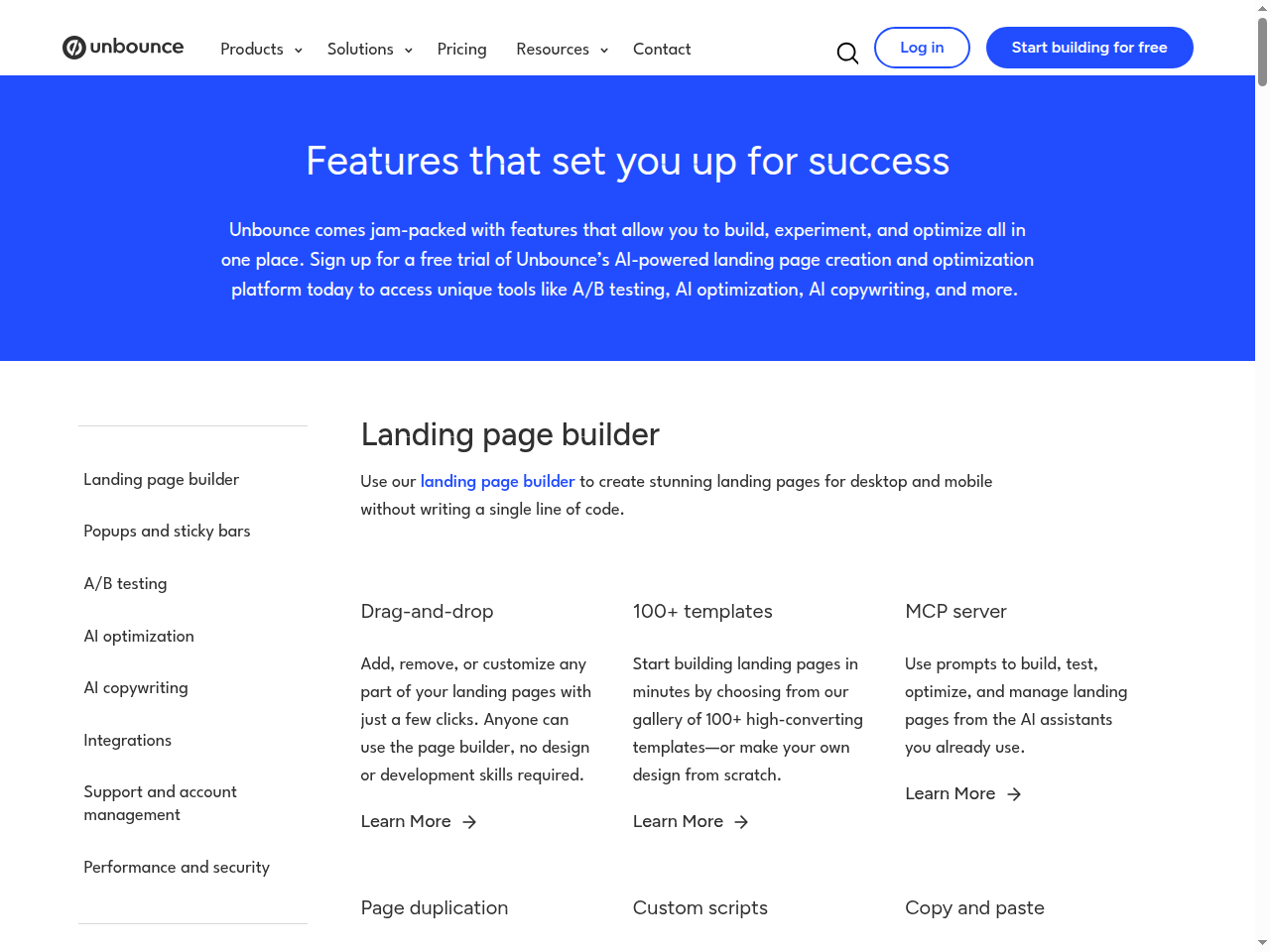
The differentiation is the optimization layer. Server-side A/B testing loads variants without flicker, supports manual traffic allocation, and reports confidence intervals. Smart Traffic, its AI routing, sends each visitor to the variant that fits their device, location, browser, and behavior, and the vendor claims it can start optimizing from as few as 50 visits. Both of those features sit behind higher tiers, which is the central catch.
Unbounce is also an enterprise-grade operation in ways GenPage simply cannot claim yet: published compliance coverage including GDPR, CCPA, CASL, and PCI-DSS, multiple global data centers, and role-based permissions with SSO on higher plans. For a regulated or procurement-heavy buyer, that maturity is often the whole decision.
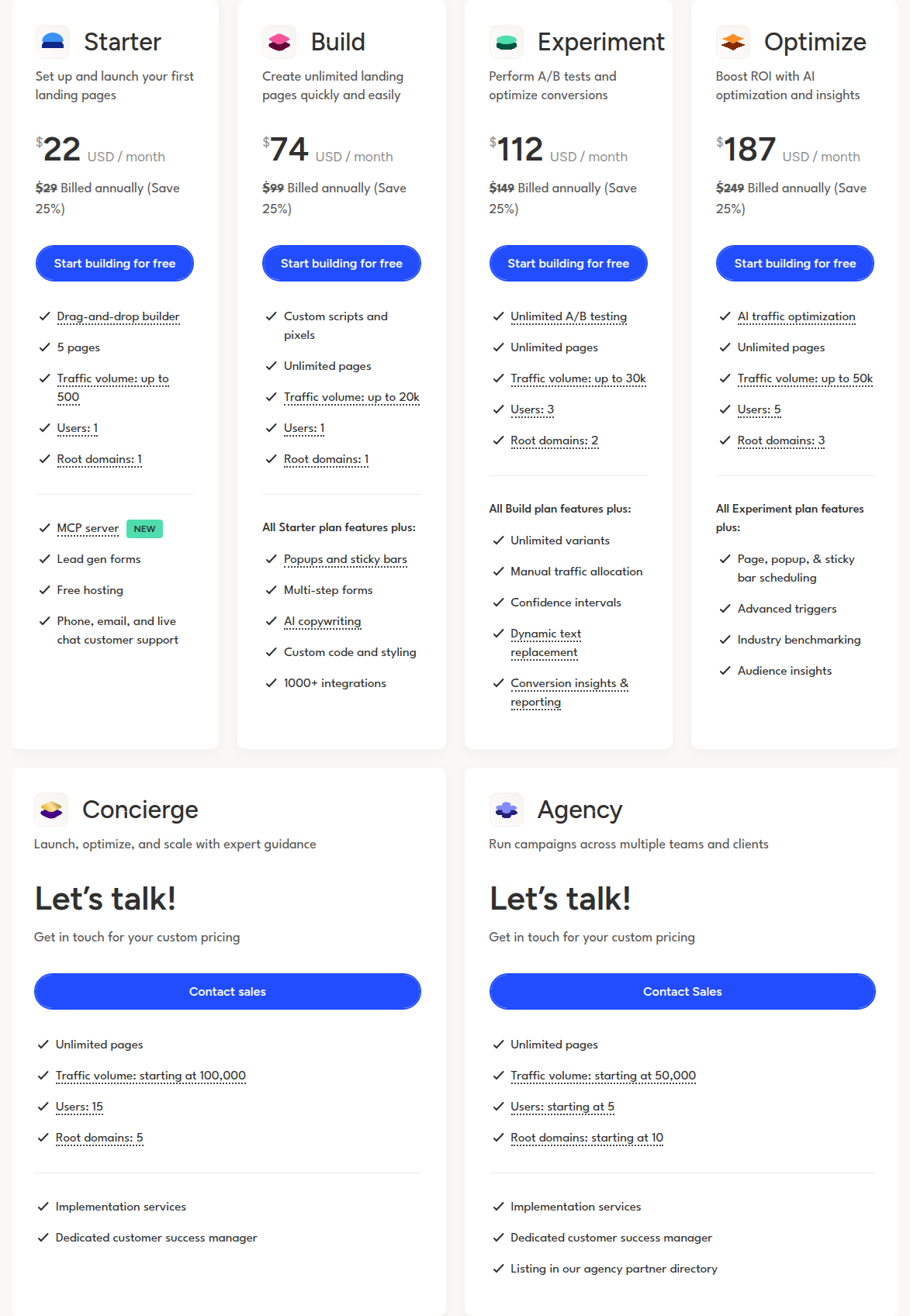
The tiers are metered by monthly unique visitors, and that cap is the number to watch. Starter runs 5 pages, 500 visitors, 1 user, and 1 root domain. Build gives you unlimited pages but 20,000 visitors and still 1 user. Experiment (30,000 visitors, 3 users) is where unlimited A/B testing and Dynamic Text Replacement unlock. Optimize (50,000 visitors, 5 users) is where Smart Traffic and audience insights live. Concierge and Agency are custom plans starting at 100,000 and 50,000 visitors respectively. Overage is a one-time charge based on the extra traffic while your pages keep running. The trial is 14 days with no credit card required, but there is no permanent free tier.
Where Unbounce Loses
- Visitor caps and overage fees on every tier. Your bill rises with your success. When a campaign takes off, you either upgrade or pay overage. GenPage’s published pages do not incur per-visitor charges at all.
- The features you actually want are gated high. A/B testing and Dynamic Text Replacement start at Experiment ($149/mo), and Smart Traffic requires Optimize ($249/mo). The cheap tiers are essentially a page builder.
- Seats are tight. Starter and Build allow a single user; Experiment allows 3; Optimize allows 5. Unlimited seats require custom plans. GenPage includes unlimited seats from $79/mo.
- No outbound or ABM workflow. Unbounce cannot import a lead list or generate a page per named account. It optimizes for traffic arriving at one URL, full stop.
- Aggregate analytics only. You get page and conversion reporting plus Smart Traffic insights, but no per-prospect visit tracking, no native heatmaps, no session replays, and no real-time “this target account just visited” alert.
- Personalization is modest. Dynamic Text Replacement swaps words based on query parameters; it is not full-page adaptation per account, and it is paywalled.
- No permanent free tier. A 14-day trial is the only way to try it without paying.
Pricing Mechanics: Credits vs Visitors
The pricing models are where the two tools actually diverge most for a growing team, so it is worth being blunt.
Unbounce charges for traffic. A “visitor” is a unique person who views a page, popup, or sticky bar at least once a month, deduplicated by cookie, and every standard tier has a ceiling. If you buy 30,000 visitors and your campaign delivers 45,000, you pay an overage for the extra. That is predictable when traffic is stable and painful when a campaign unexpectedly works. It is also worth remembering that an A/B test spends traffic on research: a 50/50 split means only half your visitors ever see each variant, and you paid for all of them.
GenPage charges for generation. Credits are spent when you generate a page, publish a variant, or run enrichments; they are not spent when someone visits a page. Published pages keep serving traffic for free, even after your credits are exhausted. The trade is the opposite risk: no traffic bill, but a metered generation budget you have to plan, and a per-credit price that is higher if you buy in small top-ups rather than upgrading the plan.
For a single high-traffic page, Unbounce’s model is the one that can get expensive, and it is a big part of why unlimited-traffic alternatives have gained ground. If traffic cost is your main worry, it is worth reading our Onepage vs Leadpages comparison, where Leadpages drops traffic caps entirely and bundles A/B testing lower down the price ladder. For teams whose real problem is that one page is not enough, GenPage removes the per-visitor question altogether.
Experimentation and Maturity
This is Unbounce’s clearest win. Server-side A/B testing with confidence intervals and an AI router that learns from small samples is a mature product, and it is the kind of rigor that a growth team builds processes around. If your job is to run disciplined experiments on a known page, start with Unbounce. If you want to see how the same feature set is gated and priced across the two biggest names in CRO, our Instapage vs Unbounce comparison breaks down where each one hides A/B testing and AI routing behind a paywall.
GenPage’s equivalent, Autopilot, is still in private beta. That is not a knock on its direction; it is a statement of what you can buy today. A team that needs proven experimentation should not adopt GenPage on the promise of a beta feature.
On maturity, Unbounce is the incumbent. Fifteen-plus years of operation, published compliance, and a large review base are hard to argue with. GenPage’s counter is speed and price on a specific job. Both of those claims are real, and neither one is a substitute for the other.
Who Should Pick What
Pick GenPage if:
- You run outbound sales, ABM, or granular paid campaigns and every account or keyword needs its own page.
- You import lead lists from CSV, Clay, Apollo, HeyReach, or Smartlead and want a page generated per record.
- You want per-lead visit tracking, heatmaps, session replays, and real-time Slack or Teams alerts when a target shows up.
- Per-visitor pricing is the thing that has burned you, and you want published pages to stay live without a traffic meter.
- You need unlimited seats without an enterprise contract.
- You can live without a mature A/B testing suite for now, and you are comfortable with a young vendor.
Pick Unbounce if:
- You drive inbound paid traffic to one high-converting page and want to perfect that page.
- You need pixel-level design control and a deep template library as your starting point.
- Server-side A/B testing with confidence intervals and AI traffic routing are core to how you work.
- You need a vendor with a long track record, published compliance, and enterprise controls like SSO and role-based permissions.
- Your traffic is predictable enough that visitor caps are a manageable line item.
- You do not need lead-list import or per-account page generation.
Bottom Line
GenPage is the pick for teams whose bottleneck is page volume. If you run outbound or granular ad campaigns and every lead or keyword needs a dedicated page, GenPage generates them at a scale Unbounce cannot match, tracks them at the lead level, and does not charge you by traffic. It is the wrong tool if you do not run those motions, if you need proven A/B testing today, or if you want the comfort of a long-established vendor. It is also a young product with a credit model you have to learn, and both of those are real costs, not footnotes.
Unbounce is the pick for teams whose bottleneck is conversion on one page. It is the more mature platform, with the better builder, the deeper template library, and the only one of the two with a real experimentation engine right now. It is the wrong tool if you need to generate pages per account, import lead lists, or avoid per-visitor costs, and its best features are locked behind $149 to $249/mo tiers.
If you want to compare how these two fit alongside other landing-page options, our Onepage vs Carrd comparison covers the cheap-and-simple end of the market, and if your GenPage pipeline depends on clean contact data, our Cleanlist vs Apollo comparison covers the enrichment layer that feeds it. For design-led site building rather than conversion pages, see Framer vs Webflow.
Prices accurate as of October 2026; check vendor sites for current rates.