2 July 2026 · Comparison
Mailwarm vs Warmy: Which Email Warmup Tool Wins in 2026?
The short answer
Mailwarm publishes real pricing tiers and a 50,000+ inbox network. Warmy counters with a named AI engine and Google Postmaster data.
Affiliate disclosure: We may earn a commission if you buy through Mailwarm links on this page, at no extra cost to you. We check every price against the vendor’s own live pricing page and say when we checked, and the verdicts below include every tool’s genuine weaknesses.
Email deliverability is not a feature you bolt onto your outreach stack. It is the foundation the stack sits on, and if your messages land in spam, no amount of personalization, sequencing, or CRM plumbing rescues the campaign. Two standalone, premium deliverability tools have carved out the high end of this market in 2026: Mailwarm and Warmy. They are the natural head-to-head for senders who have outgrown the “warmup as an add-on” bundled inside Instantly, Smartlead, or lemlist. (For how that bundled warmup stacks up between two of those platforms, see our BrandJet vs Instantly comparison: Instantly wins on cold-email scale and a 1M+ account warmup pool, BrandJet on multi-channel outreach and AI-brand monitoring.) (If your deliverability problems start further upstream, in the ESP itself, see our Brew vs Mailchimp comparison or Kit vs Mailchimp for newsletters.)
The short version: pick Mailwarm if you want the largest transparently-broken-down real-inbox network, published plan pricing you can see before you sign up, live per-provider inbox-vs-spam placement tracking, and a human deliverability audit as your entry point. Pick Warmy if you want a named AI engine (Adeline) that personalizes warmup per mailbox, native Google Postmaster data, multi-language and industry-specific warmup, and a real 7-day no-credit-card trial. Mailwarm publishes three plan tiers with dollar amounts; Warmy’s pricing is fully quote-based. Neither is the cheap option in this category.
If you want the even shorter version: solo senders who care about Gmail reputation and want to try before buying go to Warmy. Agencies and outbound teams that need provider-level placement visibility and want a booked audit call go to Mailwarm.
Where Mailwarm Wins
1. The biggest transparently-broken-down real-inbox network
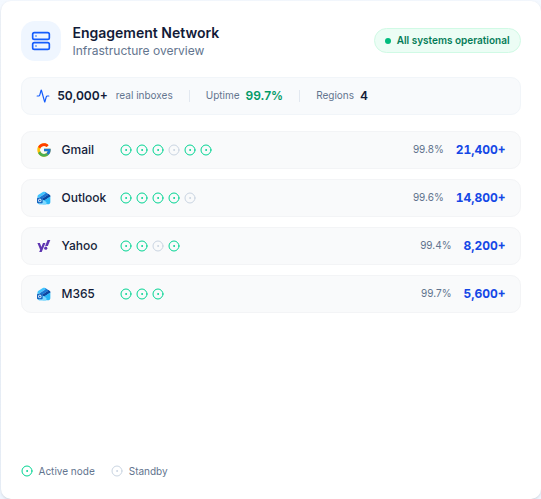
Mailwarm’s headline asset is a 50,000+ real-inbox warmup network, and, uniquely in this category, it publishes the per-provider breakdown and per-provider uptime on its public features page:
- Gmail: 21,400+ inboxes, 99.8% uptime
- Outlook: 14,800+ inboxes, 99.6% uptime
- Yahoo: 8,200+ inboxes, 99.4% uptime
- Microsoft 365: 5,600+ inboxes, 99.7% uptime
- Total: 50,000+ real inboxes, 4 regions, 99.7% overall uptime
This granularity matters more than it looks. If you’re an outbound team whose recipients overwhelmingly sit on Microsoft 365, knowing the provider has 5,600+ dedicated M365 inboxes warming your sender domain, and 99.7% uptime on that provider specifically, is a real signal you can act on. Warmy emphasizes “real people, real mailboxes, no fake accounts” qualitatively, but does not publish a comparable network count or per-provider uptime. Mailwarm is the only tool in the surveyed set that puts this level of network transparency on a public page.
2. Live inbox-vs-spam placement tracking, per provider
Most warmup tools show you activity: emails sent, opens generated, replies threaded. Mailwarm goes one layer deeper with continuous 24/7 inbox placement tests that report inbox vs spam placement per mailbox AND per SMTP, split out by provider (Gmail / Outlook / M365 / Yahoo separately). The framing is “see placement live, not days later,” and it is a genuine monitoring layer distinct from the warmup activity itself.
If a placement drop on Outlook is what’s killing your campaigns, a single aggregate “deliverability score” hides that. Mailwarm surfaces the provider-level split. Warmy leans on Google Postmaster data and a health score (more on that in the Warmy section), which is excellent for Gmail but less granular as a cross-provider placement monitor.
3. The human audit-call entry
Mailwarm’s go-to-market is built around a free Deliverability Audit booked through Calendly, billed as a “clear audit + top 3 fixes,” and “calls with experts in every plan.” The homepage leans on “15+ years of expertise” and positions expert guidance against the “chat support only” model of basic warmup tools.
This is the part that needs an honesty caveat: Warmy’s pricing page also lists “Dedicated deliverability expert” on every plan. “Expert on every plan” is therefore not unique to Mailwarm. The real, defensible difference is the form: Mailwarm pushes booked 1:1 calls and a free audit as the primary entry; Warmy’s expert is listed as included but appears to route through a “Book a demo” flow. If you want a synchronous human audit before you commit, Mailwarm’s funnel is built for that. If you just want an expert available on your plan, both have one.
4. Provider-level warmup control and use-your-own-content
Mailwarm lets you choose the warmup provider (Gmail / Outlook / M365 / Yahoo / SMTP, including AWS, SendGrid, Mailgun, Zoho), useful when you care about placement on a specific provider (Microsoft/Exchange is notoriously hard, and a dedicated M365 warmup track is rare). You can also use your own email templates during warmup, so content-filter signals match your real campaign content rather than generic warmup copy.
Where Warmy Wins
1. Adeline, a named, per-mailbox AI engine
Warmy’s core differentiator is Adeline, a named decision-making engine rather than generic “AI” marketing. Per Warmy’s product pages:
- Per-mailbox personalization: each mailbox generates hundreds of parameters; Adeline analyzes the key ones and decides the optimal warmup schedule per individual mailbox (not a one-size-fits-all ramp).
- Crowd-learning: insights from the entire Warmy mailbox fleet are applied automatically to each mailbox. Adeline “analyzes and improving by learning from the ‘crowd’ of all the mailboxes for every mailbox.”
- Predictive sending optimization: predicts optimal sending times/frequencies from real-time performance.
- AI-powered spam risk detection: flags high-spam-risk emails based on content, subject lines, sender reputation.
- Stated scale: “making 20 million decisions a day.”

This is a more concrete AI claim than Mailwarm’s “smart scheduling” and “dynamic behavior to avoid automation detection” wording. Mailwarm has no named, per-mailbox AI engine with crowd-learning. If AI-personalized warmup is what you’re buying, Warmy is the clearer purchase. (Honesty caveat: the 20M-decisions/day and crowd-learning claims are impressive but not independently substantiated on Warmy’s site, so treat them as vendor marketing, not audited fact.)
2. Native Google Postmaster integration
Warmy pulls in Google Postmaster (GPM) data natively: domain reputation, IP reputation, spam rate, and a “Health Score.” This is a real technical moat. GPM is the most authoritative Gmail reputation signal that exists; it is Google’s own data on how Gmail sees your domain. A tool that ingests it directly gives you a feedback loop Mailwarm does not advertise on its public pages.
For senders whose recipient list skews Gmail-heavy (most B2B lists do), this is the single most valuable reputation data source, and Warmy has it built in. Mailwarm lists its own dashboard and live placement monitoring, but does not advertise native GPM integration.
3. Multi-language and industry-specific warmup
Warmy offers warmup in 30+ languages to match your target audience, plus topic/industry-specific warmup: “choose the topic of emails to focus on your audience, like real estate or other industries.” Mailwarm lets you use your own templates during warmup (content-signal matching), but does not market a multi-language or industry-tailored network. For senders whose content is in a non-English language or in a specific vertical where warmup copy needs to look the part, Warmy is the only one of the two that builds this into the network itself.
4. Explicit B2B vs B2C network split
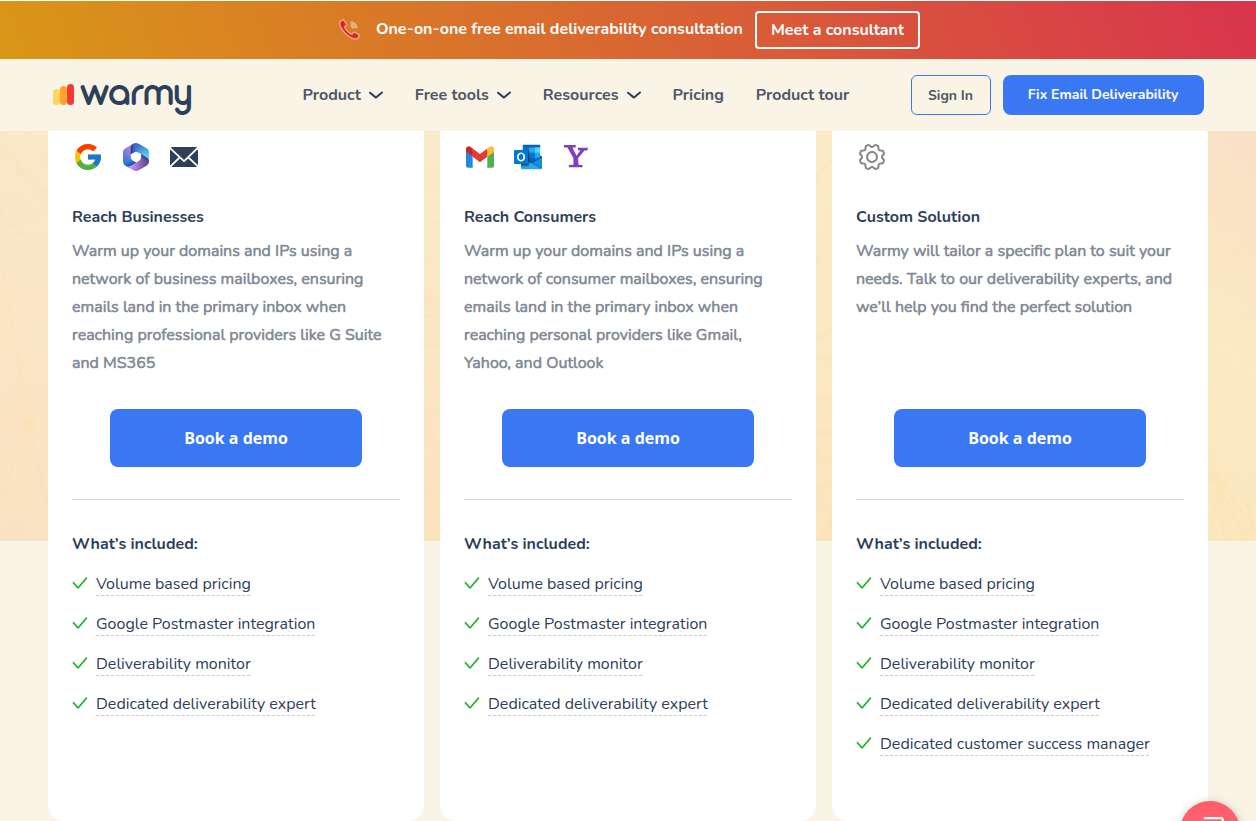
Warmy’s pricing is structured around two plan categories: B2B sender (warm up using business mailboxes: G Suite, MS365, to land in professional inboxes) and B2C sender (consumer mailboxes: Gmail, Yahoo, Outlook, to land in personal inboxes). This is a meaningful precision feature: if your recipients are overwhelmingly one type, warming up against the wrong network wastes effort. Mailwarm exposes provider choice but not an explicit B2B-vs-B2C network split.
5. A real 7-day no-credit-card trial
Warmy offers a 7-day free trial, no credit card required, cancel anytime, repeated site-wide and explicitly contrasted with the “start paid” model of less confident tools. Mailwarm does not offer a free trial on their main pricing page.
For a comparison shopper who wants to feel the product before entering a funnel, this is a meaningful edge. Warmy’s trial is a real try-before-buy path; Mailwarm’s “free” entry points are its standalone tools (Spam Checker, Blacklist Checker) and a booked audit call, not a trial of the warmup product itself.
Pricing: Mailwarm Publishes Tiers, Warmy Doesn’t
This is where the two tools diverge sharply, and it’s worth being precise about it.
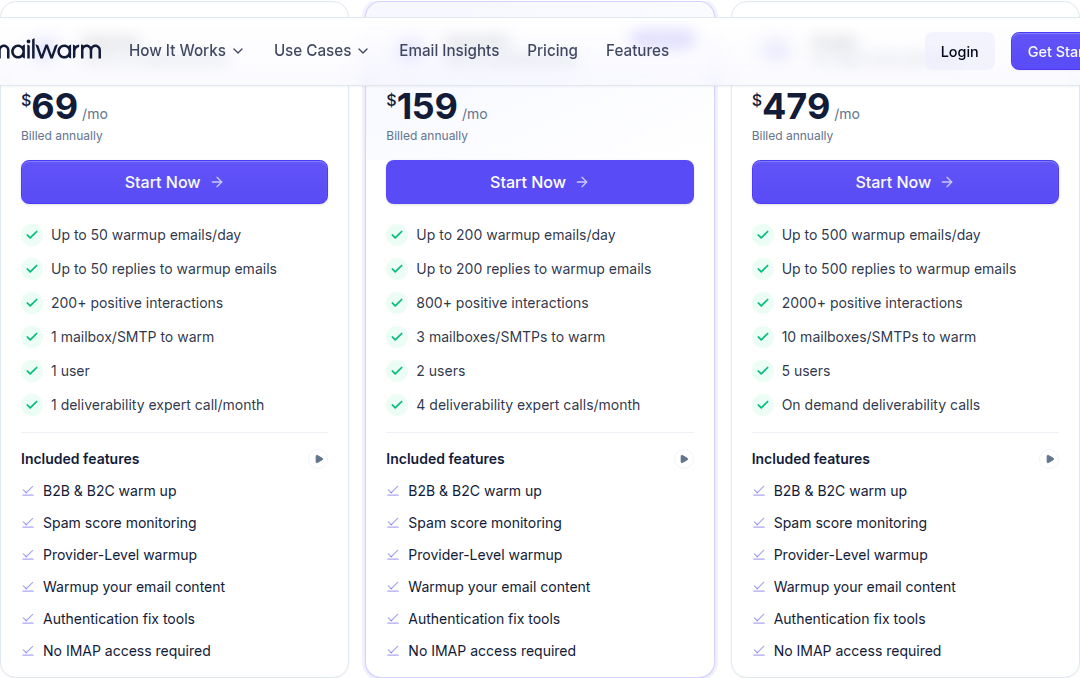
Mailwarm’s pricing page publishes three named plan tiers with real dollar amounts, billed annually (a monthly toggle is also available, at a ~13% premium over the annual rate):
- Starter: $69/mo: up to 50 warmup emails/day, up to 50 replies to warmup emails, 200+ positive interactions, 1 mailbox/SMTP, 1 user, 1 deliverability expert call/month.
- Growth: $159/mo (marked “Popular”): up to 200 warmup emails/day, up to 200 replies, 800+ positive interactions, 3 mailboxes/SMTPs, 2 users, 4 deliverability expert calls/month.
- Scale: $479/mo: up to 500 warmup emails/day, up to 500 replies, 2,000+ positive interactions, 10 mailboxes/SMTPs, 5 users, on-demand deliverability calls.
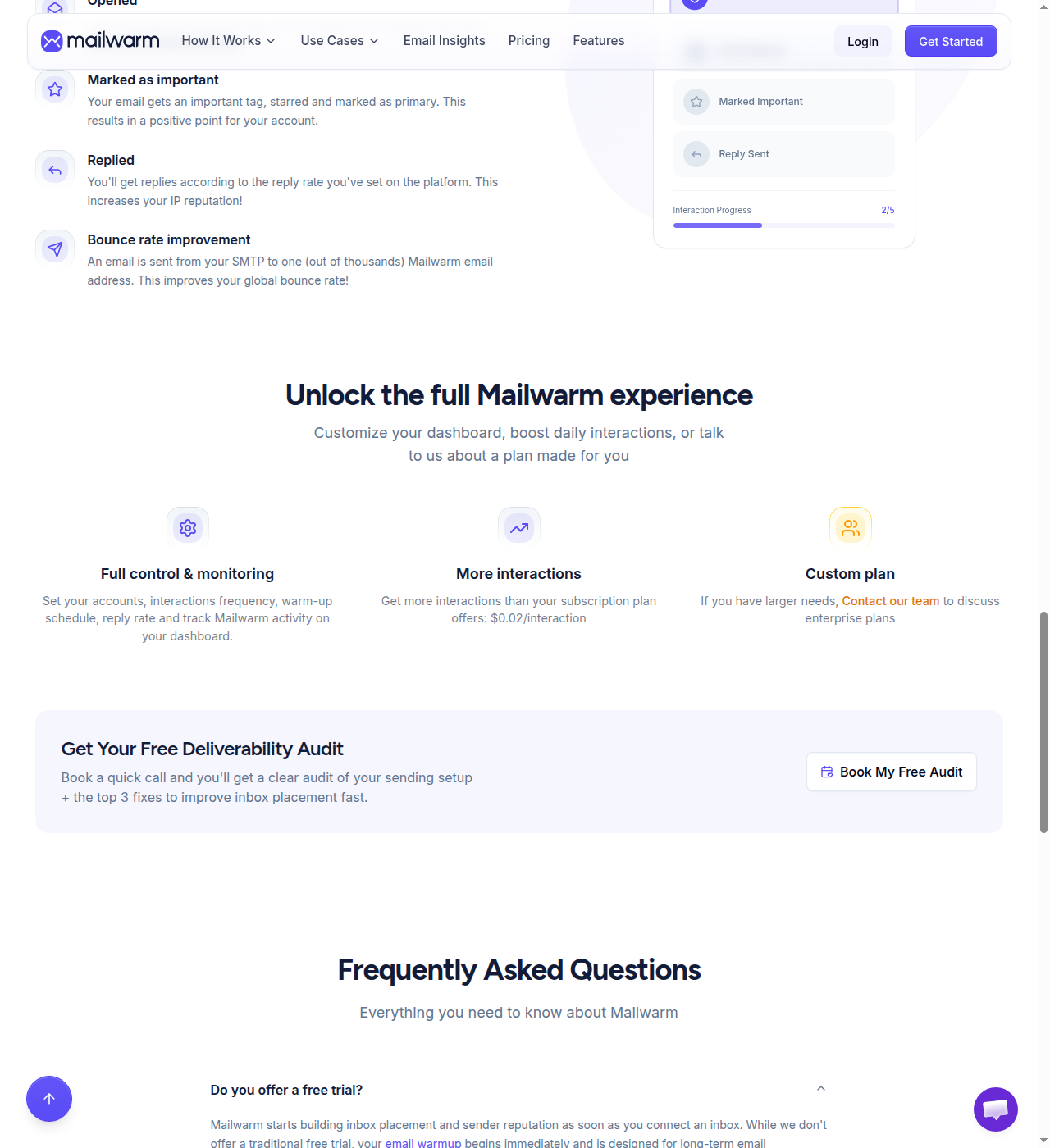
- Tailored Plan (Custom pricing): everything in Scale, unlimited mailboxes/users/warmup emails/replies, plus a dedicated deliverability expert managing your strategy end-to-end. Routed through “Talk to an Email Expert,” not a self-serve checkout.
All four tiers include B2B & B2C warm up, spam score monitoring, provider-level warmup, warmup with your own email content, authentication fix tools, and no IMAP access required. Beyond a plan’s included interaction volume, extra usage is billed at $0.02/interaction. Mailwarm still doesn’t offer a traditional free trial: its FAQ states plainly, “While we don’t offer a traditional free trial, your email warmup begins immediately and is designed for long-term email deliverability rather than short tests,” and the “Get Your Free Deliverability Audit” Calendly booking sits alongside the paid tiers as a separate, no-commitment entry point instead. (One inconsistency worth flagging: the /email-warmup-for-agencies landing page has a “Start Free Trial” button, but it routes to the same app.mailwarm.com/register paid signup as every other CTA on the site. There’s no distinct no-card trial flow behind it.)
Warmy’s pricing page, by contrast, shows no dollar amounts anywhere. It lists three plan categories (B2B sender, B2C sender, Custom), each labeled “Volume based pricing” with a “Book a demo” CTA, and the same inclusions (Google Postmaster integration, Deliverability monitor, Dedicated deliverability expert) repeated per category. To get an actual number from Warmy, you have to enter a sales conversation.
For market context, two competitors in the same standalone-warmup category also publish prices, and they’re worth naming as an anchor:
- Lemwarm (owned by lempire/lemlist): Essential $29/email/mo, Smart $49/email/mo (with annual discounts). Bundled free with lemlist if you use the parent outreach platform.
- MailReach: All-In-One (warmup + spam tester) at €20/mailbox/month on annual billing (€25/mailbox/month monthly). Priced in euros, not dollars, but still a published per-mailbox rate you can see without a sales call.
So the honest framing is: Mailwarm, Lemwarm, and MailReach will all tell you a price on the pricing page. Warmy will not. Mailwarm’s $69-$479/mo tiers sit well above Lemwarm and MailReach’s per-mailbox rates, so it isn’t the budget option even with published prices. But if seeing a number before you sign up matters to your buying process, Mailwarm clears that bar and Warmy doesn’t.
A note on pricing accuracy: prices and plan structures change. Anything stated here was checked against the live vendor pages in July 2026; verify current rates on the vendor’s site before buying.
Head-to-Head Comparison Table
| Dimension | Mailwarm | Warmy |
|---|---|---|
| Core positioning | Real-inbox network + live placement monitoring + human audit | AI engine (Adeline) + GPM integration + B2B/B2C split |
| Warmup network size | 50,000+ real inboxes, per-provider breakdown published | Not quantified; “real people, real mailboxes, no fake accounts” |
| Per-provider network detail | Gmail 21.4k+ / Outlook 14.8k+ / Yahoo 8.2k+ / M365 5.6k+ (published) | Not published |
| Per-provider uptime | Published (99.4-99.8%) | Not published |
| AI engine | ”Smart scheduling,” “dynamic behavior” (unnamed) | Adeline: per-mailbox, crowd-learning, predictive sending, spam-risk detection (named) |
| Google Postmaster integration | Not advertised | Native (domain/IP reputation, spam rate, health score) |
| Inbox-vs-spam monitoring | Live, 24/7, per mailbox + per SMTP, per provider | Deliverability insights + health score (less granular placement detail) |
| Multi-language warmup | Not advertised | 30+ languages |
| Industry/topic-specific warmup | Use-your-own-content only | Topic/industry-specific (e.g., real estate) |
| B2B vs B2C network split | Provider-level choice only | Explicit B2B-sender vs B2C-sender plan categories |
| Infrastructure checks | SPF/DKIM/DMARC, blacklist, SMTP/IMAP, reverse DNS | DMARC/DKIM/SPF/IP/Domain/Mailboxes (“safe auto settings”) |
| Bounce prevention / email verification | Built-in email verification + auto-deactivation | Not advertised as a standalone feature |
| Expert layer | Booked Calendly calls + free audit on every plan | ”Dedicated deliverability expert” on every plan (form unspecified) |
| Free trial | No traditional free trial (“Start Free Trial” button on the agency page routes to paid signup, not a distinct trial) | 7-day, no credit card, cancel anytime |
| Pricing transparency | Published: 3 tiers ($69/$159/$479 per mo, billed annually) + Custom | Opaque: “volume based pricing,” book a demo |
| Pricing model signal | Flat tier price + $0.02/interaction overage beyond included volume | Volume-based, quote-only |
| API | Not advertised on fetched pages | Warmy API (advertised) |
| Setup speed claim | ”2-min setup" | "25-second setup” |
| Best for | Agencies/teams wanting provider-level placement visibility + a human audit | Solo senders wanting AI-personalized warmup + GPM data + a real trial |
Where Mailwarm Loses (honest downsides)
- Published tiers are still expensive, and overage is metered. Starter is $69/mo for just 1 mailbox and 50 warmup emails/day; Scale is $479/mo. Beyond a plan’s included interaction volume, extra usage bills at $0.02/interaction, a cost that’s easy to see coming but still scales with activity, unlike a flat per-mailbox rate.
- No published free trial. Mailwarm does not offer a free trial on their main pricing page. Warmy’s 7-day no-credit-card trial is a real edge here.
- “Expert on every plan” is not unique. Warmy claims the same. If a sales pitch leans on “only Mailwarm includes an expert,” that is false. The defensible version is “Mailwarm’s expert is delivered as booked live calls and a free audit,” and even that needs verification against Warmy’s expert form.
- No named AI engine. Mailwarm has “smart scheduling” and “dynamic behavior,” but no named, per-mailbox AI decision engine with crowd-learning. Warmy’s Adeline is a more concrete AI claim.
- No Google Postmaster integration advertised. For Gmail-heavy senders, this is a real gap: GPM is the authoritative Gmail reputation source.
- No multi-language or industry-specific warmup. Mailwarm offers use-your-own-content but does not market a 30+ language or industry-tailored network.
- No explicit B2B-vs-B2C network split. Mailwarm exposes provider choice but not the B2B-sender vs B2C-sender segmentation Warmy builds into its plan categories.
- Interaction-based overage adds a variable cost on top of the flat tier. The $0.02/interaction line only kicks in once you exceed a plan’s included volume, but for a high-volume sender it’s still a less predictable line item than a flat per-mailbox rate.
- No visible G2/Capterra review badge. “10,000+ teams” on the homepage is a logo wall (customer names, not a review count), and Mailwarm’s public pages carry no G2 or Capterra badge or score. Warmy, by contrast, displays an actual “Award-winning on G2” section with dated award tiles (Spring 2025 High Performer, Momentum Leader, Easiest To Do Business With), real third-party review-platform recognition that Mailwarm’s public pages don’t show.
Where Warmy Loses (honest downsides)
- No transparent pricing. Unlike Mailwarm, Warmy publishes no dollar amounts at all; every plan category is “volume based pricing” behind a “Book a demo” CTA. You cannot compare Warmy’s cost to Mailwarm’s $69-$479/mo tiers, Lemwarm’s $24-$49/email, or MailReach’s €20/mailbox without entering a sales conversation.
- Inflated and inconsistent credibility numbers. “35,000+ happy businesses” (homepage/pricing), “Over 7,000 businesses trust Warmy” (homepage), and “1000+ businesses rely on Warmy” (pricing) appear on different parts of the same site. Unreliable social proof.
- Less granular live placement monitoring. Warmy shows deliverability insights and a health score, but Mailwarm’s “live inbox vs spam placement per mailbox and per SMTP, per provider, 24/7” is a more specific monitoring claim. Warmy leans on GPM + health score; Mailwarm leans on live placement tests.
- No published network size or per-provider uptime. Mailwarm publishes 50,000+ with per-provider counts and 99.4-99.8% uptime; Warmy gives no comparable network-size number.
- Vague “dedicated deliverability expert” form. Listed on every plan, but the form (chat? email? booked call?) is unspecified, and it is the same label Mailwarm uses, so it does not differentiate Warmy either.
- No free standalone audit call. Mailwarm pushes a “Free Deliverability Audit” via Calendly; Warmy’s entry is a demo/trial, not a human audit.
- B2B/B2C split can also be a limitation. If a sender needs both business and consumer placement, they may need both plan categories.
- Heavy AI marketing can read as hype. Adeline’s “20M decisions/day” and crowd-learning claims are impressive but not independently substantiated on the site.
- PayPal-only payment routing (Visa/MasterCard/AmEx “powered by PayPal”). Some enterprise buyers prefer direct card or invoice; minor but real.
Final Verdict
For agencies, outbound teams, and senders who need provider-level placement visibility and a human audit as the entry point: Mailwarm. The 50,000+ network with published per-provider breakdown and uptime, the live per-provider inbox-vs-spam monitoring, published $69-$479/mo tiers you can evaluate before signing up, and the Calendly-audit funnel are a coherent package for a team that wants to know exactly where its mail is landing and wants a human to walk them through the fixes. The $0.02/interaction overage past your plan’s included volume is the budget line to watch at high send volume.
For solo senders, Gmail-heavy lists, and buyers who want to try before they buy: Warmy. Adeline is the most concrete AI claim in the category, native Google Postmaster data is a genuine technical moat for Gmail reputation, the 30+ language and industry-specific warmup networks are unique, and the 7-day no-credit-card trial removes the buying risk that Warmy’s quote-only pricing would otherwise create.
Who is each wrong for?
- Mailwarm is wrong for you if you need a no-credit-card trial to feel the product first or a named per-mailbox AI engine. It is also wrong if your recipient list is overwhelmingly Gmail and you specifically want Google Postmaster data pulled into the platform.
- Warmy is wrong for you if you want to see a price before talking to sales, need published per-provider network size and uptime, or need live per-provider placement monitoring beyond a health score, or a free standalone human audit call. The inconsistent credibility numbers are also a yellow flag if social proof matters to your buying process.
Both tools are premium, standalone, deliverability-first; neither is the budget pick (that’s MailReach at €20/mailbox on annual, or Lemwarm if you already use lemlist). The choice between Mailwarm and Warmy is not “which is better” but “which model of deliverability help do you want”: a transparent-network-and-human-audit model with published pricing, or an AI-and-GPM-data model with a trial and quote-only pricing.
All prices, plan structures, network counts, and feature claims were checked against the live vendor pages (mailwarm.com and warmy.io) in July 2026. Pricing and feature sets change; verify current details on the vendor’s site before buying.