30 June 2026 · Comparison
Brew vs Mailchimp: AI-Native or Legacy ESP in 2026?
The short answer
if you're a solo marketer or small team who values speed — describe a campaign once and get copy, design and automation back.
if you need the full suite: SMS, landing pages, a CRM and the 300+ integrations you already rely on.
Affiliate disclosure: Some links in this post are affiliate links. If you click through and sign up, SaaSpicious may earn a commission at no extra cost to you.
Verdict: Brew wins for speed - if you want to describe a campaign in one prompt and get back copy, design, HTML, and automation logic in seconds, nothing else works this way. Mailchimp wins for breadth - if you need SMS, landing pages, a full CRM, and an ecosystem of 300+ integrations you already rely on, Brew can’t touch that. Pick Brew if you’re a solo marketer or small team who values creation speed above all else. Pick Mailchimp if you need a full marketing suite with established deliverability and you don’t mind spending hours in a drag-and-drop builder.
The Core Difference
Brew and Mailchimp are both email marketing platforms, but they were built in completely different eras for completely different workflows.
- Brew (launched May 2026) is AI-native. You type a prompt like “build me a 5-email re-engagement sequence for SaaS users who haven’t logged in for 30 days,” and it generates the entire thing - copy, HTML design, audience targeting logic, and automation flow. It is the first ESP built from the ground up around natural language.
- Mailchimp (founded 2001, owned by Intuit since 2021) is the legacy category leader. It has everything - email, SMS, landing pages, CRM, social posting, ads, and AI features layered on 20 years of platform code. Its AI is Intuit Assist, a bolt-on that can generate copy and subject lines but cannot build a full campaign from a prompt.
The question this comparison answers: is an AI-native workflow fast enough to make up for missing features, or does Mailchimp’s breadth still win?
Pricing: Brew vs Mailchimp
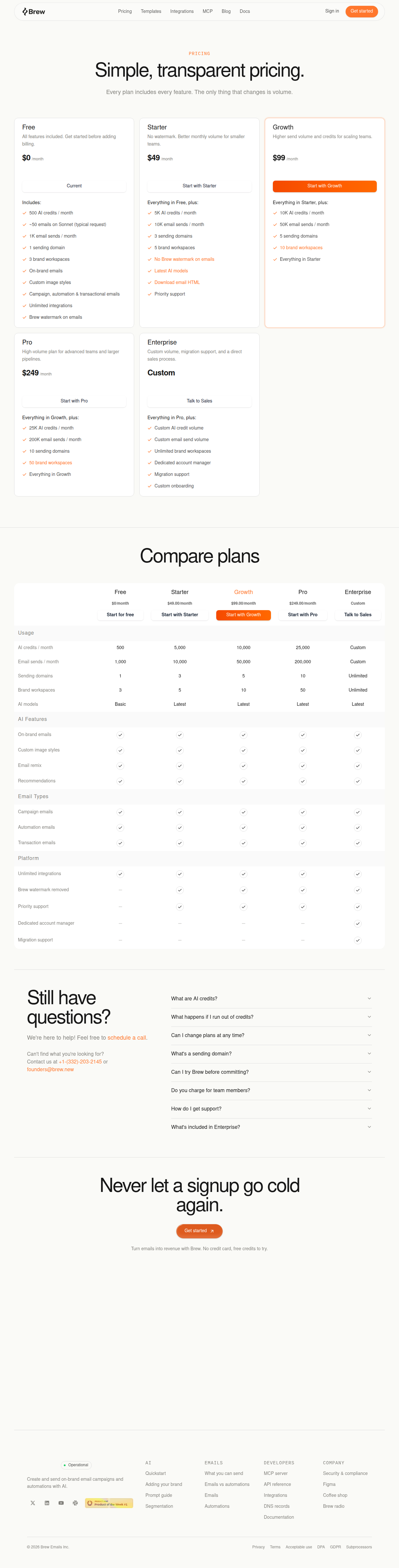
Brew Plans (all features included on every plan)
| Plan | Monthly | AI Credits | Sends/Mo | Sending Domains | Brand Workspaces |
|---|---|---|---|---|---|
| Free | $0 | 500 | 1,000 | 1 | 3 |
| Starter | $49/mo | 5,000 | 10,000 | 3 | 5 |
| Growth | $99/mo | 10,000 | 50,000 | 5 | 10 |
| Pro | $249 | 25,000 | 200,000 | 10 | 50 |
| Enterprise | Custom | Custom | Custom | Unlimited | Unlimited |
All Brew plans include unlimited team seats. The Free plan adds a Brew watermark to emails and uses basic AI models only. Paid plans remove the watermark, unlock the latest AI models, and add priority support.
Note on AI credits: Credits power every AI feature - generating emails, remixing campaigns, writing copy, analyzing performance. Each email generation costs roughly 40 credits. If you burn through your monthly cap, AI features pause but manual sending continues. Credits reset each billing cycle.
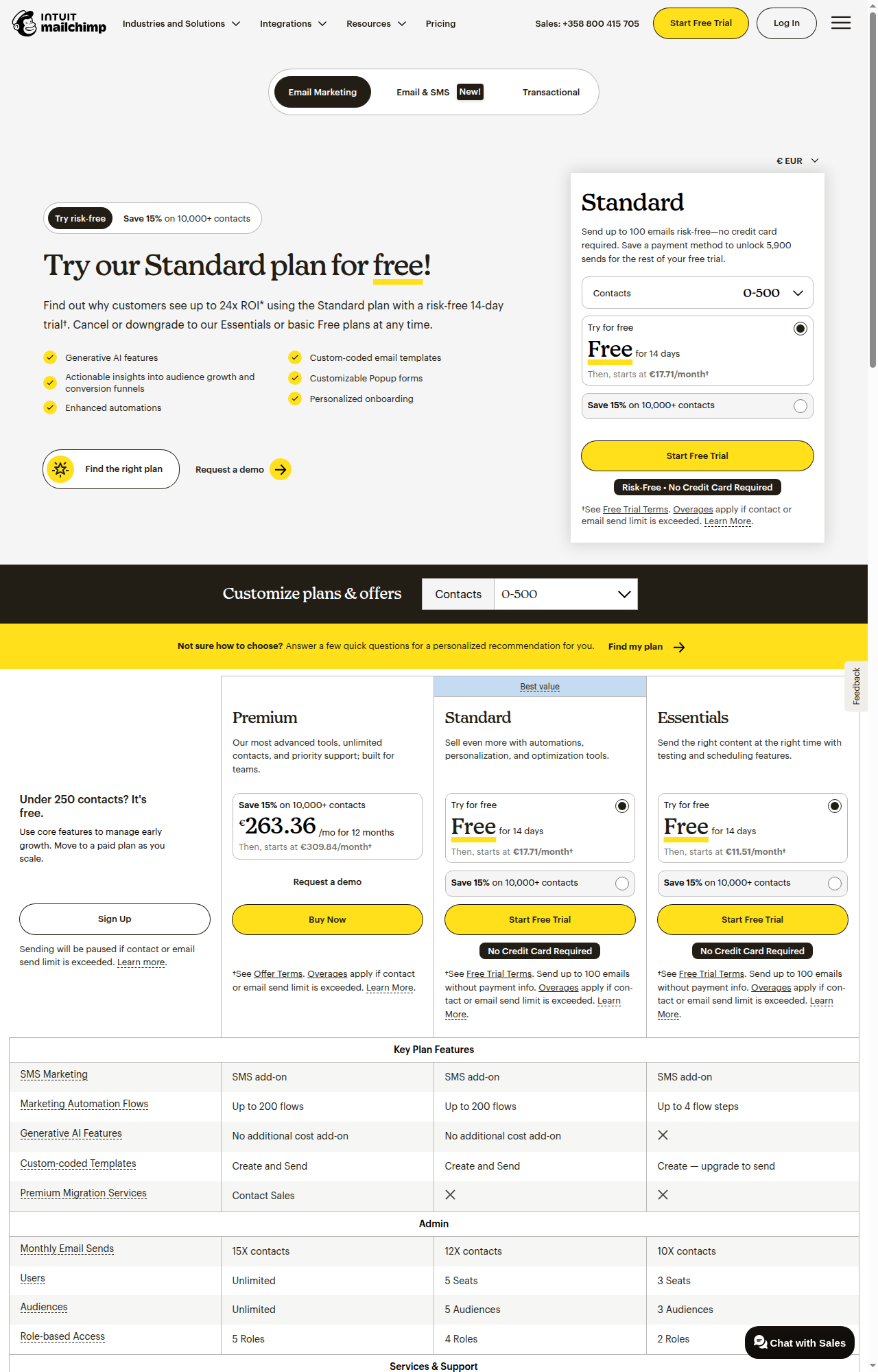
Mailchimp Plans (pricing at 500 contacts tier; scales up with audience size)
| Plan | Monthly (500 contacts) | Key Limits |
|---|---|---|
| Free | $0 | 250 contacts, 500 emails/mo (250/day), 1 audience, 1 seat, Mailchimp branding |
| Essentials | €11.51/mo | 3 audiences, 3 seats, email scheduling, A/B testing, remove branding |
| Standard | €17.71/mo | 5 audiences, 5 seats, generative AI features, custom templates, 200 automation flows |
| Premium | $309/mo EUR | Unlimited audiences/seats, phone support, predictive segmentation, multivariate testing |
Mailchimp’s pricing scales by contact count, not just features. At 10,000 contacts, the Standard plan jumps to roughly $71/mo EUR. At 50,000 contacts, the price climbs significantly higher. Overage charges apply if you exceed your send limits.
Prices accurate as of June 2026; check the vendor’s site for current rates.
How the Pricing Models Differ
Brew charges by volume (credits + sends) with flat tiers and unlimited seats. Mailchimp charges per contact, per seat, with feature-gating between plans. A 10-person team on Brew Growth pays $99/mo flat. On Mailchimp Standard, they’d need to be on Premium ($309/mo at 500 contacts) to get unlimited seats - or use the Essentials plan at $11/mo and limit to 3 seats.
For growing lists, the cost trajectory matters. Brew’s Growth plan at $99/mo handles 50,000 sends to any number of contacts. Mailchimp’s Standard plan at the same send volume - if we assume 50,000 sends at 12x contacts means roughly 4,000 contacts - would land somewhere between the $17 and $71 tiers, depending on exact contact count. But Mailchimp’s contact-based billing means your price keeps rising as your list grows, even if your sending volume stays flat.
Features: Where Each Tool Wins
Brew’s Strengths
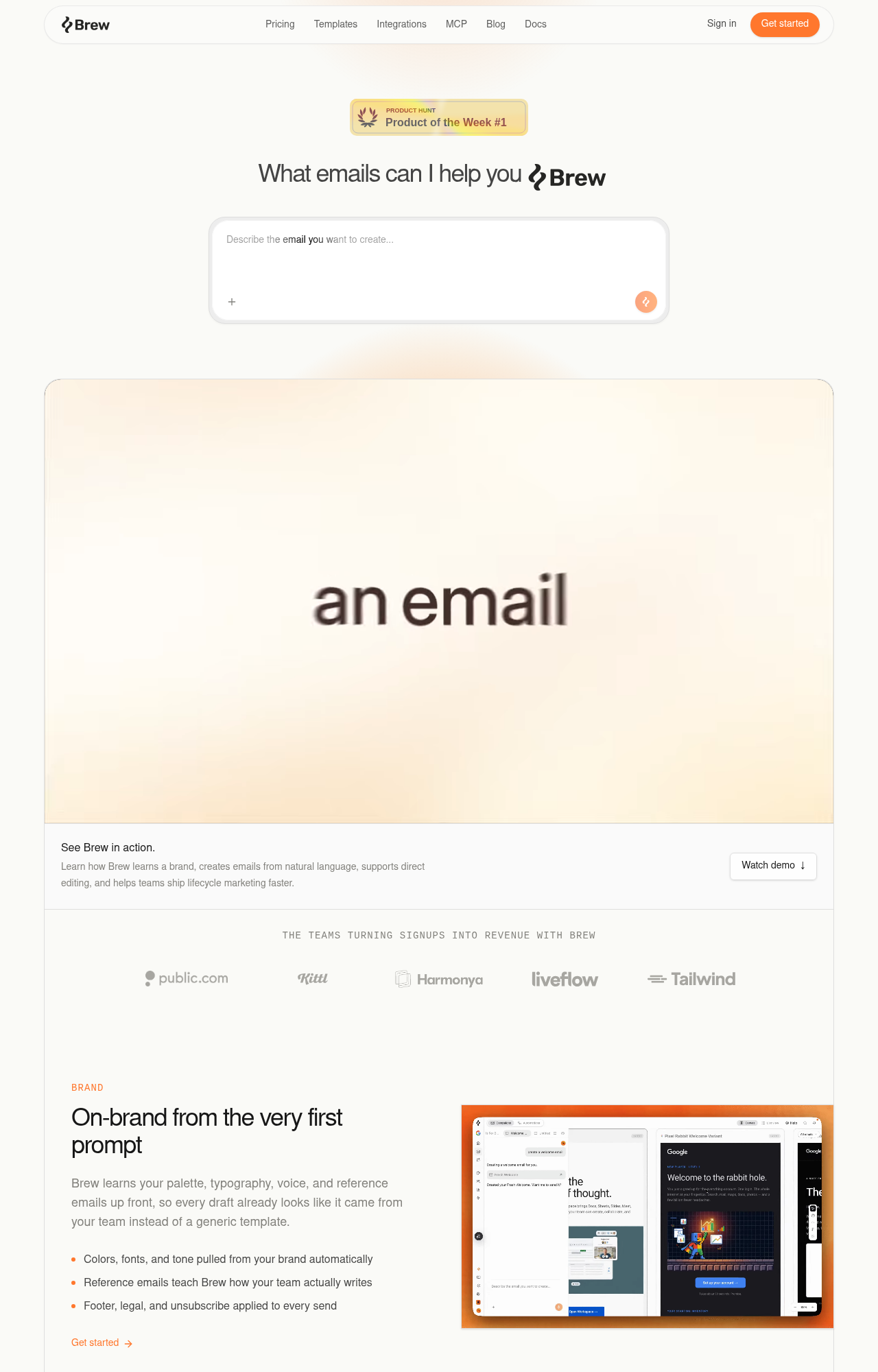
Natural language campaign creation. This is Brew’s entire reason for existing. You describe what you want - a campaign, a flow, a newsletter - and Brew generates everything in seconds. Copy, responsive HTML that renders correctly across Gmail, Outlook, and Apple Mail, audience targeting logic, and multi-step automation sequences. What takes hours or days in a traditional builder takes one prompt.
No ESP lock-in. Brew exports campaigns to any ESP. You can keep Mailchimp, Klaviyo, or HubSpot as your sending engine while using Brew as the campaign creation layer. The exported flow structure (triggers, branches, delays, audiences) maps natively to the destination ESP. You can also use Brew as your standalone ESP - DKIM, SPF, and DMARC authentication are built in.
Email-optimized HTML. Unlike generic AI design tools (Claude, Lovable) that produce web-focused HTML, Brew generates email-specific HTML that renders properly in all major inboxes. This is a real technical differentiator - email HTML is notoriously finicky, and Brew’s co-founder Thomas Park (ex-Vercel) built the email rendering engine specifically for this problem.
AI agent compatibility. Brew is built to work with AI coding agents (OpenClaw, Viktor, Claude, Lovable). An MCP (Model Context Protocol) integration is in development. You can paste Brew’s docs into any AI agent to generate campaigns programmatically - a workflow no legacy ESP supports.
Unlimited team seats on every plan. No per-user pricing. A 50-person marketing team pays the same as a solo founder on any given plan tier.
Where Brew Loses
It’s brand new. Brew launched in May 2026. At one month old, it has no track record. Deliverability reputation - how inbox providers trust the sending IPs and domains - is unknown. If your revenue depends on inbox placement, this is a real risk you need to weigh.
No SMS marketing. Mailchimp offers SMS as an add-on to paid plans. Brew is email-only. If SMS is part of your marketing strategy, Brew can’t replace that.
No CRM or deep audience management. Mailchimp has a full CRM with behavioral targeting, predictive demographics, surveys, and customer profiles. Brew is campaign-creation-focused - it builds emails, not audience databases. You’d pair it with an existing CRM or ESP.
No landing pages or websites. Mailchimp includes a landing page builder and basic website builder on all plans. Brew doesn’t build pages.
Limited integrations ecosystem. Mailchimp has 300+ pre-built integrations (Shopify, WooCommerce, Salesforce, Stripe, Canva, Zapier, and hundreds more). Brew offers API access for custom integrations but no pre-built directory.
AI credit metering. Heavy AI users on the Free plan (500 credits) or Starter plan (5,000 credits) may hit their cap quickly. At ~40 credits per email generation, 5,000 credits gets you roughly 125 generated emails per month on Starter - fine for a newsletter operator, tight for an agency building campaigns for multiple clients.
Small team risk. Brew is a 2-founder startup (Philip Sorensen, CEO, ex-Revolut; Thomas Park, CTO, ex-Vercel). Mailchimp is backed by Intuit ($170B market cap). If you’re betting your marketing stack on a tool, company longevity matters.
Mailchimp’s Strengths
Full-stack marketing platform. Email, SMS, landing pages, signup forms, social posting, retargeting ads, CRM, surveys, and analytics - all in one login. For businesses that want one tool to handle everything, Mailchimp’s breadth is unmatched.
Established deliverability. Twenty-plus years of sending reputation means Mailchimp’s infrastructure is trusted by inbox providers. For high-stakes e-commerce or enterprise email programs, deliverability is a hard requirement that new tools haven’t proven yet.
300+ integrations. Mailchimp connects to virtually every e-commerce platform, CRM, analytics tool, and marketing app. If you run a Shopify store, the Mailchimp integration syncs customers, products, and purchase history automatically.
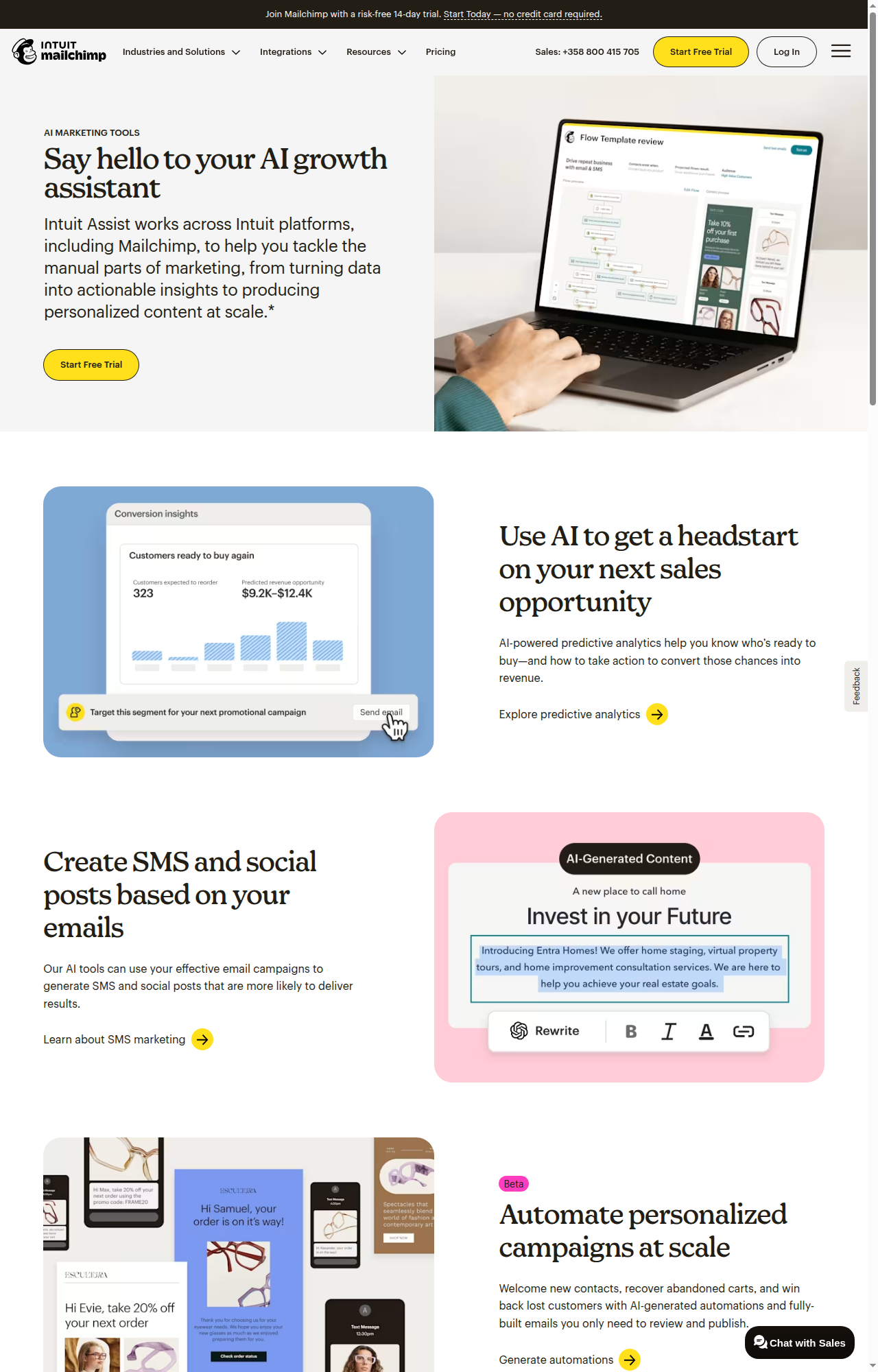
AI features exist (but are bolt-on). Intuit Assist provides generative AI copywriting, subject line suggestions, send time optimization, smart recommendations, and predictive demographics. These are real, useful features - they just don’t go as deep as Brew’s full-campaign generation.
Onboarding and support. Paid plans include 24/7 email/chat support, and Standard/Premium plans include personalized onboarding sessions. Premium adds a dedicated onboarding specialist and phone support.
Mature compliance and security. GDPR, CCPA, and enterprise security standards are built in. For regulated industries, this matters.
Where Mailchimp Loses
The builder is slow. Mailchimp’s drag-and-drop email builder and automation flow editor work, but they’re dated. Building a single campaign still means manually selecting templates, writing copy in a text box, dragging content blocks, and testing across clients. A 5-email sequence is hours of work, not one prompt.
AI is surface-level. Intuit Assist can write email copy and suggest subject lines, but it cannot generate a complete campaign with design, audience logic, and automation flow from a natural language prompt. Brew’s AI depth - full campaign generation from a single prompt - is a fundamentally different capability that Mailchimp doesn’t offer.
Pricing escalates fast. Mailchimp’s contact-based pricing means your bill grows with your list. A business with 10,000 contacts on Standard pays roughly $71/mo EUR. At 50,000 contacts, the price jumps significantly. Per-seat pricing on lower tiers (1-3 seats on Essentials, 5 on Standard) forces growing teams onto the $309/mo Premium plan. Overage charges for exceeding send limits add unpredictability.
No natural language campaign builder. You cannot type “build me a 5-email re-engagement flow” into Mailchimp and get a complete campaign. The gap between Mailchimp’s AI (copy assistance + recommendations) and Brew’s AI (full campaign generation) is the central difference between the tools.
Constant upsell pressure. User reports consistently mention aggressive in-product upsell prompts under Intuit’s ownership - upgrade nudges, add-on offers, and feature unlocks that distract from the actual work of sending emails.
Legacy platform inertia. Despite 20+ years of development, Mailchimp’s generated HTML can still break in Outlook and other clients, per user reports. Innovation pace has slowed under Intuit’s corporate structure compared to startup velocity.
Head-to-Head Comparison Table
| Dimension | Brew | Mailchimp |
|---|---|---|
| Campaign creation speed | Seconds (one prompt) | Hours (manual builder) |
| AI depth | Full campaign generation (copy + design + logic + HTML) | Copy generation + subject line helper + send time optimization |
| Email HTML quality | Purpose-built email HTML engine | Standard template system (known Outlook issues) |
| ESP lock-in | None - push to any ESP | Full lock-in to Mailchimp ecosystem |
| AI agent workflows | MCP in development, OpenClaw/Viktor/Claude compatible | Not available |
| Pricing model | Flat rate by volume, unlimited seats | Per-contact scaling, limited seats, overage charges |
| Free tier | 500 AI credits, 1,000 sends, watermark | 250 contacts, ~500 sends, branding |
| SMS | No | Yes (add-on) |
| Landing pages | No | Yes (built-in) |
| CRM depth | Minimal (campaign-focused) | Full CRM with predictive demographics |
| Integrations | Via API | 300+ pre-built |
| Deliverability | Unknown (new) | Established (20+ years) |
| Platform maturity | 1 month old | 20+ years, Intuit-backed |
| Team seats | Unlimited on all plans | 1-5 seats on lower tiers, unlimited on Premium only |
Who Should Pick Brew
Brew is for speed-first marketers who value creation velocity over platform breadth:
- Solo founders and small marketing teams who want to describe a campaign in plain English and ship it in minutes, not hours.
- Agencies and freelancers managing email campaigns for multiple clients - the per-client brand workspace support and unlimited team seats on flat pricing make Brew economically attractive compared to Mailchimp’s per-contact, per-seat model.
- Teams already using an ESP who want to layer Brew on top as a campaign creation engine. Brew’s ESP export means you can keep your existing infrastructure while replacing the slowest part of your workflow - building the emails themselves.
- AI-native workflows - if your team uses AI coding agents (Claude, Lovable, OpenClaw) or plans to, Brew is purpose-built for this. No other ESP supports MCP or agent-driven campaign creation.
- Anyone starting from zero who wants to build email marketing habits without learning a legacy builder. Brew’s prompt-driven interface has essentially no learning curve compared to mastering Mailchimp’s template system, automation builder, and audience tools.
Brew is wrong for you if: you need SMS marketing, your business depends on proven deliverability with years of sending reputation, you need a built-in CRM with deep audience segmentation, or you rely on Mailchimp’s pre-built integrations with your existing tech stack.
Who Should Pick Mailchimp
Mailchimp is for breadth-first teams who need a proven, full-stack marketing platform:
- E-commerce businesses running on Shopify, WooCommerce, or similar platforms - the deep integrations, transactional email (Mandrill), and revenue tracking make Mailchimp the default choice for stores.
- Teams that need SMS alongside email - Mailchimp’s SMS add-on is built into the platform, not a separate tool.
- Enterprises and regulated industries that need proven deliverability, compliance certifications, and a vendor with 20+ years of operational history.
- Marketing teams that want one tool for everything - email, landing pages, social posting, ads, CRM, surveys, and analytics in a single login, with a large ecosystem of pre-built integrations.
- Anyone with a large, established audience who doesn’t want to risk migration deliverability issues by switching to a brand-new sender.
Mailchimp is wrong for you if: you want to build campaigns by describing them in plain English rather than clicking through a builder, you’re tired of per-contact and per-seat pricing escalation, or you want a tool that keeps pace with the speed of AI-native startups.
The Layer Approach: Using Both
One practical angle that makes this comparison less zero-sum: you don’t have to choose exclusively. Brew exports to Mailchimp, so you can use Brew to generate campaigns and push them to your existing Mailchimp account for sending. This gives you Brew’s AI speed for campaign creation and Mailchimp’s established deliverability and audience management for sending. The flow structure - triggers, branches, delays, audiences - maps natively to Mailchimp’s automation builder.
For teams already invested in Mailchimp who are frustrated with the campaign creation workflow, this is the most realistic path. You keep your audience, integrations, and sending reputation while replacing the slowest part of the process.
Bottom Line
Brew is the most interesting thing to happen to email marketing in years - not because it’s another ESP with slightly better features, but because it rethinks how campaigns get built. If you’ve spent any time wrestling with Mailchimp’s drag-and-drop builder at 11 PM, the idea of typing a prompt and getting back a ready-to-send campaign in seconds is genuinely compelling.
But it’s one month old. That matters. Mailchimp’s two-decade head start on deliverability, integrations, and platform maturity isn’t something Brew can match quickly - and for many businesses, those things are non-negotiable.
If you’re comparing Mailchimp to newsletter-focused alternatives rather than AI-native ones, we’ve also broken that down in our Kit vs Mailchimp comparison. For a second AI-native challenger to the same incumbent, Migma AI vs Mailchimp weighs prompt-generated campaigns against Mailchimp’s twenty years of SMS, landing pages and 300+ integrations.
Pick Brew if campaign creation speed is your bottleneck and you’re comfortable with a new tool. The $49/mo Starter plan gives you plenty to evaluate whether the AI-native workflow is worth it. Try Brew free →
Pick Mailchimp if you need the full platform - SMS, CRM, landing pages, 300+ integrations - and can live with a slower campaign builder in exchange for proven everything. The Essentials plan at €11.51/mo is the practical entry point for serious email marketing. Try Mailchimp free →