22 September 2026 · Comparison
Widgo vs Intercom Fin: Can Flat Pricing Beat $9.99 Leads?
The short answer
if you want a flat monthly rate with no seat or qualification fees.
if you already use Intercom for support and want unified sales routing.
Verdict: Pick Widgo if you are a lean SaaS team or agency that wants a fixed, predictable bill, unlimited team seats, and a five-minute install for a website-only AI sales rep. Pick Fin for Sales (Intercom) if you already run your customer operations in Intercom, want an inbound agent that engages prospects on your site, Messenger, and email, or need Salesforce CRM native integration. The whole decision hinges on one question: can you tolerate paying $9.99 every time the bot qualifies someone, plus a paid helpdesk seat, in exchange for a mature, enterprise-grade platform owned by Salesforce?
Affiliate disclosure: Neither Widgo nor Fin offers a confirmed self-serve affiliate program as of September 2026, so this post is not monetized through either vendor’s links. SaaSpicious may earn commissions through other partner programs on this site. This does not affect our analysis: both tools get their honest downsides below, and we verify prices against each vendor’s live pricing page before publishing.
Two Pricing Philosophies, One Decision
The comparison really is a pricing-philosophy clash.
Widgo is a brand-new startup selling “an AI sales rep for your website visitors” at a flat monthly rate with unlimited teammates and zero per-lead fees. Fin, the customer-agent company formerly known as Intercom and now owned by Salesforce, charges per outcome: $9.99 when the bot qualifies a prospect and routes them to a sales rep, stacked on top of a paid helpdesk seat.
That one number, $9.99 per qualification, is the reason “widgo vs intercom fin” exists as a question at all. So we need to be precise about what it actually means, because Widgo’s own marketing page oversimplifies it.
The $9.99, Read Correctly
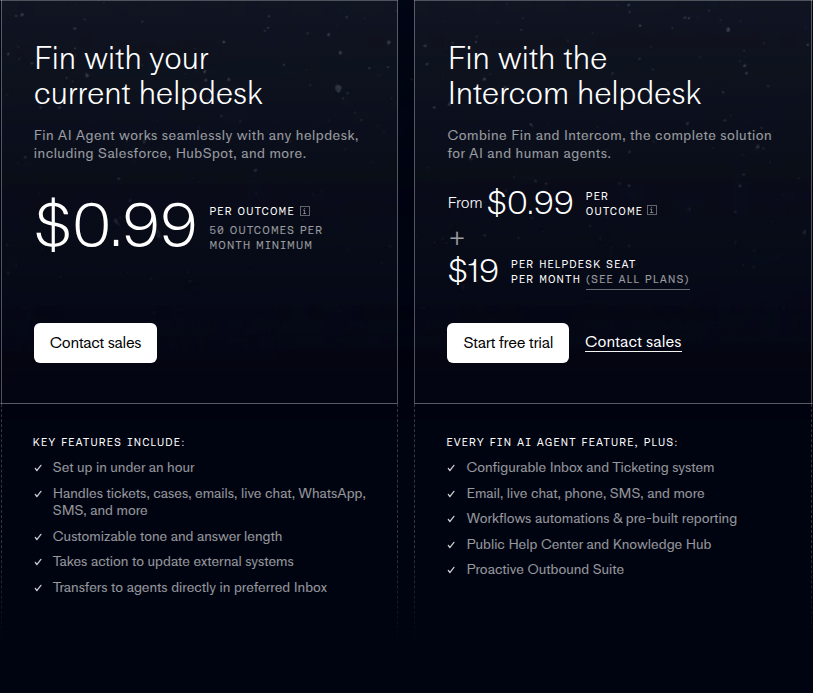
Fin’s official pricing documentation breaks outcomes into five buckets, and only one of them costs $9.99:
- $9.99 Qualification - Fin matches a prospect to the qualification criteria you defined and routes them to a human sales rep or a booked calendar.
- $0.99 Self-serve qualification - Fin routes a prospect to a trial or signup flow instead of a rep. Bookings stay hidden and follow-up is limited, but the charge is a tenth of the price.
- $0.99 Resolution - a customer confirms their issue is resolved, or stops asking for help after Fin’s answer.
- $0.99 Procedure handoff - Fin executes a configured procedure that ends in a human handoff.
- $0.99 Disqualification - Fin determines a prospect does not match your criteria.
Unanswered questions, escalations, and abandoned conversations cost $0.00, and Fin bills at most one outcome per conversation no matter how many actions it takes.
So Widgo’s “$9.99 every time it works” is a distortion. The accurate version: “$9.99 every time it successfully hands a qualified prospect to a human.” That is still the number that matters for a sales use case, because handing qualified prospects to reps is the entire point of Fin for Sales - but the post that ignores the $0.99 self-serve path is repeating vendor copy. Self-serve routing exists precisely so a team can pay a dollar per qualified trial signup instead of ten.
Widgo: Flat, Fast, and Very New
Widgo’s pitch is simple: one line of code on your site, the AI trains itself on a scan of your pages, you approve each answer before it goes live, and it identifies visiting companies, scores them 0-100, and books demos into Cal.com mid-conversation.
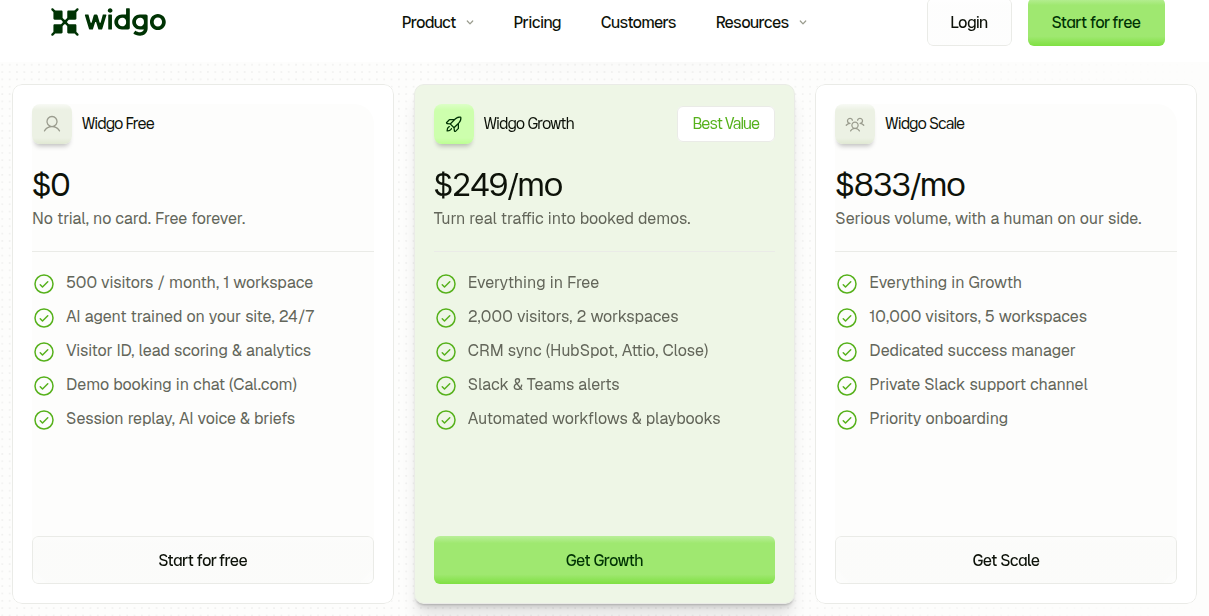
The pricing structure as shown on the live page:
| Plan | Price | Visitors/mo | Included |
|---|---|---|---|
| Free | $0 | 500 | AI agent, visitor ID + scoring, Cal.com booking, unlimited teammates, 150-page knowledge base cap |
| Growth | $249/mo | 2,000 | Everything in Free, plus CRM sync, Slack/Teams alerts, automated workflows, session replay, no KB cap |
| Scale | $833/mo | 10,000 | Everything in Growth, plus dedicated success manager, private Slack channel, priority onboarding |
| Enterprise | Custom | Custom | Everything in Scale, plus SAML SSO, 99.9% SLA, SOC 2 report, audit log, custom DPA |
A “visitor” is one unique person per calendar month regardless of return visits; bots are excluded. Past your limit the widget keeps talking, but new lead cards and analytics blur until you upgrade.
One number worth flagging before you rely on it anywhere: Widgo’s own pages disagree on the annual price. The pricing page toggle says “Yearly (2 months free)”, which works out to $2,490/year on Growth (10 x $249), but Widgo’s comparison page quotes Growth at $2,988/year (12 x $249). They also cite three different language counts across their own pages - 10 on the pricing table, 20+ in the help center, 100+ on the homepage. We used the live pricing page figures in this post; the gaps are worth knowing before you trust their marketing math anywhere else.
Who is Widgo? A Delaware corporation whose marketing site was published September 14, 2026, whose help center dates to August 2026, and whose DSALTA customer story still contains an unedited Lorem Ipsum placeholder testimonial attributed to “John Doe, Founder, CEO”. There are zero independent reviews of the sales-rep Widgo on G2, Capterra, or Trustpilot. (Sites that “review Widgo” from early 2026 are describing a different product - an AI generative-art tool of the same name.) We are rating it on the live product and its public pages, not on its testimonials, because its testimonials are demonstrably unfinished.
Fin for Sales: The Mature Counterweight
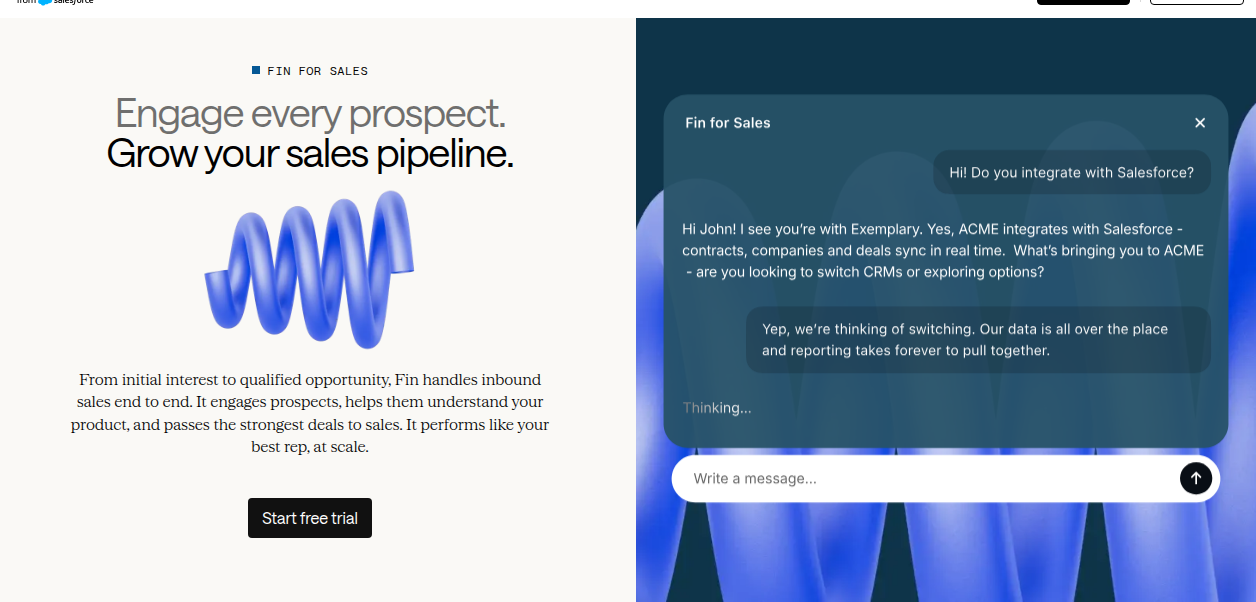
Fin for Sales runs the inbound motion end to end: Engage (proactive conversations started from what a prospect is exploring on your site, on Messenger, email, and more, per Fin’s product page), Discover (deep product answers with objection handling), Qualify (SDR-style questioning plus CRM-data enrichment), Close (routes to a rep, a trial, or a self-serve flow, booking via Calendly or Chili Piper Concierge). One thing its own documentation is explicit about: Fin does not run automated email follow-up sequences after qualification - that part of the nurture is handled by your existing workflows once Fin hands off.
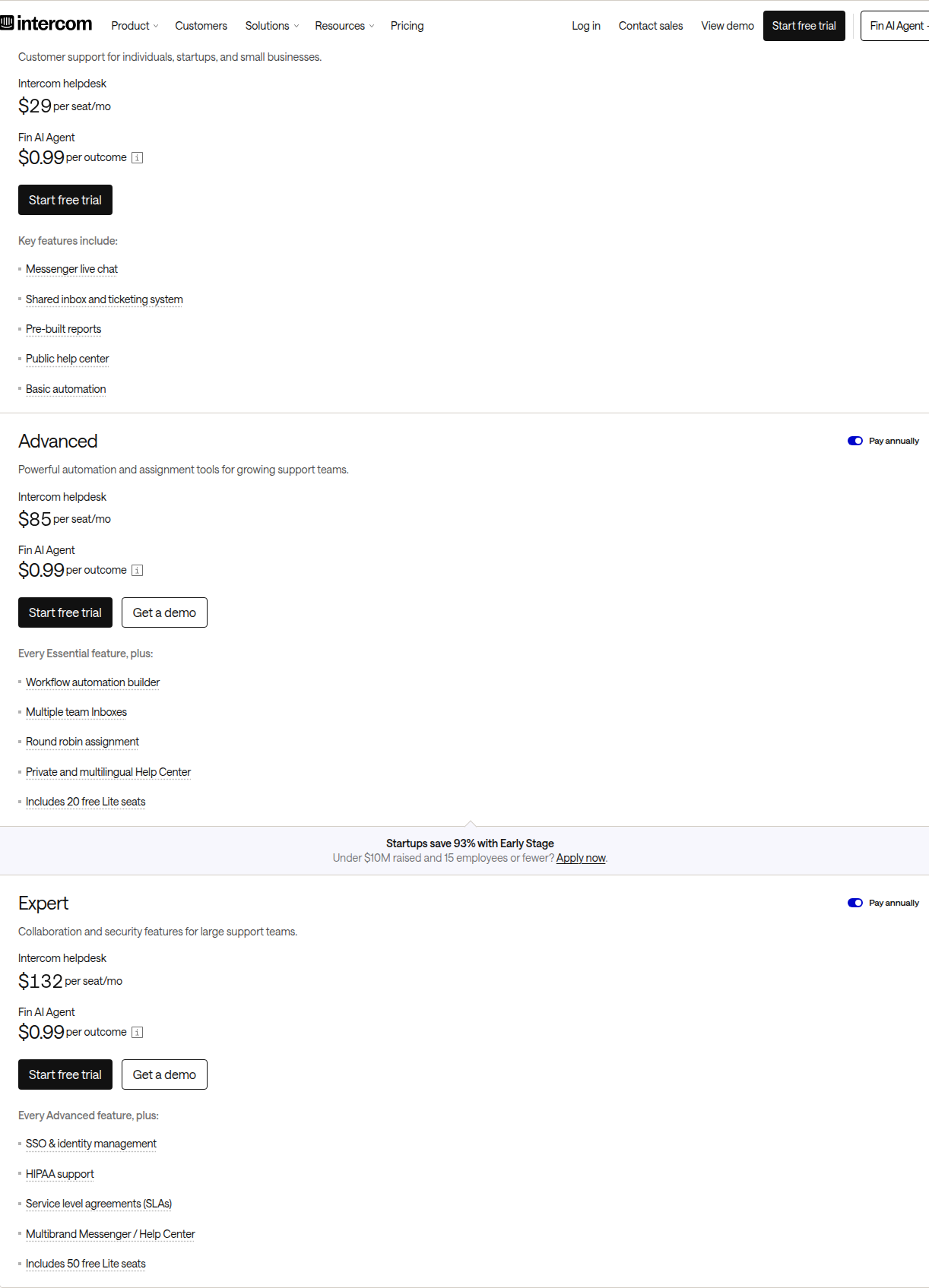
The price of that maturity is structure. Fin for Sales is only available on Intercom’s paid helpdesk plans - there is no “bring your own helpdesk” path for Sales, unlike Fin for Service, which runs standalone on Salesforce, HubSpot, Zendesk, Freshworks, or Front at $0.99/outcome with no seats and a 50-outcome monthly minimum. And the seats are not cheap: Essential $29, Advanced $85, and Expert $132 per seat per month. There is no free-forever tier; it is a 14-day trial, after which outcome billing activates automatically.
Add-ons stack separately too: Pro add-on $99/month, Copilot $29/agent/month billed annually ($35 monthly), and Proactive Support Plus $99/month.
One more piece of context that matters for a 2026 purchase: Salesforce completed its ~$3.6 billion acquisition of Fin on September 10, 2026, after signing the agreement on June 15. Fin now runs inside Salesforce AI Labs under CEO Eoghan McCabe. For a team already invested in Salesforce CRM that is pipeline synergy; for a small startup it is a reason to ask what an enterprise owner does to pricing and contract minimums next year.
The Honest Head-to-Head
Widgo publishes a comparison table against Fin. It is directionally fair on the headline numbers, so we repeat it with the corrections Fin’s own docs force:
| Dimension | Widgo Growth | Fin for Sales |
|---|---|---|
| Pricing model | Flat $249/month | $9.99/qualification to a rep; $0.99 self-serve |
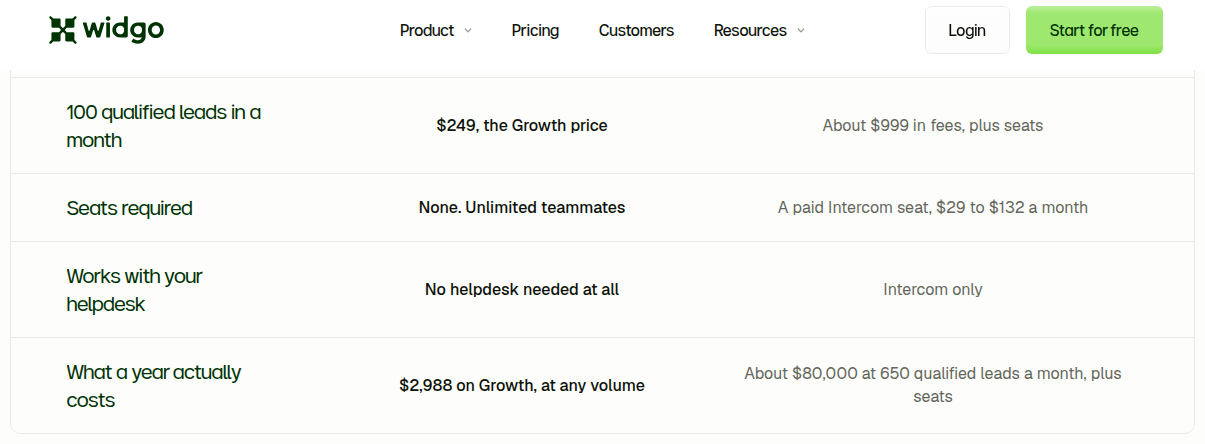
| 100 qualified leads/mo | $249 no matter the volume | ~$999 in outcome fees, plus seats |
| Seats | None, unlimited teammates | Paid Intercom seat, $29-$132/mo |
| Helpdesk | None needed | Intercom only (Sales path) |
| Annual cost at 650 qualified leads/mo | $2,988 or $2,490 depending on which Widgo page you read | Roughly $80,000 once seats are added |
| Channels | Website widget only | Messenger, email, and more |
| Outbound / lead nurture | None | No automated email follow-up after qualification; nurture runs in your existing workflows |
Sanity-checking Widgo’s worst-case math: 650 qualifications x $9.99 = $6,493.50/month, x 12 = $77,922, and two Essential seats add $696, which is “roughly $80,000” by any fair reading. Widgo’s “$249 vs about $999 a month at 100 qualified leads” checks out the same way: 100 x $9.99 is $999 in fees, before seats. The arithmetic against Fin’s published $9.99 is sound - Widgo just leaves the $0.99 self-serve path out of its table. Our table does not.
Where Widgo Loses
- It is completely unproven. A site published September 2026, a help center from August, zero G2/Capterra/Trustpilot reviews, and a Lorem Ipsum testimonial on its own case-study page. Widgo’s security claims (SOC 2 Type II, HIPAA BAA) are on its site but you cannot verify them against any independent report yet. Choosing it is a bet on a very young company.
- Inbound website chat only. No outbound email, no phone calls, no WhatsApp, no SMS, no mobile apps. If you want to chase a visitor who left, Widgo cannot help you.
- Not a CRM, not a helpdesk. No ticketing, no shared agent inbox, no knowledge base for human reps. It is a visitor-capture widget that feeds data elsewhere.
- Visitor caps with blur. Growth’s 2,000 unique visitors/month runs out fast on a busy site, and past the cap your lead cards and analytics blur until you upgrade.
- Cal.com only, out of the box. No native Chili Piper Concierge integration; Fin books via Calendly and Chili Piper.
- Its own numbers disagree. Annual price ($2,490 vs $2,988), language count (10 vs 20+ vs 100+), and the CRM list on the pricing page (HubSpot, Attio, Close) differs from the help center list (HubSpot, Salesforce, Pipedrive, Attio, Close, Folk).
Where Fin Loses
- Outcome costs scale with success. At $9.99 per rep-routed qualification, a website that converts well produces a large, unpredictable monthly bill. It is the same cost-gap logic that makes the Crisp vs Intercom decision turn on how many agents and outcomes you run: Intercom’s economics favor predictable-support teams, not high-volume inbound sales agents.
- Fin for Sales is Intercom-locked. You cannot run it on Zendesk, HubSpot, or Freshdesk. It means migrating your helpdesk to Intercom and paying $29-$132/seat/month on top of outcome fees.
- No free tier. Fourteen days, then billing starts automatically. Widgo’s Free plan is permanent.
- Setup and maintenance are real work. Playbooks, workflows, custom procedures, simulation and regression test suites. This is a platform to operate, not a widget to install.
- Add-on fatigue. Advanced reporting (Pro $99/mo), agent assistance (Copilot $29-$35/seat/mo), and proactive sequences (Proactive Support Plus $99/mo) each bill separately.
- Post-acquisition uncertainty. Salesforce ownership is a genuine plus for CRM-native enterprises, and a genuine question mark for startups worried about contract gating and price inflation.
Bottom Line
Buy Widgo Growth if you are an early-stage SaaS or lean sales team that wants a flat, predictable $249/month, unlimited seats, a five-minute install, and automated inbound meeting booking without paying $9.99 per pipeline event or buying a helpdesk suite to get it. It is the right call for a team whose website is its main lead source and whose budget cannot absorb per-qualification surprises.
But do not buy Widgo if you need your sales conversations to extend beyond your website, a real helpdesk underneath the chat, or a vendor with an independent track record - or if losing leads to you being the one debugging your AI sales rep at month one sounds acceptable. Widgo is a promising widget, not a mature sales operation.
Buy Fin for Sales if you already live in Intercom, need one agent spanning support and sales, want native Salesforce CRM integration, and can absorb a bill that grows with your conversion rate. Its enterprise compliance posture (SOC 2, ISO 27001, HIPAA) and native Salesforce ecosystem are unmatched by anything Widgo offers today.
And know who Fin is wrong for: a cost-sensitive early-stage company that does not yet have 100 qualified leads a month. At that volume the $9.99-per-qualification model plus Intercom seats is a large, unpredictable line item you do not need yet - that buyer is exactly who Widgo is built for.
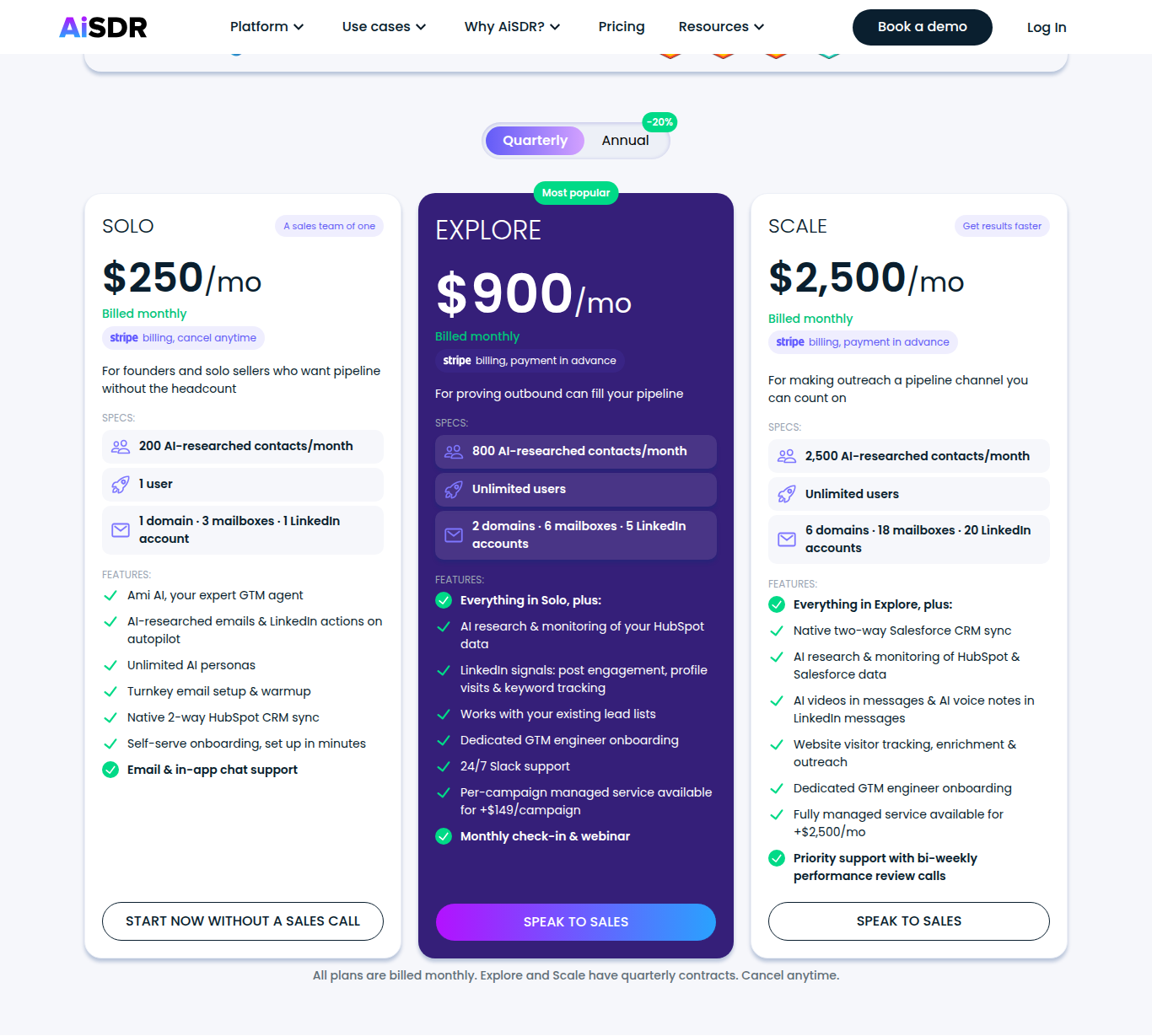
Prices accurate as of September 2026; check the vendor sites for current rates. If you are weighing the broader pipeline stack around this decision: AiSDR, Artisan, and 11x are the AI SDRs that do outbound follow-up - the job Widgo does not touch; Youkti vs ZoomInfo is the inbound enrichment layer that can feed a tool like this; Lightfield vs HubSpot is the CRM decision once leads actually land in your pipeline; and Zinley vs Smith.ai covers adding an AI phone answering layer if that channel matters to you.