29 June 2026 · Comparison
Crisp vs Intercom: The Cost Gap That Changes the Decision
The short answer
if a predictable bill matters most and you want chat, CRM, ticketing and a status page at one flat rate.
if you can't compromise on AI maturity, enterprise integrations, or proactive messaging like product tours and targeted sequences.
Verdict: For teams of 10 or more agents, Crisp wins on price by a factor of 4-6x while delivering a comparable feature set. Intercom wins when you need enterprise compliance (HIPAA, SSO), the deepest integration ecosystem (350+ apps), or the most battle-tested AI agent in the industry. If your team is under 10 agents and you qualify for Intercom’s startup program, Intercom becomes genuinely affordable, but only for 1-2 years.
Who picks what: Pick Crisp if your primary constraint is budget predictability and you want CRM, ticketing, and a status page bundled at a flat rate. Pick Intercom if your business can’t compromise on AI maturity, enterprise integrations, or proactive outbound engagement (product tours, checklists, targeted sequences).
Affiliate disclosure: SaaSpicious may earn a commission if you click links in this post and make a purchase. This does not affect our analysis. We check prices against each vendor’s live pricing page and name the downsides on both sides, regardless of partner status.
Why This Comparison Matters
Intercom dominates the customer support conversation. It’s the default recommendation in VC circles, the tool Anthropic itself uses for its AI agent, and the brand with 12,000+ Fin customers and a G2 leader spot. But Intercom’s per-seat pricing plus per-outcome AI billing creates bills that shock teams as they scale.
Crisp is built on the opposite philosophy: flat per-workspace pricing with unlimited conversations. One price covers your entire team, your AI agent, your CRM, your knowledge base, and your status page. The question isn’t which tool is “better” in a vacuum. It’s which pricing model and feature set match your team’s size and compliance requirements.
If you’re comparing other SaaS tools, we’ve published hands-on comparisons across marketing, support, and ecommerce tools. See the full comparison library.
Pricing: The Gap That Defines the Decision
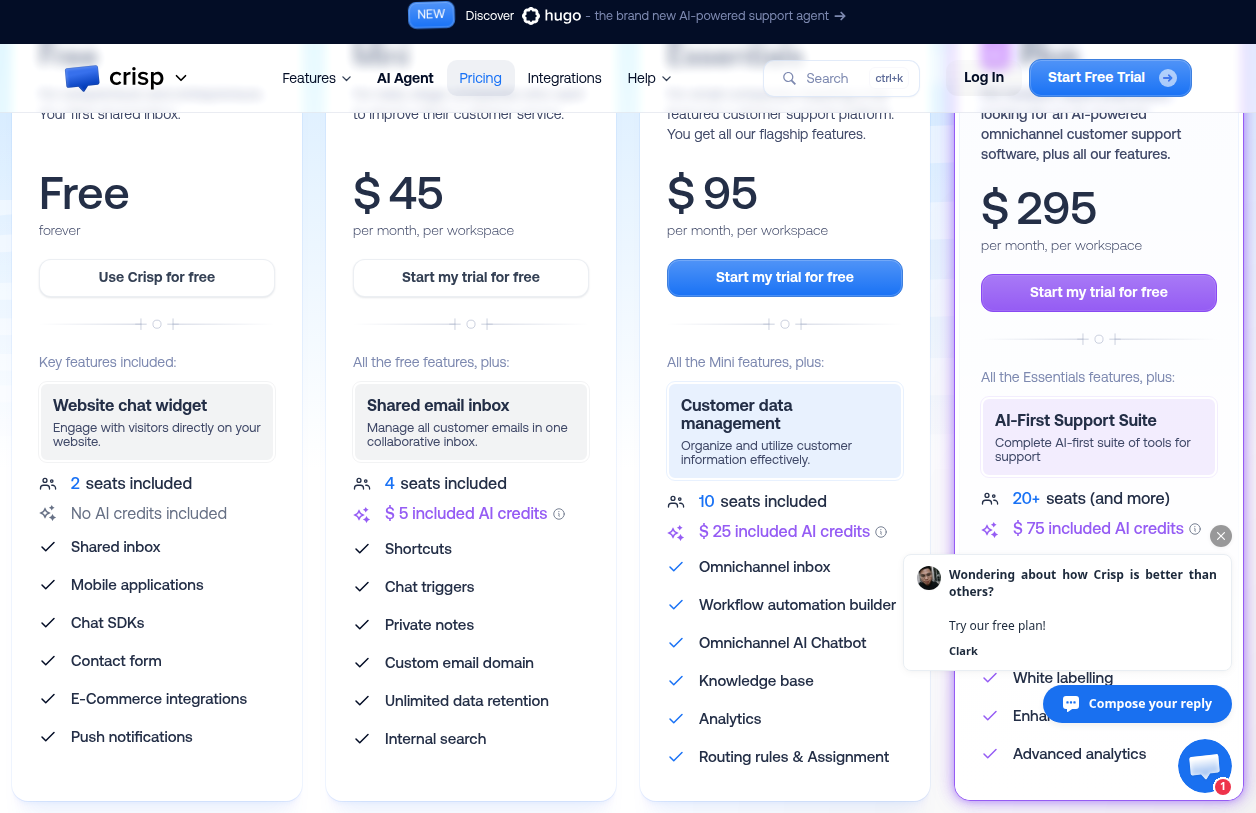
Crisp Pricing: Flat, Predictable, Per-Workspace
Crisp charges per workspace, not per agent. You pay one price regardless of how many conversations you handle.
| Plan | Monthly Price | Seats Included | AI Credits | Key Addition |
|---|---|---|---|---|
| Free | $0 | 2 | $0 | Chat widget, shared inbox, mobile apps, e-commerce integrations |
| Mini | $45 | 4 | $5 (~90 conversations) | Shared email inbox, shortcuts, chat triggers, custom email domain |
| Essentials | $95 | 10 | $25 (~450 conversations) | Omnichannel inbox, workflow automation, AI chatbot, knowledge base, analytics |
| Plus | $295 | 20+ | $75 (~1,350 conversations) | AI-first suite, ticketing, 100+ integrations, white labelling, advanced analytics |
| Enterprise | Custom | Custom | Custom | Dedicated onboarding, personalized SLA, custom features, team training |
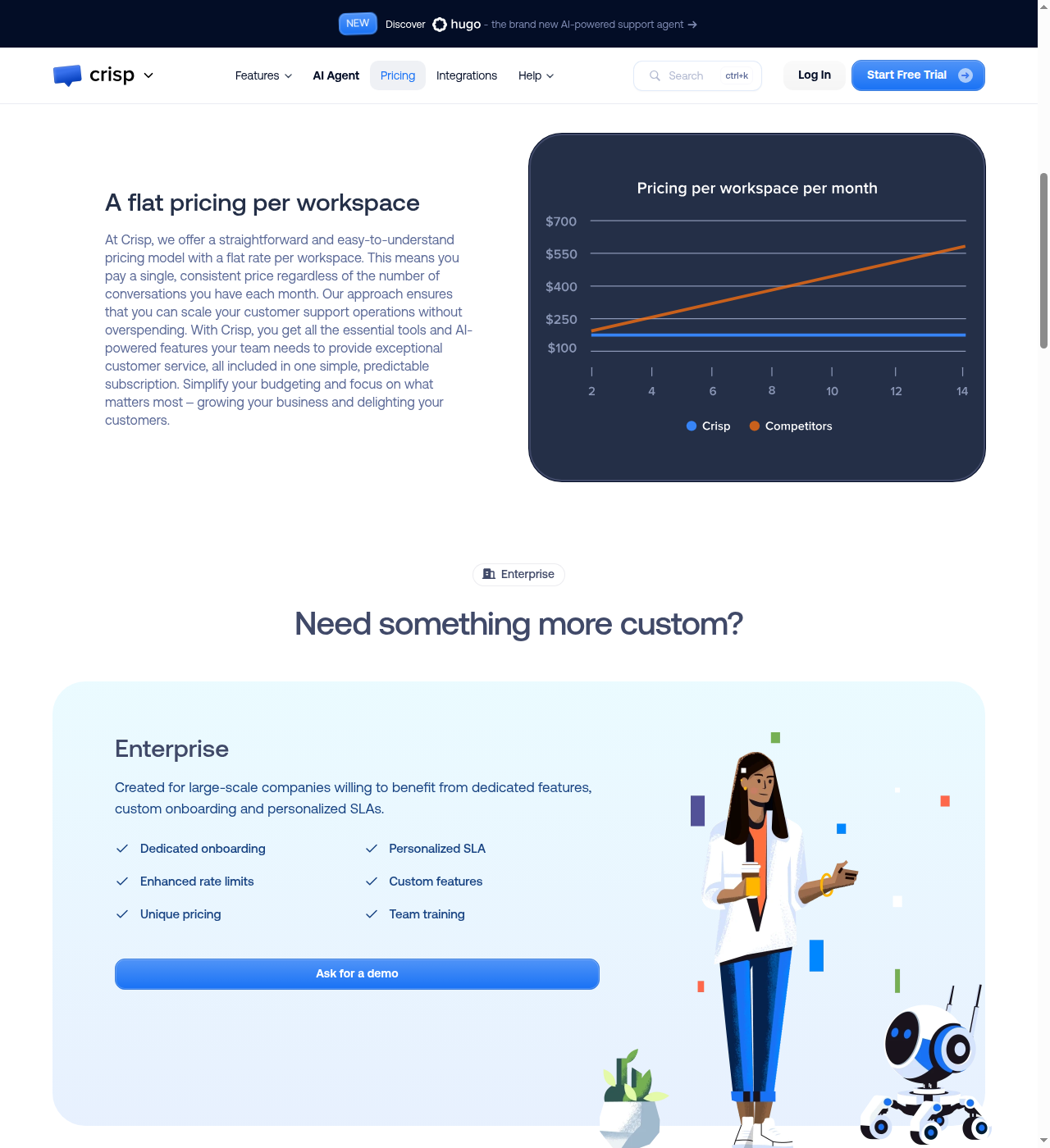
Additional seats beyond the included count cost $10/month on the Plus plan. There are no conversation-based charges: unlimited conversations on every plan.
Crisp’s pricing page confirms yearly billing is available (“You can enable yearly payment mode on your Plans page in the Crisp app after you subscribed to a plan”), but the discount percentage is only shown after you’ve already subscribed and logged into the app; it isn’t published on the public pricing page.
The Plus plan’s “20+ seats” means 20 seats are included in the base price, with additional agents billed at $10/month each beyond that.
Intercom Pricing: Per-Seat Plus Per-Outcome
Intercom charges per full seat plus $0.99 per Fin AI outcome. Add-ons for Copilot, Pro analytics, and Proactive Support Plus are separate charges.
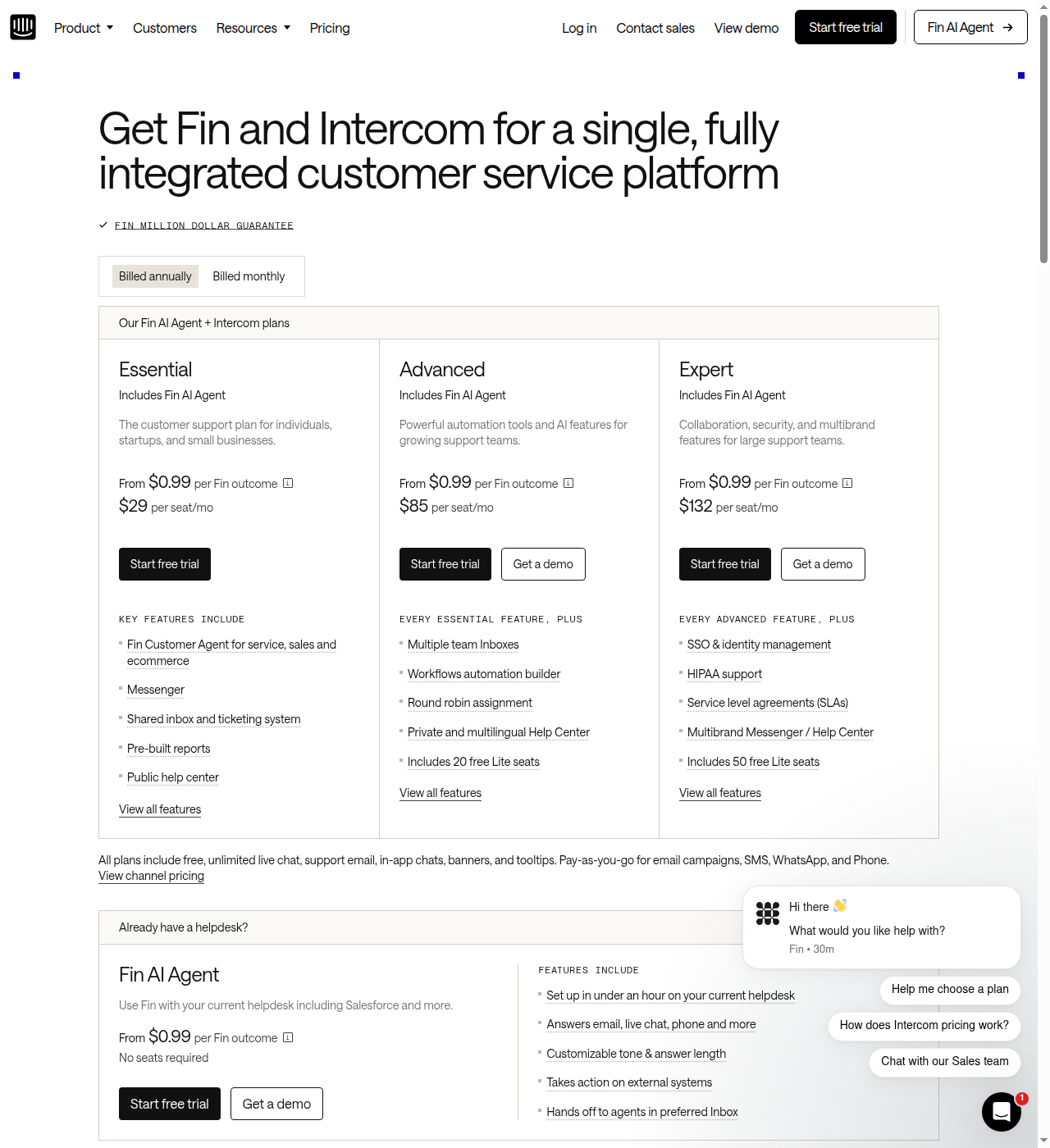
| Plan | Price per Seat/mo | Fin Outcomes | Key Features |
|---|---|---|---|
| Essential | $29 | From $0.99/outcome | Fin AI Agent, Messenger, shared inbox, ticketing, pre-built reports, public help center |
| Advanced | $85 | From $0.99/outcome | Multiple inboxes, workflows automation builder, round robin, private/multilingual help center, 20 free Lite seats |
| Expert | $132 | From $0.99/outcome | SSO & identity management, HIPAA support, SLAs, multibrand, 50 free Lite seats |
| Fin (standalone) | No seats required | $0.99/outcome | Use Fin with existing helpdesk (Salesforce, HubSpot, etc.) |
Add-ons (optional, separate charges):
- Pro: $99/mo (AI insights, CX Score, Topics, Recommendations, includes 1,000 conversations analyzed/mo)
- Copilot: $29/agent/mo (unlimited AI assistant usage)
- Proactive Support Plus: $99/mo (product tours, checklists, surveys, in-app messages, includes 500 messages/mo)
The Intercom Essential plan does not include the workflows automation builder.
The Intercom Expert plan includes SSO, HIPAA support, and SLAs at the $132/seat price.
TCO Comparison: 10-Agent Team, Moderate AI
Let’s model a 10-agent team handling 500 AI-assisted resolutions per month, with all the standard add-ons.
| Cost Item | Crisp Plus | Intercom Advanced |
|---|---|---|
| Base/platform | $295/mo | $850/mo (10 x $85) |
| AI/Fin | Included ($75 credits) | $495/mo (500 x $0.99) |
| Copilot | Included | $290/mo (10 x $29) |
| Proactive tools | Included (campaigns) | $99/mo (Proactive Support Plus) |
| Analytics/insights | Included (custom dashboards) | $99/mo (Pro add-on) |
| Ticketing | Included | Included |
| CRM | Included (built-in) | Not included (requires separate tool) |
| Status page | Included | Not included (requires separate tool) |
| Monthly total | $295 | $1,833+ |
That’s a 6.2x difference. At 20 agents, the Intercom side would be roughly $3,500+/mo while Crisp stays at $295 (or $295 + 10 extra seats at $10 each if you have 30 agents).
Prices accurate as of June 2026; check the vendor’s site for current rates. These figures use annual billing rates for Intercom where applicable.
AI Agent Showdown: Hugo vs Fin
Hugo (Crisp)
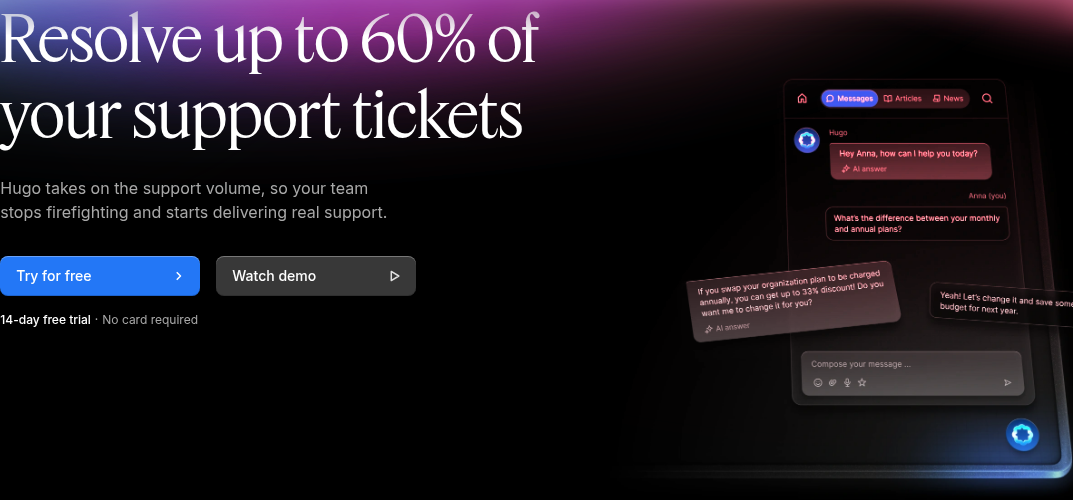
Hugo is Crisp’s dedicated AI agent, launched prominently in 2026. It’s a standalone product (hugo.ai) that also integrates natively with the Crisp platform.
Key characteristics:
- Model-agnostic: You choose the underlying model: Claude, ChatGPT, Llama, or your own custom model. Hugo adapts instantly.
- MCP (Model Context Protocol) server: Hugo connects to live business tools via MCP, enabling it to access real data and perform actions (not just answer questions).
- No-code builder: Anyone on the team can train and deploy Hugo in minutes. Four-step setup: train, build workflow, deploy, measure.
- Resolution rates: Case studies claim 60% (AFS Foiling), 40% (Emma), 40% (Spider VO). These are smaller European companies, not enterprise-scale proof points.
- AI credits model: Each Crisp plan includes a set dollar amount of AI credits. Credits cover AI conversations; if you exceed them, you pay as you go. No per-resolution billing.
- Internal AI Copilot: Agents get an AI assistant that suggests answers, summarizes conversations, and pulls context.
Hugo’s edge: The MCP architecture and model-agnostic design are genuinely forward-looking. Instead of being locked into Intercom’s proprietary models, you control which AI brain powers your support. For technically sophisticated teams, this flexibility matters.
Hugo’s weakness: The case studies are thin compared to Intercom’s. AFS Foiling, Emma, and Spider VO are not household names. There’s no Anthropic-level endorsement, no published benchmark data against competitors, and no third-party verification of those resolution rate claims.
Fin (Intercom)
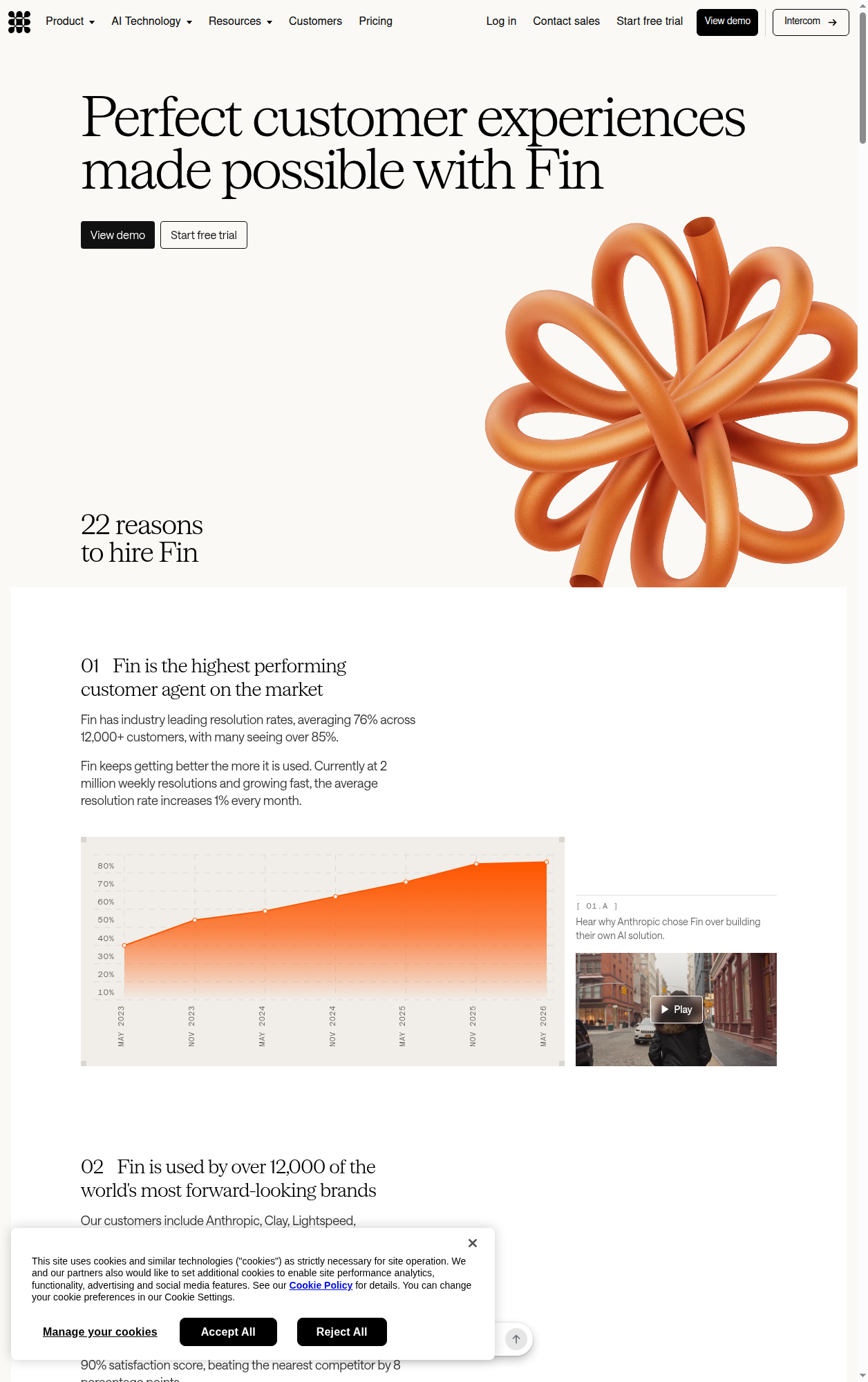
Fin is Intercom’s AI agent, positioned as “the highest performing Customer Agent” on the market. It’s battle-tested by over 12,000 customers including Anthropic, DoorDash, and Riot Games.
Key characteristics:
- Proprietary models (Apex 1.0 and Apex Flash): Custom-trained on billions of customer experience interactions. Claims 2.8% higher resolution rate and 65% fewer hallucinations than Sonnet 4.6.
- Resolution rate: Averages 76% across 12,000+ customers, with many seeing over 85%. Rate increases 1% every month as the system learns.
- Outcome-based pricing: $0.99 per Fin outcome (resolution, procedure handoff, or disqualification). You only pay when Fin delivers value.
- Full testing suite: Run simulated conversations before going live. Regression testing, manual inspection, and one-click recommendations.
- Procedures: Fin can take complex multi-step actions on external systems: process refunds, update accounts, troubleshoot technical issues.
- Enterprise trust: SOC 2, ISO 27001, ISO 42001, HIPAA, GDPR, SSO, SCIM, IP restrictions. Data can be hosted in US, EU, or Australia.
- Customer proof: Anthropic chose Fin over building their own solution. Lightspeed reports 65% resolution. Robin reports 50%. Synthesia cut resolution time by 96%.
Fin’s edge: Maturity. This isn’t a 2026 launch. Fin has been iterating since 2023. The customer roster is the strongest in the category. The pricing model means you only pay for value, but that value can add up fast.
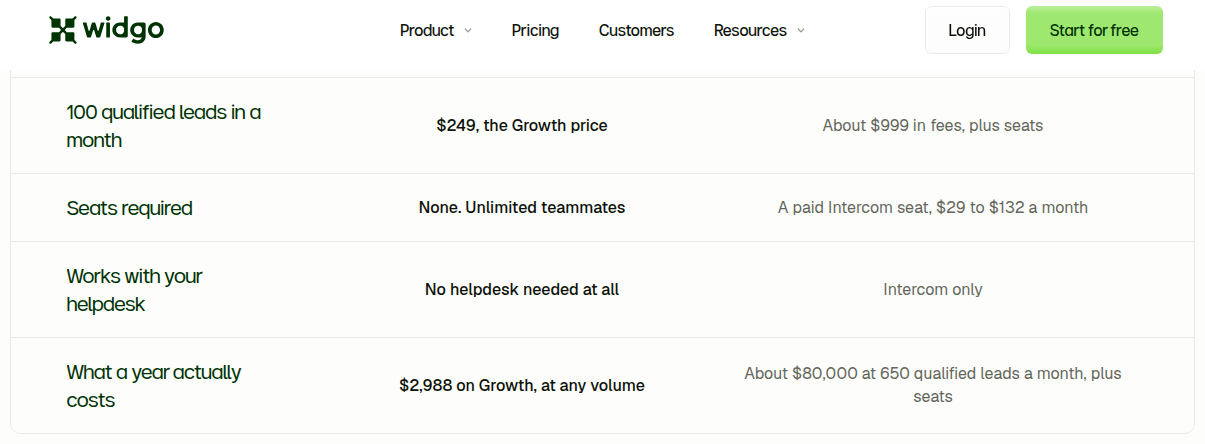
Fin’s weakness: The per-outcome pricing creates unpredictable bills. If your support volume spikes, your Fin bill spikes with it. And because Copilot, Pro analytics, and Proactive Support are all separate add-ons, the sticker price of “$29/seat” is misleading. The real cost for a fully-loaded setup is much higher. The same model gets steeper when Fin moves from support to sales: a qualification routed to a rep costs $9.99 per outcome on top of the seat charge, a cost gap we price out in our Widgo vs Fin comparison, where Widgo wins for teams that want a flat bill and Fin wins for Intercom shops that want unified sales routing.
No independent third-party benchmark of Hugo vs. Fin resolution rates exists. Both vendors cite only their own customer data: Hugo claims up to 60% (smaller European companies), Fin claims a 76% average across 12,000+ customers. These numbers aren’t directly comparable given the very different customer profiles behind them.
Pricing Model Philosophy: Flat vs Usage-Based
This is the core philosophical difference between the two products, and it determines who each tool is right for.
Crisp’s flat model works for:
- Teams that want predictable monthly bills
- Growing teams where per-seat costs would spiral
- Companies that handle high conversation volumes (unlimited conversations)
- Businesses that prefer an all-in-one bundle (CRM, ticketing, status page included)
Intercom’s usage-based model works for:
- Teams willing to pay for outcomes rather than access
- Companies that want the option to start small and scale usage
- Organizations that value the discipline of paying only for resolved interactions
- Teams using the startup program (93% off for 1-3 years)
The flat model favors larger teams. The per-seat model favors smaller teams. This is the reverse of what most software does, and it’s why a 10-agent team faces a 6x price gap.
Feature Depth Comparison
| Feature Area | Crisp | Intercom |
|---|---|---|
| Live chat widget | Yes (customizable, SDKs) | Yes (Messenger, in-app, mobile, web) |
| Omnichannel inbox | Yes (WhatsApp, Messenger, Instagram, SMS, Telegram, Line, Viber, email) | Yes (email, chat, phone, WhatsApp, social) |
| AI agent | Hugo (MCP, model-agnostic) | Fin (proprietary Apex models) |
| AI pricing model | Credits included in plan | $0.99/outcome |
| Built-in CRM | Yes (profiles, segments, lifecycle) | Basic profiles only (no full CRM) |
| Knowledge base | Yes (multilingual, custom domain, SEO) | Yes (public/private, multilingual) |
| Ticketing | Yes (customer portal) | Yes (AI-powered) |
| Status page | Yes (included) | No (requires separate tool) |
| Workflow automation | No-code visual builder | No-code automation builder (Advanced+) |
| Proactive outbound | Campaigns (email, in-app) | Proactive Support Plus (tours, checklists, surveys, mobile push) |
| Integrations | 100+ (Plus plan) | 350+ App Store |
| SSO | Not publicly offered on any plan | Expert plan (included) |
| HIPAA | Not publicly offered on any plan | Expert plan (included) |
| Data residency | EU-hosted (Netherlands, Germany) | US, EU, or Australia |
| Uptime SLA | No public percentage (Enterprise gets a “Personalized SLA,” undisclosed) | 99.8% SLA |
| Free plan | Yes (2 seats, basic features) | No (14-day trial only) |
Where Crisp Loses
AI maturity and enterprise trust. Hugo’s case studies are small European companies. Intercom’s Fin has Anthropic as both a customer and a partner. If you’re a US-based company that needs AI you can bet the business on, Intercom’s track record is harder to dismiss.
Integration depth. 100+ integrations on the Plus plan vs Intercom’s 350+. No native deep Salesforce or Jira integration at Intercom’s level. If your support workflows are tightly coupled to Salesforce, Intercom is the safer bet.
Proactive outbound. Crisp’s campaigns feature is basic compared to Intercom’s Proactive Support Plus. Product tours, interactive checklists, in-app tooltips, mobile push, and targeted messaging sequences are all Intercom territory that Crisp doesn’t match.
Enterprise compliance. No public SSO, SCIM, or HIPAA on Crisp. Intercom’s Expert plan includes all three. For compliance-heavy industries (healthcare, finance, enterprise), this alone can disqualify Crisp.
Free plan depth. Crisp Free is extremely limited: 2 seats, zero AI credits, 100 customer profiles. Intercom’s startup program (93% off + 1 year Fin free) is more generous for early-stage companies, if you qualify.
Brand recognition (US). Crisp is well-known in Europe but less recognized in the US. For teams that care about resume compatibility or executive buy-in, Intercom’s brand carries weight.
Where Intercom Loses
Cost escalation. This is the headline problem. A 10-agent Advanced team with Copilot, Pro, and Proactive Support Plus hits $1,833+/mo before Fin outcomes. At 20 agents, you’re looking at roughly $3,500+/mo. Crisp stays at $295 (or marginally more for extra seats).
Add-on fatigue. Intercom’s pricing structure is genuinely confusing. Copilot ($29/agent), Pro ($99), Proactive Support Plus ($99). Each is a separate decision and a separate line item. What Crisp bundles in Plus for $295 flat, Intercom spreads across 3-4 separate charges.
No built-in CRM. Intercom has customer profiles and activity timelines but no full CRM. If you need contact management, segmentation, and lifecycle tracking inside your support tool, Crisp includes it. Intercom expects you to integrate an external CRM.
No status page. Infrastructure status pages aren’t a core support feature for everyone, but if you need one, Intercom doesn’t offer it. Crisp includes infrastructure monitoring and incident notifications.
Unpredictable AI bills. $0.99 per Fin outcome means your bill scales linearly with customer inquiries. A viral product launch or a seasonal spike hits your Intercom bill directly. Crisp’s unlimited conversations and included AI credits mean your monthly cost is fixed.
US-centric data processing. Intercom’s primary data processing is US-based, with EU and Australia as add-on options. For EU companies with strict GDPR requirements, Crisp’s EU-native hosting (Netherlands + Germany) may be simpler to justify to compliance teams.
Startup Program: The Intercom Wildcard
Intercom’s Early Stage program changes the math for qualifying companies. Here’s what it includes:

Year 1: 93% discount: you pay $65/mo for 6 Advanced seats, 6 Copilot seats, 20 Lite seats, Proactive Support Plus, and Pro. Plus 300 free Fin outcomes and 15 qualifications per month.
Year 2: 50% discount: $451.50/mo with 165 free outcomes (for post-April 2025 joiners).
Year 3: 25% discount: $677.25/mo with 90 free outcomes.
Eligibility: Under $10M in funding, fewer than 15 employees, not an existing Intercom customer.
The catch: The 93% discount applies to seats and add-ons but NOT to additional Fin outcomes beyond the free allocation, SMS, outbound WhatsApp, or Phone usage. After year 3, you graduate to full list price. Some features (SSO, HIPAA, SLAs, multibrand) are Expert-only and not available in the startup program.
The 93% discount applies to seats and add-ons, but does not apply to Fin outcomes beyond the free allocation, SMS, outbound WhatsApp, or Phone.
If you qualify, the startup program is genuinely compelling. $65/mo for a full Intercom suite is cheaper than Crisp Essentials ($95). But you need a plan for year 4 and beyond, when you’re paying full list price.
Data Residency: EU-Native vs US-Native
This matters more than most comparison posts acknowledge.
Crisp is a French company (Crisp IM SAS). All messaging data is hosted in the Netherlands, plugin servers in Germany. GDPR compliance is the default, not an add-on. DPA available. TLS encryption. 2FA included on all plans.
Intercom is a US company (San Francisco, with a Dublin office). US hosting is the default. EU and Australia hosting are available as options. GDPR compliance is certified. SOC 2, ISO 27001, ISO 27701, HIPAA, CCPA. SSO and SCIM on Expert plan.
For EU companies that need to demonstrate data sovereignty to regulators or clients, Crisp’s EU-native setup simplifies compliance. For companies that need HIPAA or ISO 42001 (AI management), Intercom is the only option of the two.
Crisp vs Intercom: FAQ
Is Crisp cheaper than Intercom?
For teams of 10 or more agents, dramatically so. Crisp charges a flat per-workspace rate ($295/month on Plus with 20 seats and unlimited conversations included), while Intercom charges per seat ($29-$132/month each) plus $0.99 per Fin AI outcome plus separate add-ons. Our 10-agent model came out to $295/month on Crisp vs $1,833+/month on Intercom — a 6.2x gap. Under 5 agents the gap narrows: Intercom Essential for 5 agents is $145/month vs Crisp Essentials at $95.
Which is better, Crisp or Intercom?
It depends on team size and compliance needs, not on one tool being objectively better. Crisp wins for 10+ agent teams that want a predictable bill and a bundled CRM, ticketing, and status page; it’s also EU-native (data hosted in the Netherlands and Germany). Intercom wins if you need HIPAA, SSO, or SLAs (Expert plan), deep Salesforce/Jira workflows from its 350+ app ecosystem, or the most battle-tested AI agent in the category.
Does Crisp have an AI agent like Intercom’s Fin?
Yes — Hugo. It’s model-agnostic (you choose Claude, ChatGPT, Llama, or a custom model), connects to live business tools via MCP, and is billed through AI credits already included in each plan ($75 worth on Plus) rather than per resolution. Fin is the more proven agent: a 76% average resolution rate across 12,000+ customers including Anthropic, vs Hugo’s 40-60% claims from smaller European case studies. No independent third-party benchmark of the two exists.
Does Intercom have a free plan?
No — Intercom offers a 14-day trial only, while Crisp has a genuine free plan (2 seats, chat widget, shared inbox, mobile apps, but zero AI credits). What Intercom offers instead is its Early Stage startup program: 93% off in year 1 (about $65/month for a full suite) if you have under $10M in funding, fewer than 15 employees, and aren’t an existing customer — but the discount steps down to 50% then 25%, and you pay full list price from year 4.
Why is Intercom so expensive?
Because the costs stack. The advertised $29-$132 per seat is only the base: Fin AI costs $0.99 per outcome, and Copilot ($29/agent/month), Pro analytics ($99/month), and Proactive Support Plus ($99/month) are all separate add-ons. A fully loaded 10-agent Advanced setup reaches $1,833+/month, and because Fin is billed per outcome, a spike in support volume raises the bill with it. Crisp bundles the equivalent features into one flat $295/month rate.
Bottom Line
Pick Crisp if:
- You have 10+ agents and the per-seat math kills you
- You want a predictable monthly bill with no per-resolution surprises
- You need CRM, ticketing, and a status page bundled in one price
- EU data residency is a hard requirement
- You value model flexibility (MCP, choice of AI brain) over proven enterprise AI
Pick Intercom if:
- You need HIPAA, SSO, or SLAs for compliance
- Your support stack is deeply integrated with Salesforce, Jira, or 350+ other apps
- You want the most battle-tested AI agent (Anthropic-backed, 12,000+ customers)
- You need sophisticated proactive outbound (product tours, checklists, mobile push, surveys)
- You qualify for the startup program and can plan for post-year-3 pricing
- You’re under 10 agents where the per-seat cost gap is smaller
Who this comparison is wrong for:
- Teams under 5 agents: The price gap narrows significantly. Intercom Essential at $29/seat ($145/mo for 5 agents) vs Crisp Essentials at $95 is comparable. At this size, feature fit matters more than cost.
- Teams that need voice-first support: Neither tool is primarily phone-focused. Look at Aircall, Talkdesk, or a dedicated contact center platform. If it’s calls you need answered rather than a chat inbox staffed, our Zinley vs Smith.ai comparison covers AI-versus-human answering for small teams.
- Ecommerce-only shops: Gorgias is more purpose-built for Shopify/WooCommerce integration. Crisp and Intercom both support ecommerce but aren’t specialized.
Support inboxes only catch the people who write in. If you also want to see what is said about you elsewhere, Octolens vs Brand24 splits it by where your users actually are: Octolens watches GitHub, Hacker News and Stack Overflow, Brand24 covers Facebook, Instagram and review sites with deeper analytics.