15 June 2026 · Comparison
Best Gumroad Alternatives 2026: Sellfy, Payhip, and More
The short answer
Leaving Gumroad after the 10% fee hike? Sellfy wins for most creators with 0% fees and print-on-demand. See how Payhip, Lemon Squeezy, and Podia compare.
Verdict: Sellfy is the best Gumroad alternative for most creators. If you’re selling digital products, want 0% platform fees, and could use built-in print-on-demand and email marketing, Sellfy is the clear pick. But it’s wrong for creators who need a free plan to start, software license keys, or a full course builder. Here’s how every alternative stacks up.
Affiliate disclosure: Some links in this post are affiliate links. If you click through and make a purchase, we may earn a commission at no extra cost to you. Sellfy is an affiliate partner.
Why Creators Are Leaving Gumroad
Gumroad built its reputation on dead-simple digital product sales with no monthly fee. But the math changed for many creators when the 10% flat transaction fee started eating into real money. On $3,000 in monthly sales, Gumroad takes $300 plus $0.50 per transaction. On $5,000, it’s $500. That’s real money that could fund a paid plan on a platform with zero transaction fees.
Gumroad also has real strengths worth acknowledging: it’s the simplest onboarding in the space, handles global taxes as Merchant of Record since January 2025, and has a built-in Discover marketplace. But for creators who’ve grown past the “free is good enough” stage, the alternatives look increasingly better.
Here’s every meaningful Gumroad alternative, ranked by who each one is actually right for.
The Comparison At a Glance
| Tool | Monthly Starting Price | Platform Fee | Free Plan | Best For |
|---|---|---|---|---|
| Sellfy | $22/mo (annual) | 0% | No (14-day trial) | Digital + physical + merch |
| Gumroad | $0 | 10% + $0.50 | Yes | Simplest setup, zero risk |
| Payhip | $0 | 5% (Free) / 2% (Plus, $29/mo) / 0% (Pro, $99/mo) | Yes | EU sellers, budget start |
| Lemon Squeezy | $0 (ecommerce) | 5% + $0.50 | Yes | Software sellers, MoR tax |
| Podia | $42/mo (annual) / $49/mo (monthly) | 5% (Mover) / 0% (higher) | No (30-day trial) | Courses + community |
| Stan Store | Not published (signup required) | 0% | No (14-day trial) | Social media creators |
| Shopify | €24/mo (annual) | 1.6%+ (card rates) | No (3-day trial) | Physical + digital businesses |
Prices accurate as of June 2026; check the vendor’s site for current rates. Payment processing fees (Stripe/PayPal, typically ~2.9% + $0.30) are additional on all platforms unless noted.
Sellfy: Best All-Around Gumroad Alternative
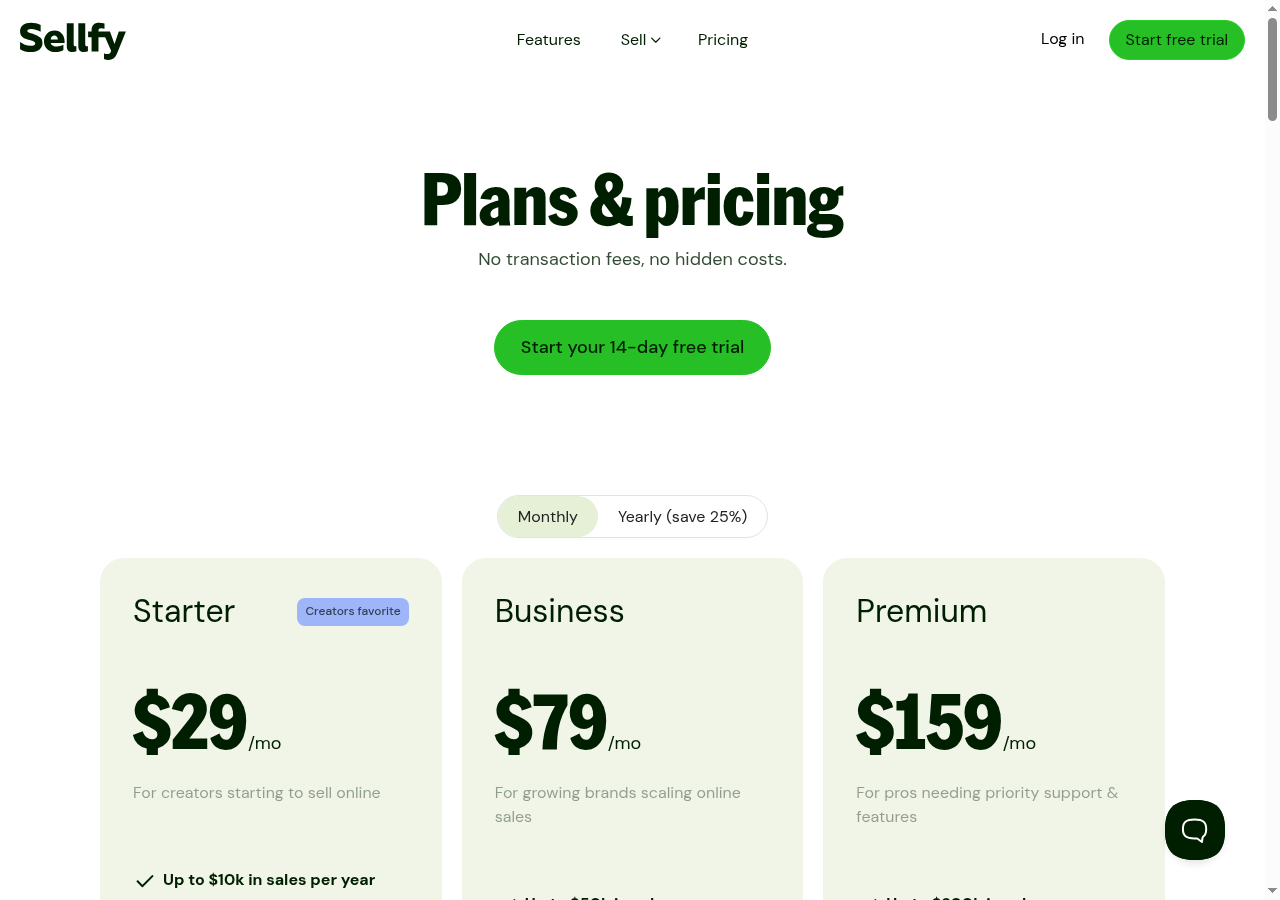
Sellfy is the headline recommendation because it solves Gumroad’s biggest problem: the fee model. Sellfy charges a flat monthly subscription with 0% transaction fees on all plans. There’s no percentage cut on your sales. If you sell $10,000 in a month, Sellfy keeps $0 of that $10,000 beyond your plan cost. Gumroad would keep $1,000.
Pricing:
| Plan | Monthly | Annual (per mo) | Annual Sales Cap |
|---|---|---|---|
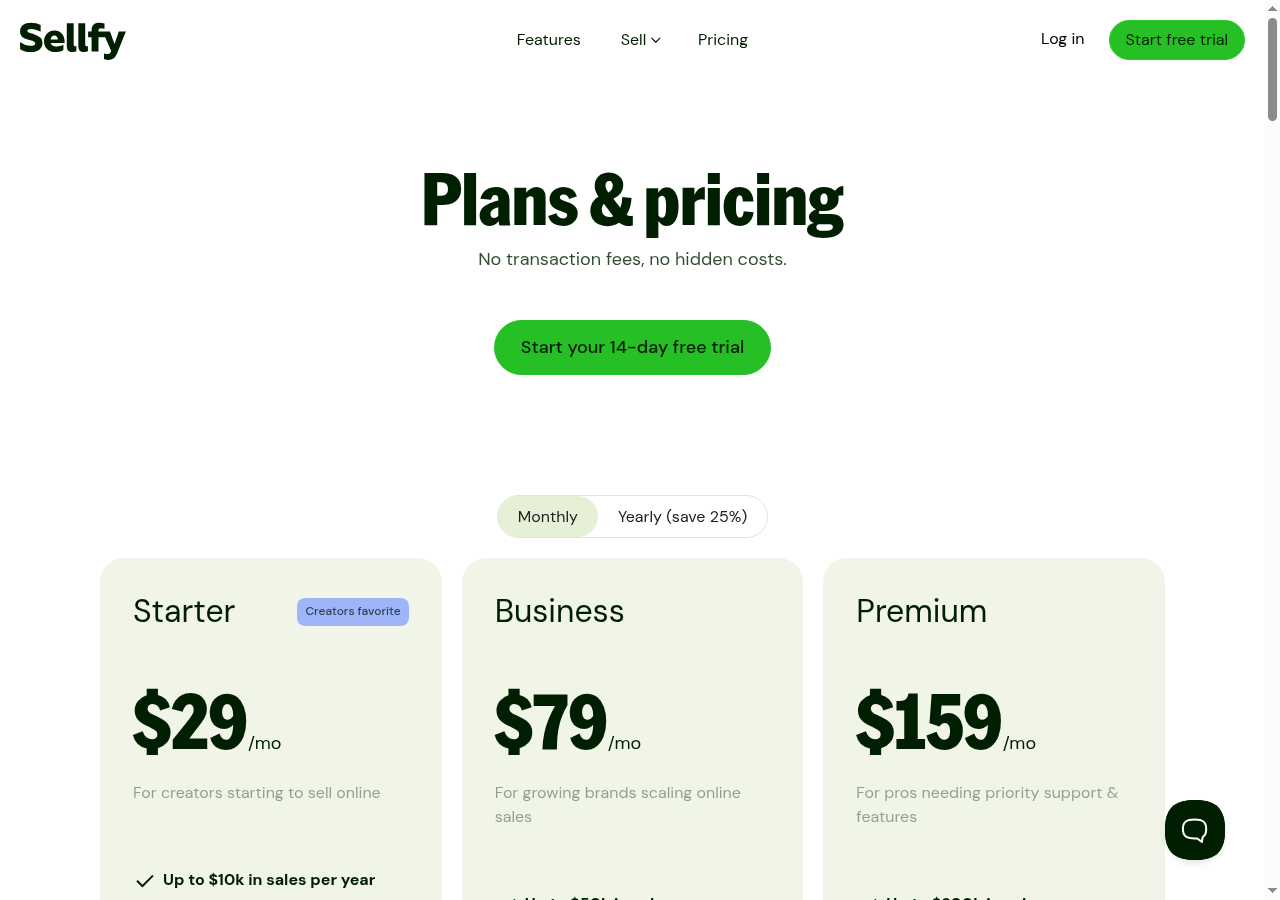
| Starter | $29/mo | $22/mo | Up to $10k/yr |
| Business | $79/mo | $59/mo | Up to $50k/yr |
| Premium | $159/mo | $119/mo | Up to $200k/yr |
All plans include 0% transaction fees, unlimited products, digital products, physical products, subscriptions, and print-on-demand. File size limits range from 10GB (Starter) to 20GB (Premium). If you exceed your annual sales cap, a 2% overage fee applies on the excess unless you upgrade.
What Sellfy does that Gumroad doesn’t:
- Built-in print-on-demand (t-shirts, hoodies, mugs — automatic production and fulfillment)
- Built-in email marketing with credits (2,000 on Starter, 10,000 on Business, 50,000 on Premium)
- PDF stamping for piracy deterrence
- Cart abandonment emails (Business+ plans)
- Built-in affiliate program (Business+ plans)
- Product upselling at checkout (Business+ plans)
- Store translation based on visitor location
Where Sellfy loses:
- No free plan. You must pay monthly. Gumroad, Payhip, and Lemon Squeezy all offer $0 to start.
- Annual revenue caps. If you outgrow your plan’s $10K/$50K/$200K cap, you pay 2% overage or must upgrade. There’s no unlimited-revenue tier.
- No course builder. You can sell course files but there are no student dashboards, quizzes, drip content, or certificates. Podia owns this space.
- No community features. No member forums, DMs, or chat.
- No license key generation. Software sellers should look at Lemon Squeezy or Gumroad.
- No “pay what you want” pricing. Gumroad and Lemon Squeezy have this.
- No public API. Sellfy offers webhooks and Zapier integration, but does not provide a traditional public REST API for developers.
- Simpler store design. Fewer themes and less customization depth than Shopify or Podia.
Who Sellfy is right for: Creators selling a mix of digital downloads, subscriptions, and physical merch. Video creators, musicians, and designers who want flat pricing and don’t need a course builder. Best for the $10K-$200K annual revenue range.
Who should skip Sellfy: Anyone who needs a free starting point, software license keys, a full online course platform, or unlimited revenue with no cap.
[Sellfy affiliate CTA: Start your 14-day free trial on Sellfy]
Gumroad: Still the Simplest, But You’ll Pay For It
Gumroad is the benchmark — and still the easiest way to start selling digital products. You can upload a file, set a price, and share a link in under five minutes. No monthly commitment, no plan to pick.
Pricing:
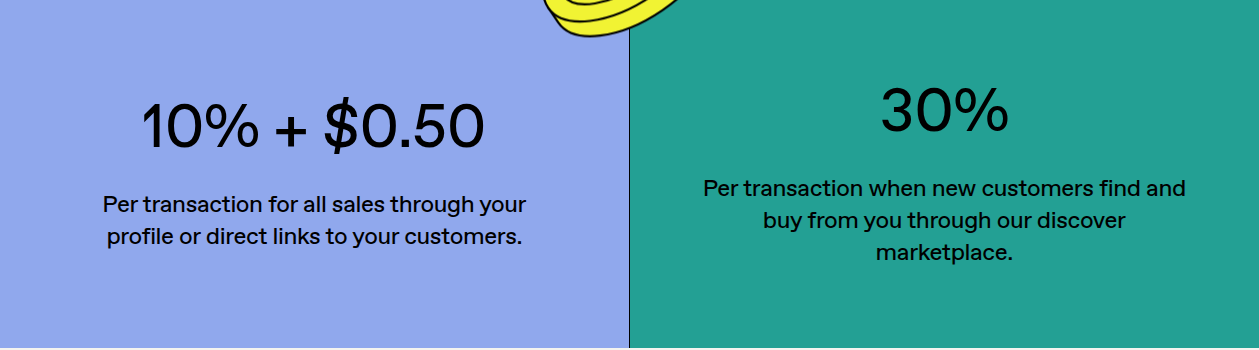
- $0/mo, 10% + $0.50 per transaction (direct sales)
- 30% per transaction (Discover marketplace sales)
- Merchant of Record since January 2025 — handles all global sales tax
The break-even math vs Sellfy: At $220/mo in sales, Gumroad’s 10% fee equals Sellfy Starter’s $22/mo annual price. At $500/mo in sales, Gumroad takes $50 vs Sellfy’s $22. At $3,000/mo, Gumroad takes $300 vs Sellfy’s $22. The higher your revenue climbs, the more dramatic Sellfy’s advantage becomes.
Where Gumroad still wins:
- Zero risk to start. No credit card, no commitment.
- Discover marketplace can bring you new customers (though at a 30% cut).
- License key generation for software products.
- “Pay what you want” pricing.
- Multiple file versions per product.
- 10 years of market presence and a massive creator community.
Where Gumroad loses:
- The 10% fee is punishing at scale. On $50K annual revenue, that’s $5,000 in platform fees.
- No built-in email marketing credits beyond broadcasts.
- No print-on-demand or physical products.
- No course builder, community features, or upselling tools.
- Store design options are minimal — you get a page, not a full storefront.
- No custom domain in the traditional sense (you live at username.gumroad.com).
- The 30% Discover fee feels like an app store tax.
Who Gumroad is right for: Creators just starting out who want zero upfront cost and maximum simplicity. Solo creators selling ebooks, templates, and simple digital downloads under $500/mo.
Payhip: The Free-Start Platform for EU Sellers
Payhip positions itself as a simple, free-to-start platform for selling digital products, with a focus on EU sellers thanks to built-in VAT handling.
Pricing:
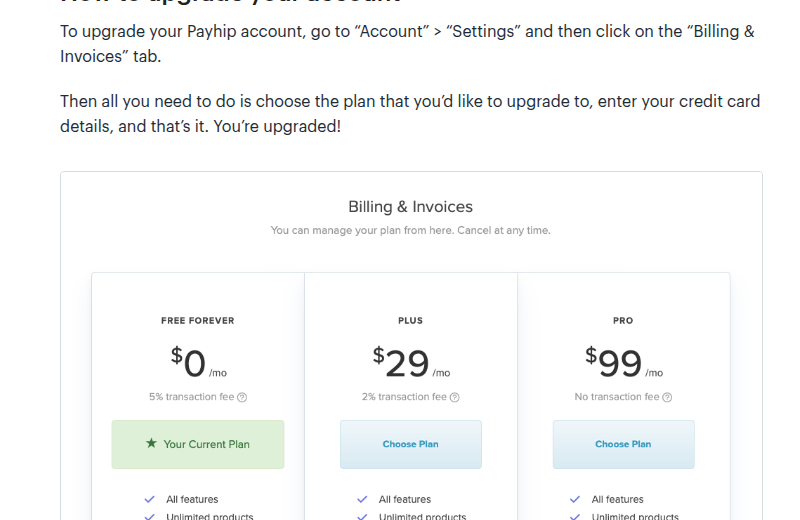
- Free Forever plan: $0/mo, all features and unlimited products, but a 5% transaction fee on every sale
- Plus plan: $29/mo, transaction fee drops to 2%
- Pro plan: $99/mo, no Payhip transaction fee at all (PayPal/Stripe processing fees still apply)
Where Payhip wins:
- Free plan with unlimited products and all features unlocked — you can start selling immediately
- EU VAT handling built in
- A genuine course builder: video/text/quiz/survey/assignment lessons, drip content, prerequisites, and certificates
- Membership sites with gated post feeds (text, video, image, polls) and scheduling
- Software license key generation (auto-generated or pre-uploaded keys, with verification)
- Affiliate program, referral system, coupons, and cross-selling tools
- Multiple store themes with a drag-and-drop store builder and custom domains
Where Payhip loses:
- Less brand recognition than Gumroad, Sellfy, or Shopify
- The public API currently covers only coupons and license keys — not a full storefront API like Lemon Squeezy’s
- No built-in print-on-demand network (Sellfy’s specialty)
- The 5% fee on the free plan, stacked with PayPal/Stripe processing fees, adds up quickly for low-revenue sellers compared to Pro’s 0%
Who Payhip is right for: EU-based creators wanting a free start with VAT handling and unlimited products. Budget-conscious course or membership creators who want Podia-style features (drip content, certificates, gated posts) without Podia’s price tag.
Lemon Squeezy: Best for Software Sellers and Global Tax Handling

Lemon Squeezy has carved out a loyal following, especially among software developers and SaaS founders. Its killer feature is being a full Merchant of Record — Lemon Squeezy takes legal liability for global tax collection, calculation, filing, and remittance.
Pricing:
- $0/mo for ecommerce features
- 5% + $0.50 per transaction
- Email marketing: $0/mo for up to 500 subscribers, then paid tiers scale with list size (e.g., $75/mo for 15,000 subscribers on the annual-discount rate).
- Volume-based pricing available for large sellers
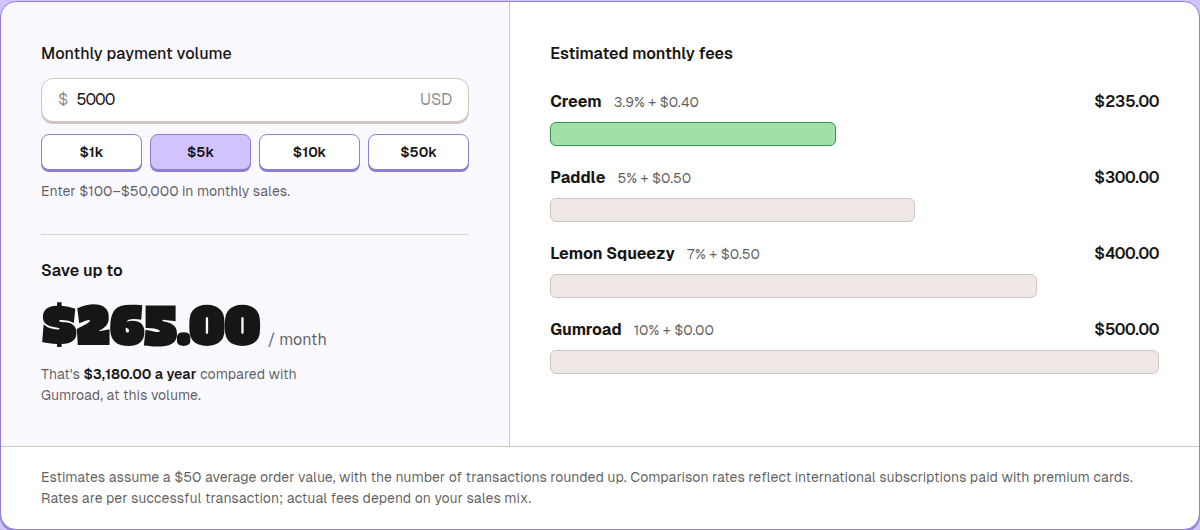
Key update: Stripe acquired Lemon Squeezy in July 2024. The team is now building “Stripe Managed Payments,” Stripe’s own Merchant of Record product. Lemon Squeezy itself continues to operate under “Sold through Link, LLC f/k/a Lemon Squeezy LLC,” but the long-term direction points toward migration to Stripe’s infrastructure. Current users should be aware of this transition. Our Creem vs Lemon Squeezy head-to-head prices that end-state: once the 3.5% Managed Payments fee stacks on Stripe’s card rates, the successor lands at 6.4-8.9% + 30¢, versus Creem’s flat 3.9% + 40¢ - which is why the challenger wins sellers on usage-based billing while Lemon Squeezy still suits anyone who wants Stripe-backed stability today.
Where Lemon Squeezy wins:
- Full Merchant of Record — files and pays taxes globally. This is massive for international sellers.
- Built-in license key management — automatic issue, deactivate, re-issue
- Strong API and developer docs
- Usage-based billing support
- AI fraud protection
- 21 payment methods, 130+ currencies
- Customer portal for self-service subscription management
- Abandoned cart and failed payment recovery
- Lead magnets and “pay what you want” pricing
Where Lemon Squeezy loses:
- 5% + $0.50 fee still stacks up. At $1,000/mo in sales, you pay $52.50 to Lemon Squeezy vs $22 to Sellfy Starter.
- Stripe acquisition creates uncertainty about long-term product direction
- No physical products or print-on-demand
- No course builder or student dashboard
- No community features
- Email marketing is capped at 500 free subscribers; paid tiers add cost
- Smaller ecosystem than Gumroad or Shopify
- No Discover marketplace — you drive your own traffic
Who Lemon Squeezy is right for: Software developers, SaaS founders, and anyone selling globally who wants tax liabilities handled. Creators comfortable with percentage-based pricing.
Who should skip Lemon Squeezy: High-volume sellers where the 5% fee exceeds what a flat-rate platform would cost. Course creators, community builders, and merch sellers.
Podia: Best for Courses, Community, and Coaching
Podia is the all-in-one for knowledge entrepreneurs. If your business is built around courses, memberships, coaching, and community, Podia does everything in one place.
Pricing (annual billing shown; monthly pricing is higher):
| Plan | Annual (per mo) | Monthly | Email Subs | Transaction Fee |
|---|---|---|---|---|
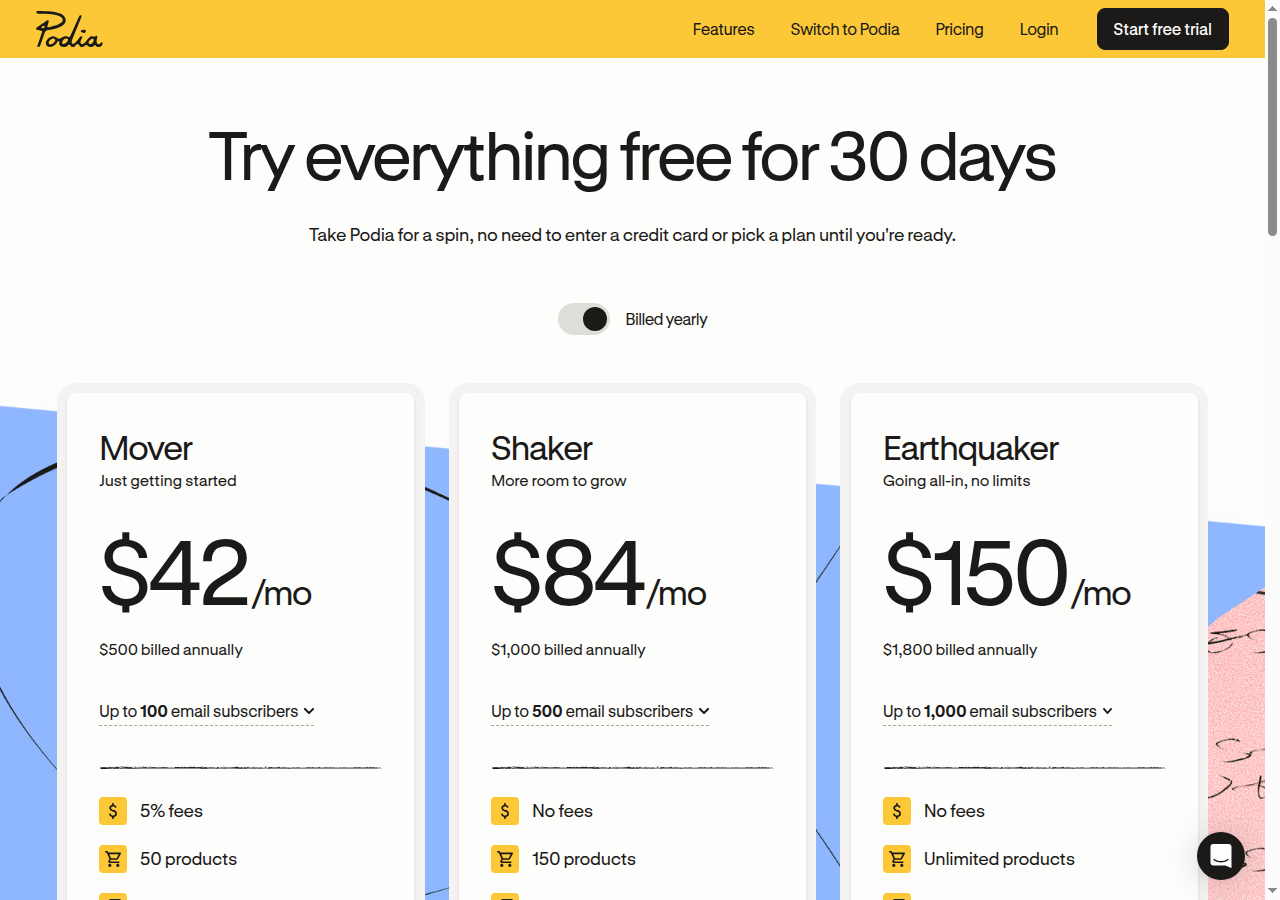
| Mover | $42/mo ($500/yr) | $49/mo | Up to 100 | 5% |
| Shaker | $84/mo ($1,000/yr) | $99/mo | Up to 500 | 0% |
| Earthquaker | $150/mo ($1,800/yr) | $179/mo | Up to 1,000 | 0% |
All plans include: online courses, digital downloads, coaching, community, events, website builder, blog, custom domain, 1,900+ integrations, and email/chat support. Payment processing via Stripe/PayPal adds ~2.9% + $0.30.
Where Podia wins:
- Full course builder with video/audio/text lessons, quizzes, drip content, certificates, student progress tracking, and cohort management
- Built-in community with spaces, DMs, group chat, activity feeds, and badges
- Built-in website builder with drag-and-drop, blog, and landing pages
- Full email marketing suite with broadcasts, automations, segmentation, and tags
- Coaching integrations (Calendly, SavvyCal, etc.)
- Affiliate marketing on Shaker+ plans
- No Podia fees on Shaker and Earthquaker plans
Where Podia loses:
- Expensive entry point. $42/mo (billed annually) is significantly more than Sellfy’s $22/mo, Gumroad’s $0, or Lemon Squeezy’s $0.
- 5% transaction fee on the Mover plan eats margins on your cheapest option
- Email subscriber caps are low — 100 on Mover, 500 on Shaker, 1,000 on Earthquaker. Sellfy gives 2,000 email credits on its cheapest plan.
- No print-on-demand or physical products
- No license key generation
- No “pay what you want” pricing
- No free plan — 30-day trial only
- No marketplace or product discovery
- Course-heavy: if you don’t need courses or community, you’re paying for features you won’t use
- File size limit of 5GB per file (Sellfy allows up to 20GB on Premium)
Who Podia is right for: Course creators, coaches, membership site owners, and community builders. If your business model revolves around teaching and community, Podia is purpose-built for you.
Who should skip Podia: Simple download sellers, software creators, merch-focused sellers, and anyone who doesn’t need the course/community stack. The price premium only makes sense if you use those features. If you are weighing exactly that trade, our Sellfy vs Podia comparison splits it by product type rather than price: Sellfy for physical products and merch at 0% fees, Podia for courses, coaching and communities.
Stan Store: Best for Social Media Creators
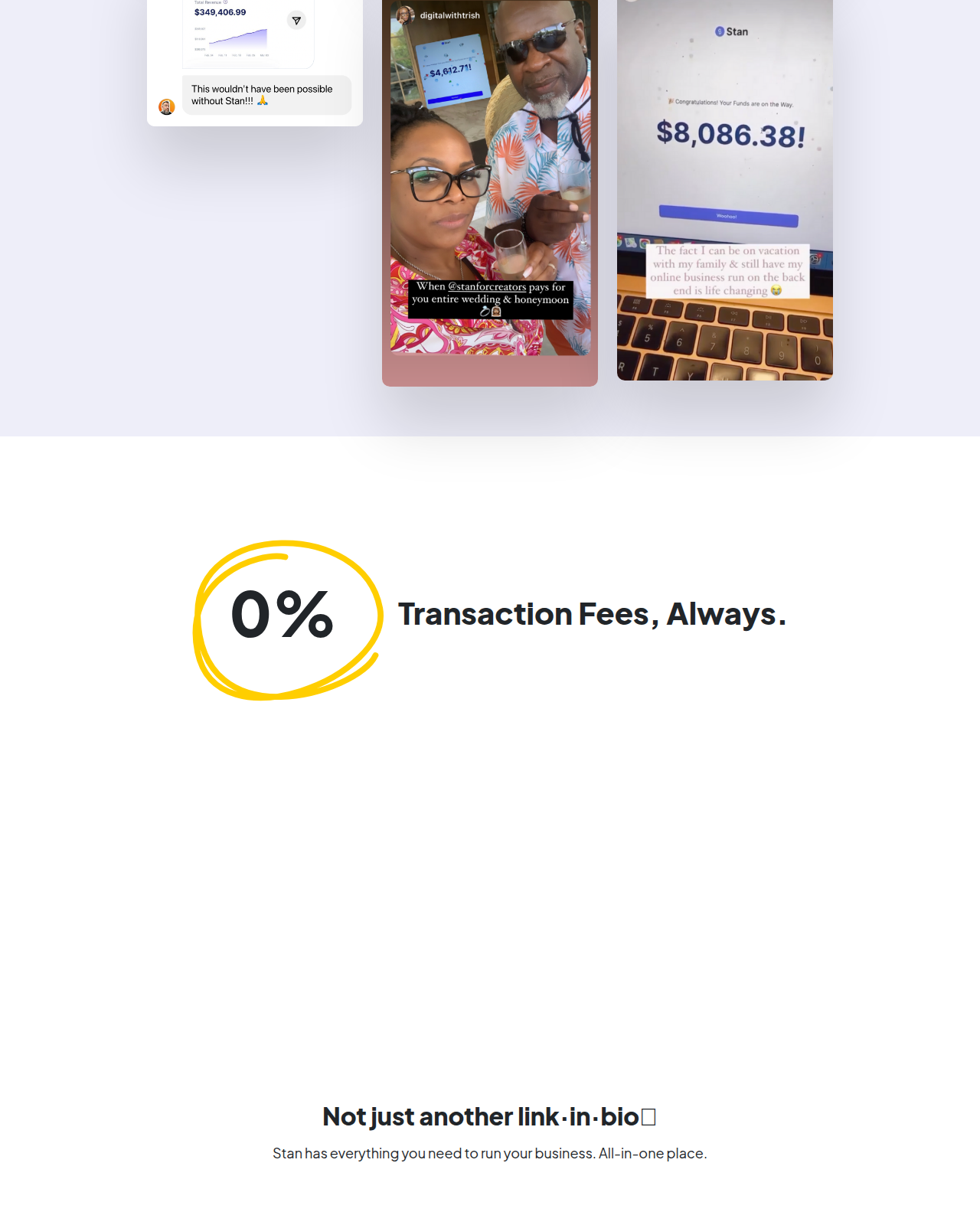

Stan Store is built for the Instagram/TikTok/YouTube creator workflow. It’s a link-in-bio commerce platform designed for mobile-first, social-driven selling.
Pricing:
- 0% transaction fees, always — confirmed on homepage
- 14-day free trial — confirmed on homepage
- Plan names, monthly prices, and feature gates are not published anywhere on Stan’s public site — the /pricing page itself returns “This Stan Store is currently under construction,” and details only surface once you sign up.
Where Stan Store wins:
- Purpose-built for social media creators — your store is your link-in-bio
- 0% transaction fees across all sales
- 1-Tap Checkout optimized for mobile conversion
- Stan AutoDM for automated Instagram DM responses
- Built-in email marketing, affiliate tools, upsells, and order bumps
- Stanley AI assistant for store management
- Courses, coaching, digital downloads, memberships, and webinars all supported
- No coding required
Where Stan Store loses:
- Pricing is opaque. Plan prices and feature gates are not publicly available without signing up.
- No print-on-demand or physical products — digital only
- No license key generation for software sellers
- Mobile-first design may feel limited on desktop
- Smaller, less proven platform than Sellfy, Gumroad, or Podia
- No marketplace or product discovery
- No Merchant of Record — you handle your own taxes
- No native custom domain support (requires forwarding rules) and no developer API (Zapier integration only).
- Course features are basic compared to Podia — no quizzes, certificates, drip, or cohorts
Who Stan Store is right for: Social media influencers and creators whose primary traffic source is Instagram, TikTok, or YouTube. Coaches and content creators who live inside the link-in-bio ecosystem.
Who should skip Stan Store: Traditional ecommerce sellers, software creators, anyone needing deep customization, or those who want transparent pricing before signing up.
Shopify: The Heavyweight (Overkill for Most Creators)
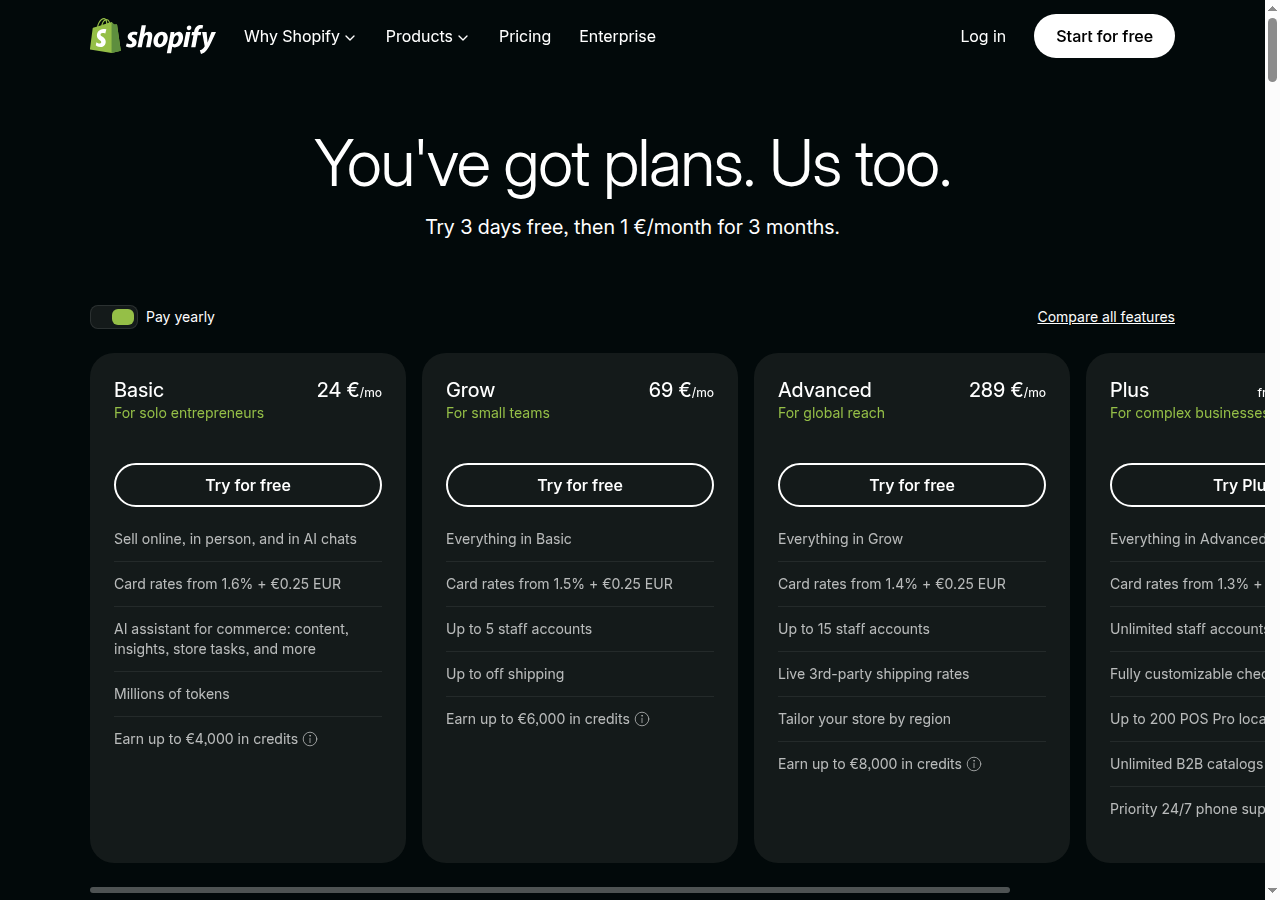
Shopify is the world’s largest ecommerce platform, and it can sell digital products — but it was built for physical goods. For a creator just selling ebooks or templates, Shopify is a sledgehammer when you need a screwdriver.
Pricing (EUR-based pricing as shown on Shopify’s public pricing page; USD pricing varies by country):
| Plan | Monthly | Annual (per mo) | Card Rates | Staff |
|---|---|---|---|---|
| Basic | €32/mo | €24/mo | From 1.6% + €0.25 | 1 owner |
| Grow | €92/mo | €69/mo | From 1.5% + €0.25 | 5 |
| Advanced | €384/mo | €289/mo | From 1.4% + €0.25 | 15 |
| Plus | From €2,100/mo | — | From 1.3% + €0.25 | Unlimited |
Pricing and card rates vary by country; check Shopify’s pricing page for your local currency.
Where Shopify wins:
- Massive ecosystem — thousands of apps, themes, and integrations
- Best-converting checkout in ecommerce (15% better than competitors, per Shopify)
- AI assistant (Sidekick), omnichannel selling, agentic commerce
- Full marketing suite with email, SMS, automations, and abandoned checkout recovery
- Sell everywhere: online, in-person (POS), social media, marketplaces, AI chats
- Unlimited products, unlimited bandwidth, free SSL
- 200+ professional themes
- Shopify Capital, Balance, and Credit for business financing
Where Shopify loses for digital product sellers:
- Overkill and overpriced. €24/mo minimum (annual) for what Gumroad does free. Most features (inventory, shipping, POS) are irrelevant to digital sellers.
- Digital downloads require an app. Not native. Adds friction and potential additional costs. Gumroad, Sellfy, and Lemon Squeezy do this out of the box.
- Transaction fees stack. Subscription + payment processing + possible app subscriptions + third-party provider fee if not using Shopify Payments.
- No built-in course builder, community, license keys, or “pay what you want” — all require separate paid apps.
- No Merchant of Record for digital products — you handle your own taxes.
- Steeper learning curve than any Gumroad alternative here.
- Forces you into their ecosystem — harder to migrate away.
Who Shopify is right for: Established businesses selling both physical and digital products. Brands that need a full ecommerce presence across all channels.
Who should skip Shopify: Solo creators selling ebooks, templates, or simple digital downloads. Anyone who doesn’t sell physical products. The cost and complexity don’t justify the use case.
Fee Model Breakdown: When Each Platform Makes Sense
The decision largely comes down to a single question: at what revenue level does a flat-fee platform beat a percentage-fee one?
At $500/mo in sales:
- Gumroad (10%): $50 in fees
- Lemon Squeezy (5%): $25 in fees
- Sellfy Starter (annual): $22 total
- Podia Mover (annual): $42 + 5% = $67 total
At $2,000/mo in sales:
- Gumroad: $200 in fees
- Lemon Squeezy: $100 in fees
- Sellfy Starter: $22 total (but $2,000/mo = $24K/yr, which exceeds the $10K cap — must upgrade to Business at $59/mo)
- Sellfy Business (annual): $59 total
- Podia Shaker (annual): $84 total, 0% fees
At $10,000/mo in sales:
- Gumroad: $1,000 in fees
- Lemon Squeezy: $500 in fees
- Sellfy Premium (annual): $119 total (covers up to $200K/yr)
- Podia Earthquaker (annual): $150 total, 0% fees
The break-even for Sellfy vs Gumroad happens around $220/mo in sales. Above that, Sellfy’s flat fee is cheaper. For a deeper head-to-head with screenshots and setup comparisons, read our Sellfy vs Gumroad comparison. For Lemon Squeezy, the break-even with Sellfy Starter is around $440/mo in sales (5% of $440 = $22). Above that, Sellfy costs less in platform fees. Gumroad’s 10% also looks different against a percentage-fee challenger than against a flat one: our Zolt vs Gumroad comparison works through why Zolt’s headline 2% is not all-in the way Gumroad’s 10% is, and why the ~$250/mo break-even mostly matters to MENA, India and UAE creators.
Also Worth Considering
A few platforms didn’t make the main roundup but deserve a mention:
- SamCart: A checkout-and-funnel platform built around order bumps, upsells, and A/B-tested checkout pages rather than a storefront. Core plan is $79/mo, Pro is $199/mo (both drop 25% on annual billing), plus SamCart’s own payment processing (SamPay) at 2.9% + $0.30 per transaction on top of the plan fee (verified on samcart.com/pricing, 2026-09-10). It shows up as a top pick on several other “Gumroad alternatives” roundups, but it’s really aimed at creators running high-ticket offers and sales funnels, not simple digital downloads — it’s a heavier, pricier tool than anything else on this list.
- Etsy: Worth naming because it’s the other place people already go to sell digital downloads, not just physical goods. Etsy charges $0.20 per listing (good for four months or until it sells, whichever comes first), plus a 6.5% transaction fee and a 3% + $0.25 payment processing fee on every sale — roughly $1.20 in per-sale fees on a $10 download, on top of the listing fee (verified on etsy.com/sell, 2026-09-10). Etsy’s advantage over everything else here is built-in shopper traffic; its disadvantage is that you’re renting a storefront on someone else’s marketplace, with no email list of your buyers unless you build one separately.
- Whop: A marketplace-and-storefront platform built around Discord/Telegram communities, courses, and digital products. No monthly plan fee — Whop charges 2.7% + $0.30 per domestic card transaction (plus 1.5% for international cards and 1% for currency conversion), and a separate 3% platform fee only applies when a sale is gated through Discord, Telegram, or TradingView (verified on whop.com/network/pricing, 2026-09-10). That’s a materially different model from Sellfy’s flat subscription or Gumroad’s flat 10% — worth a look if your audience already lives in a Discord or Telegram community rather than on a standalone storefront.
- Paddle: Merchant of Record for SaaS companies. 5% + $0.50 per transaction. Direct Lemon Squeezy competitor with a B2B focus.
- ThriveCart: One-time purchase model (no monthly fee). Strong funnel and upsell builder. Interesting for creators who prefer lifetime pricing.
- Kajabi: Premium all-in-one (courses + email + community). Starts around $149/mo. Enterprise-tier course platform.
- Fourthwall: Merch + memberships for creators. Competitor to Stan Store in the link-in-bio space.
Gumroad Alternatives: FAQ
What is the best free Gumroad alternative?
Payhip’s Free Forever plan is the closest match to Gumroad’s zero-cost model — unlimited products with no monthly fee, at a 5% transaction fee (dropping to 2% on the $29/mo Plus plan, 0% on Pro). Lemon Squeezy is also free to start, at 5% + $0.50 per transaction.
Is there a Gumroad alternative with no transaction fees at all?
Sellfy, Stan Store, and Podia’s higher tiers all charge 0% platform transaction fees, but every one of them requires a paid monthly plan to get there — there’s no free-and-fee-free option in this category. (Etsy is the exception worth naming, but not the good kind: it charges a flat 6.5% transaction fee regardless of plan, since it has no monthly plans to begin with.) You’re always trading a monthly fee for a lower (or zero) percentage cut.
Can I sell digital downloads on Etsy instead of Gumroad?
Yes — Etsy supports digital downloads, and its existing shopper traffic is a real advantage over building your own audience from scratch. But you’ll pay a $0.20 listing fee plus roughly 9.5% combined in transaction and processing fees per sale, and you don’t get an email list of your buyers unless you build one outside Etsy.
What should software makers use instead of Gumroad?
Lemon Squeezy is built for this: license key generation, a Merchant of Record that handles global tax, and a real API. Payhip also generates license keys on its Plus and Pro plans if you want a cheaper entry point.
Bottom Line: Pick Based on What You Sell
Pick Sellfy if you sell digital downloads, subscriptions, or want to add print-on-demand merch. The flat monthly fee with 0% transaction fees saves real money above $220/mo in sales. Start your 14-day free trial on Sellfy.
Pick Gumroad if you’re just starting out and want zero upfront cost. The 10% fee only hurts once you’re making real money, and there’s no easier onboarding in the space.
Pick Lemon Squeezy if you sell software, need license keys, or want full Merchant of Record tax handling with a strong API.
Pick Podia if your business is built around online courses, coaching, and community. The price premium only makes sense if you use those features.
Pick Payhip if you’re in the EU, want a free plan with unlimited products and VAT handling, or need a budget course/membership platform with software license key support.
Pick Stan Store if you’re a social media creator whose entire funnel lives on Instagram, TikTok, or YouTube.
Pick Shopify if — honestly, most digital-only creators shouldn’t. It’s built for physical ecommerce and adds cost and complexity for a use case every other tool on this list handles natively.