4 July 2026 · Comparison
Loops vs Resend (2026): Which Email Platform for SaaS?
The short answer
Loops bills by contact with unlimited sends on paid plans. Resend meters transactional and marketing separately. The honest cost breakdown.
Affiliate disclosure: SaaSpicious earns a commission if you sign up to Loops through links on this page. That doesn’t change the verdict below - Resend wins clearly in the cases where it wins, and we say so.
See also: Beehiiv vs Substack for newsletter-first tools, Brew vs Mailchimp and Kit vs Mailchimp for newsletters if you send lifecycle email but don’t need a developer API, and Mailwarm vs Warmy if deliverability, not platform choice, is the bottleneck.
The verdict (read this first)
Pick Loops if you run a SaaS product and want onboarding sequences, broadcast newsletters, lifecycle workflows, and receipts from one dashboard on one predictable contact-based bill. Pick Resend if your email is overwhelmingly code-driven transactional (auth, alerts, invoices) and you want the leanest API with the broadest SDK coverage and React Email templating. Some teams genuinely run both - that is a real double-cost and we will not hide it.
Loops is wrong for you if you author email as raw HTML, need inbound/receiving email, want a dedicated IP, or need 9 official SDKs across Java/Rust/.NET. Resend is wrong for you if your primary job is newsletters and lifecycle journeys and you don’t write code, because its marketing surface is newer and shallower and its non-developer editor is thin.
How they actually differ (the short version)
These two products are converging on the same territory from opposite directions, and the marketing copy from both sides understates the overlap.
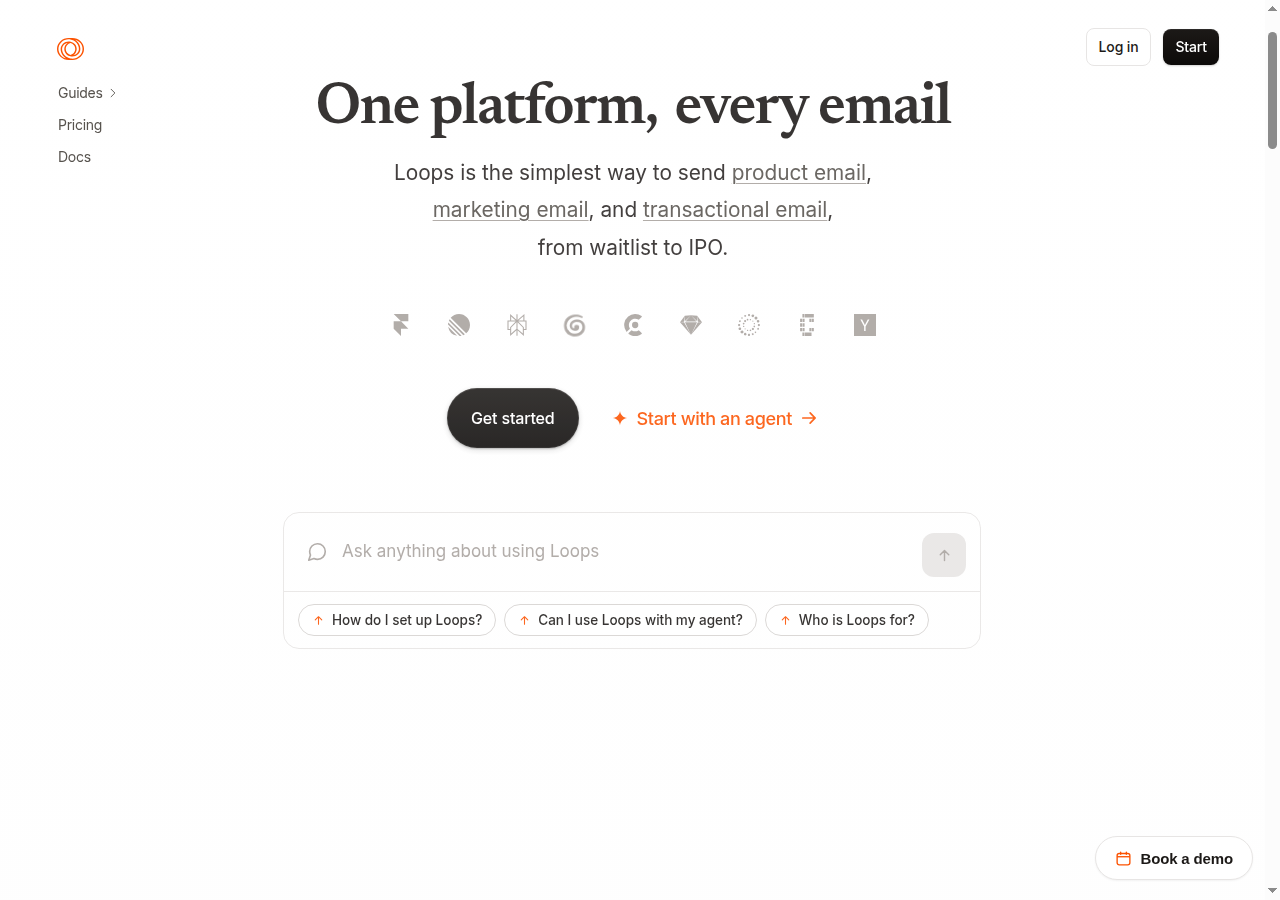
- Loops started as one product for marketing + lifecycle + transactional email, organized around a visual editor, saved segments wired to product properties, and Goals that tie email to product events like Free to Pro upgrades. Its pitch is “one platform, every email.”
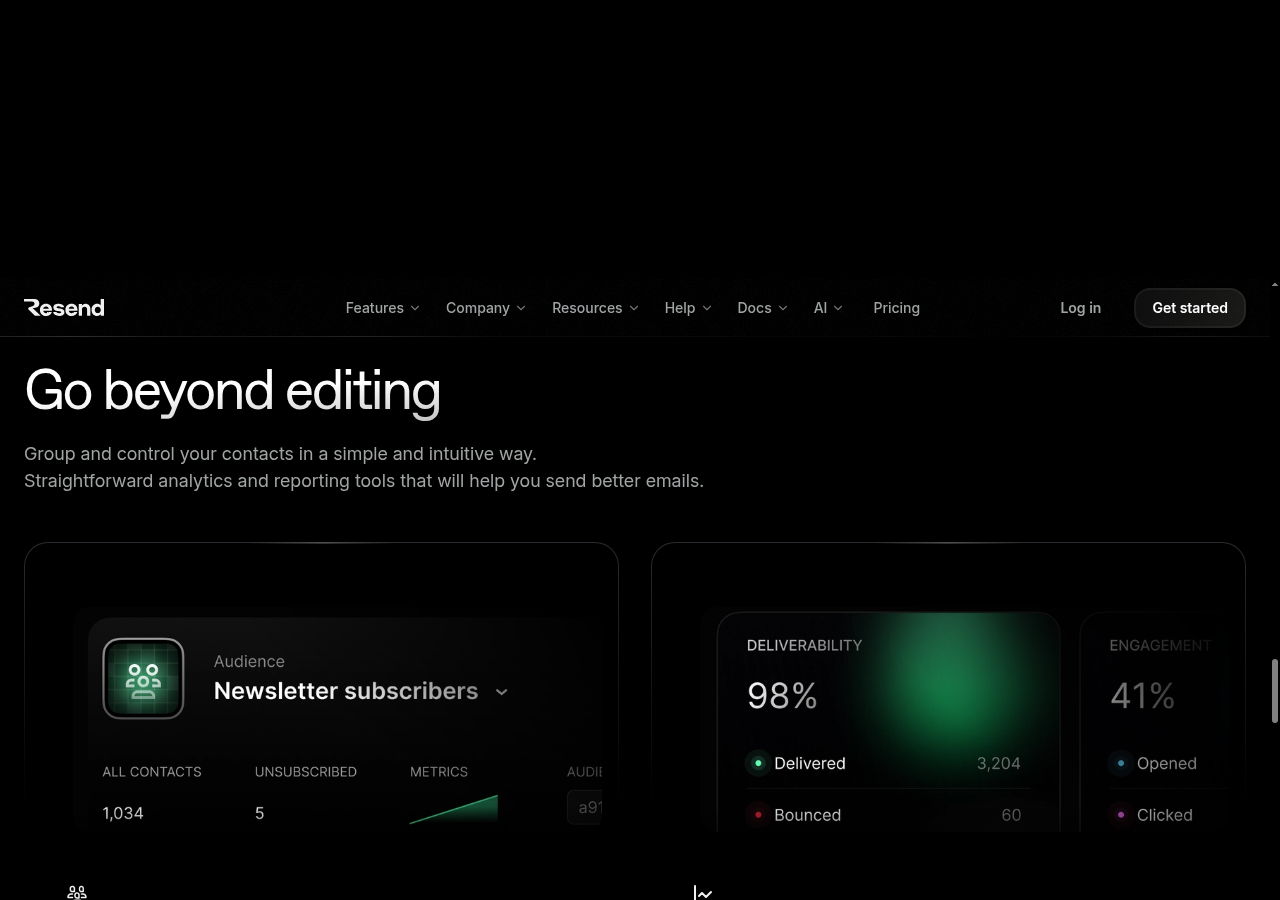
- Resend started as a transactional-only send API (the modern SendGrid replacement) and has since added Broadcasts (marketing), Automations, Contacts, Segments, Topics, Contact Properties, and inbound email. Its pitch is “the email API for developers.”
The territory they’re fighting over is the same: a SaaS team that wants one vendor for receipts, alerts, onboarding, and newsletters. The honest framing is not “marketing tool vs developer tool” - it’s “which side of the same market did each one build from.”
The single clearest differentiator for a finance/ops buyer is pricing model fit, and that’s where this comparison spends most of its time.
Pricing: the decisive dimension
This is where Loops and Resend stop being comparable and start being a finance decision. Prices below are from the live pricing pages in July 2026; verify the vendor site before you sign anything.
Loops: pay for contacts, send unlimited
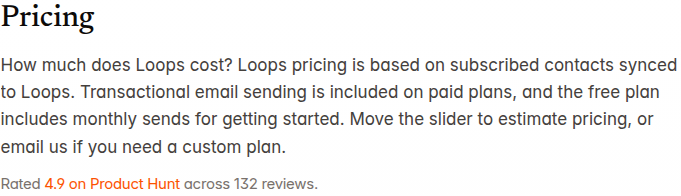
Loops prices on subscribed contacts, not send volume. The slider on the pricing page runs up to 1.5m+ contacts.
- Free: $0/mo, up to 1,000 subscribed contacts, up to 4,000 sends/month (marketing + transactional combined), all features included, “Powered by Loops” footer on every email, no credit card required.
- Paid: Contact-based tiers above Free, driven by a continuous slider on the pricing page (no fixed named tiers except at the two ends). Public slider labels run from 100 contacts up to “1.5m+”. Paid plans have no separate send limit - transactional email sending is included at no additional charge, and the Loops branding comes off. Transactional recipients who aren’t also sent marketing email do not count as billable contacts. The page does not publish a static tier table; every position from 100 to 1.5m contacts is labeled “Growing Audience Plan” and priced continuously. We moved the slider ourselves and recorded: 15,000 contacts = $149/mo, 100,000 contacts = $399/mo, 1,000,000 contacts = $3,999/mo. Above 1.5m contacts it switches to “Custom Plan” / “Custom pricing” / “Contact us”.
- Billing is monthly in advance via Stripe; the contact count at billing time sets the tier; service is never interrupted mid-cycle.
The trade-off is opacity at the top end: the public pricing page does not publish a static named tier table. Only the Free plan (“Early Stage Plan”, 1,000 contacts, Free) renders explicitly; every paid position on the slider is called “Growing Audience Plan” until you pass 1.5m contacts, where it becomes “Custom Plan” / “Contact us”. There’s no way to see the full price curve at once - you read one price at a time as you drag. Sample points we captured directly: 15,000 contacts = $149/mo, 100,000 contacts = $399/mo, 1,000,000 contacts = $3,999/mo. Forecasting cost past the early-stage band means dragging the slider to your actual contact count rather than reading a table, which is harder than reading Resend’s published per-email table.
Resend: two SKUs, metered automations
Resend splits email into two products. Transactional Email is priced per email sent. Marketing Email is a separate contact-based plan. A SaaS that sends receipts AND a weekly newsletter from Resend is paying for two subscriptions.
Transactional (per-email):
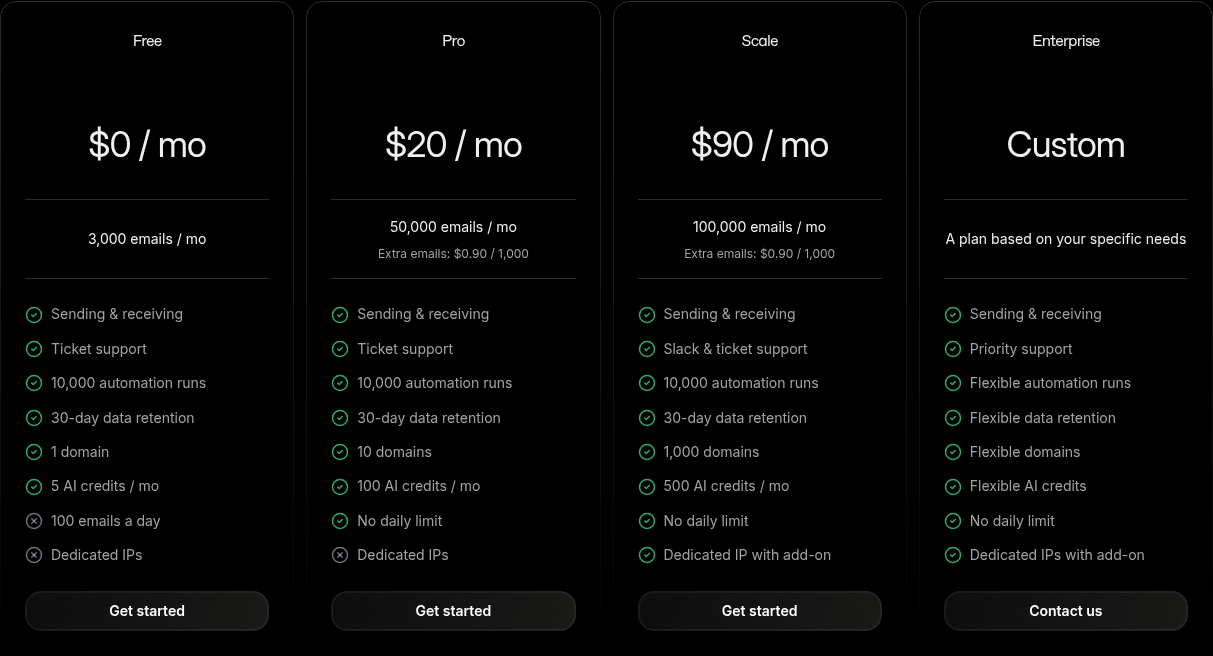
| Plan | Price/mo | Emails/mo | Overage per 1,000 | Daily cap | AI credits | Domains |
|---|---|---|---|---|---|---|
| Free | $0 | 3,000 | - | 100/day | 5 | 1 |
| Pro | $20 | 50,000 | $0.90 | none | 100 | 10 |
| Pro | $35 | 100,000 | $0.90 | none | 100 | 10 |
| Scale | $90 | 100,000 | $0.90 | none | 500 | 1,000 |
| Scale | $160 | 200,000 | $0.80 | none | 500 | 1,000 |
| Scale | $350 | 500,000 | $0.70 | none | 500 | 1,000 |
| Scale | $650 | 1,000,000 | $0.65 | none | 500 | 1,000 |
| Scale | $825 | 1,500,000 | $0.52 | none | 500 | 1,000 |
| Scale | $1,150 | 2,500,000 | $0.46 | none | 500 | 1,000 |
| Enterprise | Custom | Custom | Custom | none | Flexible | Flexible |
Every row above was re-captured by moving the resend.com/pricing slider ourselves in July 2026 (see resend_tx_step2.png through resend_tx_idx6.png).
Marketing (separate plan, per-contact):
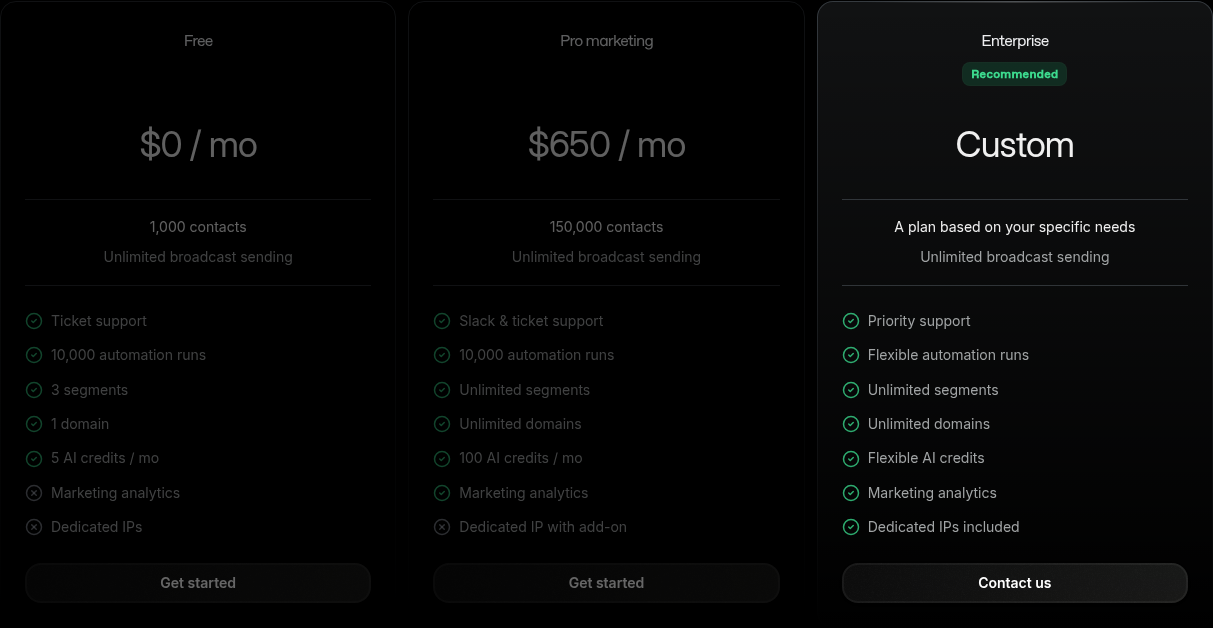
| Plan | Price/mo | Contacts |
|---|---|---|
| Free | $0 | 1,000 |
| Pro marketing | $40 | 5,000 |
| Pro marketing | $80 | 10,000 |
| Pro marketing | $180 | 25,000 |
| Pro marketing | $250 | 50,000 |
| Pro marketing | $450 | 100,000 |
| Pro marketing | $650 | 150,000 |
| Enterprise | Custom | Custom |
Every row above was re-captured by moving the resend.com/pricing Marketing emails slider ourselves in July 2026 (see resend_mkt_step3.png through resend_mkt_idx5.png). The slider only exposes these contact bands - there is no 15,000-contact tier between 10,000 and 25,000.
Marketing plans are not capped by email sends, only by contacts. Broadcasts can only be sent to existing Contacts.
Automations on Resend: all paid plans include 10,000 automation runs/mo, then $0.0015 per run. The Free plan also gets 10,000 runs/mo with no overage.
Add-on: Dedicated IP is $30/mo on the Scale tier, available once you exceed 3,000 emails/day, with automatic warmup, monitoring, and autoscaling.
All plans (free through enterprise) include the RESTful API, SMTP relay, official SDKs, inbound emails, batch sending, open and link tracking, React Email, multi-region sending, DKIM/SPF/DMARC, webhooks, SOC 2 Type II, GDPR, MFA, and API key permissions.
The cost-model decision in one paragraph
If your SaaS sends a low volume but high-frequency mix of lifecycle + transactional + broadcast email to a known audience, Loops’s contact-based unlimited-sends model is almost always cheaper and more predictable. If your email is a small set of high-volume transactional templates (alerts, invoices, auth) and your team writes React Email by hand, Resend’s published per-email table is cheaper and more forecastable. A SaaS running both receipts at scale AND a mature lifecycle program often ends up paying for both products - which is honest, and is not a defect of either tool.
Feature comparison
Pricing, plan limits, SDK counts, and plan-matrix rows (inbound, multi-region, dedicated IPs, data retention, AI credits) below were re-verified directly against loops.so/pricing, resend.com/pricing, and each vendor’s public docs in July 2026. Rows describing editor UX, workflow node types, and social proof are drawn from each vendor’s own marketing pages and are attributed to the vendor, not independently re-tested by us.
| Dimension | Loops | Resend |
|---|---|---|
| Core paradigm | One product for marketing + lifecycle + transactional | Developer-first transactional API, marketing added on top |
| Pricing model | Per subscribed contact, unlimited sends on paid plans | Per-email (transactional) + per-contact (marketing) - two plans |
| Free tier | 1,000 contacts, 4,000 combined sends/mo, Loops branding | 3,000 transactional sends (100/day cap) + 1,000 marketing contacts, no branding |
| Automation billing | Unlimited workflow entries on paid plans | 10,000 automation runs/mo, then $0.0015/run |
| Email editor | Visual block editor, Writing mode, themes, slash menu, dynamic {} insertion, columns/sections/arrays | React Email (code-first), dashboard template editor, embedded React Email editor option |
| Plain HTML email | Not supported (MJML import only) | Supported via API/SMTP and React Email |
| SDK count | JS, Go, PHP, Ruby, Nuxt module | 9: Node, Python, PHP, Ruby, Go, Java, Laravel, Rust, .NET |
| CLI | Yes (contacts, events, transactional, campaigns, workflows, components, themes) | Yes (send, account management, agent-friendly) |
| MCP server | Agent skills + CLI, no public hosted MCP | Hosted remote MCP at mcp.resend.com + self-hosted MCP + agent skills + Agent Email Inbox |
| Inbound / receiving email | No | Yes (receive, forward, reply, attachments, custom domains) |
| Multi-region sending | Not surfaced in docs | Yes |
| Dedicated IP | Not advertised | $30/mo add-on on Scale, with auto-warmup, monitoring, autoscaling |
| Goals / conversion tracking | Yes (Free to Pro, onboarding, referrer, custom) | No equivalent tied to product events (webhooks + custom analytics only) |
| Saved segments wired to product properties | Yes, central feature | Segments exist, but tied to contact properties not live product events |
| Branching + experiments in workflows | Yes (Branch + Experiment node types) | Condition + Wait-for-Event steps; no native experiment step advertised |
| Marketing (broadcasts) | Campaigns, mature | Broadcasts, newer; “Migrating from Audiences to Segments” doc indicates recent refactor |
| Transactional | Transactional API + SMTP, with idempotency + attachments | Transactional API + SMTP, with idempotency + batch + custom headers + scheduled + tags |
| Contact/audience model | Audience, mailing lists, preference center, contact properties | Contacts + Topics + Segments + Contact Properties (recently restructured) |
| Deliverability tooling | DKIM/SPF/DMARC, BIMI, sending avatar, hide-my-email, bounce reduction, large-audience warmup | All of the above + multi-region + dedicated IP + DMARC analyzer tool |
| Webhooks | Yes (event notifications + payload examples) | 12+ event types, signed, retries + replays, self-hosted ingester |
| Customer social proof | Framer, Linear, Perplexity, Clerk, Reuters, YC W22 (4.9 PH, 132 reviews) | Smaller, dev-focused stories (e.g. Airgoods) |
| Compliance | SOC 2, GDPR, DPA, Data Privacy Framework | SOC 2 Type II, GDPR, MFA, API key permissions |
| Per-seat pricing | None, free team seats | Per team, no equivalent unlimited-seats pitch |
| AI features | AI translation + Guardian content validation (not credit-metered in published docs) | 5/100/500/flexible AI credits/mo for email generation, editing, automation generation |
Where Loops wins, and where it loses
Loops wins on
- One product, one bill, one audience. Marketing, lifecycle, and transactional share the same editor, contact model, and API. No separate transactional add-on to buy and wire up.
- Contact-based pricing with unlimited sends on paid plans. Predictable cost for a SaaS whose users receive a lot of automated lifecycle and transactional mail.
- All features on all plans + free team seats. No feature gating by tier, no per-seat. Small teams can ship lifecycle and transactional from day one without upgrade pressure.
- Goals + conversion tracking tied to product events. Free to Pro upgrades, onboarding completion, referral clicks - revenue framing, not just opens and clicks.
- Visual workflow builder with branching and experiments. Six node types, four triggers, audience filters, mailing-list scoping. Resend’s Automations exist but the visual surface is younger.
- SaaS-lifecycle social proof. Framer, Linear, Perplexity, Clerk, Reuters - exactly the ICP Loops is selling to.
Loops loses on
- No plain HTML email. Deliberate, but a real blocker if you have existing HTML templates, transactional email from a prior provider, or engineers who write HTML/React Email by hand. MJML import exists; raw HTML does not.
- Pricing opaque at the top end. The public page flashes Free and “Early Stage Plan” at 1,000 contacts; above that you move a slider or talk to sales. Harder to forecast as you grow past the early-stage band than reading Resend’s published table.
- Smaller developer-tooling surface. Five SDKs (JS, Go, PHP, Ruby, Nuxt) vs Resend’s nine. Resend is more language-complete.
- No dedicated IP offering visible. Resend offers a dedicated IP add-on on Scale with auto-warmup, monitoring, autoscaling. Loops does not advertise one.
- No inbound / receiving-email product. Resend has Resend Inbound (receive, forward, reply, attachments, custom receiving domains). Loops is outbound only.
- No multi-region sending documented. Resend explicitly markets it; Loops doesn’t surface region selection.
Where Resend wins, and where it loses
Resend wins on
- API + language coverage. Nine official SDKs plus ~30 framework quickstarts, Rust and Java included. For polyglot engineering teams, this is meaningfully broader than Loops.
- React Email as first-class. Email-as-code with React components, CLI upload, embedded editor option. For developers who already write JSX, the most ergonomic templating story on the market.
- Hosted MCP server + agent skills + Agent Email Inbox.
mcp.resend.com, Skills Discovery, Resend Skill, React Email Skill, Email Best Practices Skill, CLI Skill, Agent Email Inbox Skill. The most agent-native developer email product today. - Resend Inbound. Receive via webhook, get content and attachments, forward, reply, custom receiving domains. Loops has no inbound product at all.
- Multi-region sending and dedicated IPs at a published price. $30/mo add-on on Scale with auto-warmup and monitoring. Useful at the 3,000+/day threshold where you want isolated reputation.
- Published, granular high-volume cost table. Real $/1,000 emails at 500K, 1M, 2.5M - you can actually forecast.
- Webhook event granularity + retries/replays + self-hosted ingester. Twelve email events plus contact and domain events; signed webhooks; retries and replays; an open-source ingester to dump everything into your own DB. Resend treats email events like observable infrastructure.
- Idempotency keys + batch sending (100 emails/call) + scheduled sends + custom headers. Production-grade transactional primitives.
Resend loses on
- Two SKUs to get marketing + transactional from one brand. A SaaS running receipts, lifecycle sequences, and a weekly newsletter pays for a Transactional plan AND a Marketing plan, plus automation overage past 10K runs/mo. Loops folds all three into one contact-based plan.
- Marketing surface is younger and shallower. Resend only recently added Broadcasts, Automations, Contacts, Segments, Topics, Contact Properties - the docs include a “Migrating from Audiences to Segments” page signaling a recent model change. Loops was built around marketing/lifecycle from day one.
- Automations are metered. 10K runs/mo on Free/Pro, then $0.0015/run. A high-frequency lifecycle suite (onboarding + upgrade + churn + re-engagement + digest) blows past 10K runs fast. Loops runs unlimited workflow entries on paid plans.
- No visual email editor for non-developers. Templates are React Email or dashboard templates; no equivalent of Loops’s Writing-mode block editor with themes, slash menu, dynamic brace insertion. A marketer who can’t write JSX is stuck with a thinner dashboard editor.
- Weaker SaaS-lifecycle social proof. Customer stories on resend.com are smaller (“Airgoods” is the public example). For a SaaS buyer evaluating lifecycle email, Loops’s Framer/Linear/Perplexity/Clerk/Reuters roster is more directly relevant.
- AI credit metering. Free 5 / Pro 100 / Scale 500 / Enterprise flexible, monthly reset, no rollover. A team using AI email generation heavily hits the cap and pauses the AI features. Loops’s AI translation and Guardian validation aren’t credit-metered in published docs.
- No free team seats concept. Resend bills per team. Loops explicitly does not charge for team seats on any plan.
- Data retention is 30 days on Free/Pro/Scale. Only Enterprise gets flexible retention. Loops docs don’t surface a retention cap on the equivalent plan.
What about the “just run both” option
The brief’s decision rule is honest about this and we’ll repeat it: some teams genuinely run both. Specifically, a high-volume transactional workload that wants Resend’s deliverability primitives (dedicated IP, multi-region, inbound) AND a mature marketing/lifecycle program that needs Loops’s visual editor and Goals.
The cost is real: two subscriptions plus possible Resend automation overage past 10K runs/mo. If you’re at the stage where you’re asking “should we run both,” the answer is usually: you are not at that stage yet, and one of the two will cover 90% of your needs. Pick based on which 10% you can’t live without.
- If the 10% is “inbound email, dedicated IP, multi-region, 9 SDKs, React Email” - pick Resend and accept that marketing is younger.
- If the 10% is “Goals tied to product events, visual branching workflows, saved segments wired to product properties, unlimited sends on a contact bill” - pick Loops and accept that developer-tooling breadth is thinner.
Bottom line
Pick Loops if you are a SaaS team whose email volume is dominated by lifecycle, onboarding, and newsletter sends to a known audience, and you want one predictable contact-based bill with a visual editor and Goals wired to product events.
Pick Resend if your email is overwhelmingly code-driven transactional, you value broad SDK/language coverage, you want React Email or email-as-code, or you need inbound email, multi-region, or a dedicated IP, or you want email integrated into an AI agent stack.
Loops is wrong for you if you author raw HTML/React Email templates, need 9 SDKs, need inbound email, or need a dedicated IP. Resend is wrong for you if your primary need is newsletters and lifecycle journeys and you don’t write code.
[CTA: Try Loops free - 1,000 contacts and 4,000 sends/mo, no card required.]
Prices accurate as of July 2026; check the vendor sites for current rates.