24 June 2026 · Comparison
beehiiv vs Substack: Which Newsletter Platform Wins in 2026?
The short answer
if you plan to earn real money from your newsletter and want to keep more of it — a flat fee, and none of your subscription revenue.
if you're starting with no audience and want the platform to help you find readers, plus its community features and reader app.
Affiliate disclosure: Some links in this post are affiliate links. If you click through and make a purchase, we may earn a commission at no extra cost to you. This does not affect our verdict.
The Short Answer
Pick beehiiv if you plan to earn real money from your newsletter and want to keep more of it, or if you want multiple revenue streams (ads plus paid subscriptions plus digital products). beehiiv charges a flat monthly fee and takes 0% of your subscription revenue.
Pick Substack if you have zero audience and need the platform to help you find readers, or if you value community features like Notes, Chat, and a native reader app. Substack is completely free until you start earning, then takes a 10% cut of paid subscriptions.
If you are already earning over roughly $5,000/year in subscription revenue, beehiiv’s flat fee is cheaper than Substack’s 10% revenue share. At $120K/year, the difference is roughly $11,652 in your pocket.
beehiiv: The Revenue-First Newsletter Platform
Pricing
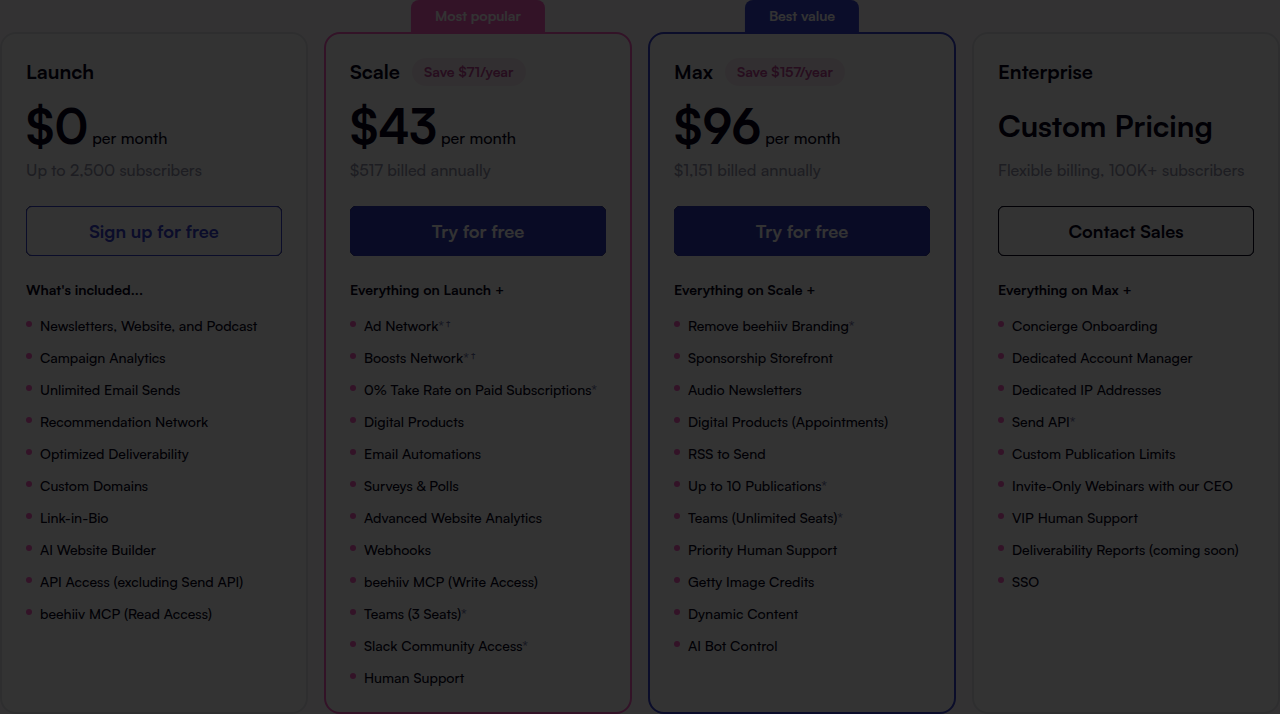
beehiiv has four plans:
| Plan | Monthly Price | Subscriber Limit | Key Features |
|---|---|---|---|
| Launch | $0 | Up to 2,500 | Unlimited email sends, newsletter, website, custom domains, AI (10 credits/day), 3 publications |
| Scale | $43/mo or $517/yr | Up to 100,000 | Ad Network, Boosts, 0% take on paid subs, digital products, automations, surveys, 3 team seats, premium support |
| Max | $96/mo or $1,151/yr | Up to 100,000 | Remove beehiiv branding, sponsorship storefront, audio newsletters, 10 publications, unlimited team seats, priority support, Getty images |
| Enterprise | Custom | 100,000+ | Concierge onboarding, dedicated account manager, dedicated IPs, Send API, SSO |
Prices accurate as of June 2026; check beehiiv.com/pricing for current rates.
beehiiv charges by subscriber count, not by revenue. The Launch plan is free up to 2,500 subscribers. Once you cross that threshold, you pay the flat monthly fee regardless of whether you are earning $0 or $50,000 a month. This is the core trade-off: you pay whether or not you are making money, but once you ARE making money, you keep 100% of subscription revenue minus Stripe processing (2.9% + $0.30 per transaction).
Monetization: More Ways to Earn
beehiiv gives you multiple revenue paths on a single platform:
- Paid subscriptions with a 0% platform take (Scale plan and above)
- Ad Network that matches your newsletter with advertisers automatically. beehiiv reports publishers have earned over $37M through the network
- Boosts (paid recommendation marketplace) where you get paid for recommending other newsletters
- Direct sponsorships with a built-in storefront to attract sponsors
- Digital products you can sell directly through the platform
This is beehiiv’s biggest advantage over Substack. If you have a newsletter with 50,000 free subscribers but only 500 paid subscribers, you can still earn meaningful revenue through ads and Boosts. On Substack, you would earn nothing from those 50,000 free readers.
Growth Tools Without the Network
beehiiv provides growth tools like a recommendation network, referral program, Magic Links, and subscribe forms. But it does not have a native reader app or a social discovery layer like Substack Notes. Growth on beehiiv is your responsibility. You bring the audience, or you build one using external channels like social media, SEO, or cross-promotions.
Where beehiiv Loses
- You pay even when you are not earning. The Scale plan costs $516+/year regardless of your revenue. If you have 3,000 subscribers and zero paid conversions, you are paying for a platform that is not paying you.
- No reader app. Subscribers read your newsletter in their email inbox. There is no native mobile app for consuming beehiiv content, which matters for audience retention and habit formation.
- No social or discovery layer. There is no equivalent to Substack Notes, no built-in community chat, and no platform-level discoverability. If you do not already have an audience, beehiiv will not help you find one.
- Feature gating. The free Launch plan is generous, but monetization features (Ads, digital products, automations) all require the paid Scale plan. If you want white-label (no beehiiv branding), you need the Max plan.
- Quality concerns from competitors. Ghost, a competing platform, has publicly claimed that beehiiv features “break pretty often” and that support responsiveness can be slow. These are competitor claims, not our first-hand experience, but worth noting if reliability is critical to your operation.
Substack: The Network-First Publishing Platform
Pricing
Substack is free to start with no monthly platform fee. Instead, Substack takes 10% of paid subscription revenue plus standard Stripe processing fees. There are no subscriber limits and no tiered feature gating. Every feature is available to every publication, regardless of size.
Prices accurate as of June 2026; check substack.com for current rates.
This revenue-share model means Substack costs you nothing until you earn. If your newsletter makes $0, you pay $0. If it makes $10,000, Substack takes $1,000. At $120,000/year in subscription revenue, you are paying Substack roughly $12,000 a year.
Built-In Discovery Network
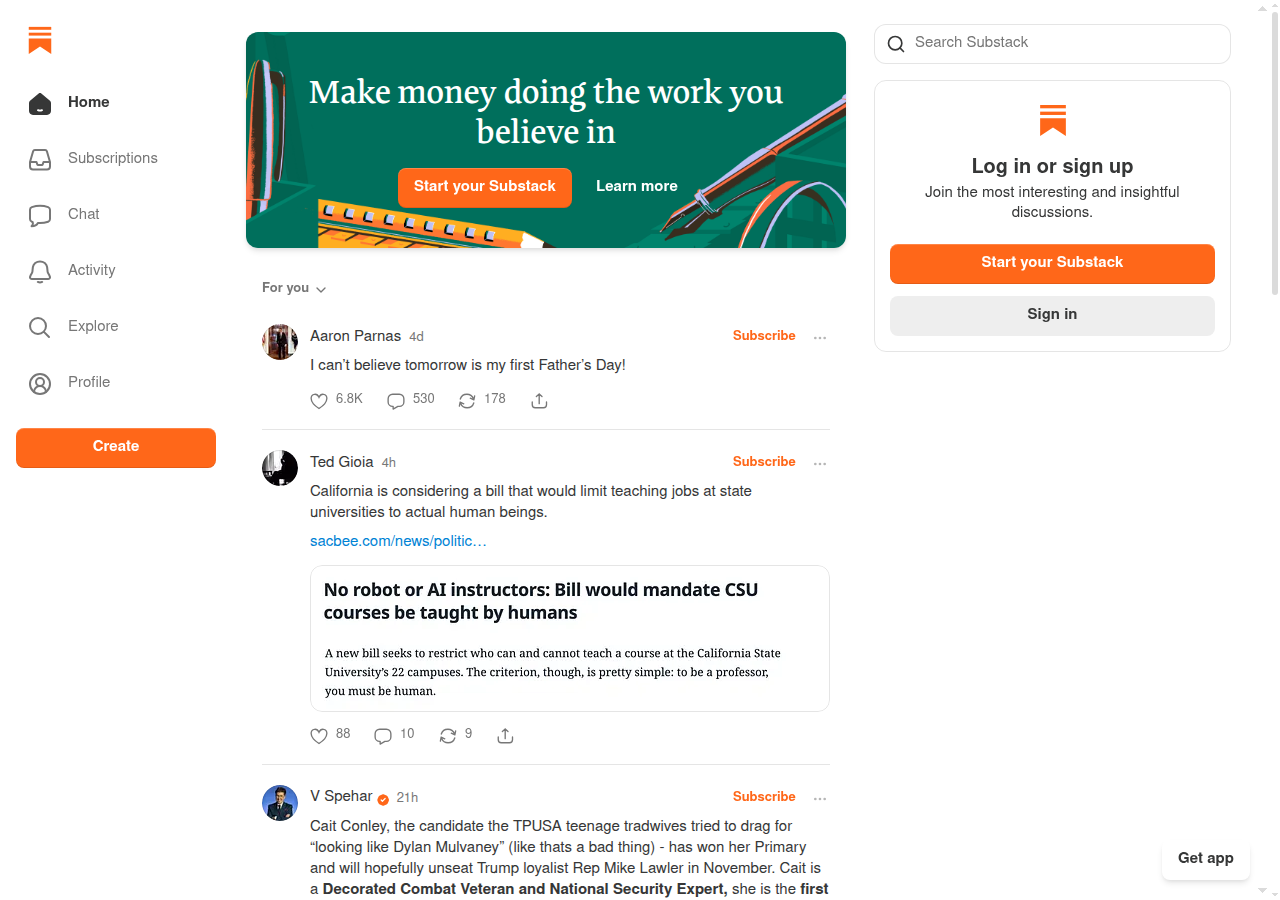
Substack is not just an email tool. It is a publishing platform with a built-in reader network. Roughly 30% or more of new paid subscriptions on Substack come from within the platform itself, according to Substack’s own reporting.
Key discovery and community features:
- Notes (a Twitter/X-like short-form feed integrated into the platform)
- Reader app for iOS, Android, and TV with millions of readers browsing and discovering content
- Cross-publication recommendations that connect your publication with similar creators
- Category leaderboards where readers find top publications by topic
- Chat and direct messaging for community building with subscribers
- Comments on every post with threaded replies and moderation tools
These are features beehiiv does not have equivalents for, and they are genuinely useful for growing an audience from scratch.
The Editorial Experience
Substack’s editor is widely considered excellent. It supports rich text, code blocks with syntax highlighting, LaTeX for math, recipe blocks with structured data, polls, image galleries, and native video and audio embeds. Posts can be published as articles, podcasts, videos, or live streams all from the same tool.
Additional capabilities include:
- Full podcast hosting with automatic distribution to Apple Podcasts and Spotify
- Native video hosting with live streaming and real-time chat
- AI voiceover to automatically generate audio narration of written posts
- Headline A/B testing
- Automated welcome and drip email sequences
- Subscriber import and export (you own your list)
- Legal support through Substack Defender for qualifying publishers
Where Substack Loses
- The 10% cut is permanent and uncapped. At $500,000/year in subscription revenue, you pay Substack $50,000. That same amount on beehiiv costs you at most $1,151/year (Max plan). The revenue share never goes away, and Substack actively promotes other publications to your subscribers on its platform, which means you are essentially paying to help Substack grow its network using your audience.
- Single monetization model. Substack only makes money for you through paid subscriptions. There is no built-in ad network, no digital products marketplace, and no way to monetize a large free audience directly. If your conversion rate from free to paid is low, you are leaving money on the table compared to beehiiv.
- Limited design control. All Substack publications share a recognizable look. While you can adjust colors, fonts, and layout templates, you cannot build a fully custom website the way you can on beehiiv or Ghost.
- No API access. Substack is a closed ecosystem. There is no public API for integrating with external tools or building custom workflows.
- Limited automations. You can set up basic welcome and drip sequences, but there is no visual automation builder, no behavior-based triggers, and no advanced segmentation.
- Twitter/X link penalty. Multiple sources report that Substack links are deprioritized on Twitter/X’s algorithm, which reduces distribution for writers who rely on that platform.
- Custom domain costs extra. Using your own domain requires a $50 one-time fee, though Substack now also offers domain purchasing directly through the platform.
Feature Comparison Table
| Feature | beehiiv | Substack |
|---|---|---|
| Monthly platform fee | $0-$96+/mo (by subscriber count) | $0 (always) |
| Revenue model | Flat fee + 0% take | 10% revenue share |
| Paid subscriptions | Yes (Scale+) | Yes (all plans) |
| Ad network | Yes (Scale+) | No |
| Digital products | Yes (Scale+) | No |
| Direct sponsorship tools | Yes (Scale+) | Manual only |
| Podcast hosting | Yes (episode-limited) | Yes (full) |
| Live video | No | Yes |
| Reader mobile app | No | Yes (iOS, Android, TV) |
| Social feed (Notes) | No | Yes |
| Community chat | Comments only | Chat, DM, comments |
| A/B testing | Yes | Yes |
| Automations | Yes (Scale+) | Basic sequences |
| Segmentation | Yes | Limited |
| API access | Yes (paid plans) | No |
| Custom domains | Included | Extra fee |
| Multi-publication | 3-10 depending on plan | Separate accounts |
| Website builder | Yes | Basic theming |
| Legal support | No | Yes (Defender) |
| AI tools | Yes (beehiiv AI) | AI voiceover only |
| Subscriber limit | Capped by plan | Unlimited |
| Own your list | Yes | Yes |
The Math: When beehiiv Becomes Cheaper
The cross-over point where beehiiv’s flat fee becomes cheaper than Substack’s 10% cut is roughly $5,170/year in subscription revenue. At that point, beehiiv’s $517 annual Scale fee costs less than Substack’s $517 cut.
At scale, the difference is dramatic:
| Annual Subscription Revenue | beehiiv Cost (Scale) | Substack Cost (10%) | You Keep More With |
|---|---|---|---|
| $5,000 | $517/yr | $500/yr | Substack |
| $12,000 | $517/yr | $1,200/yr | beehiiv |
| $50,000 | $517/yr | $5,000/yr | beehiiv |
| $120,000 | $517/yr | $12,000/yr | beehiiv |
| $500,000 | $1,151/yr (Max) | $50,000/yr | beehiiv |
The Bottom Line
Most creators who already have an audience or are serious about building a revenue-generating newsletter business should pick beehiiv. The flat-fee model saves meaningful money at any nontrivial revenue level, the multiple monetization paths (ads, Boosts, digital products) let you diversify income, and the 0% platform take on subscriptions means you keep what you earn.
beehiiv is also the better pick for publishers running multiple newsletters, anyone who needs API access or deep integrations, and creators who want a proper website alongside their newsletter.
Substack is the right pick for a specific group: creators starting from absolute zero with no existing audience. If you have no email list, no social following, and no plan for driving traffic independently, Substack’s built-in discovery network, Notes feed, and reader app will help you find your first subscribers in a way beehiiv cannot match.
Substack also wins for creators who value community (Chat, DMs, live video) as a core part of their publication, and for writers who want the best pure editorial experience without worrying about monetization features they do not need yet.
For everyone else, the math eventually tilts toward beehiiv. And the higher your revenue grows, the more the Substack “tax” costs you every single year, forever.
See also: If your newsletter needs fall somewhere between these two, our Kit vs Mailchimp comparison covers two more newsletter platforms with different strengths - Kit for solo creators selling products, Mailchimp for businesses needing a full marketing suite. And once you’re ready to sell sponsorships, our Passionfroot vs Paved comparison covers the two main ways to get newsletter ads booked.
beehiiv vs Substack: FAQ
Does either platform help with SEO or search traffic?
Both let posts live on the open web with a custom domain, so both are technically indexable by Google — this isn’t unique to either. Neither company publishes SEO-specific tooling (meta title/description control, structured data, sitemaps) as a headline feature on its pricing or comparison pages as of this check, and none of the independent reviews we read named search traffic as a real growth channel for either platform. If organic search is your primary acquisition plan rather than existing audience or paid social, that’s a gap in what either tool solves for — you’d be relying on general web publishing basics, not a platform-specific SEO advantage. (Checked beehiiv.com and substack.com, 2026-09-10; no SEO-specific feature found on either.)
How long does it take to migrate from Substack to beehiiv, and do you lose subscribers?
By beehiiv’s own account it’s fast and one-directional. It puts the whole move at under an hour for most newsletters: roughly two minutes to upload your subscriber list, ten minutes to import your content, and thirty minutes to transfer paid subscriptions. beehiiv states no subscribers are lost in the process (it cites migrating lists of 500,000+ subscribers without dropping a contact), and for paid subscribers specifically, the payment method, billing cycle, and subscription stay unchanged — readers aren’t asked to re-enter a card or re-subscribe. The only thing that changes for them is who keeps the revenue: you, instead of Substack’s 10% cut (source: beehiiv.com/comparisons/substack, checked 2026-09-10 — this is beehiiv’s own claim as the receiving platform, not an independent audit, so treat the exact minute counts as a best case). The asymmetry is real, though: beehiiv built this tool because it’s the direction it wants traffic to flow. Neither platform publishes an equivalent purpose-built importer for moving a newsletter back from beehiiv to Substack, so that direction means exporting your subscriber list and rebuilding your post archive by hand.