9 July 2026 · Comparison
Context.dev vs Firecrawl (2026): Which Web Data API Wins?
The short answer
if your scraping keeps running into anti-bot protection, or you want company and brand data bundled behind one API key.
if you need browser interaction, change monitoring at scale, self-hosting, or the widest set of SDKs and community support.
Affiliate disclosure: SaaSpicious earns a commission if you sign up to Context.dev through links on this page. That does not change the verdict below - Firecrawl wins clearly in the cases where it wins, and we say so.
See also: Framer vs Webflow and Loops vs Resend for other “which side of the market did each tool build from” decisions, and Brew vs Mailchimp if you want an AI-native replacement of a legacy API rather than a scraping pick.
The verdict (read this first)
Pick Context.dev if your scraping workload leans hard on anti-bot-protected sites, or you want company/brand/industry enrichment (NAICS, SIC, transaction descriptors, firmographics, a no-API-call logo CDN) bundled behind one API key on a flat 1-credit stealth rate. Pick Firecrawl if you need browser interaction, autonomous agent search, change monitoring at web scale, self-hosting for data residency, PDF/audio/video parsing, or the broadest SDK + community ecosystem.
Context.dev is wrong for you if you need to click, fill forms, or drive a live browser session; you want an autonomous “describe it, go find it” agent; you require self-hosting or SOC 2 Type 2 today; or you parse PDFs/audio/video as a core workflow. Firecrawl is wrong for you if your pages sit behind aggressive anti-bot (the 5x stealth surcharge bites), you need typed company/industry data not just page content, or you do not want to pay for fetches that came back with a 4xx/5xx from the target site.
This is not a “one wins” post. The two tools were built from opposite sides of the same market - Firecrawl from the scraping/interaction engine, Context.dev from the enrichment/resolved-entity layer - and the honest decision hinge is capability breadth vs enrichment depth + flat stealth pricing.
Which is better for AI agents?
Short answer: if your agent needs to click, fill forms, log in, or navigate a live browser, Firecrawl wins - its /interact and /agent endpoints are built for exactly that, and Context.dev has no equivalent. If your agent just needs fast, reliable page content plus resolved company or brand data (logos, NAICS/SIC, firmographics) without babysitting anti-bot blocks, Context.dev wins - its stealth bypass is a flat 1 credit per page (Firecrawl’s is 5), and requests that come back blocked are not billed at all.
For structured data extraction specifically: both return JSON against a schema (Context.dev at 10 credits, Firecrawl at 5 credits via JSON mode), so the cheaper call is Firecrawl’s - unless what you’re extracting is company/brand/industry data (NAICS, SIC, transaction/merchant resolution), which only Context.dev offers.
How they actually differ (the short version)
- Firecrawl is the open-source (AGPL-3.0) category leader by community size, purpose-built as a scraping/extraction/interaction engine for AI agents and RAG pipelines. Its signature features are a
/interactendpoint that drives a live browser, an/agentendpoint that searches and navigates without URLs, web-scale/monitorfor change detection, a first-class CLI, self-hosting, and media parsing. It charges 5 credits per page for stealth/enhanced proxy. - Context.dev is a managed, proprietary API organized around giving AI agents “web context” - not just page content, but typed, resolved entities: brand looked up by domain/name/email/stock ticker, NAICS/SIC industry codes, transaction/merchant resolution, firmographics, and a Logo Link CDN you embed with one
<img>tag. Stealth/anti-bot bypass is included at a flat 1 credit per page on every plan, and failed/blocked requests are not billed.
The territory they overlap on (scrape to markdown, crawl, sitemap, web search, JSON extraction, screenshot, MCP server) is roughly comparable. The territory they do not overlap on is where the decision lives: Firecrawl has interaction/agent/monitor/open-source/CLI/media; Context.dev has resolved entities, NAICS/SIC, transaction ID, firmographics, Logo Link CDN, flat stealth, and failed-request forgiveness.
A point of fact discipline before we go further: do not trust either vendor’s own comparison page about the other. Firecrawl’s /alternatives/firecrawl-vs-context-dev asserts that Context.dev “has no web search endpoint” (false - Context.dev lists Web Search at 1 credit/result) and quotes a Context.dev price ($49/mo for 30,000 credits) that does not match Context.dev’s live pricing page. Context.dev’s own compare page markets “no concurrency cap” as a hard advantage, but its docs only ever publish rate limits, never concurrency - that is marketing framing, not a verified spec. We flag both.
Pricing: where the real argument is
Prices below are from the live pricing pages and docs in July 2026; verify the vendor site before you sign anything.
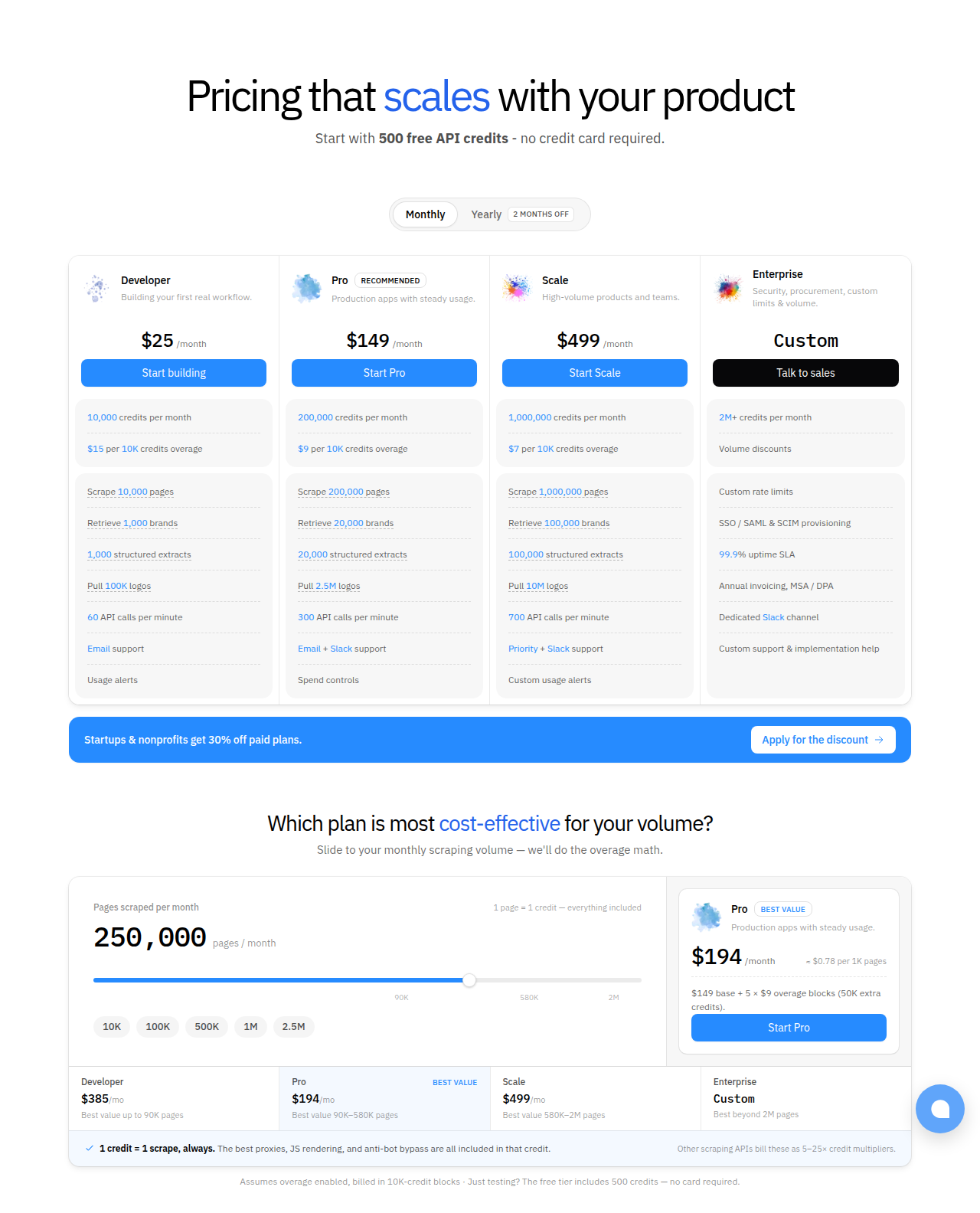
Context.dev: flat 1-credit stealth, no billing on failed requests
Context.dev prices on credits, billed monthly with two months free on annual. Work-email signup gets double the free credits.
- Free: $0, 500 credits (work email, 30 calls/min) / 250 credits (free email, 10/min) plus 10K Logo Link quota. No card; returns 401 on depletion.
- Developer: $25/mo, 10,000 credits, 60/min, metered overage $15 per 10K.
- Pro (recommended): $149/mo, 200,000 credits, 300/min, overage $9 per 10K.
- Scale: $499/mo, 1,000,000 credits, 700/min, overage $7 per 10K.
- Enterprise: custom, 2M+ credits, custom rate limit, SSO/SAML, SCIM, 99.9% SLA, MSA/DPA, dedicated Slack.
The standout posture: “No hidden surcharges for stealth requests. JS rendering, anti-bot bypass, and premium proxies are all included at the standard 1 credit per page” - on every plan - and failed or blocked requests are not billed. Advanced calls cost more: brand retrieve, styleguide, JSON extract, NAICS, SIC, and transaction ID each cost 10 credits; fonts and screenshot cost 5; web search costs 1 per result; scrape images costs 1 per image with enrichment. So on Context.dev, enrichment-heavy workloads consume credits roughly 10x faster than straight scraping - that is a real cost lever to model before you commit.
Firecrawl: 5 credits for stealth, billed on successful fetch
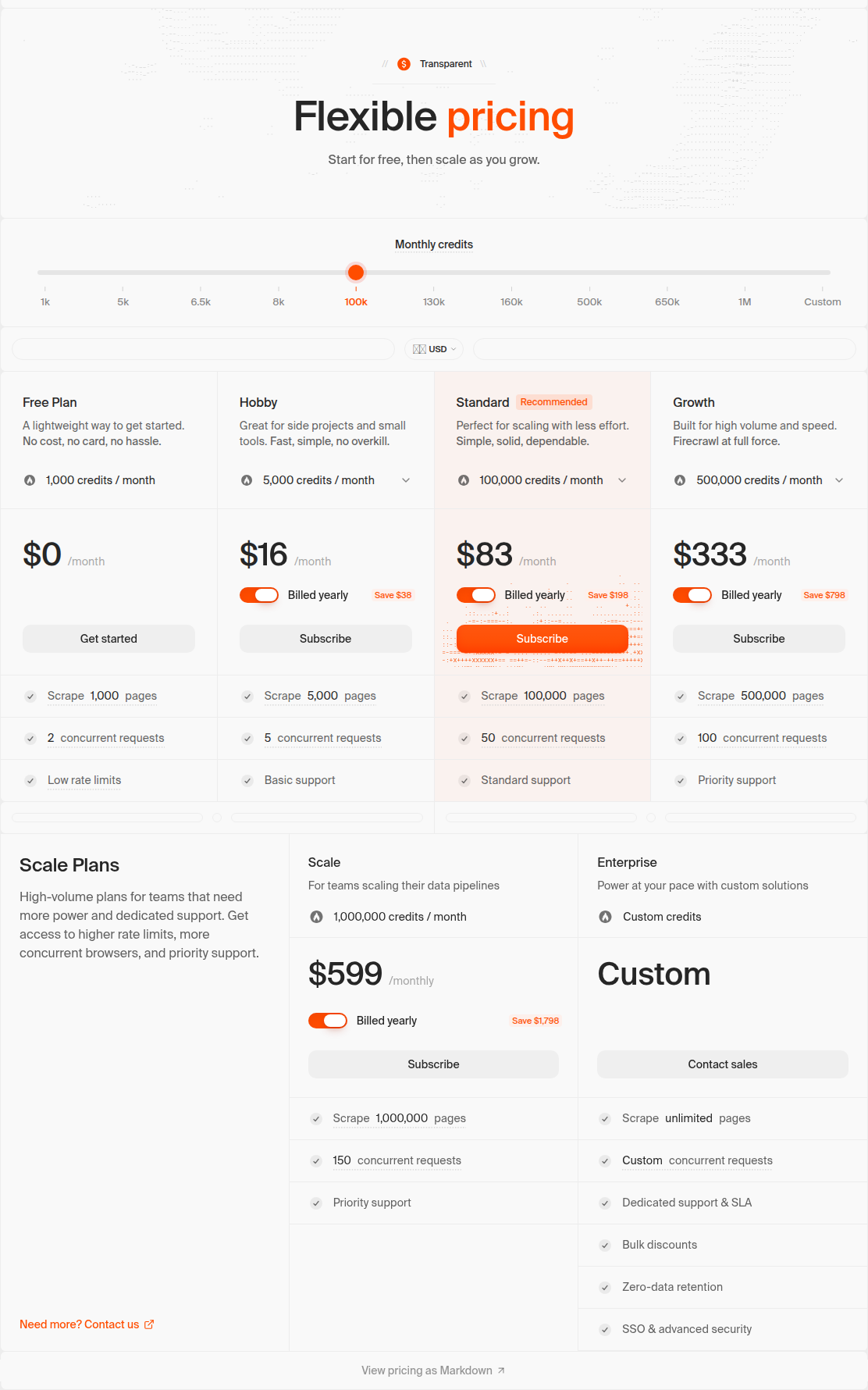
Firecrawl prices on credits too, billed yearly (a monthly toggle is higher; the annual card shows “Save $X” amounts). Credits do not roll over except with auto-recharge and custom annual Scale/Enterprise.
- Free: $0, 1,000 credits, 2 concurrent requests, keyless tier for agents.
- Hobby: $16/mo billed yearly (Save $38), 5,000 credits, 5 concurrent.
- Standard (recommended): $83/mo billed yearly (Save $198), 100,000 credits, 50 concurrent.
- Growth: $333/mo billed yearly (Save $798), 500,000 credits, 100 concurrent.
- Scale: $599/mo (Save $1,798), 1,000,000 credits, 150 concurrent.
- Enterprise: custom, unlimited credits, custom concurrency, dedicated support/SLA, bulk discounts, ZDR, SSO.
Per-scrape surcharges (verified in Firecrawl’s own scrape docs): base scrape = 1 credit; JSON mode +4 (5 total); enhanced proxy (stealth/anti-bot) +4 (5 total); question/highlights formats +4 each; PII redaction +4; audio/video extraction +4; PDF parsing +1 per page; Zero Data Retention +1 per page. JS rendering itself is automatic and included - it is not a surcharge, which is a correction worth making because some Context.dev comparisons conflate “stealth” and “JS rendering.” On both tools, plain JS rendering is free; the surcharge Firecrawl levies is specifically for stealth/enhanced proxy.
The failed-request policy is the other pricing hinge: Firecrawl does not charge on its own failures (timeouts, server errors), but it does charge when a fetch succeeds even if the target site responds with a 4xx or 5xx. Context.dev does not bill those. If your scraper hits a lot of dead or rate-limited URLs, that differential compounds.
The pricing decision in one paragraph
On a pure-stealth, anti-bot-heavy workload, the per-1K-page credit cost is ~5x on Firecrawl vs 1x on Context.dev. On a pure markdown scrape across unprotected public pages, both cost 1 credit/page, and Firecrawl’s lower entry price (Hobby $16/mo vs Context.dev’s Developer $25/mo) wins. On enrichment (brand/NAICS/transaction/extract), Context.dev’s 10-credit calls add up fast, while Firecrawl folds JSON extraction into a 5-credit call. On dead-URL workloads, Context.dev’s “free on blocked” beats Firecrawl’s “billed on successful fetch even if the site 4xx’d.” There is no overall cheaper tool - only a cheaper tool for your specific mix.
Feature comparison
Pricing, plan tiers, endpoint credit costs, SDK counts, and compliance rows below were re-verified against context.dev/pricing, firecrawl.dev/pricing, and docs.firecrawl.dev/features/scrape in July 2026. Rows describing vendor marketing claims (scale numbers, GitHub stars, customer logos) are attributed to the vendor, not independently re-tested by us.
| Dimension | Context.dev | Firecrawl |
|---|---|---|
| Primary pitch | Web context + enrichment/resolved-entity API for AI agents | Open-source scraping/interaction/agent engine at scale |
| Open source / self-hostable | No (proprietary, managed-only) | Yes (AGPL-3.0 platform; MIT SDKs) |
| Scrape to Markdown / HTML | Yes (1 credit) | Yes (1 credit) |
| Crawl / sitemap / images | Yes | Yes |
| Web search | Yes (1 credit/result) | Yes (2 credits/10 results, search + scrape in one call) |
| Screenshot | Yes (5 credits) | Yes (format) |
| JSON schema extraction | Yes (10 credits) | Yes (5 credits: 1 + 4 JSON mode) |
| Product extraction | Yes (10 credits) | Yes (product format, deterministic) |
| Brand data (per-page) | Yes (styleguide 10, fonts 5) | Yes (branding format: colors/fonts/typography/UI) |
| Resolved brand entities (by domain/name/email/ticker) | Yes (10 credits) - unique | No (per-page only) |
| NAICS/SIC industry classification | Yes (10 credits) - unique | No |
| Transaction/merchant enrichment | Yes (10 credits) - unique | No |
| Company firmographics (employees/revenue/valuation) | Yes (via brand retrieve) - unique | No |
Logo Link CDN (no-API-call <img>) | Yes (separate quota, no rate limits) - unique | No |
Browser interaction (/interact) | No | Yes (2 credits/browser min) - unique |
Autonomous agent (/agent, Spark models) | No | Yes (5 free daily runs + dynamic) - unique |
Web-scale monitoring (/monitor) | No | Yes (1 credit/page/check) - unique |
| CLI | No | Yes - unique |
| PDF/DOCX/audio/video parsing | Not surfaced as dedicated endpoints | Yes (PDF +1/page; audio/video +4) |
| Stealth / anti-bot proxy | Flat 1 credit/page (every plan) | 5 credits/page (1 + 4 enhanced proxy) |
| JS rendering | Included (1 credit) | Included (1 credit, automatic) |
| Failed-request billing | Not billed (failed/blocked) | Billed if fetch succeeds (even 4xx/5xx) |
| Concurrency model | Rate limits only (no published concurrency cap) | Explicit caps: 2/5/50/100/150/custom |
| Rate limits (calls/min) | 30/60/300/700/custom | (concurrency-based) |
| PII redaction | Not surfaced | Yes (+4 credits) |
| Zero Data Retention (ZDR) | Not surfaced | Yes (Enterprise, +1 credit) |
| Location/language targeting | Not surfaced | Yes (country + languages) |
| Caching (maxAge) | Brand cache quarterly; scrape cache not surfaced | Yes (2-day default, up to 5x speed) |
| Change tracking | Not surfaced | Yes |
| Batch scrape | Via crawl (conceptual) | Dedicated /batch/scrape |
| MCP server | Yes | Yes (400K+ installs claimed) |
| SDKs | TS, Python, Ruby, Go, PHP (5) | Python, Node, Go, Rust, Java, Elixir + CLI (6 + CLI) |
| Integrations | Zapier, Make | Zapier, n8n, Lovable, agent Skills |
| Compliance | SOC 2 Type I (Type II in progress) | SOC 2 Type 2 |
| YC-backed | Yes | Yes |
| Free tier | 500 credits + 10K Logo Link (work email) | 1,000 credits, 2 concurrent, keyless agent tier |
| Entry paid price | $25/mo (Developer, 10K credits) | $16/mo billed yearly (Hobby, 5K credits) |
| Mid price | $149/mo (Pro, 200K credits) | $83/mo billed yearly (Standard, 100K credits) |
| High-volume price | $499/mo (Scale, 1M credits) | $599/mo (Scale, 1M credits) |
| Annual billing | 2 months free | ”Save $38/$198/$798/$1,798” (about 2 months) |
| Startup discount | Up to 30% for 1 year | Not surfaced |
| Overage | Metered, 10K blocks ($15/$9/$7) | No roll-over; auto-recharge rolls over |
| Affiliate program | 25% / 3 yrs + $250 bounty + 25%-off-6-mo (Dub) | 25% / 12 mo then 15% ongoing, no approvals (Dub) |
| Stated scale | ”5K+ Developers” (vendor-claimed) | 148k GitHub stars, 1.25M devs, 150K+ companies, 5B+ requests (vendor-claimed) |
| Named enterprise customers | Similarweb, Klarna, Sunrun (vendor-published) | Apple, Canva, Shopify, Zapier, Replit, Alibaba, DoorDash (vendor-published) |
Where Context.dev wins, and where it loses
Context.dev wins on
- Flat 1 credit/page for stealth/anti-bot, on every plan. The single clearest pricing edge vs Firecrawl. On a workload that hits anti-bot-protected sites, this is up to a 5x cost gap, confirmed against Firecrawl’s own docs.
- Failed/blocked requests are not billed. More generous than Firecrawl, which charges when a fetch succeeds even on a 4xx/5xx site response.
- Resolved brand entities by domain, company name, email, or stock ticker. Canonical logos/colors/fonts/socials/firmographics across the web, not a per-page guess. Firecrawl’s
brandingformat is per-page only. - NAICS and SIC industry classification. No Firecrawl equivalent.
- Transaction/merchant-descriptor enrichment. Resolve messy card descriptors like “SQ *BLUE BOTTLE” to the brand. No Firecrawl equivalent.
- Logo Link CDN. One
<img>tag, no API call, no SDK, no backend, about 20ms, separate quota, no rate limits. Firecrawl makes you scrape the logo URL yourself. - Company firmographics (employees, revenue, founded, valuation, industry, socials) via brand retrieve. No Firecrawl equivalent.
- Rate-limit-based access with no published concurrency cap (marketeted as an advantage; see the caveat in losses). Firecrawl enforces explicit 2-150 concurrent caps.
- Startup/nonprofit discount up to 30% for 1 year. Not surfaced on Firecrawl.
- MCP server plus Zapier plus Make plus 5 SDKs (TS, Python, Ruby, Go, PHP).
Context.dev loses on
- No browser interaction. No equivalent to Firecrawl’s
/interact(click, fill forms, navigate via AI prompts or Playwright code, stateful sessions, live view). For dynamic pages behind login, pagination, or multi-step flows, Context.dev fetches URLs directly but cannot operate the page. A real capability gap. - No autonomous agent endpoint. No equivalent to Firecrawl’s
/agent, which searches, navigates, and retrieves from a natural-language description without URLs. Context.dev requires a known URL or a search query. - No web-scale monitoring or change detection. No equivalent to Firecrawl’s
/monitorwith scheduled checks, webhook/email alerts, same/new/changed/removed classification, and AI-goal filtering. - No CLI. API + SDKs + MCP only. Firecrawl ships a first-class
firecrawl scrape/search/crawl/interact/mapCLI for terminal and agent workflows. - Proprietary, not self-hostable. All data flows through Context.dev’s managed platform. Firecrawl is AGPL-3.0 and self-hostable - a dealbreaker-edge for teams with data-residency or compliance requirements, or a preference for open source.
- No dedicated PDF/DOCX/audio/video parsing endpoints surfaced. Firecrawl auto-detects and parses PDFs/DOCX via
/scrape, has/parsefor local files, and extracts audio/video (MP3 from YouTube, etc.). Context.dev’s docs do not surface equivalent media parsing. - Smaller ecosystem and scale. Context.dev’s “5K+ Developers” claim is roughly three orders of magnitude smaller than Firecrawl’s claimed 1.25M developers / 150K+ companies / 5B+ requests / 148k GitHub stars. Fewer SDKs (5 vs Firecrawl’s 6 + CLI; Firecrawl adds Rust, Java, Elixir; Context.dev adds Ruby, PHP). No surfaced Wikipedia/Wikimedia partnership.
- SOC 2 Type I (Type II in progress) vs Firecrawl’s SOC 2 Type 2. Compliance-maturity gap for enterprise buyers.
- No ZDR, no PII redaction, no location/language targeting, no explicit caching/maxAge layer, no change tracking. All of which Firecrawl ships.
- Higher entry price for pure scraping. Developer $25/mo (10K credits) vs Firecrawl Hobby $16/mo billed yearly (5K credits). And Context.dev’s advanced calls cost 10 credits each, so enrichment-heavy workloads consume credits 10x faster than scraping - the cost lever cuts both ways.
- “No concurrency cap” is marketing, not a verified spec. Context.dev’s own pricing FAQ publishes rate limits only (30/60/300/700 calls per minute by plan) and never mentions concurrency. We state it as “rate-limit-based, no published concurrency cap.” Do not treat it as a hard guarantee.
- No published independent benchmark. Context.dev points to customer case studies (the SiteGPT “switched from Firecrawl” story is vendor-published) but publishes no head-to-head benchmark.
Where Firecrawl wins, and where it loses
Firecrawl wins on
/interactbrowser interaction. Scrape then click, fill forms, or navigate via AI prompts or Playwright code, with stateful sessions, profiles, and a live embeddable browser view. 2 credits per browser minute. The strongest capability edge for dynamic, login-gated, or multi-step workflows, and Context.dev has nothing equivalent./agentautonomous data gathering. Describe what you need; Spark models search, navigate, and retrieve with optional URLs and structured schema output. 5 free daily runs plus dynamic pricing. Context.dev has nothing equivalent.- Open source + self-hostable (AGPL-3.0). Deploy on your own infrastructure for data residency, compliance, or cost control. The hosted/cloud version avoids the AGPL obligation. For regulated teams and open-source-preferring builders, this is a genuine dealbreaker-edge in Firecrawl’s favor.
/monitorweb-scale change detection. Scheduled scrapes/crawls, same/new/changed/removed classification, webhook and email alerts, AI-goal filtering in plain language. 1 credit per page per check.- First-class CLI plus agent Skills (Claude Code, Cursor, Windsurf, OpenCode, Antigravity). Context.dev has no CLI.
- PDF/DOCX/audio/video media parsing as dedicated capability -
/scrapeauto-detects PDFs/DOCX,/parsehandles local files, audio extraction (MP3 from YouTube) and video extraction. - Largest ecosystem and community. Firecrawl-claimed 148k GitHub stars, 1.25M developers, 150K+ companies, 5B+ requests, 400K+ MCP installs, 2.5M+ weekly SDK downloads. Apple, Canva, Shopify, Zapier, Replit, Alibaba, DoorDash logos. Wikipedia/Wikimedia partnership. This is a real credibility/scale edge for risk-averse buyers, even with the numbers vendor-attributed.
- SOC 2 Type 2, more mature than Context.dev’s Type I.
- Lower entry price plus more tiers. Hobby $16/mo billed yearly (5K credits) vs Context.dev Developer $25/mo (10K credits); 6 tiers vs 4 + Enterprise.
- Deeper infrastructure-feature bench. ZDR, PII redaction, location/language targeting, caching/maxAge up to 5x speed, change tracking, dedicated
/batch/scrape. - More SDKs plus CLI. Python, Node, Go, Rust, Java, Elixir + CLI vs Context.dev’s TS, Python, Ruby, Go, PHP.
Firecrawl loses on
- Stealth/enhanced proxy costs 5 credits/page. The single biggest pricing weakness vs Context.dev (flat 1 credit). On anti-bot-heavy workloads, that is up to a 5x cost gap, confirmed in Firecrawl’s own docs (screenshot below).
- Bills successful fetches on 4xx/5xx site errors. Less generous than Context.dev, which does not bill failed or blocked requests at all.
- Concurrency caps (2-150 concurrent). Explicit per-plan limits. Context.dev markets rate-limit-only access with no published concurrency cap - though, as above, that is marketing, not a verified spec.
- No resolved brand entities or company enrichment. Firecrawl’s
brandingformat is per-page (scrapes whatever one page renders). No lookup by domain/name/email/ticker, no canonical logos across the web, no NAICS/SIC, no transaction/merchant enrichment, no firmographics. For teams that need typed company/brand data, this is the core Context.dev edge. - No Logo Link CDN equivalent. No no-API-call
<img>logo embed. You scrape the logo URL yourself.

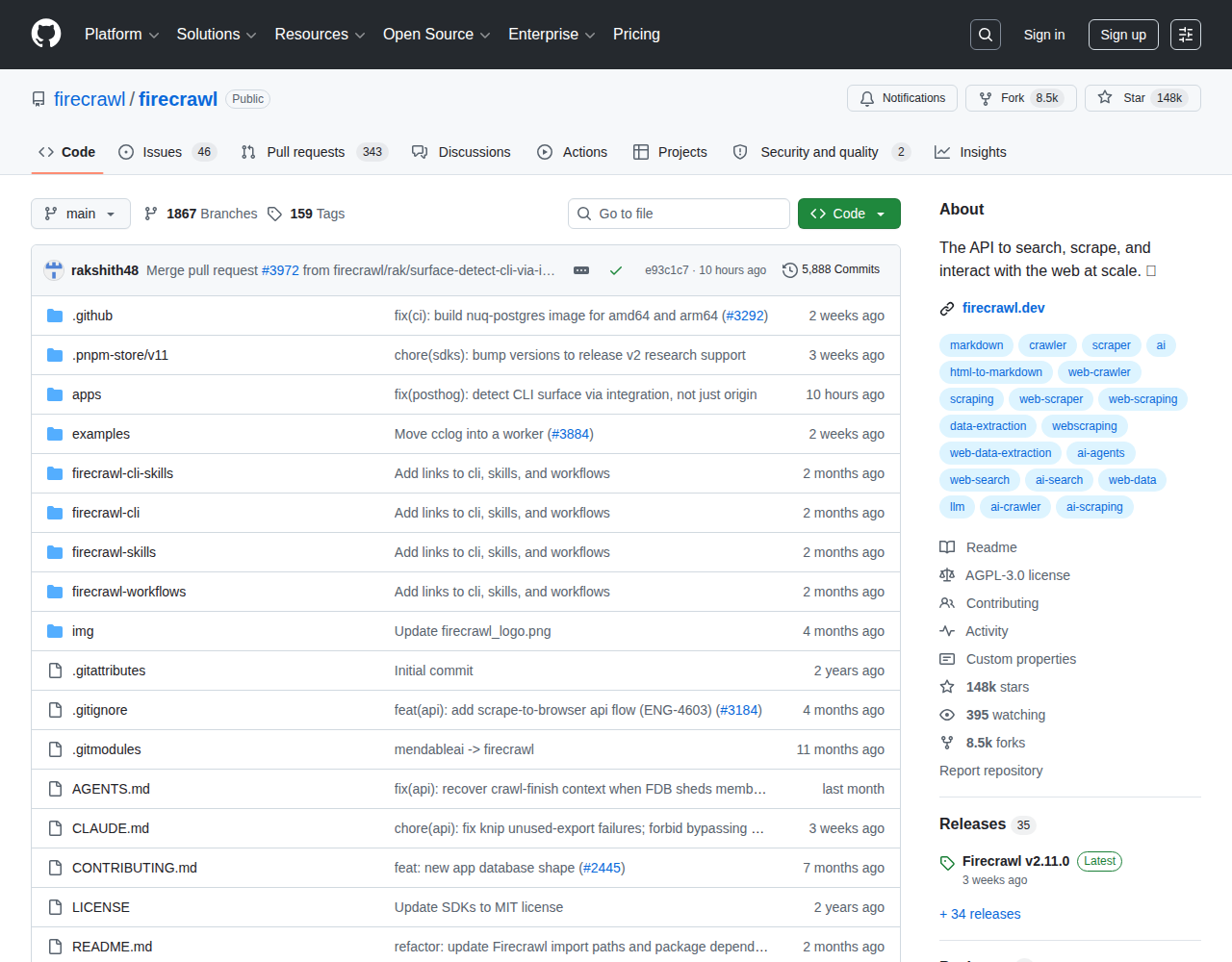
- AGPL-3.0 can be a blocker for some commercial embedding. AGPL’s network-use disclosure obligation deters some enterprises from embedding the open-source version in proprietary products. It is also a positive (open source, self-hostable, auditable) - present both sides. If you want self-host and closed-source embedding, the license is a real consideration and the hosted version is your workaround.
- Credits do not roll over except with auto-recharge and custom annual Scale/Enterprise. Context.dev replenishes monthly with metered overage - similar in practice, but worth stating.
- No startup/nonprofit discount surfaced (Context.dev offers up to 30% for 1 year).
- Brand intelligence is newer and shallower. Firecrawl’s
brandingformat exists, but Context.dev’s resolved-entity brand intelligence (multi-lookup-key, firmographics, a styleguide as a resolved design system) is more mature and is Context.dev’s core product, not a side feature. - Internally-conducted benchmarks only. Firecrawl’s “we lead on coverage/quality/recall/speed” is a vendor-run benchmark, not independent. Attribute it as “Firecrawl’s own benchmark” if cited.
Bottom line
Pick Context.dev if your workload hits anti-bot-protected sites heavily (the 5x-vs-1x stealth gap is a real cost multiplier), you want to consolidate scraping plus brand/company/industry/transaction enrichment behind one key, you need NAICS/SIC or transaction/merchant resolution, or you want a no-API-call logo CDN. Context.dev is also more generous on failed requests, which matters if you scrape a lot of dead or rate-limited URLs.
Pick Firecrawl if you need browser interaction, an autonomous agent that searches without URLs, change monitoring at web scale, self-hosting for data residency or compliance, PDF/audio/video parsing, SOC 2 Type 2, or the largest SDK + community ecosystem. Firecrawl is also cheaper at the entry tier and at plain markdown scraping across unprotected public pages.
Context.dev is wrong for you if you need to drive a live browser, run an autonomous agent, self-host on your own infra, parse media, or hold SOC 2 Type 2 today. Firecrawl is wrong for you if stealth surcharges break your unit economics, you need typed company/industry data rather than page content, or you do not want to pay for fetches that returned a 4xx/5xx from the target site. Saying one “wins” overall misrepresents two tools built from opposite sides of the same market.
[CTA: Try Context.dev free - 500 credits and 10K Logo Link quota on the work-email tier, no card required, with 25% off for 6 months via our link.]
If what you actually need is a search API rather than a scraper, AnySearch vs Tavily covers that pair: Tavily if you want priced plans, compliance and research endpoints today, AnySearch if a 30x larger free tier and vertical data matter more.
Once your agent is fetching real data, the next problem is watching what it does with it — our Prefactor vs Langfuse comparison covers observability and access control for agent stacks.
Prices accurate as of July 2026; check the vendor sites for current rates.