30 July 2026 · Comparison
Prefactor vs Langfuse: Which Fits Your Agent Stack?
The short answer
if your agents take irreversible actions and you need a brake pedal, not just a dashboard.
if you need open-source observability with self-hosting, prompt management, and dramatic cost advantage.
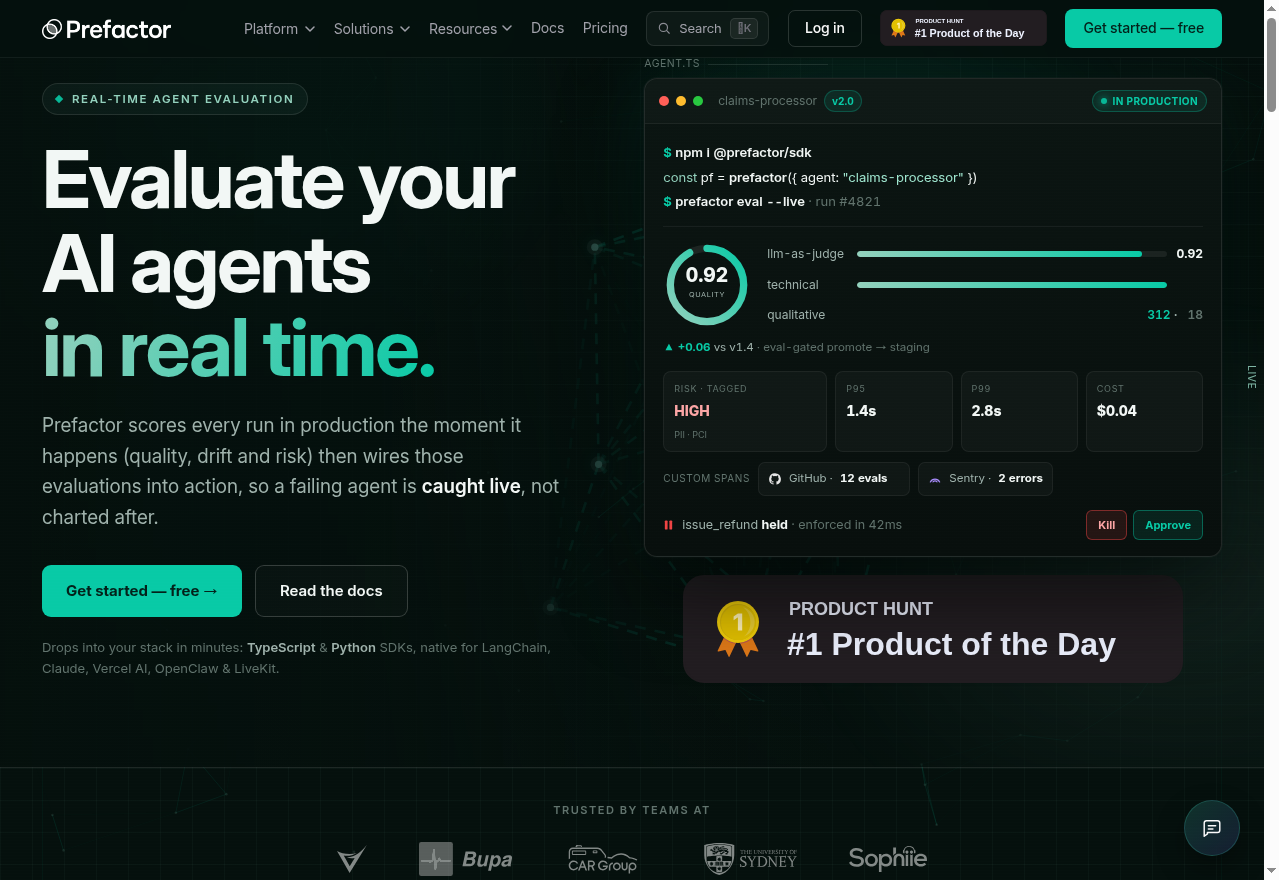
Pick Langfuse if you want open-source tracing with the best prompt management in the category, self-hosting, and by far the lowest cost. Pick Prefactor if your agents take irreversible actions - API calls, database writes, customer-facing messages - and you need a brake pedal that can hold, block, or escalate a bad run before it reaches a user, not just a dashboard that charts the damage afterward. They aren’t true competitors; Langfuse observes and Prefactor enforces, and most production teams running agents at real scale eventually want both.
Disclosure: This post may contain affiliate links. If you click through and sign up, we may earn a commission at no extra cost to you. This does not influence our analysis.
See also: Context.dev vs Firecrawl if you’re picking the data layer your agents run on, and Lovable vs Replit Agent if the agent in question is an AI app builder rather than something you’re shipping to production yourself.
The Core Difference: Observe vs Enforce
Langfuse and Prefactor both sit in the AI agent observability space, but they split at the most critical point: what happens after a problem is detected.
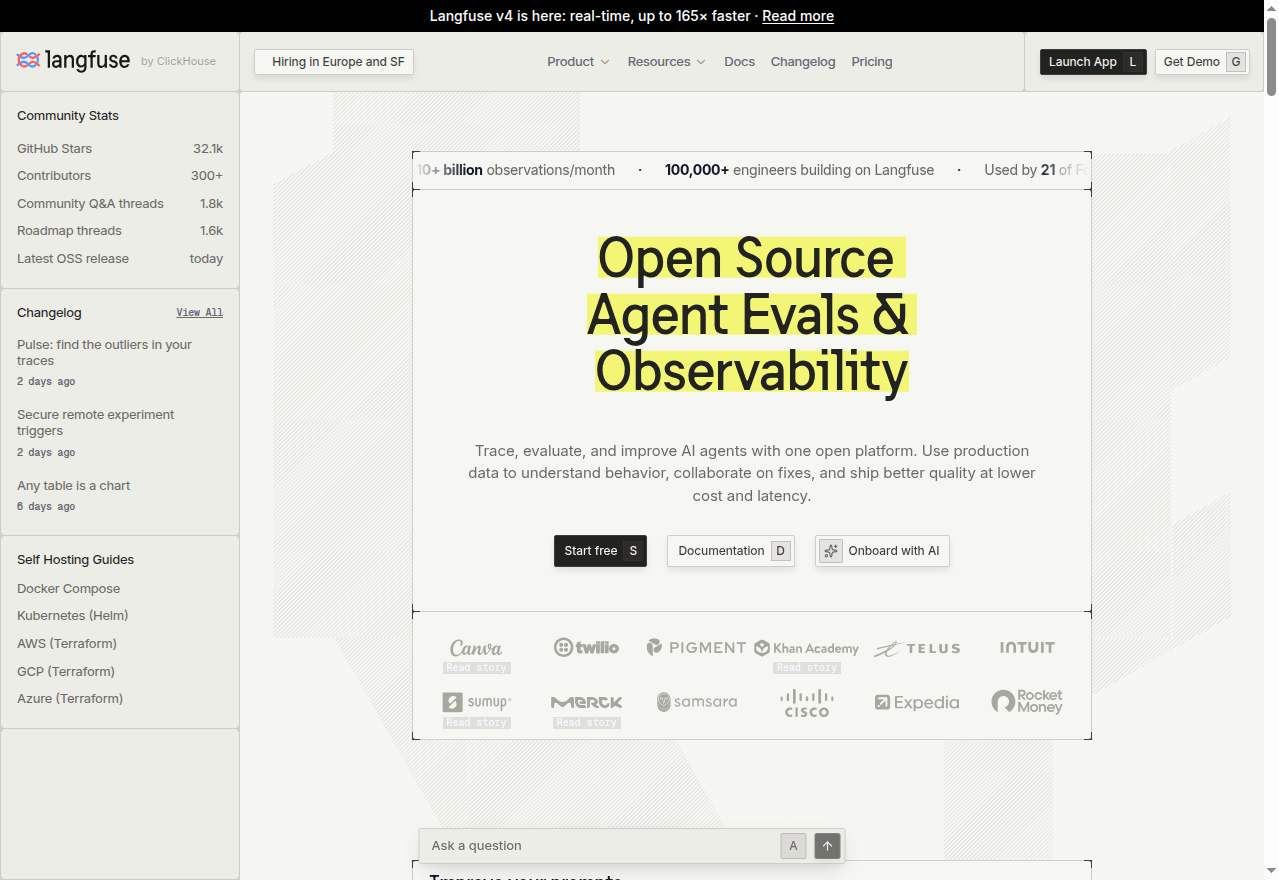
Langfuse traces every LLM call, tool invocation, and decision your agent makes. It gives you dashboards, scores, alerts, and prompt management. When an agent leaks PII or calls the wrong API, Langfuse records it and shows you a chart. It is a dashboard.
Prefactor does the same observing, then adds a second layer: enforcement. When a run crosses a risk threshold, Prefactor can hold the action for human approval, block it outright, or throttle it - at runtime, before the action reaches a user. It is a brake pedal.
This is not a marketing distinction. It is a genuine product architecture difference. Langfuse is built on OpenTelemetry and designed for tracing at scale. Prefactor is built as a reliability layer that reads trace data and adds runtime controls. They can - and often should - work together.
Where Each Tool Wins
Langfuse wins on:
-
Open source and self-hosting. Langfuse is MIT-licensed. You can self-host it for free using Docker Compose or Kubernetes. There is no vendor lock-in and no usage-based pricing when self-hosted. Prefactor only offers self-hosting on Enterprise plans.
-
Prompt management. Langfuse has the most mature prompt management in the space: versioning, deployment labels, a playground for testing, A/B experiments, composability, caching, and GitHub integration. Prefactor does not do prompt management at all.
-
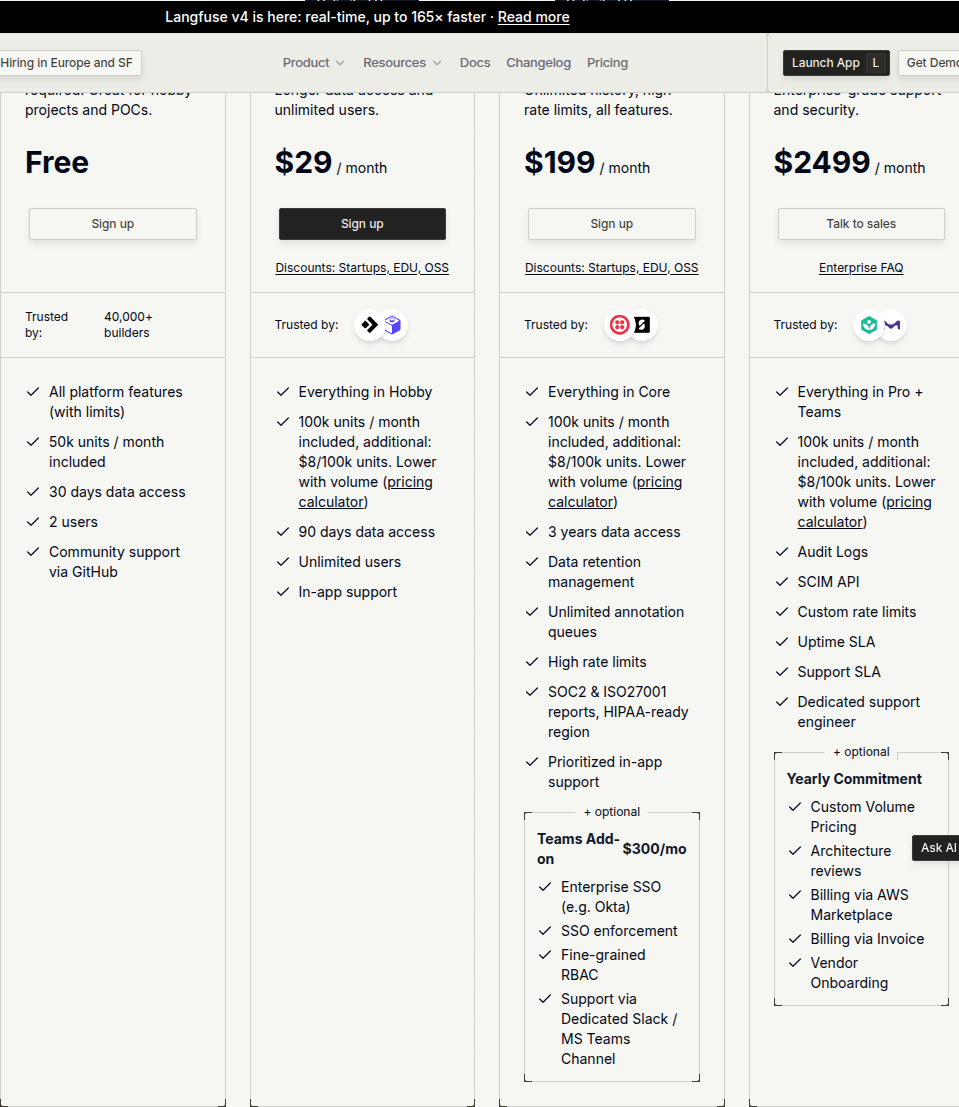
Cost. Langfuse is dramatically cheaper at every volume. The Hobby plan is free for 50,000 units/month. Core starts at $29/month with 100,000 units included and graduated pricing down to $6.00 per 100,000 units at high volumes. Self-hosting is free. Prefactor’s Scaleup plan starts at $250/month (100,000 spans) and scales linearly.
-
Adoption and integrations. Langfuse has 100+ framework integrations, the largest open-source community in the space, and backing from ClickHouse, which acquired Langfuse. It is the default choice for teams starting with LLM observability.
-
Full platform. Langfuse covers observability + prompt management + evaluation + metrics under one roof. You don’t need to stitch multiple tools together for the basics.
Prefactor wins on:
-
Runtime enforcement. This is the entire reason Prefactor exists. When an agent is about to take a risky action - call a production API, write to a database, send a customer-facing message - Prefactor can pause the run and hold it for human approval, block it outright, or throttle it. Langfuse records the action after it happens. No amount of Langfuse dashboards replaces a brake pedal.
-
Agent-level quality scores. Prefactor gives you a quality score per agent tracked across versions, with automated drift detection against a baseline. Langfuse scores at the trace level - you can spot a trend manually, but nothing flags it automatically.
-
Eval-gated promotion. Prefactor gates agent promotion through dev → staging → production only when evals pass, with instant rollback. This treats agents like software artifacts - versioned, staged, and promoted with confidence.
-
Custom spans. Prefactor lets you pull context from any datasource (GitHub, Linear, Jira, databases, internal APIs) into the agent run, so evaluations are grounded in what actually happened - not just the LLM output.
-
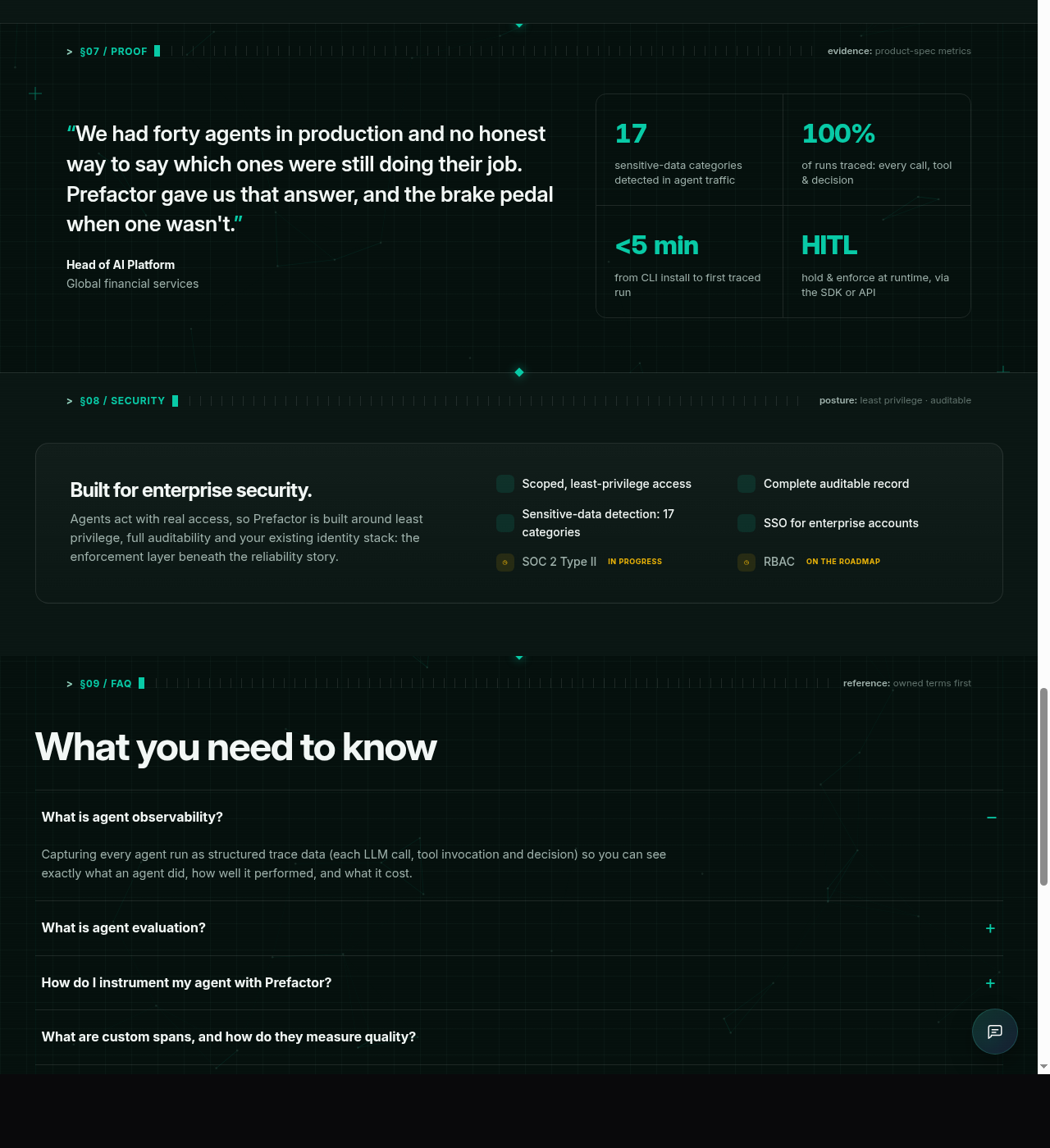
Built-in PII detection. 17 categories of sensitive data detection run on every span, on every plan, at no per-check cost. Langfuse offers client-side data masking but does not have the same depth of built-in PII detection.
-
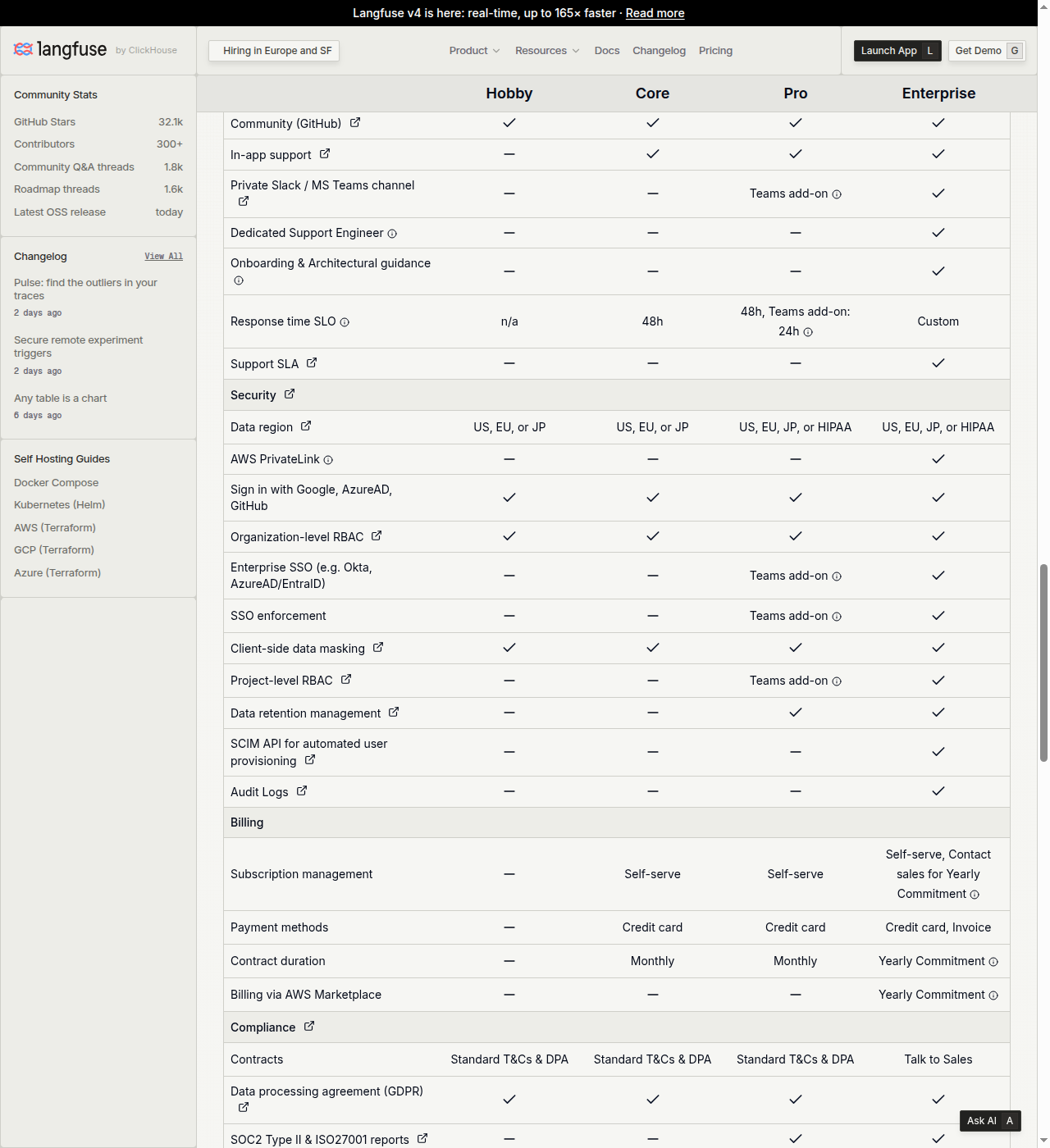
Immutable audit trails on every plan. Prefactor logs every action, score, and intervention to append-only storage. Langfuse gates audit logs behind Enterprise ($2,499/month).
Honest Comparison Table
| Capability | Langfuse | Prefactor |
|---|---|---|
| LLM tracing (spans, traces) | Yes (native) | Yes (reads existing traces) |
| Runtime enforcement (hold/block) | No | Yes (core differentiator) |
| Prompt management | Yes (versioning, playground, A/B, caching) | No |
| Self-hosting | Yes (free, MIT license) | Enterprise only |
| Open source | Yes (MIT) | No (proprietary) |
| Quality score per agent | Per trace only | Yes (cross-version, drift detection) |
| Eval-gated promotion | No | Yes |
| PII detection | Client-side masking | 17 categories, every plan |
| Audit logs | Enterprise only ($2,499/mo) | Every plan |
| Framework integrations | 100+ | 40+ (across LLM providers, agent frameworks, cloud, observability, identity, and data storage) |
| Starting price (free tier) | Free (50k units/month) | Free (25k spans/month) |
| Lowest paid plan | $29/month (Core) | $250/month (Scaleup) |
| Unlimited seats | Yes (Core and above) | Yes (every plan) |
| SOC 2 Type II | Pro+ ($199/mo) | In progress |
| Data regions | US, EU, Japan, HIPAA | US, EU, Asia Pacific |

Pricing: The Real Numbers
Prefactor
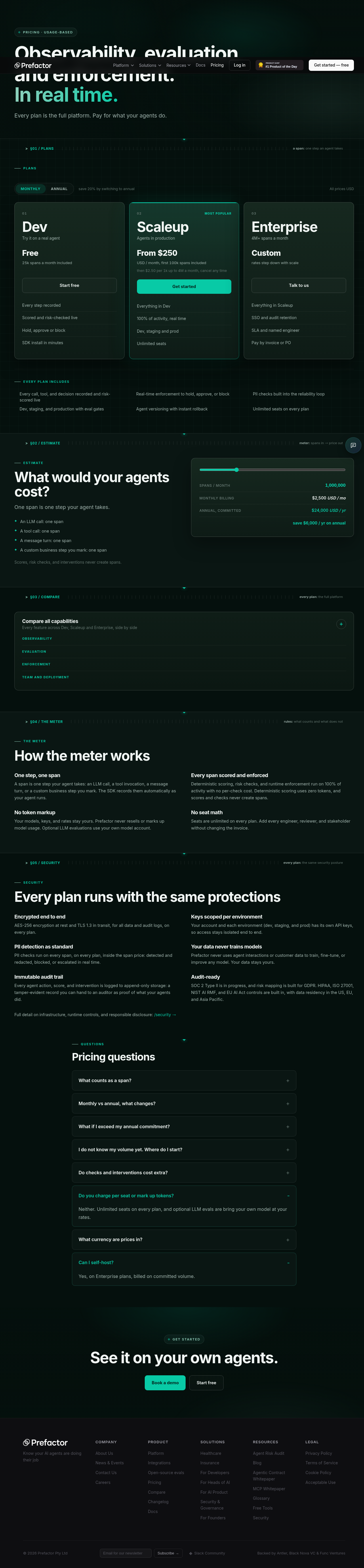
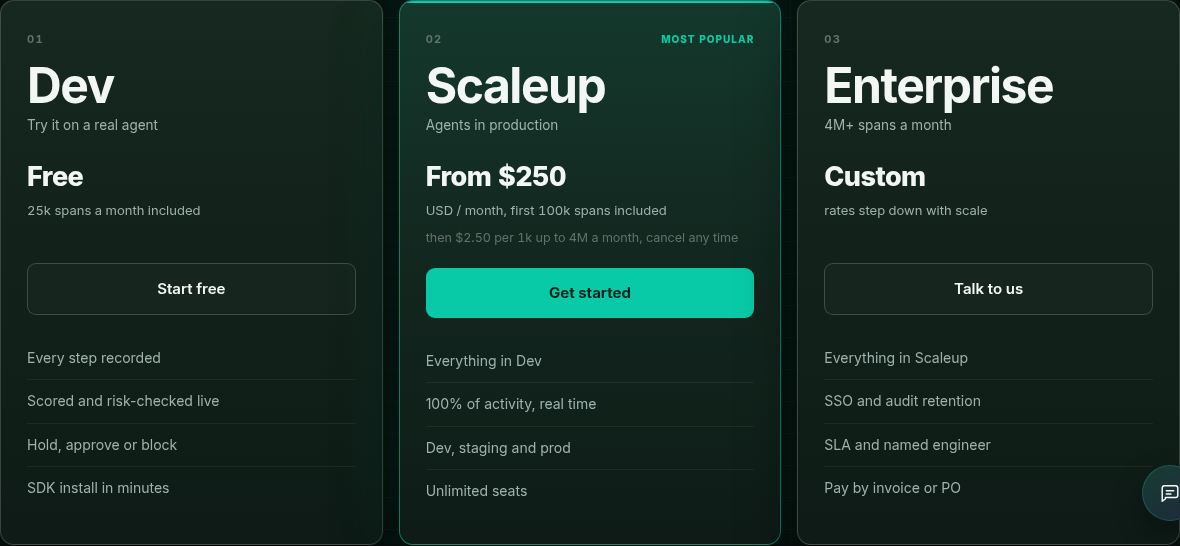
Prefactor bills on spans - one span equals one step an agent takes (LLM call, tool call, message turn, or custom step). Scoring, risk checks, and interventions are free - they never create additional spans.
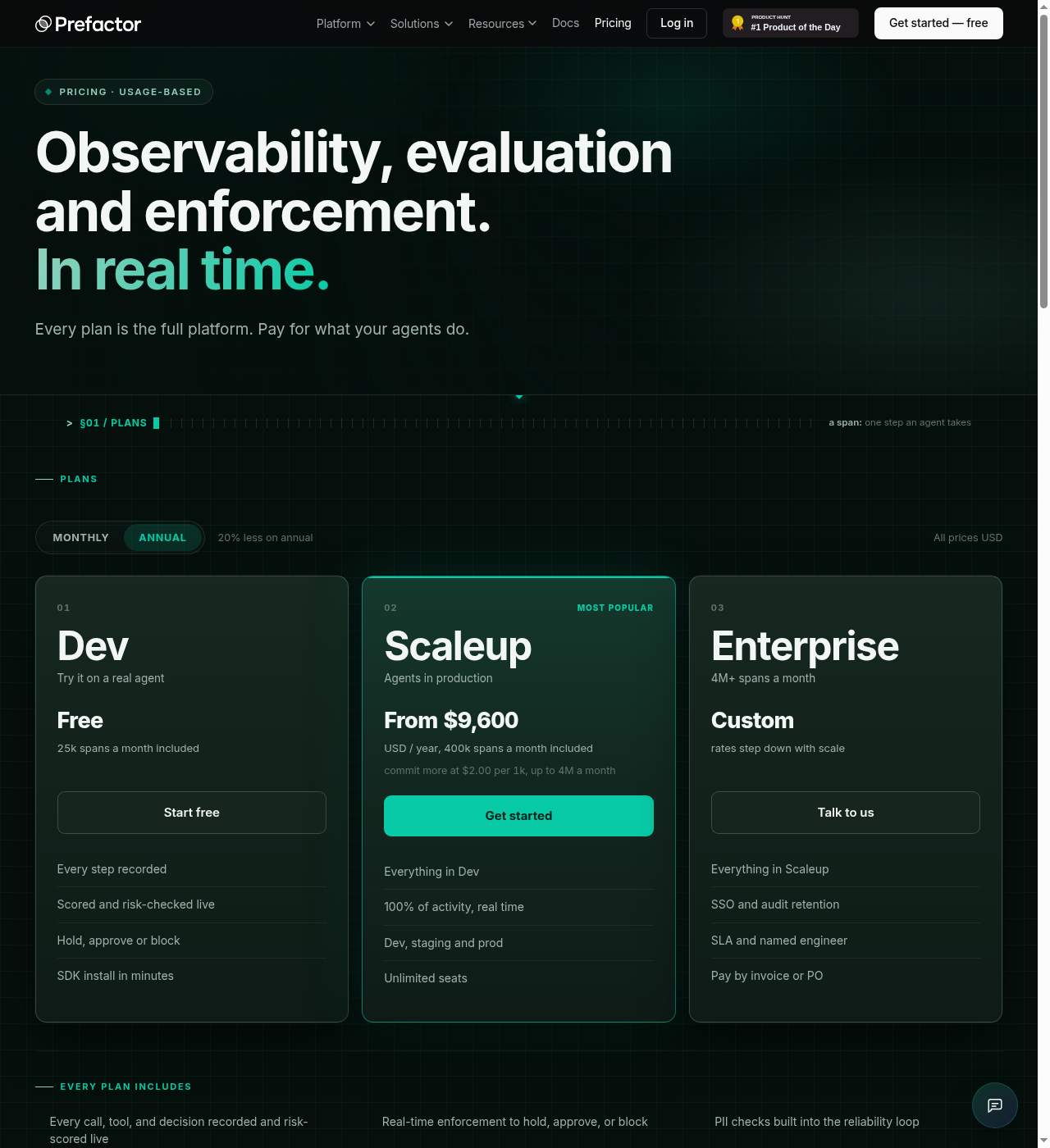
| Plan | Monthly Price | Spans Included | Overage |
|---|---|---|---|
| Dev | Free | 25,000/month | No paid option |
| Scaleup (monthly) | $250/month | 100,000/month | $2.50 per 1,000 spans (up to 4M) |
| Scaleup (annual) | $9,600/year ($800/mo effective) | 400,000/month | $2.00 per 1,000 spans (up to 4M) |
| Enterprise | Custom | 4M+/month | Rates step down with volume |
- Unlimited seats on every plan.
- No token markup - you bring your own model keys for optional LLM evals.
- PII detection included in span price on all plans.
- Self-hosted available on Enterprise only.
Prices as of July 2026. Check prefactor.ai/pricing for current rates.
Langfuse (Cloud)
Langfuse bills on units - any tracing data point (traces, observations/spans/events, scores).
| Plan | Monthly Price | Units Included | Overage (Graduated) |
|---|---|---|---|
| Hobby | Free | 50,000/month | No paid option |
| Core | $29/month | 100,000/month | $8/100k (100k-1M), then down to $6/100k |
| Pro | $199/month | 100,000/month | Same graduated rates |
| Enterprise | $2,499/month | 100,000/month | Custom volume pricing available |
| Teams Add-on | +$300/month | - | SSO, RBAC, private Slack |
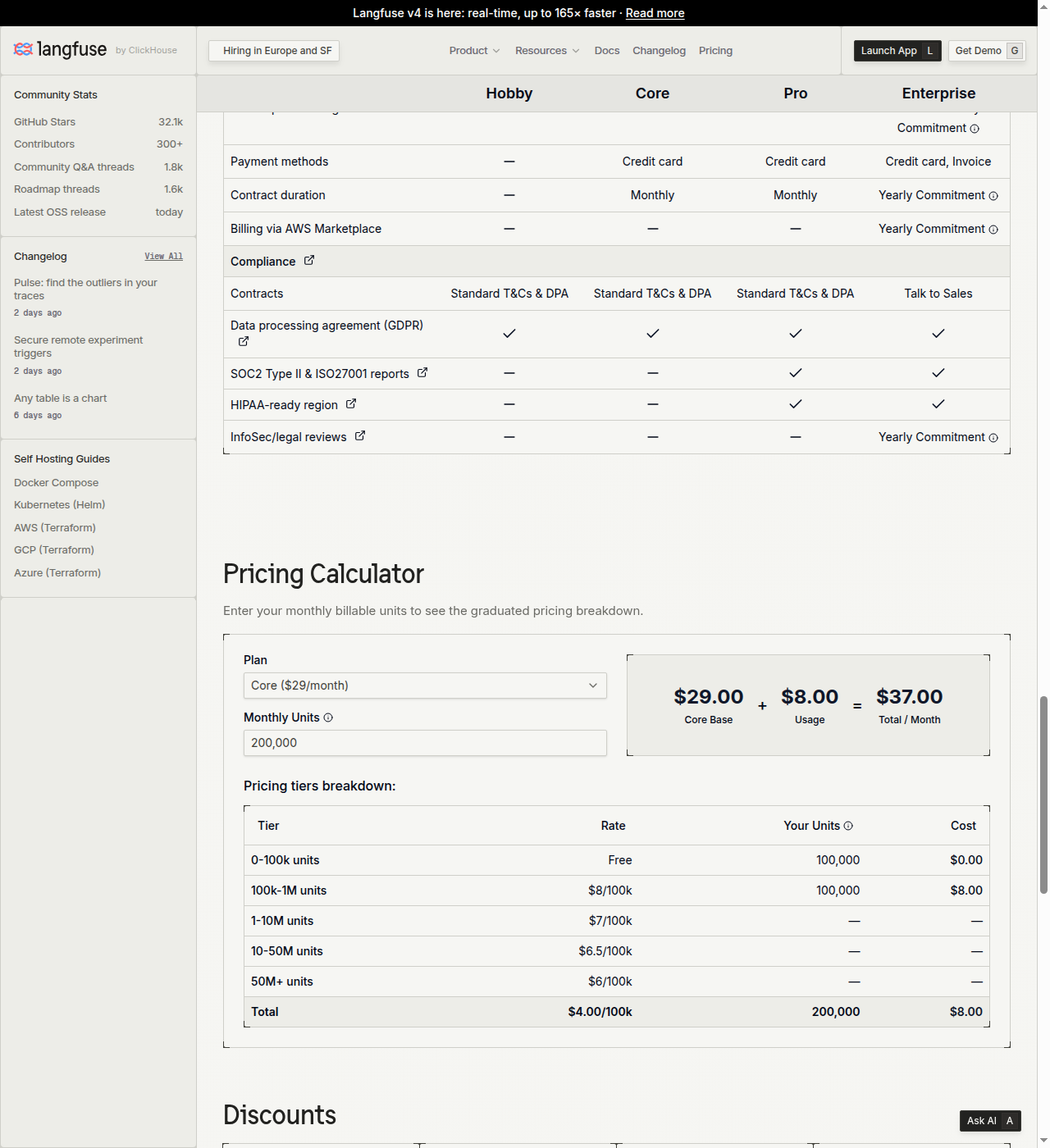
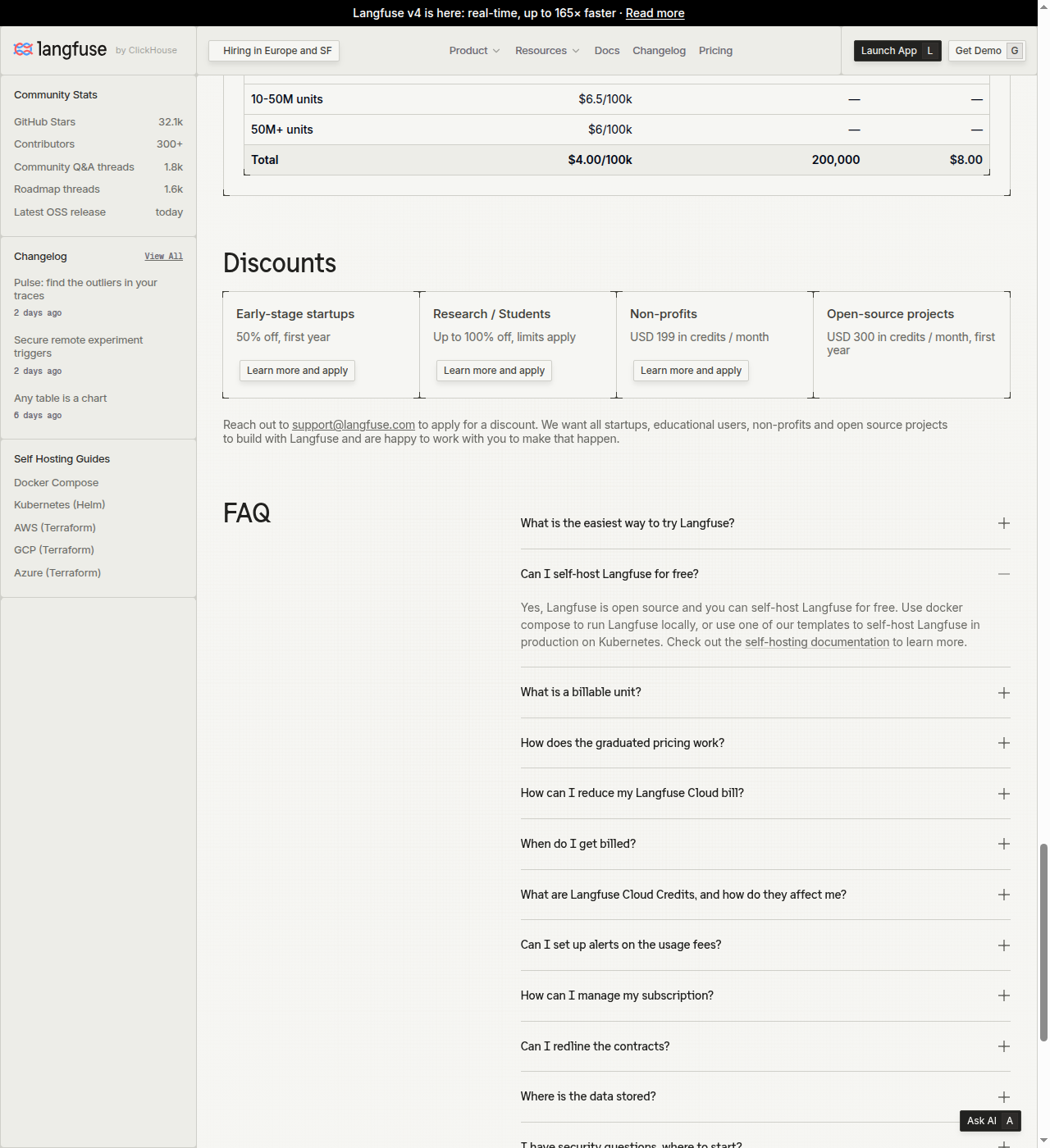
Graduated overage pricing (applies across all paid plans):
- 0–100k units: included in plan
- 100k–1M: $8.00 per 100,000 units
- 1M–10M: $7.00 per 100,000 units
- 10M–50M: $6.50 per 100,000 units
- 50M+: $6.00 per 100,000 units
Self-hosting Langfuse is free (MIT license). Discounts available for startups (50% off first year), researchers/students, non-profits, and open-source projects.
Prices as of July 2026. Check langfuse.com/pricing for current rates.
Cost Comparison at Key Volumes
At 100,000 spans/units per month:
- Prefactor Scaleup: $250/month (monthly plan)
- Langfuse Core: $29/month
- Langfuse is roughly 8.6x cheaper.
At 1,000,000 spans/units per month:
- Prefactor Scaleup: ~$2,500/month (monthly plan)
- Langfuse Core: ~$101/month
- Langfuse is roughly 25x cheaper.
But: these numbers compare fundamentally different products. Prefactor’s spans include runtime enforcement - holding, blocking, and human-in-the-loop intervention that Langfuse doesn’t offer at any price. If you need a brake pedal, Langfuse’s price advantage is irrelevant because it can’t solve that problem.
Where Langfuse Loses
It can’t stop anything. Langfuse is a world-class observability platform, but it operates on an “observe and score” model. When an agent does something wrong - leaks PII, calls the wrong API, writes bad data - Langfuse records it and shows you after the fact. For agents that take irreversible actions in production, that gap is the difference between a charted failure and a prevented one.
No agent-level quality tracking. Langfuse scores at the trace level. You can compare scores manually, but there is no automated quality score per agent that tracks across versions, no drift detection, and no eval-gated promotion. If you’re running dozens of agents and need to know which ones are degrading, you’re building that tracking yourself.
Audit trails require Enterprise. If you need an immutable, auditable record of what your agents did and which decisions were made, you need Langfuse Enterprise at $2,499/month. Prefactor includes this on every plan.
Prompt management is powerful but siloed. Langfuse’s prompt management is best-in-class, but if your primary need is runtime enforcement and agent reliability, prompt management alone won’t solve that problem.
Where Prefactor Loses
It costs real money. Prefactor starts at $250/month for production use. Langfuse starts at $29/month (or free if self-hosted). For a team with simple observability needs - trace your LLM calls, check costs, run a few evals - Prefactor is overkill and overpriced.
No prompt management. If you need prompt versioning, a playground, A/B testing, or GitHub-integrated prompt workflows, Prefactor offers none of it. You’ll need another tool for that layer.
Not open source. Prefactor is proprietary. If your organization has a policy requiring open-source infrastructure or you need full control over your data, Langfuse’s MIT license and self-hosting are hard requirements that Prefactor cannot meet.
It reads traces - it doesn’t create them natively. Prefactor ingests trace data from your existing setup (OpenTelemetry, framework SDKs). It does not do native tracing the way Langfuse does. If you don’t already have tracing in place, you need to set that up first, and Langfuse is a natural starting point for that.
SOC 2 is still in progress. For compliance-sensitive teams that require SOC 2 Type II certification today, Langfuse Pro ($199/month) has it. Prefactor’s SOC 2 is in progress with no published completion date.
Younger and smaller. Langfuse has years of production deployment, an acquisition by ClickHouse, and the largest open-source community in the space. Prefactor launched more recently and has a smaller install base. For risk-averse enterprise buyers, Langfuse’s track record matters.
The ClickHouse Acquisition Factor
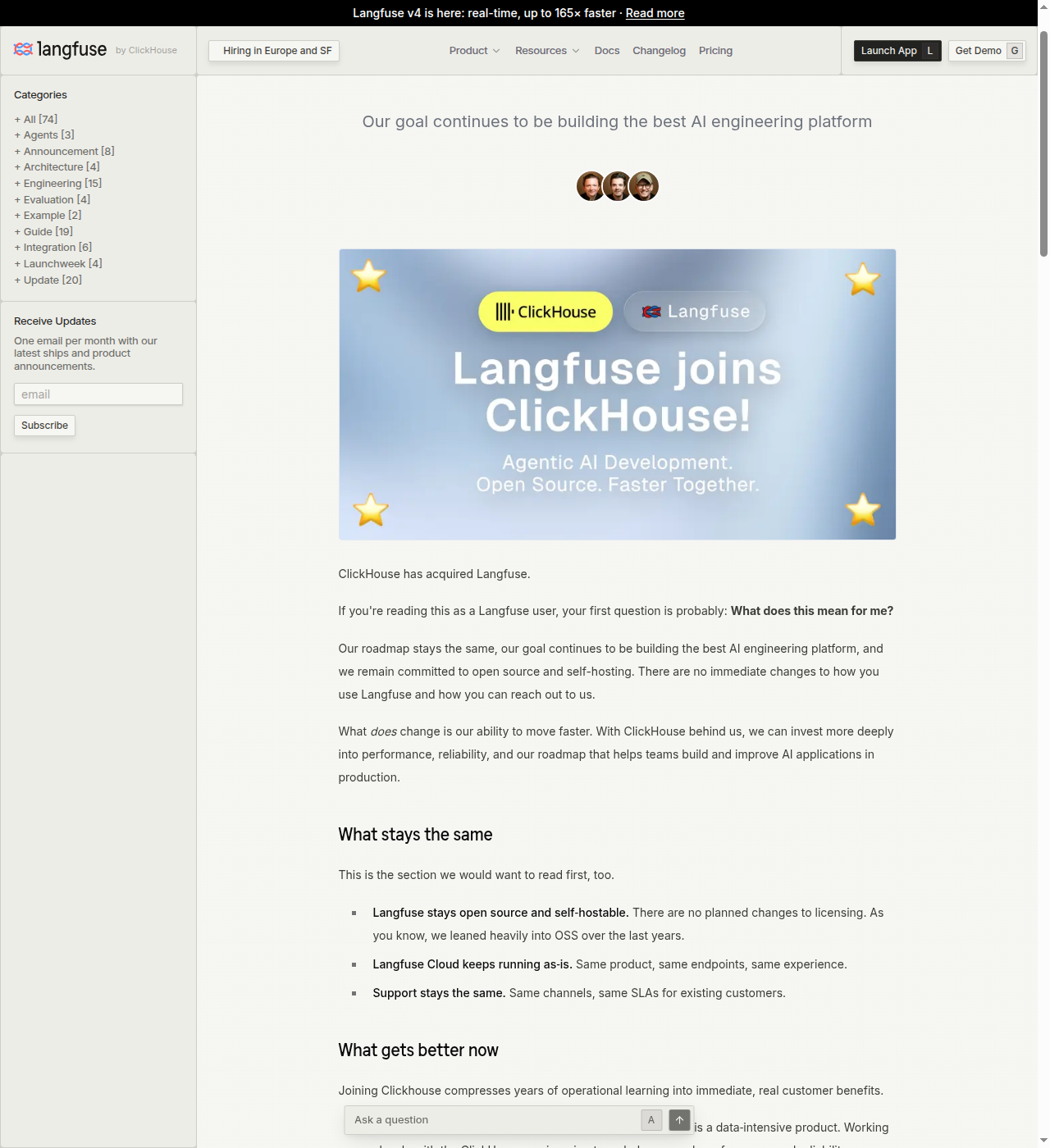
Langfuse was acquired by ClickHouse. The Langfuse team joined ClickHouse, the product roadmap continues unchanged, and the MIT open-source license explicitly remains. Langfuse already ran on ClickHouse (migrated from PostgreSQL in late 2024), so the acquisition gives it deeper database engineering resources and proven infrastructure at massive scale.
For buyers, this is mostly positive in the near term: more engineering resources behind the same product. The reasonable long-term concern is whether Langfuse’s roadmap gradually couples to ClickHouse-native architecture in ways that affect self-hosting flexibility or data residency. That concern is speculative, but enterprise buyers should ask about it directly.
The Honest Verdict
Pick Langfuse alone if:
- You need open-source observability with self-hosting as a first-class option.
- You need prompt management (versioning, playground, A/B testing) alongside tracing.
- You are cost-conscious - Langfuse is dramatically cheaper at every volume, and free self-hosting exists.
- Your agents don’t take irreversible actions that need runtime blocking. If an agent’s worst failure mode is a bad text response, Langfuse’s dashboards are enough.
Add Prefactor on top of Langfuse (or any tracing tool) if:
- Your agents take actions that can’t be undone - calling APIs, writing to databases, sending customer-facing messages, moving money.
- You need auditable proof that agents behaved correctly, with an immutable record on every plan.
- You need runtime enforcement - holding, blocking, or escalating risky actions before they execute.
- You run multiple agent versions and need quality scores tracked across versions with automated drift detection.
Pick Prefactor alone if:
- Runtime enforcement is your primary need and you can get tracing from elsewhere (OpenTelemetry, your framework’s native tooling, or an existing observability stack).
- Prompt management is not a requirement - or you already have a prompt workflow you’re happy with.
- You need audit trails, PII detection, and enforcement in one layer without paying enterprise pricing for basic compliance features.
This is not an either/or decision for most production teams. Langfuse gives you best-in-class tracing and prompt management at the lowest cost. Prefactor adds the enforcement layer - the brake pedal - that stops bad agent actions before they hit users. If your agents are running in production and taking actions that matter, the honest recommendation is Langfuse for observability, plus Prefactor for enforcement. The stack is stronger with both.