19 July 2026 · Comparison
Lovable vs Replit Agent: Which AI Builder Ships Faster?
The short answer
Lovable wins on governance and MCP control from Claude or Cursor. Replit Agent wins on mobile output and parallel agents. Plus the credit math.
Verdict: Lovable wins for teams that need enterprise governance, transparent pricing, and letting external AI tools drive the builder itself. Replit Agent wins for builders who want mobile apps, a visual design canvas, and parallel agent speed. Pick Lovable if you’re building internal tools with SSO requirements or want to control the builder from Claude Desktop or Cursor via MCP. Pick Replit Agent if you need to ship web and mobile apps simultaneously and want a Kanban board for team coordination.
Affiliate disclosure: Some links in this post are affiliate links. If you click and buy, we may earn a commission at no extra cost to you. Lovable is an affiliate partner.
See also: Lovable vs bolt.new if you’re weighing Lovable against a design-system-led alternative, and Bolt.new vs v0 if you only need frontend components.
Both Lovable and Replit Agent promise the same thing: describe your app in plain English, and AI builds it for you. No coding required. But once you look past the marketing, they’re built for very different buyers. Lovable is a credit-based AI software engineer focused on production web apps with enterprise governance. Replit Agent is an evolved IDE with parallel AI agents, a visual design canvas, and multi-platform output.
After testing both platforms side by side, here is where each one wins, where each one loses, and how to pick.
At a Glance: Lovable vs Replit Agent
| Lovable | Replit Agent | |
|---|---|---|
| Core output | Web apps (React + Supabase + Tailwind) | Web, mobile apps, slides, videos, animations |
| Starting price | Free (5 daily credits, 30/month cap) | Free (daily credits, 1 published project) |
| First paid tier | Pro $25/mo (100 credits) | Core $18/mo annual (was $20) |
| Team collaboration | Unlimited members on all plans, shared credit pool | 0-15 collaborators depending on plan |
| Design tool | AI image generation + workspace themes | Infinite Canvas (visual, direct manipulation) |
| Agent model | Plan Mode (think) + Build Mode (execute) | Parallel agents, self-testing, Kanban board |
| Enterprise certs | SOC 2 Type II, ISO 27001, GDPR | SOC 2 |
| SSO / SCIM | SSO + SCIM on Business and Enterprise | SSO + SCIM on Enterprise (both Self-Serve and Sales-Assisted) |
| MCP direction | Exposes an MCP server — Claude, Cursor, VS Code connect into Lovable | Runs an MCP client — Agent connects out to external tools |
| Code ownership | Export to GitHub/GitLab | Import/export from GitHub |
Pricing Compared
Prices accurate as of July 2026; check each vendor’s site for current rates.
Lovable Pricing
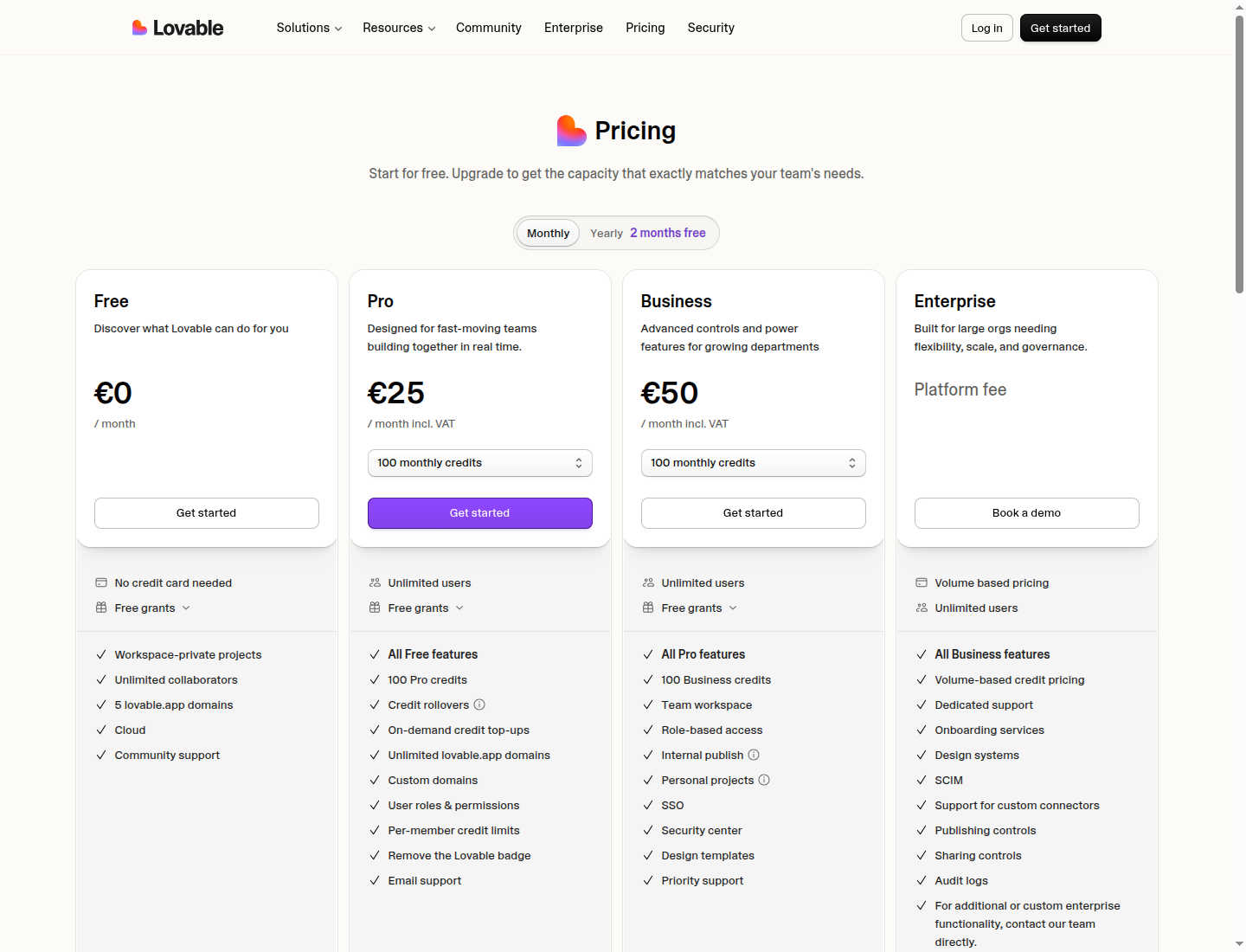
Lovable uses a credit-based system. You get credits for building (prompting the AI), hosting (Lovable Cloud), and AI features in your deployed app. All three pull from the same credit balance.
Free: 5 daily build credits (capped at 30/month), 20 Cloud credits/month, 4 AI gateway credits/month. Unlimited workspace members. Git sync included.
Pro: Starts at $25/mo (100 credits), ranges up to $2,250/mo (10,000 credits). Annual billing knocks it down to $21/mo to $1,875/mo. Adds code download, custom domains, hide Lovable badge, email support, credit rollovers, auto top-up, per-member credit limits.
Business: Starts at $50/mo (100 credits), ranges up to $4,300/mo (10,000 credits). Annual: $42/mo to $3,584/mo. Adds SSO, role-based access, design templates, personal projects, internal publish, priority support, security center.
Enterprise: Custom, volume-based credits. Adds SCIM, audit logs, workspace insights, scheduled security scans, dedicated support, onboarding, design systems, publishing/sharing controls, custom connectors.
Credit costs in build mode vary by task complexity. Here are example costs from Lovable’s docs:
- “Make the button gray”: 0.50 credits
- “Remove the footer”: 0.90 credits
- “Add authentication”: 1.20 credits
- “Build a landing page with images”: 2.00 credits
Top-ups cost $15 for 50 credits ($0.30/credit) on Pro, $30 for 50 credits ($0.60/credit) on Business.
What’s unique: Plan Mode costs a flat 1 credit per message and never modifies your code. You can think, investigate, and compare approaches without fear of breaking anything.
Replit Agent Pricing
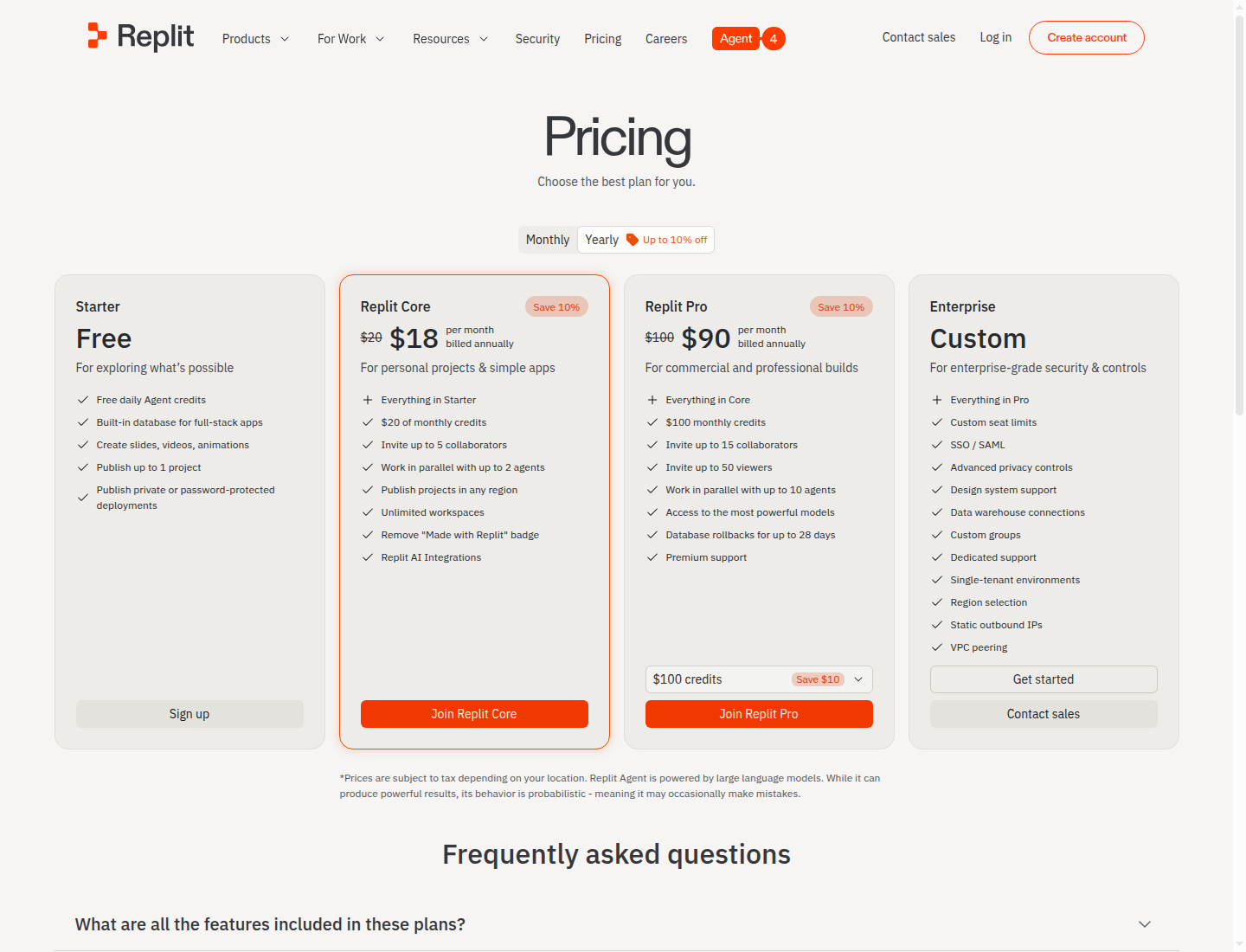
Replit also uses a credit system, but it’s less granularly documented than Lovable’s. You receive monthly credits with each paid plan.
Starter (Free): Free daily Agent credits, built-in database for full-stack apps, create slides/videos/animations, publish 1 project, private/password-protected deployments.
Core: $18/mo annual (was $20). $20 of monthly credits, up to 5 collaborators, 2 parallel agents, publish in any region, unlimited workspaces, remove “Made with Replit” badge, Replit AI Integrations.
Pro: $90/mo annual (was $100). $100 in monthly credits, up to 15 collaborators, up to 50 viewers, 10 parallel agents, access to most powerful models, database rollbacks (28 days), premium support.
Enterprise: Custom pricing. Everything in Pro plus custom seat limits, SSO/SAML, SCIM, advanced privacy controls, design system support, data warehouse connections, custom groups, dedicated support, single-tenant environments, static outbound IPs, VPC peering.
Replit’s “Effort-Based Pricing” (pay-as-you-go) is mentioned in their FAQ but not broken down into specific per-prompt costs like Lovable does. What exactly a credit buys you is less transparent.
The Credit Math Neither Vendor Shows You
Neither pricing page does this arithmetic for you, but it changes what you’re actually paying for.
Lovable’s Business tier isn’t selling you more credits — it’s selling you a ~2x credit markup for SSO. Pro is $25/mo for 100 credits ($0.25/credit) up to $2,250/mo for 10,000 credits ($0.225/credit). Business is $50/mo for the same 100 credits ($0.50/credit) up to $4,300/mo for 10,000 credits ($0.43/credit). Same credit volumes, roughly double the per-credit price at every tier. You’re not buying more building power on Business — you’re buying SSO, role-based access, and the security center, priced as a credit surcharge rather than a flat add-on fee.
Replit’s Core-to-Pro upgrade doesn’t reprice credits at all. Core is $18/mo (annual) for $20 of monthly credits — a $0.90-per-dollar-of-credit ratio. Pro is $90/mo (annual) for $100 of monthly credits — also $0.90 per dollar. Whatever you’re paying extra for when you move from Core to Pro (10 collaborators instead of 5, 10 parallel agents instead of 2, premium support, 28-day database rollbacks), it isn’t cheaper credits — the credit-to-dollar ratio is identical at both tiers.
What $25/mo of Lovable actually buys, in real tasks: using Lovable’s own published per-prompt costs, 100 Pro credits is roughly 50 “build a landing page with images” prompts (at 2.00 credits each), or about 83 “add authentication” prompts (at 1.20 credits each), or 200 basic style tweaks like “make the button gray” (at 0.50 credits each) — in a single month, before you even top up.
Where Lovable Wins
Enterprise Governance Depth
Lovable has the deeper compliance stack. Its security page displays “SOC 2 Type II,” “GDPR,” and “ISO 27001” certification badges under a “Compliant and certified” heading. You get SSO and role-based access starting at the Business tier ($50/mo). Enterprise adds SCIM provisioning, audit logs, scheduled security scans, and workspace insights. If your company requires ISO 27001 specifically, Lovable is the one with a visible badge for it.
Replit’s own security page shows a single “SOC 2” badge under the same kind of “Compliant and certified” section, and offers SSO/SCIM on Enterprise, but the compliance depth is thinner on the public page. No ISO 27001 badge, no scheduled security scans advertised.
An MCP Server You Can Drive From Claude or Cursor
Lovable runs an MCP server: you point Claude Desktop, Cursor, or VS Code at it, and from there you can scaffold a new Lovable app, read and edit source files, run live SQL against the project database, and trigger a deploy — all without opening the Lovable UI. It turns Lovable into a tool your existing AI coding workflow calls, rather than a separate app you have to context-switch into.
Replit also talks about MCP, but it means the opposite thing. Replit Agent is an MCP client: it connects out to external MCP servers (a transcript-fetcher, an API, a data source) to pull in tools it doesn’t have natively. There’s no equivalent to Lovable’s setup where Claude or Cursor drives Replit itself. If what you want is “control my app builder from the AI tool I already use daily,” Lovable is the one that does it; if you want “give my Replit Agent more external tools to call,” that’s what Replit’s MCP support is for.
Unlimited Team Members on Every Plan
Lovable charges by credit usage, not by seat. Every plan, including Free, supports unlimited workspace members. You add people freely and set per-member credit limits to control cost. Replit gates collaborators behind plan tiers: none on Starter, 5 on Core, 15 on Pro.
Plan Mode: Think Before You Build
Lovable’s Plan Mode (1 credit per message, never modifies code) is a genuinely useful feature if you’re working through architecture decisions or debugging a problem. You can brainstorm, investigate, and compare approaches without worrying the AI will rewrite something you didn’t ask it to. Replit has no equivalent separation of thinking and building.
Transparent Per-Message Credit Costs
Lovable publishes example credit costs for specific prompts. You know “make the button gray” costs about 0.50 credits and “build a landing page” costs about 2.00. Replit mentions “Effort-Based Pricing” but doesn’t break down what specific tasks cost. If you’re budget-conscious, Lovable’s transparency wins.
Where Replit Agent Wins
Multi-Platform Output (Including Mobile Apps)
Replit builds web apps, mobile apps, landing pages, slides, videos, and animations in the same project with shared context. Lovable is web-only. If you need a mobile app alongside your web app, Replit is the only choice here.
Infinite Canvas for Visual Design
Replit’s Infinite Canvas lets you design visually with direct manipulation. You can tweak designs, generate variants, edit hover and active states, and apply responsive overrides — all on a canvas. Lovable handles design through AI image generation and workspace themes, but there’s no visual design tool you can directly manipulate. If you’re a designer or visual thinker, Replit’s canvas is a different category.
Parallel Agents for Speed
Replit Agent 4 runs multiple agents simultaneously. One handles auth, another the database, another the frontend, another the backend design. You see progress for each agent in real time. Lovable processes one prompt at a time. For complex multi-component builds, Replit’s parallel execution is faster.
Agent Self-Testing
Replit Agent tests its own code in a browser, generates a report, and fixes the issues it finds. Replit claims this system is “3x faster and 10x more cost effective than Computer Use Models.” Lovable does not advertise self-testing capability. If you’re building something you need to ship without a QA team, agents that test themselves are a real advantage.
Kanban Board for Team Coordination
Replit includes a Kanban task board where your team submits requests in any order and Agent 4 intelligently sequences and executes them. Everyone can see what the agents are doing. Lovable has project visibility and usage tracking, but no built-in task board for team coordination.
Longer Platform History
Replit was founded around 2016 and has a massive legacy user base. Lovable is younger. For organizations that value platform stability and longevity, Replit’s track record is worth considering.
Where Lovable Falls Short
- Web-only. No mobile app generation. If you need iOS or Android output, Lovable simply can’t do it.
- No visual design canvas. You describe what you want; the AI generates it. There’s no direct-manipulation design tool like Infinite Canvas.
- Single-agent execution. Lovable processes one prompt at a time. No parallel agent model for simultaneous multi-component work.
- Younger platform. Founded more recently than Replit, with a smaller track record to point to.
- No built-in Kanban/task board. Team coordination depends on external tools.
Where Replit Agent Falls Short
- No MCP server for the platform itself. Replit’s MCP support only runs outward (Agent connecting to external tools). Unlike Lovable, you can’t point Claude Desktop or Cursor at Replit and have it scaffold, edit, or deploy your project for you.
- No Plan Mode. Every prompt is a build prompt. There’s no “think without executing” mode, which means every exploration costs build credits and potentially modifies your code.
- Collaborator caps on lower tiers. Starter gives you zero collaborators. Core limits you to 5. Pro gives you 15. Lovable gives you unlimited on Free.
- Credit transparency. Replit doesn’t publish per-prompt cost examples the way Lovable does. It’s harder to predict what your $25 or $100 in monthly credits actually buys you.
- “Made with Replit” badge on free plan. You need Core ($20/mo) just to remove branding. Lovable removes its badge at Pro ($25/mo).
- No ISO 27001 badge on the public security page. Lovable’s security page shows one; Replit’s shows only SOC 2. If your procurement checklist requires ISO 27001 specifically, verify directly with Replit’s sales team before assuming parity.
- Git sync limited to GitHub. Replit only syncs to GitHub. Lovable syncs to both GitHub and GitLab.
When Both Lose to Alternatives
These two aren’t the only options in the AI app builder space. Consider alternatives when:
- bolt.new (StackBlitz): Better if you need instant browser-based environments and native Supabase integration. Bolt’s WebContainers tech gives fast sandboxed environments.
- v0 by Vercel: Better if you only need frontend React/Next.js components, landing pages, or shadcn/Tailwind UI. v0 deploys straight to Vercel and is frontend-only.
- Cursor: Better if you’re a developer who wants AI-assisted coding, not prompt-to-app. Cursor is an IDE with AI features, not a no-code builder.
- Traditional no-code tools (Bubble, Webflow): Better if you need pixel-perfect visual control without AI unpredictability.
Bottom Line: Who Should Pick What
Pick Lovable if: You need enterprise governance (ISO 27001, SCIM, audit logs), you want to drive the builder itself from Claude, Cursor, or VS Code via MCP, you value unlimited team members on any plan, you want a separate “plan” mode, or transparent per-message credit costs matter to you.
Pick Replit Agent if: You need mobile apps alongside web, you want a visual design canvas, parallel agent execution saves you real time, you want agents that test their own code, or your team uses Kanban-style task management.
Neither is right if: You need instant browser-based environments (go to bolt.new), you only need frontend components (go to v0), or you’re a developer who writes code (go to Cursor).
Want to try Lovable? Sign up for free and get 5 daily build credits with no credit card required.