7 July 2026 · Comparison
Bolt.new vs v0 (Vercel): Which AI App Builder Wins in 2026?
The short answer
if you want hosting, database, auth, storage and payments bundled into one subscription, with no separate accounts to set up.
if you're already on Next.js, React and Tailwind and you ship on Vercel.
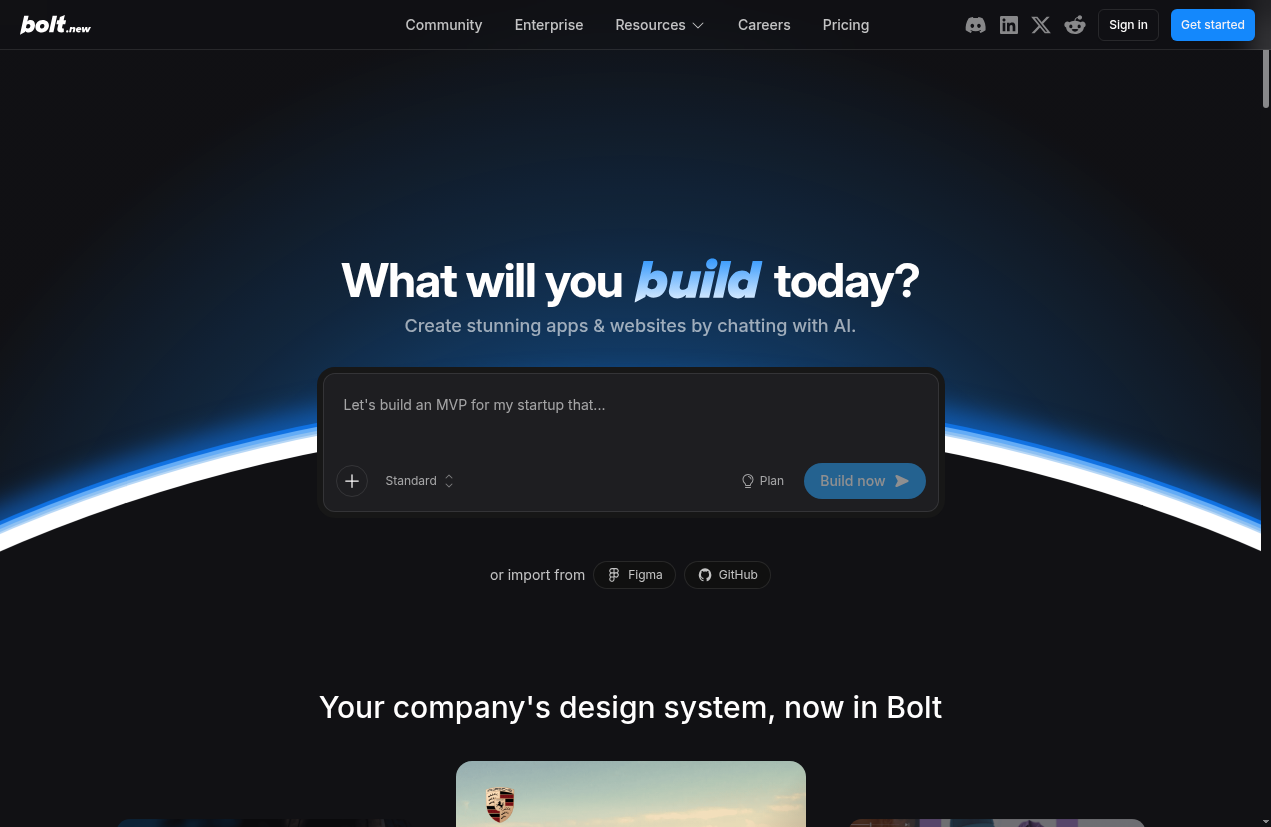
Disclosure: SaaSpicious publishes affiliate-supported comparisons. We checked bolt.new’s homepage and pricing page footers for a public affiliate or partner program and found none as of July 2026, so no affiliate links appear on this page. We test every tool we recommend against its live pricing page; we have not been paid to write this verdict.
Pick v0 if you are already on Next.js + React + Tailwind + shadcn and ship on Vercel. Pick Bolt.new if you want a bundled, single-subscription backend (hosting + database + auth + storage + analytics + Stripe) without provisioning separate provider accounts. Those are the only two questions worth asking first. The easy “v0 is frontend only, Bolt is full-stack” framing is dead - v0 added full-stack capabilities (an isolated VM preview called Vercel Sandbox, database integrations, GitHub PRs, a full VS Code-style editor) in its February 4, 2026 update, so both tools now build full-stack apps. The real decision hinge has moved to how each tool goes full-stack: Bolt bundles, v0 orchestrates.
The decision in one paragraph
Bolt Cloud is a built-in backend - hosting (Netlify-powered), a database (Supabase-powered), auth, file storage, server/edge functions, analytics, custom domains, SEO boost, and Stripe payments under one subscription. v0 takes the opposite route: it provisions accounts on best-of-breed external providers (Neon, Supabase, Upstash, Vercel Blob, Snowflake, AI model platforms) through the Vercel Marketplace and wires the environment variables in for you. Bolt’s pitch is “stop stitching together platforms.” v0’s pitch is “best-in-class Next.js expertise on Vercel’s enterprise infrastructure, you pick the providers.” Everything else in this comparison flows from that single fork.
Bolt.new vs v0 at a glance
| Dimension | Bolt.new | v0 (Vercel) |
|---|---|---|
| Full-stack approach | Bundled - Bolt Cloud (hosting + DB + auth + storage + Stripe) under one subscription | Orchestrated - Vercel Marketplace provisions separate accounts on Neon/Supabase/Upstash/Snowflake/Stripe |
| Preview fidelity | In-browser WebContainer preview | Vercel Sandbox - isolated VM runs server-side code, API routes, DB connections, env vars as in production |
| Agent / model control | 2 agents (Standard + Max); Bolt auto-routes, user does not pick | 4 model tiers (Mini / Pro / Max / Max Fast); user picks, published per-token pricing |
| Free plan | 300K tokens/day, 1M/month, public + private projects, hosting to 333K requests, Bolt branding | $5 credits/month, Vercel deploy, Design Mode, GitHub sync, 7 messages/day cap |
| Entry paid (solo) | Pro $25/mo flat - 10M tokens/month, no daily limit, no branding, custom domain, token rollover | None for new users (Premium $20 is sunsetted); entry is Team $30/seat |
| Tech stack | Framework-agnostic (WebContainer) | Locked: Next.js, React, TypeScript, Tailwind, shadcn/ui, AI SDK 6 |
| Deployment | Bolt Cloud hosting (Netlify-powered), custom domains | One-click Vercel deploy (same company) |
| Git integration | Native GitHub import, agents.md convention | Auto-branching, auto-commits, PR open/merge from v0, never pushes to main |
| Design-system import | Team plan+ ($30/seat); internal Storybook; pre-loaded Porsche/MUI/Chakra/Shadcn/WAPO/Cloudscape | Design Systems 2.0 - saved as a “skill” with v0.json schema, starter-app review gate; Cloudscape example; v0’s own docs do not state which plan gates base import |
| Mobile | None surfaced | iOS app - prompt, generate, iterate, preview, env vars, GitHub, DB integrations, MCP selection |
| Named enterprise customers | None in fetched copy | Vanta (Jeremy Epling, CPO), Code and Theory (David DiCamillo, CTO) with quotes |
| Compliance | SSO, audit logs, “compliance support” on Enterprise | SOC 2 Type 2 (in scope), ISO, GDPR, HIPAA inherited; AWS Marketplace + Bedrock on Enterprise |
| Data training default | Not surfaced (Enterprise is the privacy tier) | May train on user content by default; Business opts out by default; Enterprise never trains |
| Affiliate program | None found in footer/pricing page | None in v0 footer |
Where Bolt.new wins
1. One bundled backend, one subscription
This is Bolt’s clearest material edge. Bolt Cloud gives you hosting, unlimited databases, auth and user management, file storage, server/edge functions, analytics, custom domains, SEO boost, and Stripe payments under one paid plan. You do not provision a separate Neon account, a separate Supabase account, a separate Upstash account. The trade is honest: Bolt Cloud is powered by Netlify and Supabase under the hood, so you are buying Bolt’s wrap of those providers, not picking the providers yourself. If “one bill, no extra accounts” matters more to you than “I pick Neon because I want Postgres at scale,” Bolt wins this dimension outright.
2. A genuinely more usable free tier
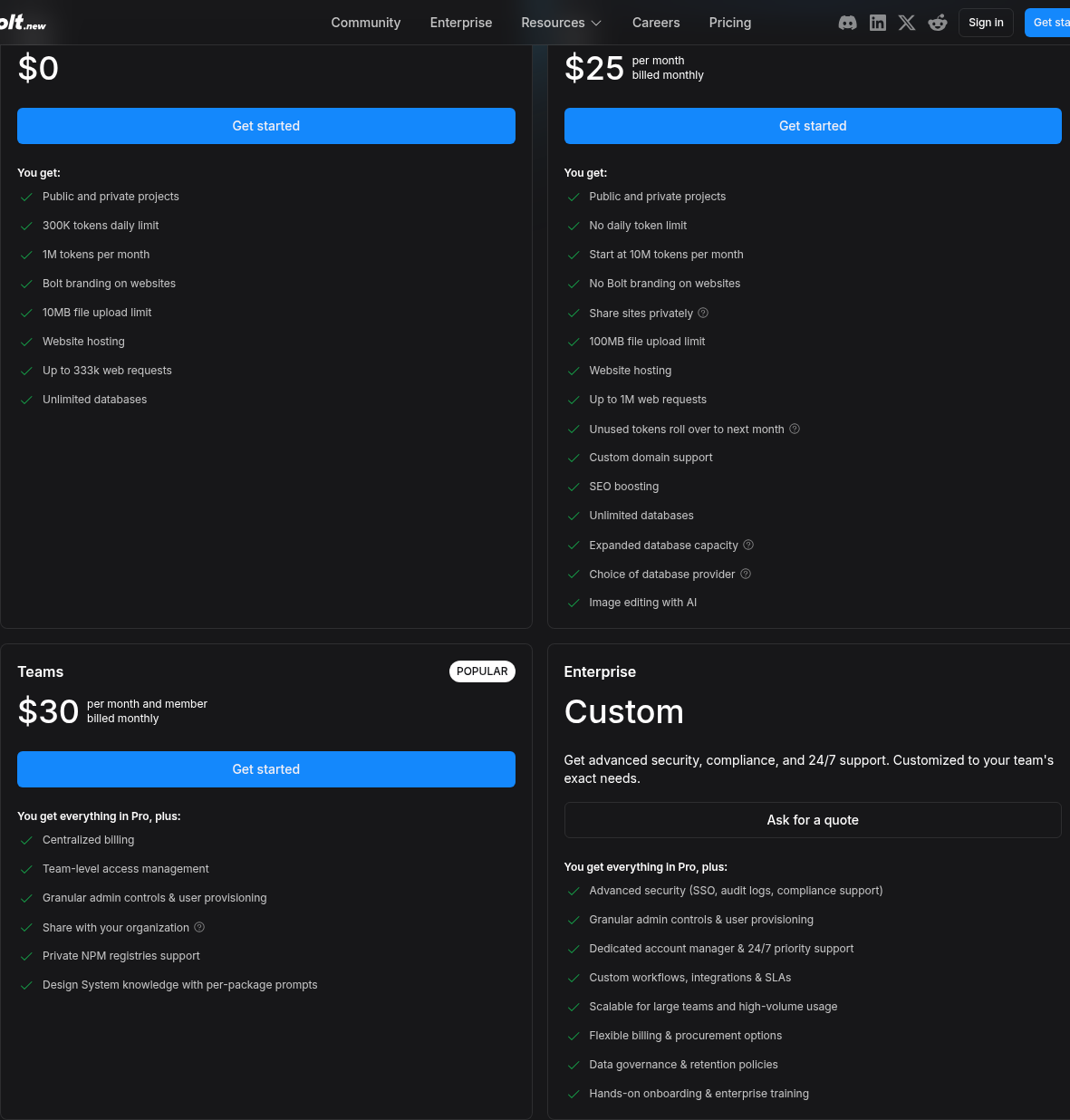
Bolt Free gives 300K tokens/day and 1M tokens/month, public and private projects, and website hosting up to 333K web requests. There is no message cap. v0 Free gives $5 of monthly credits but caps you at 7 messages/day, and that message cap, not the credit balance, is the binding constraint - a free user can barely iterate in a sitting let alone a day. For a student or a founder kicking the tires, Bolt’s free tier is substantially more usable.
3. A cheaper entry tier for solo buyers
Bolt Pro is $25/month flat (not per-seat): 10M tokens/month, no daily cap, no Bolt branding, custom domain, SEO boost, expanded database capacity, choice of database provider, AI image editing, and token rollover. v0 has no equivalent solo tier for new users - the Premium $20 plan was sunsetted and the live pricing page shows only Free, Team $30/seat, Business $100/seat, and Enterprise. For a solo buyer, $25 flat beats $30 per seat.
4. Token rollover
Bolt pays-plan tokens roll over for one extra month (valid up to two months total) as of July 1, 2025; Free-plan tokens do not roll over. v0 has no equivalent rollover mechanic - included monthly credits renew on cycle, and purchased additional credits have their own expiry. For a buyer whose usage is bursty (a weekend sprint, then nothing for three weeks), rollover recovers wasted spend.
5. A pre-loaded named-brand design-system gallery
Bolt’s homepage leads with design-system import, not templates, and surfaces pre-loaded public design systems free for everyone to build with: Porsche, Material UI, Chakra, Shadcn, Washington Post, and AWS Cloudscape. On the Team plan ($30/seat) you can import your own design system from GitHub repos, NPM packages (public or private registry), Storybook URLs, documentation websites, or uploaded files/PDFs; Bolt compiles them into an internal Storybook and builds from your real components. Bolt’s own docs confirm this is Team-plan-and-up only, that a combined 10 design systems per team can be added or synced per week, and that setup typically takes 45 to 60 minutes.
The catch, important for honesty: v0 has now matched this capability with Design Systems 2.0 (see below). Design-system import is no longer Bolt-unique. But Bolt’s pre-loaded named-brand gallery is a stronger marketing surface - you can boot a Porsche-styled app from the homepage without first having a design system to import.
6. A deep-reasoning “Max” agent for refactors
Bolt has two agents: Standard (fast, token-efficient, all users) and Max (deep reasoning for large-scale apps, complex/interconnected features, refactors, open-ended tasks). Max is Pro-only. Bolt’s pitch is “Bolt automatically routes to the right model for each task, balancing quality and cost. No more juggling platforms or guessing which agent to use.” If you do not want to think about which model to pick, Bolt removes that decision. (See “Where Bolt loses” for the inverse - buyers who want to pick a cheaper model for trivial tasks cannot.)
7. The agents.md convention
Drop an agents.md file into a project and Bolt detects and uses it as the entry point for agent instructions. This is a repo-file convention. v0’s analogue is “Instructions” (formerly “Rules”), managed through a UI. If you want agent configuration version-controlled alongside the codebase instead of locked in a vendor UI, Bolt’s approach is cleaner.
Where v0 wins
1. The cleanest Next.js + React + shadcn + Tailwind stack, deployed to Vercel
v0 is built by Vercel for Vercel. The code it generates is optimized for the deploy target by the same company that owns both. If your production stack is (or will be) Next.js + React + TypeScript + Tailwind + shadcn/ui on Vercel, v0 is the path of least resistance; nothing else in this category matches that specific combination of stack-expertise plus deploy-target-native. Bolt is framework-agnostic via WebContainer, which is real flexibility, but it is not Vercel-native.
2. Production-accurate previews (Vercel Sandbox)
As of the February 4, 2026 update, v0 previews run your code in Vercel Sandbox - a lightweight virtual machine that runs server-side code, API routes, database connections, and environment variables exactly as in production. Bolt’s preview is the in-browser WebContainer preview. For a real full-stack app with API routes and DB calls, v0’s preview fidelity is a genuine edge. v0’s own FAQ acknowledges the tradeoff (“Why does v0 feel slower?” - Sandbox builds take more time than the old browser preview) so the slower-paces trade is in the open.
3. Explicit model control with published per-token pricing
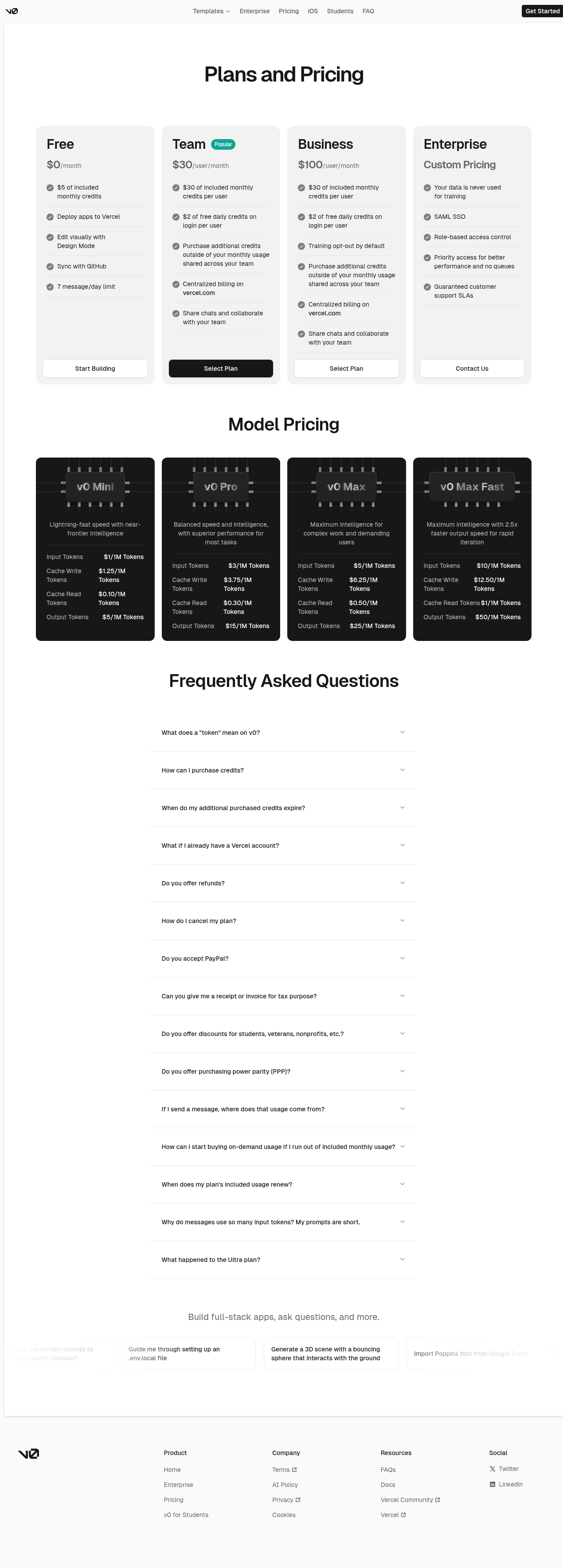
v0 publishes four model tiers with per-token prices on the public pricing page:
| Model | Input (per 1M) | Cache Write | Cache Read | Output (per 1M) | Positioning |
|---|---|---|---|---|---|
| v0 Mini | $1 | $1.25 | $0.10 | $5 | Lightning-fast, near-frontier |
| v0 Pro | $3 | $3.75 | $0.30 | $15 | Balanced; “superior performance for most tasks” |
| v0 Max | $5 | $6.25 | $0.50 | $25 | Maximum intelligence for complex work |
| v0 Max Fast | $10 | $12.50 | $1 | $50 | Max intelligence + 2.5x faster output |
You can pick Mini for a trivial change to conserve budget or Max Fast for rapid iteration on hard problems. Bolt hides model selection - “Bolt automatically routes to the right model” - which is simpler for a beginner but removes cost control from a power user. v0’s per-model table is also how a buyer can reason about cost-per-task before spending. Bolt publishes no equivalent per-model token price table.
4. More transparent, more granular agentic capability
v0 documents its agentic behavior in more detail. Web search with inline citation links, browser use (v0 opens the app it built, screenshots it, critiques the design, debugs flows, can visit external URLs for visual references), automatic error fixing (missing files/deps, syntax, runtime, import/export), Fix with v0 (20 free uses per day when a deployment has errors; after the daily cap, consumes credits), terminal commands in the sandbox with three permission modes (Ask, Auto, Full), and MCP tool-calling against marketplace integrations. Bolt’s agent description is coarser: Standard/Max plus “auto-tests, refactors, iterates” and the vendor claim “98% less errors.” More transparency matters when you are trusting the agent with a real codebase.
5. Auto-branching Git workflow that protects main
When a chat connects to GitHub, v0 automatically creates a branch (e.g. v0/main-abc123), every code change creates a commit, you can open and merge pull requests from inside v0, and v0 never pushes to main directly. This is more opinionated and safer than a standard GitHub import. Bolt’s GitHub import is capable but does not bake in branch-per-chat with main protection.
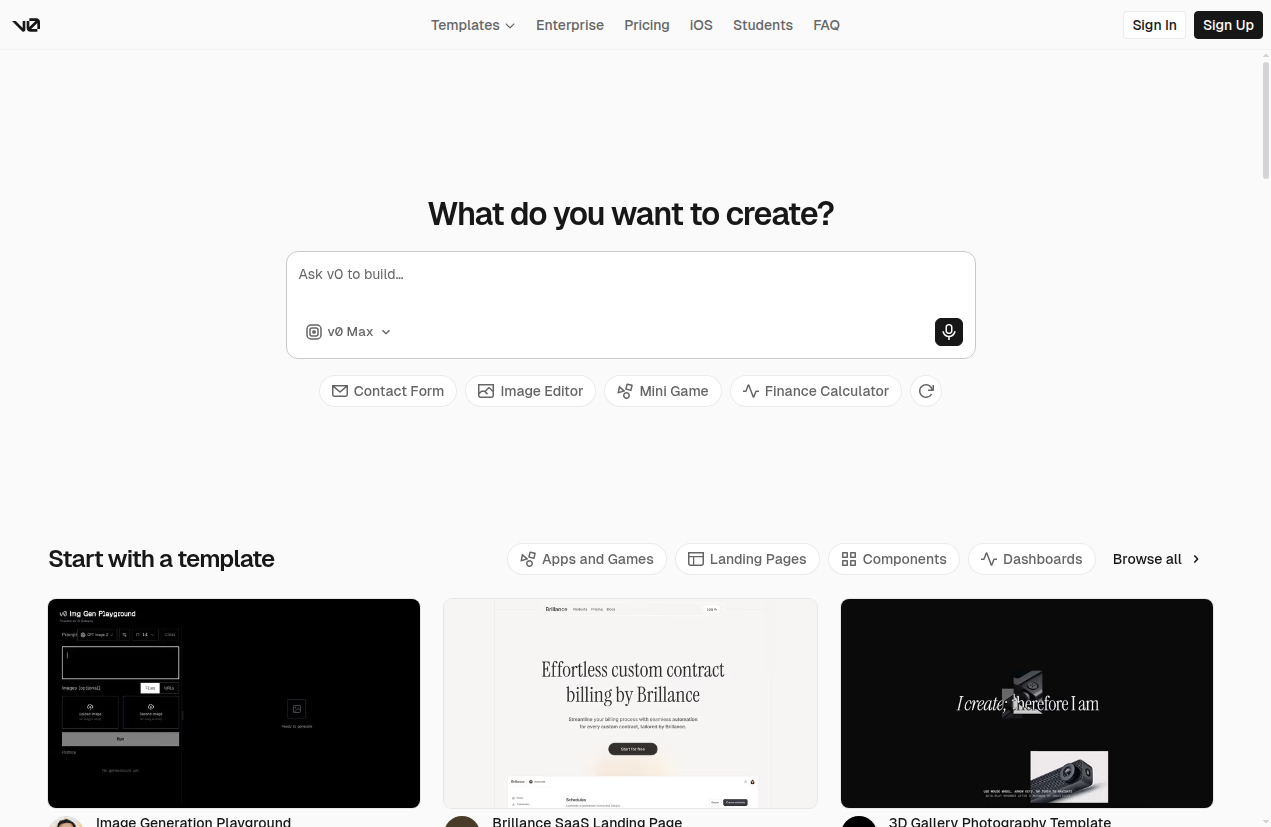
6. iOS app and a templates-first on-ramp
v0 ships a dedicated iOS app - prompt, generate, iterate, preview, manage environment variables, connect GitHub, set up database integrations, and select MCP servers from mobile. Bolt surfaces no mobile app. v0’s homepage also leads with a public templates gallery (Apps and Games, Landing Pages, Components, Dashboards, with author attribution, view counts, fork counts), which is a better beginner on-ramp than Bolt’s design-system-led homepage for someone with no design system to import.
7. Enterprise credibility and compliance inheritance
v0’s enterprise page names real customers with quotes - Vanta (Jeremy Epling, CPO) and Code and Theory (David DiCamillo, CTO) - and v0 inherits SOC 2 Type 2 (in scope), ISO, GDPR, and HIPAA from Vercel, plus AWS Marketplace availability and AWS Bedrock inference on Enterprise. Bolt publishes no named enterprise customers in its fetched copy (“trusted by” strip has no legible names). For a regulated team or an enterprise buyer evaluating credibility, v0 has the materially stronger surface.
8. Design Systems 2.0 (closes the gap with Bolt)
v0’s Design Systems 2.0 teaches v0 your design system as a saved “skill” in your workspace/team and stores it in a v0.json file (schema version 1: up to 3 GitHub references for sources, environment.providers for shared env vars, starter path). Sources: npm package (.tgz/.tar), GitHub repo (with at least one real consumer app recommended), Storybook/docs links, Figma frames/nodes, private package credentials (NPM_TOKEN as Development shared env var, requires Developer role on Vercel). v0 reads sources, builds a starter app to verify its understanding, pauses for your review, and saves the skill only after you approve. v0’s docs do not explicitly state which plan gates base import - they only note that on any paid team plan, owners can optionally restrict who can edit a saved skill. The built-in example is Cloudscape (Amazon’s open-source design system). The reviewer gate before save is a more careful workflow than Bolt’s internal-Storybook compaction. This is no longer an area where Bolt can claim uniqueness; both tools now import your real components.
Where Bolt.new loses (required honest section)
- No mobile app. v0 ships an iOS app; Bolt surfaces none. If building/editing from mobile is a real workflow for you, Bolt is out.
- No public templates gallery. Bolt’s homepage leads with design-system import. For a beginner with no design system to import, the on-ramp is weaker. v0 and Lovable both lead with templates.
- No named enterprise customers. v0 publishes Vanta and Code and Theory with quoted results. Bolt’s “trusted by” strip has no legible customer names in the fetched copy. For an enterprise buyer, this is a credibility dent.
- Narrower compliance surface. Bolt Enterprise lists SSO, audit logs, “compliance support.” v0 inherits SOC 2 Type 2, ISO, GDPR, and HIPAA from Vercel, plus AWS Marketplace and AWS Bedrock inference. For regulated teams, v0’s compliance inheritance is materially stronger.
- Hidden model selection. “Bolt automatically routes to the right model” is simpler for a beginner but removes cost control from a power user. A v0 user who wants to force Mini for a trivial task to conserve budget can; a Bolt user cannot.
- Opaque pricing above the entry Pro tier. The public pricing page shows Free, Pro $25, Teams $30/seat, Enterprise. Higher Pro token tiers above 10M/month, the Teams per-member token allotment, and annual Pro token-reload prices are not on the public page - they live behind the in-app subscription panel. v0 publishes full per-token pricing for all four model tiers on its public pricing page.
- Most token spend is invisible file-system sync, not code generation. Bolt’s own pricing FAQ admits “the larger the project, the more tokens used per message.” Cost grows with project size, not change size, which means a one-line edit to a large Bolt project still spends tokens on file-system sync. v0’s credit model has the same input-token cost problem (v0’s FAQ also has “Why do messages use so many input tokens? My prompts are short.”) but at least v0 exposes per-model pricing so a buyer can reason about it.
- No Platform API / embed product. v0 Enterprise pitches “Add v0 to your products with the Platform API” and AWS Bedrock inference. Bolt’s fetched pages surface no equivalent embed or API product.
- No affiliate program found. We checked the bolt.new homepage and pricing page footers live and found no “Affiliates” or “Partners” link in the Resources, Company, or Social sections. No affiliate links appear anywhere in this post as a result.
- Most of its homepage claims are unverified vendor marketing. “98% less errors,” “Build big without breaking - Bolt handles projects 1,000 times larger than before,” “The #1 professional vibe coding tool.” Quote as vendor claims, not verified facts.
Where v0 loses (required honest section)
- Orchestrated backend = multiple provider accounts, not one subscription. v0 provisions Neon/Supabase/Upstash/Snowflake/Stripe accounts via the Vercel Marketplace. The Marketplace automates the provisioning and wires the environment variables, but you still end up with accounts on multiple services, each with its own limits, free tiers, and billing surfaces. For a buyer who wants one bill and one backend, Bolt Cloud’s bundled model is simpler and cheaper to reason about.
- The 7-messages/day free cap is the binding constraint. $5 of monthly credits is generous on paper, but at 7 messages per day a free user cannot iterate meaningfully in a sitting. Bolt Free gives 300K tokens/day with no message cap, a substantially more usable free tier.
- No entry paid tier for new solo users below $30/seat. The FAQ references a sunsetted “Premium $20/month” plan; the live pricing page reflects the post-sunset state (Free, Team $30/seat, Business $100/seat, Enterprise). For a solo buyer, v0’s cheapest paid tier ($30/seat Team) costs more than Bolt Pro’s $25 flat, and per-seat pricing scales faster at small team sizes.
- Vercel lock-in for the full experience. v0’s FAQ: “For the full experience (environment variables, deployments, previews), your GitHub repo should be connected to a Vercel project. You can still export code and deploy elsewhere.” Bolt Cloud is also a lock-in, but Bolt is framework-agnostic; v0 is Next.js/Vercel-native. A team not on Next.js + Vercel gets less value from v0.
- The tech stack is fixed. Next.js, React, TypeScript, Tailwind, shadcn/ui, AI SDK 6. Excellent if that is your stack; a non-starter if you need Vue, Svelte, Solid, or a non-React backend framework. Bolt’s WebContainer model is more framework-flexible.
- No token rollover. v0 included monthly credits renew monthly; the FAQ does not surface a rollover mechanic. Bolt rolls paid-plan tokens over for one extra month.
- May train on your content by default. v0’s FAQ: “v0 may use user-generated prompts and/or content as inputs to models.” Business opts out by default; Enterprise never trains; Vercel platform-services customer data is never used for training. Bolt’s pages do not surface an equivalent training-on-user-content default. For privacy-conscious teams not on Business/Enterprise, this is a real negative.
- Slower previews for full-stack apps. Vercel Sandbox runs real builds; the old browser preview is gone. v0’s own FAQ acknowledges this with a “Why does v0 feel slower?” entry. Bolt’s in-browser WebContainer preview is faster for simple iterations, the trade being lower fidelity for full-stack code.
- No consumer affiliate program surfaced in the v0 footer either (Terms, AI Policy, Privacy, Cookies). Same commercial gap as Bolt for an affiliate post - but Bolt, not v0, is the designated affiliate tool for this slug, so Bolt’s gap is the blocking one for us and v0’s is informational.
Other options (one paragraph each)
-
Lovable is the third leg of the Bolt/Lovable/v0 triangle and the beginner-friendly pick. It is templates-led, GitHub-export-first, has a simpler Plan/Build credit model, and ships its own mobile app and Telegram integration. If the reader is neither a Vercel/Next.js team (v0) nor a design-system-led professional team (Bolt) - if they are a non-developer who wants templates plus the simplest credit model - Lovable is the answer. See our dedicated Lovable vs Bolt.new post for the details.
-
Replit Agent is the broader-coverage alternative if you need non-web runtimes (mobile-native, scripts, longer-running backend services) and not just Next.js or WebContainer apps. Replit’s own positioning (“Make apps & sites with natural language prompts,” aimed at “both technical & non-technical creators”) spans business software, chatbots, games, and dashboards, not just web apps.
-
Cursor is the AI-native IDE for the buyer who already writes code and wants the AI enhancing their editor rather than driving a chat-to-app flow. It is adjacent to both Bolt and v0 but competes for the same “AI build software” budget. Cursor is one of the closest analogues to Bolt’s developer-led DNA and v0’s Git-integration pivot.
Should you run both?
Realistically: yes, sometimes, but only at the seam. A team could prototype UI in v0 (templates, Figma import, shadcn fidelity, Vercel Sandbox previews) and move the repo to Bolt when they need a bundled backend without provisioning Supabase/Neon separately. Both support GitHub, so the bridge is the repo. The cost is two subscriptions plus a manual transfer - there is no auto-sync. Conversely, a team already on Vercel has no reason to leave v0 for Bolt unless they specifically need Bolt Cloud’s bundled model, a non-Next.js stack, or token rollover. We are not going to pretend that running both is free; the double-cost is real and worth naming.
Bottom line - name a pick and who it is wrong for
For a solo buyer or a small team that wants hosting + database + auth + storage + Stripe in one subscription without provisioning five provider accounts: Bolt.new Pro at $25/month flat is the cleaner, cheaper entry. It is wrong for you if your stack is not Next.js-compatible (Bolt’s WebContainer is framework-flexible, so this is not actually a strike against Bolt - but Bolt Cloud’s host/DB providers are fixed under the hood), if you need SOC 2/ISO/GDPR/HIPAA compliance inheritance that Bolt does not surface, or if you want production-accurate previews and explicit per-model cost control.
For a team already on Next.js + React + Tailwind + shadcn shipping to Vercel: v0 is the path of least resistance. The code is built by Vercel for Vercel, the previews run on the same Vercel Sandbox that runs production, and the Git workflow protects main. It is wrong for you if you are not on Next.js/Vercel, if you want one bundled backend bill, if you are a solo buyer sensitive to the $30/seat entry tier, if you want token rollover, or if you are privacy-conscious and not on Business/Enterprise (v0 may train on your content by default).
For a non-developer who wants templates and the simplest credit model: skip both and read our Lovable vs Bolt.new post. Lovable is the third leg of this triangle and the easiest on-ramp for the persona neither of these tools optimizes for.
Prices accurate as of July 2026; check the vendor’s site for current rates. Bolt.new pricing is from bolt.new/pricing and v0 pricing is from v0.dev/pricing, both fetched live on 2026-07-07. Both vendors change plans and token allowances frequently - confirm on the live pricing page before you commit.