5 August 2026 · Comparison
OpenSEO vs Ahrefs: Open-Source MCP or Data Moat?
The short answer
if you want an open-source, $10/mo pay-as-you-go SEO tool with first-party GSC data in your AI coding agent.
if you require 16-year historical backlink depth, proprietary crawler freshness, and an enterprise marketing suite.
Affiliate disclosure: some links on this page are affiliate links. If you buy through them, SaaSpicious may earn a commission at no extra cost to you. This does not change our verdicts; every tool below gets an honest “where it loses” section.
Verdict: pick OpenSEO if you are a solo developer, indie founder, or lean agent-first team that wants a $10/mo pay-as-you-go SEO tool with first-party Google Search Console data queryable from Claude, Cursor, or Codex with zero per-seat fees. Pick Ahrefs if you are an agency, enterprise SEO team, or professional link builder who needs 16-year backlink history, web-scale index freshness, 7-platform AI visibility tracking, or an all-in-one marketing suite. This is not a close call on the same axis: it is a price-and-agent story versus a data-and-suite story, and the honest answer depends on which of those two problems you actually have.
Both tools cover the same core SEO workflows: keyword research, backlinks, rank tracking, and site audits. Both ship MCP servers so AI agents can query their data. The difference is what sits underneath each one. OpenSEO (MIT-licensed, launched publicly July 2026) resells DataForSEO data and sells the software at $10/month. Ahrefs (founded 2011) runs its own crawl infrastructure with a 35T-record backlink history and a full search-marketing suite on top. The post below breaks down the data provenance, the real pricing on both sides (including the $29 Ahrefs Starter plan that OpenSEO’s own marketing omits), and the MCP comparison done properly.
The quick answer
| OpenSEO | Ahrefs | |
|---|---|---|
| What it is | Open-source, pay-as-you-go SEO platform (MIT license) | Proprietary full search-marketing suite |
| Data layer | Resells DataForSEO APIs (28% hosted markup) | Own web index, 35T backlink history, 493.9B pages |
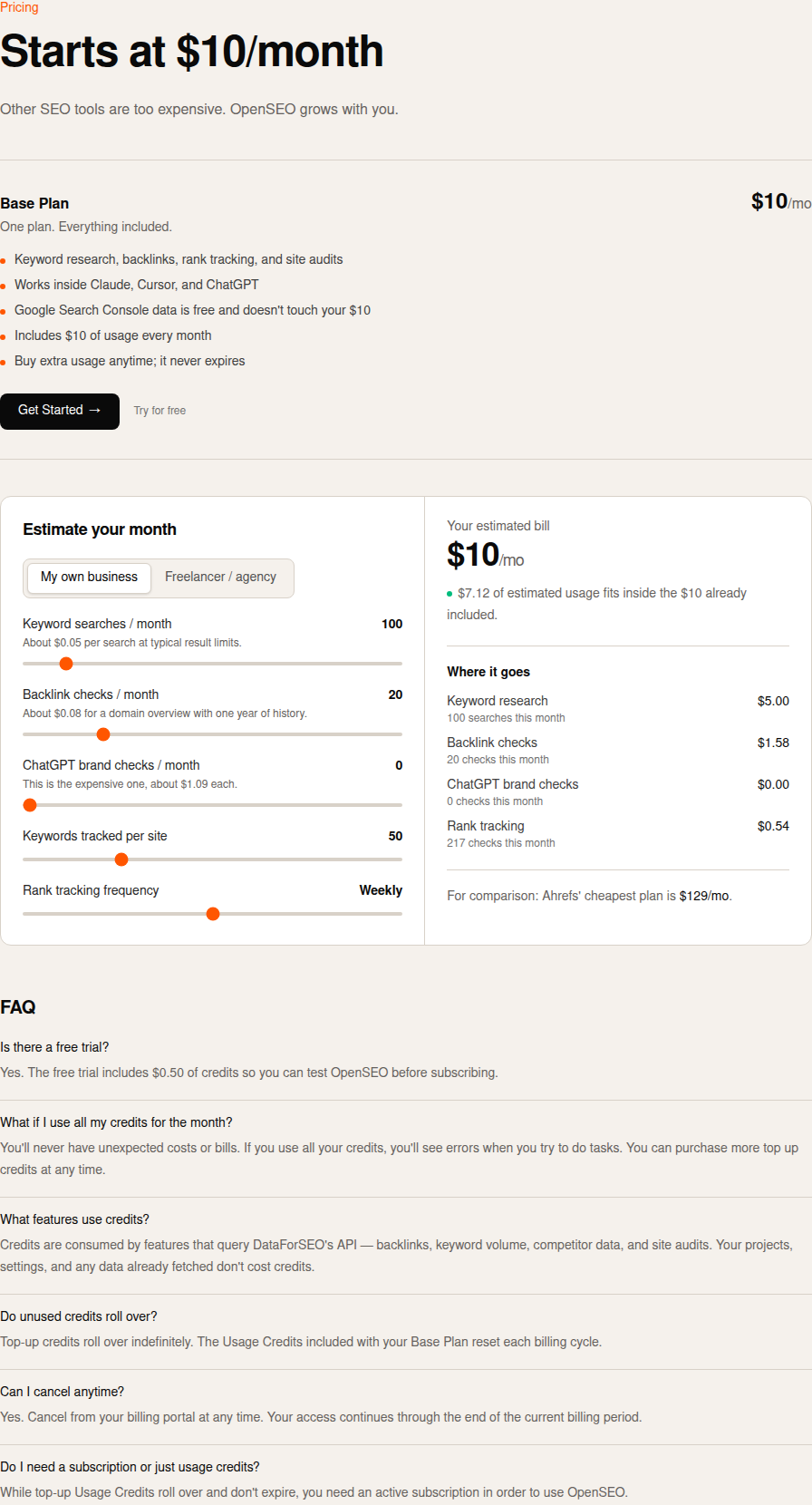
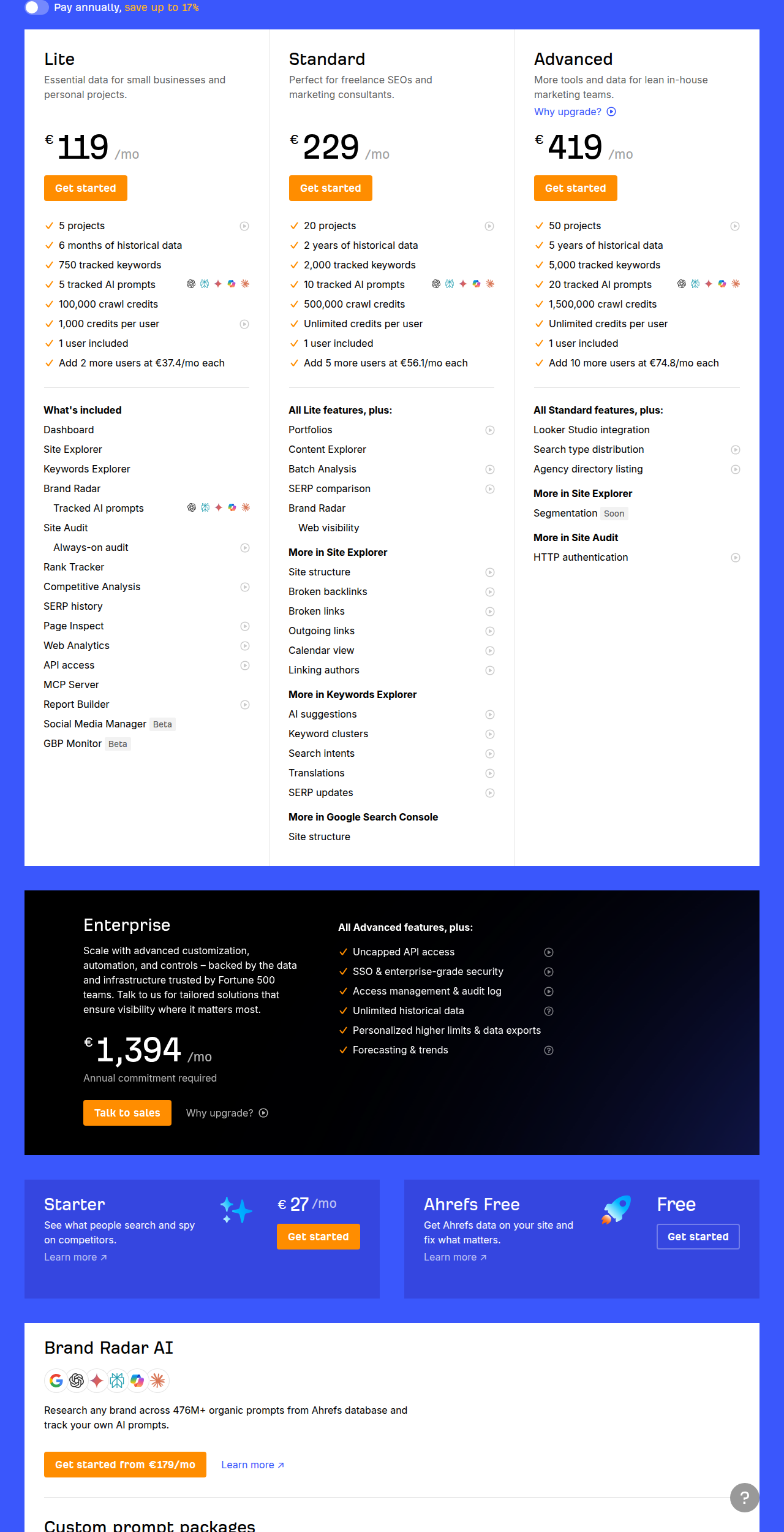
| Entry price | $10/mo incl. $10 usage | $29/mo Starter (200 credits) or $129/mo Lite |
| Self-hosting | Yes (Docker / Cloudflare, BYO DataForSEO key) | No |
| MCP server | Yes, one $10 plan; zero-credit first-party GSC data | Yes, on all paid plans; serves Ahrefs’ own index |
| AI visibility | 2 sources (ChatGPT, Google AI Overviews), ~$1.09/check | 7 AI indexes (Brand Radar), from €179/mo standalone |
| Suite breadth | SEO workflows only | Content, PPC, social, analytics, reporting, local SEO |
Prices are live as researched 2026-08-05; check vendor pages before buying.
The core conflict: price versus data
The SEO industry has treated the $129+/month software bill as the cost of doing research. OpenSEO’s pitch is to separate the software layer from the data layer. The software is free (MIT license, self-hostable); the data is pay-per-use, and the hosted $10/month plan includes $10 of usage credits that reset each billing cycle, with top-up credits that never expire.
But OpenSEO’s own pricing page states: “For comparison: Ahrefs’ cheapest plan is $129/mo.” That is stale and misleading as of August 2026. Ahrefs sells a Starter plan at $29/mo (€27) with 200 monthly credits, and a free Ahrefs Free tier. Starter is thin - 200 credits goes fast for active users, and it is monthly-only with no add-ons - but the “$129 vs $10” line is marketing, not a fair comparison. The honest price story is:
- OpenSEO $10/mo - flat, includes $10 of usage, no per-seat fees, self-hostable for near-zero if you bring your own DataForSEO key.
- Ahrefs Starter $29/mo - a real plan, but 200 credits is a sampler; most active users outgrow it (Ahrefs’ own blog says so).
- Ahrefs Lite $129/mo - the lowest plan that feels like a working budget: 5 projects, 750 tracked keywords, 1,000 credits per user.
Data provenance: where the numbers actually come from
This is the fact most OpenSEO writeups skip. OpenSEO does not crawl the web. Every keyword-volume, backlink, and site-audit request goes to DataForSEO, a ~10-year-old pay-per-use API provider. The GitHub README is explicit: “The way the hosted service makes money is by charging 28% extra for every request we make to DataForSEO.”
Two ways to run OpenSEO:
- Hosted, $10/mo - includes $10 of usage; OpenSEO applies the 28% markup on DataForSEO requests (credits reset each billing cycle, while top-ups never expire).
- Self-hosted, free - Docker (personal use) or Cloudflare (team/internet-facing, works on the free plan). You bring your own DataForSEO API key and pay DataForSEO directly; costs run slightly lower than the hosted estimates. DataForSEO requires a $50 minimum deposit to fund your account.
DataForSEO’s own index stats (dataforseo.com/our-data, live): 8.1B Google keywords, 1.88T live backlinks, 186.3B live pages, 525.9M Google SERPs.
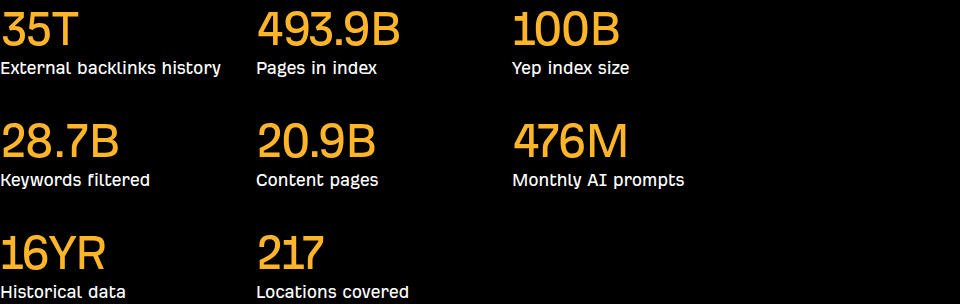
Ahrefs’ numbers are a different class: 35T external backlinks history, 493.9B pages in index, 28.7B filtered keywords, 476M monthly AI prompts, updated every 15-30 minutes from its own Yep1 supercomputer. Both vendors self-report these figures, so treat them as vendor data - but the direction is consistent and material: Ahrefs owns its index and has roughly 18x more backlink history records; OpenSEO licenses a smaller, shallower index.
What this means in practice: for well-covered domains and common keywords, DataForSEO-backed data (and thus OpenSEO) is fine. For niche, long-tail, or historical backlink investigations - “who linked to this page in 2018?”, “what does the full link profile of this obscure domain look like?” - Ahrefs’ depth and 16-year history are materially better. If your workflow depends on multi-year link analysis, OpenSEO is not a drop-in Ahrefs replacement.
The MCP comparison, done honestly
Both tools have MCP servers. The claim “Ahrefs has no AI-agent story” is wrong, and any post that implies it will get eaten alive by readers.
Ahrefs MCP (ahrefs.com/mcp): included on all paid plans - Lite, Standard, Advanced, Enterprise. Rows per request: 100 / 250 / 500 / unlimited. API units per month: 100K / 400K / 1M / 2M. Works in ChatGPT (mention @Ahrefs), Claude, Cursor, and Copilot Studio. Use cases: trending keyword research, international opportunity spotting, competitor traffic analysis at scale, backlink profile audits.
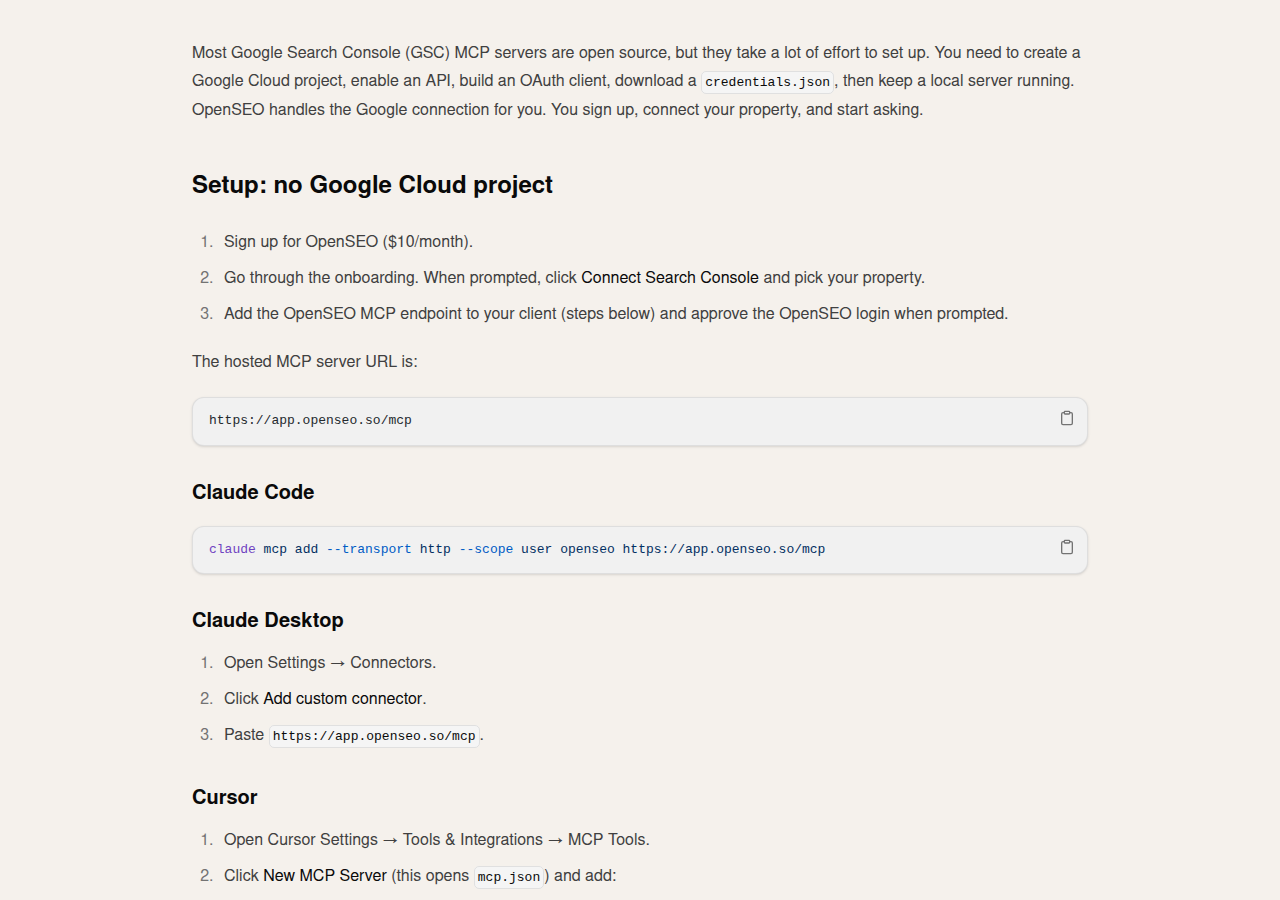
OpenSEO MCP: one remote server at https://app.openseo.so/mcp, included on the single $10 plan. Setup one-liners: Claude Code claude mcp add --transport http --scope user openseo https://app.openseo.so/mcp; Codex codex mcp add openseo --url https://app.openseo.so/mcp; Cursor via mcp.json.
The real differentiators, which favor OpenSEO:
- First-party Google Search Console data via MCP, zero credits, zero Google Cloud setup. OpenSEO’s GSC MCP serves your Search Console clicks/impressions/CTR/position (up to 16 months) plus URL inspection, read-only, using
webmasters.readonly, and it never touches your $10 usage. The DIY alternative requires creating a Google Cloud project, enabling the Search Console API, building an OAuth client, and running a local server - roughly 30 minutes of console work. Ahrefs’ MCP serves Ahrefs’ own database; it does not hand your first-party GSC data to your agent with zero setup. - Price of entry: $10 flat vs €119+/mo for a working Ahrefs plan.
- Agent workflow tooling: OpenSEO ships pre-built Agent Skills and a “save findings back to the project for human review” loop, built for Claude Code / Cursor / Codex workflows.
Where Ahrefs’ MCP wins: data depth available to the agent (its own index with 16-year history), and breadth of client support (ChatGPT and Copilot Studio connectors beyond the standard MCP clients). OpenSEO’s MCP edge is price + first-party GSC + agent-native workflow, not MCP exclusivity.
Where OpenSEO wins
- Price and usage billing. $10/mo including $10 of usage, top-ups never expire, no per-seat fees. Ahrefs adds €37.40-€93/mo per extra user depending on tier. For a solo dev, the arithmetic is not close.
- Open source and self-hosting. MIT license, Docker/Cloudflare deploy, BYO DataForSEO key. You can fork it and build your own tool. Ahrefs is closed-source with no self-hosting path.
- First-party GSC in your agent. Zero-credit, zero-setup Search Console data inside Claude/Cursor/Codex is genuinely unique; no DIY OAuth project needed on the hosted plan.
- Focused UI. “Focused workflows instead of a bloated, complex SEO suite” - real for solo/lean teams who resent Ahrefs’ sprawl.
- GitHub traction. With over 10.4k stars and 1.2k forks under an MIT license, stars and forks are moving fast for a July 2026 launch.
Where OpenSEO loses
- No owned index. Everything is DataForSEO-licensed. If DataForSEO’s pricing, reliability, or index quality shifts, OpenSEO shifts with it. The 28% hosted markup is the hidden cost inside the $10 plan.
- Backlink index depth and history. DataForSEO’s 1.88T live backlinks vs Ahrefs’ 35T-record, 16-year, every-15-30-minutes-updated history. Niche and historical link research is where Ahrefs is categorically deeper.
- Thin AI visibility. OpenSEO covers 2 AI sources (ChatGPT, Google AI Overviews) via ad-hoc lookups at ~$1.09 per ChatGPT check; Ahrefs Brand Radar tracks 7 AI indexes with ongoing per-month monitoring.
- Early-stage product. Two-person team, launched publicly July 2026, fast-changing codebase, no SOC 2 / SSO / enterprise compliance, no multi-seat agency permissions, no public API.
- No suite breadth. No Content Explorer, no PPC data, no social media manager, no email alerts, no white-label reporting.
- Credit metering ceiling. The $10/mo includes $10 of usage; heavy rank tracking or frequent backlink checks will consume credits and require top-ups. $10 is not unlimited.
Where Ahrefs wins
- The data moat. Own crawl infrastructure, 35T backlink history, 16 years of historical data, 493.9B pages, 28.7B keywords across 217 locations, updated every 15-30 minutes. This is the entire reason the comparison exists.
- Suite breadth. Content Explorer, AI Content Helper, Web Analytics, Bot Analytics, Social Media Manager, Report Builder, Portfolios, Batch Analysis, GBP Monitor, PPC data, Email Alerts - a full marketing suite.
- AI visibility depth. Brand Radar tracks 7 AI indexes (AI Overviews, AI Mode, ChatGPT, Copilot, Gemini, Perplexity, Grok) with 476M monthly prompts indexed; OpenSEO does 2-source lookups.
- MCP included on all paid plans, with ChatGPT/Claude/Cursor/Copilot Studio support - the agent story exists, just at a higher price.
- Maturity. ~15 years, enterprise compliance (SSO, audit logs), Ahrefs Academy, certification, free-tools ecosystem, documented API with 100K-2M monthly API units on paid plans.
Where Ahrefs loses
- Price floor and seats. Starter’s $29/mo buys 200 credits that run out fast; the working plans start at €119/$129/mo, and per-user add-ons (€37.40-€93/mo each) compound the bill for any team.
- Closed source and lock-in. No self-hosting, no code access, no custom data-pipeline extensions.
- No zero-setup first-party GSC MCP. Ahrefs MCP queries Ahrefs’ database; it won’t put your Search Console data in your agent without Google Cloud OAuth overhead.
- Brand Radar is expensive. Standalone from €179/mo (bundled check allowances 150/300/600/2,500 per tier) - an add-on price for the exact capability OpenSEO includes in the flat $10 plan.
- Suite complexity. For a solo creator who only needs keyword research and rank tracking, the feature surface is bloat.
Competitive landscape
If neither of these fits, context helps:
- SEMrush ($139.95/mo Pro, active affiliate program) - the other full-suite incumbent, closest feature-parity alternative to Ahrefs for agencies.
- SE Ranking ($44-$129/mo, own MCP + AI Search Toolkit) - the roundup favorite for “cheap Ahrefs alternative.”
- Budget/specialist: Mangools ($30.50/mo), Moz Pro ($49/mo), SpyFu ($39/mo), Majestic ($49.99/mo, backlinks only).
- Open-source/self-host peers: SerpBear (rank tracking), SEONaut (auditing) - thinner projects; OpenSEO did not invent the category, it’s the most complete one.
For readers building crawl-and-data workflows, our CrawlRaven vs Screaming Frog and Context.dev vs Firecrawl comparisons cover the technical SEO and data-scraping ends of this stack; if you’re evaluating AI-first tooling more broadly, Crisp vs Intercom covers the support-agent side of the agentic trend.
Bottom line
Pick OpenSEO if you’re a solo developer, indie founder, or lean agent-first team: $10/mo flat (incl. $10 usage), open source, self-hostable, first-party GSC data inside your AI coding agent, no per-seat fees. Pick Ahrefs if you’re an agency, enterprise team, or professional link builder who needs 16-year backlink history, proprietary crawler freshness, 7-platform AI visibility, or one suite covering SEO plus content, PPC, and social.
And who each pick is wrong for: OpenSEO is wrong for agencies and enterprises doing client-scale, historical link analysis - the data depth isn’t there, and neither is the compliance story. Ahrefs is wrong for solo devs and freelancers paying $129+ for light keyword and rank tracking, MCP-first developer teams, and anyone who resents per-seat pricing. If you’re on the fence and both bills are real options, the honest tiebreaker is simple: do you need to go deep on backlinks, or do you need your own search data in your agent? One of those is a $10/month answer.