24 July 2026 · Comparison
CrawlRaven vs Screaming Frog: Best Alternative in 2026?
The short answer
Screaming Frog gives you everything. CrawlRaven tells you what to do first. Here's which one fits your workflow.
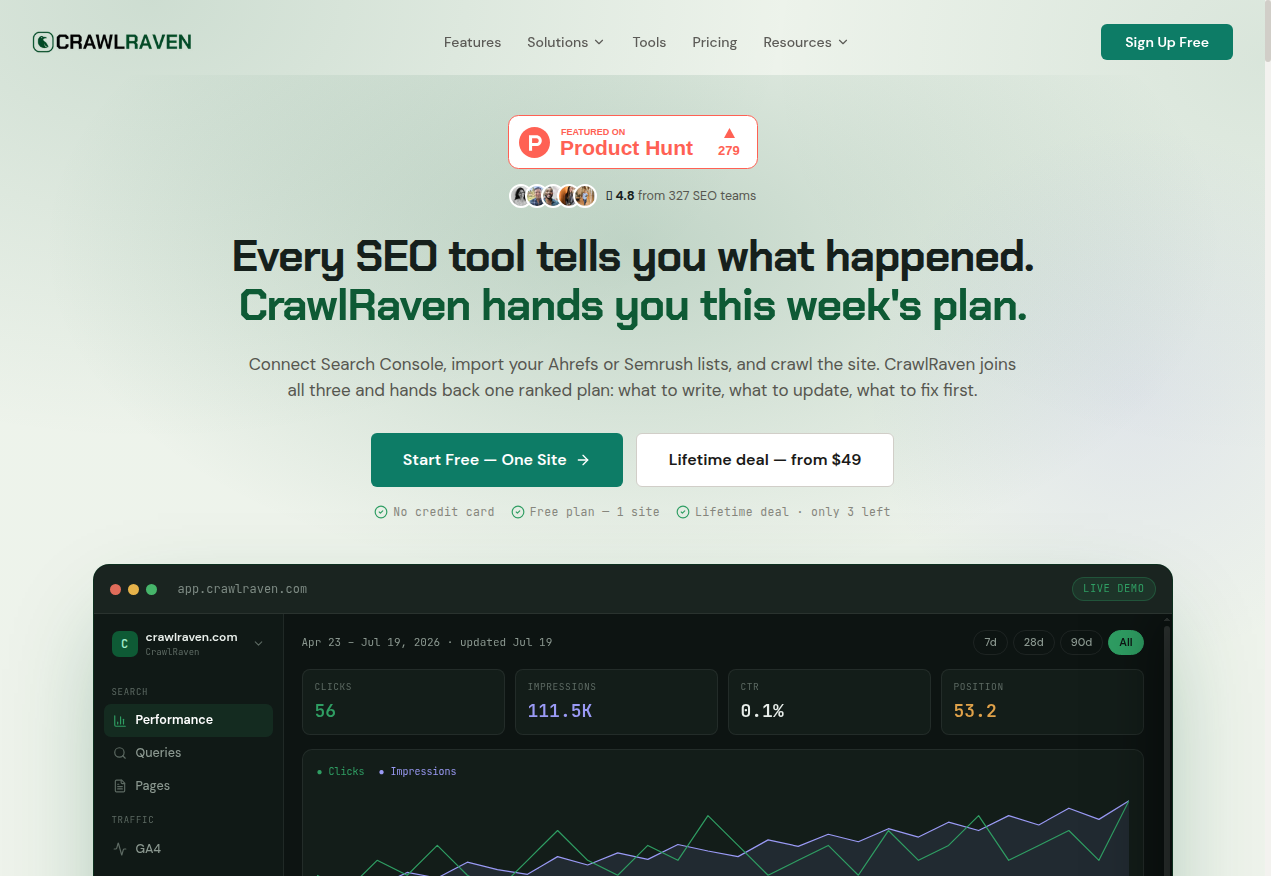
Verdict: Screaming Frog wins for deep forensic audits, complex migrations, and custom extraction with no URL limits. CrawlRaven wins for weekly monitoring, client reporting, and turning crawl data into a prioritized to-do list you can actually act on. If you’re searching for Screaming Frog alternatives because you’re tired of manually triaging 300-row spreadsheets, CrawlRaven is the most direct answer in 2026. Many SEO teams run both — and that’s the right call more often than you’d think.
We check every price against the vendor’s own live pricing page at SaaSpicious. Browse all our comparisons for more hands-on breakdowns like this one.
Affiliate disclosure
Some links in this post are affiliate links. If you buy through them, SaaSpicious may earn a commission at no extra cost to you. This does not influence our verdicts — we write the downsides of every tool we cover, including the one we earn from.
The real problem with raw crawl data
You run a crawl on your site. Screaming Frog (or any crawler) hands you back a 300-row spreadsheet of issues: missing alt text, duplicate titles, broken links, canonical conflicts, redirect chains. All in one flat list. A broken image sits next to a page-killing hreflang misconfiguration, and nothing tells you which one is costing you traffic.
Meanwhile, Google Search Console shows you queries you rank for, positions dropping week over week, and pages earning impressions on page two. Your Ahrefs or Semrush export tells you what you could rank for. Three tools, three exports — and the strategy lives in a spreadsheet nobody has opened in three weeks.
This is the gap CrawlRaven and Screaming Frog approach from opposite directions.
Core philosophy: to-do list vs raw data dump
CrawlRaven says: “Here’s what to do this week.” It joins GSC data, your keyword research imports, and its own site crawl into one ranked action plan. Every issue comes with a concrete recommendation and an estimated ranking impact. The output is a to-do list, not a dashboard.
Screaming Frog says: “Here’s everything we found.” It crawls your site like Googlebot and returns structured data about every page — every HTTP header, every redirect hop, every canonical tag, every missing meta description. The output is a 50-column spreadsheet. You triage it yourself.
Neither approach is wrong. They serve different moments in an SEO workflow.
Head-to-head comparison table
| Dimension | CrawlRaven | Screaming Frog |
|---|---|---|
| Deployment | Cloud (browser-based) | Desktop (Windows, macOS, Linux) |
| Core philosophy | Ranked to-do list with concrete steps | Raw data dump — you triage |
| GSC integration | OAuth one-click, synced daily, core of product | API integration (paid license required) |
| Keyword research | CSV import from Ahrefs/Semrush/any tool, merges with GSC data | None built in — relies on third-party API integrations |
| Issue prioritization | AI-ranked by impact x effort, every item has a recommendation | None — 300+ issues in a flat list |
| Crawl depth | 200-point audit (technical audit labeled “coming soon” on lifetime plans as of July 2026) | 300+ checks, every HTTP header and redirect hop |
| Custom extraction | Template-driven | Full XPath, CSS path, regex — unrestricted |
| White-label reports | Yes (on $99 lifetime tier) | No — must export and rebuild manually |
| URL limits | No per-plan breakdown; site claims “50K pages per crawl” in one place and “100,000+ pages” in another | 500 (free); Unlimited (paid) |
| JavaScript rendering | Documented as part of the 200-point audit (still “coming soon”) — headless Chromium, SPA/hydration checks | Full Chromium with render-vs-raw comparison |
| AI features | AI-prioritized fix list (built-in) | AI API integration (OpenAI/Gemini/Claude/Ollama — you bring API key) |
| Offline use | No (cloud-only) | Yes |
| Team collaboration | Multi-user dashboard (on paid tiers) | None — single machine |
| Maturity | New (launched 2026, ~2,400 users) | Mature (since 2010, used by Fortune 500 companies) |
Feature deep-dive
GSC integration and AI prioritization (where CrawlRaven wins)
CrawlRaven’s core differentiator is how it joins data sources. You connect Google Search Console via OAuth (one click, no API key wrangling), import your Ahrefs or Semrush keyword lists as CSV, and CrawlRaven merges both with its own site crawl. The result is a single view that answers three questions at once:
- What’s actually happening? (GSC — queries, clicks, impressions, positions)
- What do you want to happen? (your keyword research — terms you’re targeting)
- Can your site support it? (the crawl — technical issues that block ranking)
Every issue gets ranked by estimated ranking impact. A canonical conflict on a page earning 10K monthly impressions ranks higher than a missing alt tag on a page nobody searches for. Every item includes a concrete recommendation: “add this keyword to this page,” “create a new page for this topic gap,” or “fix this redirect chain on this URL.”
Screaming Frog can pull in GSC data and Google Analytics too — but only on the paid license, and only as a data overlay. It does not join datasets, map keywords to pages, or prioritize fixes. You export everything to a spreadsheet and build the strategy yourself.
Crawl depth, custom extraction, and JS rendering (where Screaming Frog wins)
Screaming Frog is the industry standard for a reason. Its crawler checks over 300 SEO issues, from broken links and redirect chains to structured data validation, hreflang tags, accessibility (WCAG), and security headers. It renders JavaScript with a full Chromium engine and lets you compare the rendered page against the raw HTML — critical for React, Angular, and Vue.js sites where content loads client-side.
Custom extraction is where Screaming Frog leaves every competitor behind. You can use XPath, CSS selectors, or regex to pull any data from any page: product prices, publication dates, structured data values, custom text patterns. CrawlRaven’s extraction is template-driven — useful for common scenarios, but nowhere near the flexibility of Screaming Frog’s raw scraping engine.
For migration projects, Screaming Frog’s crawl comparison feature lets you run crawls before and after a site change and diff the results at the URL level. CrawlRaven doesn’t offer this.
Deployment: cloud vs desktop
CrawlRaven runs in a browser. No install, no machine staying on overnight, no RAM burn. You can check your plan from any device. Your team shares one dashboard.
Screaming Frog runs on your desktop. Crawl speed depends on your hardware. Large crawls (50K+ URLs) eat 8-32 GB of RAM. Your machine must stay on during crawls. There’s no shared dashboard — teammates can’t see crawl results unless you export and share files.
This is Screaming Frog’s biggest structural limitation, and it’s one the company has never addressed. If you work on a team, you’ll feel the friction every week.
White-label reporting
CrawlRaven’s $99 lifetime tier includes white-label PDF reports you can brand and send to clients. For agencies, this eliminates 5-8 hours per client per month spent rebuilding reports in Google Sheets or Looker Studio.
Screaming Frog has no built-in reporting. You export raw data and build reports from scratch. This is the reality agencies live with — and it’s a major hidden cost of the tool.
Pricing
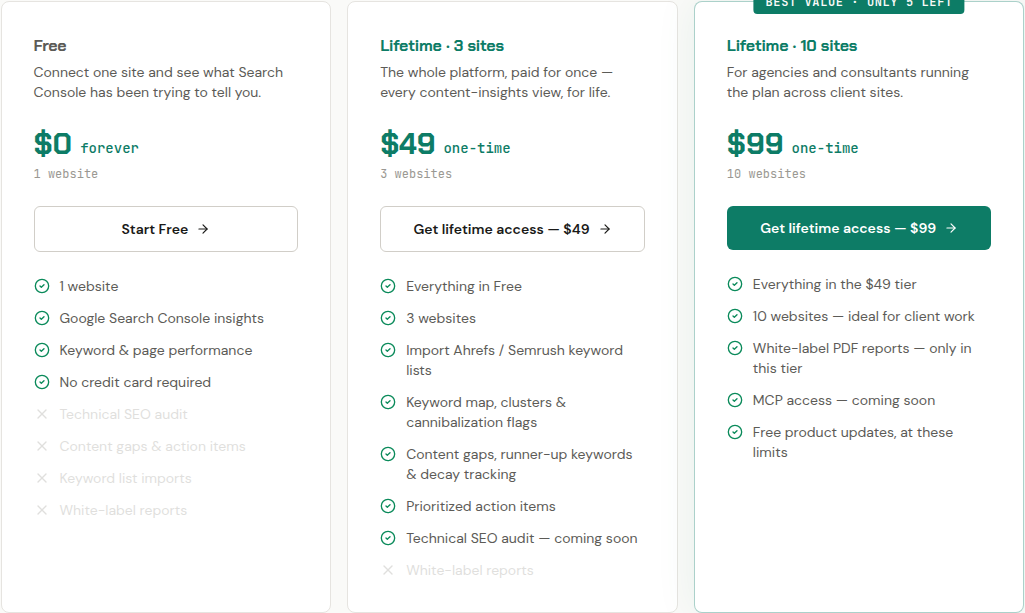
CrawlRaven’s current pricing is a lifetime deal — not a subscription:
| Plan | Price | Sites | Key inclusions |
|---|---|---|---|
| Free | $0 forever | 1 | GSC insights, keyword and page performance, no credit card |
| Lifetime 3 sites | $49 one-time | 3 | Full content insights (clusters, gaps, action items), keyword imports, technical audit coming soon |
| Lifetime 10 sites | $99 one-time | 10 | Everything above plus white-label PDF reports, MCP access coming soon |
The lifetime deal is limited (a handful of licenses remaining as of July 2026). After they sell out, CrawlRaven moves to regular subscription pricing. That pricing hasn’t launched, but CrawlRaven’s own affiliate commission table and its own “Screaming Frog Alternatives” blog post both point to the same figures: a $9/mo Starter plan, a $29/mo Pro plan, and a $99/mo top tier (called “Business” on the affiliate page, “Max” on the blog post — the two vendor pages don’t agree on the name, but they agree on price).
CrawlRaven also doesn’t break out per-crawl URL limits by plan tier anywhere on its site. What it does publish, inconsistently, is an overall crawl-capacity claim: a homepage-style stat block says “50K pages per crawl,” while the technical SEO audit landing page says it crawls “up to 100,000+ pages.” Neither figure is tied to a specific plan.
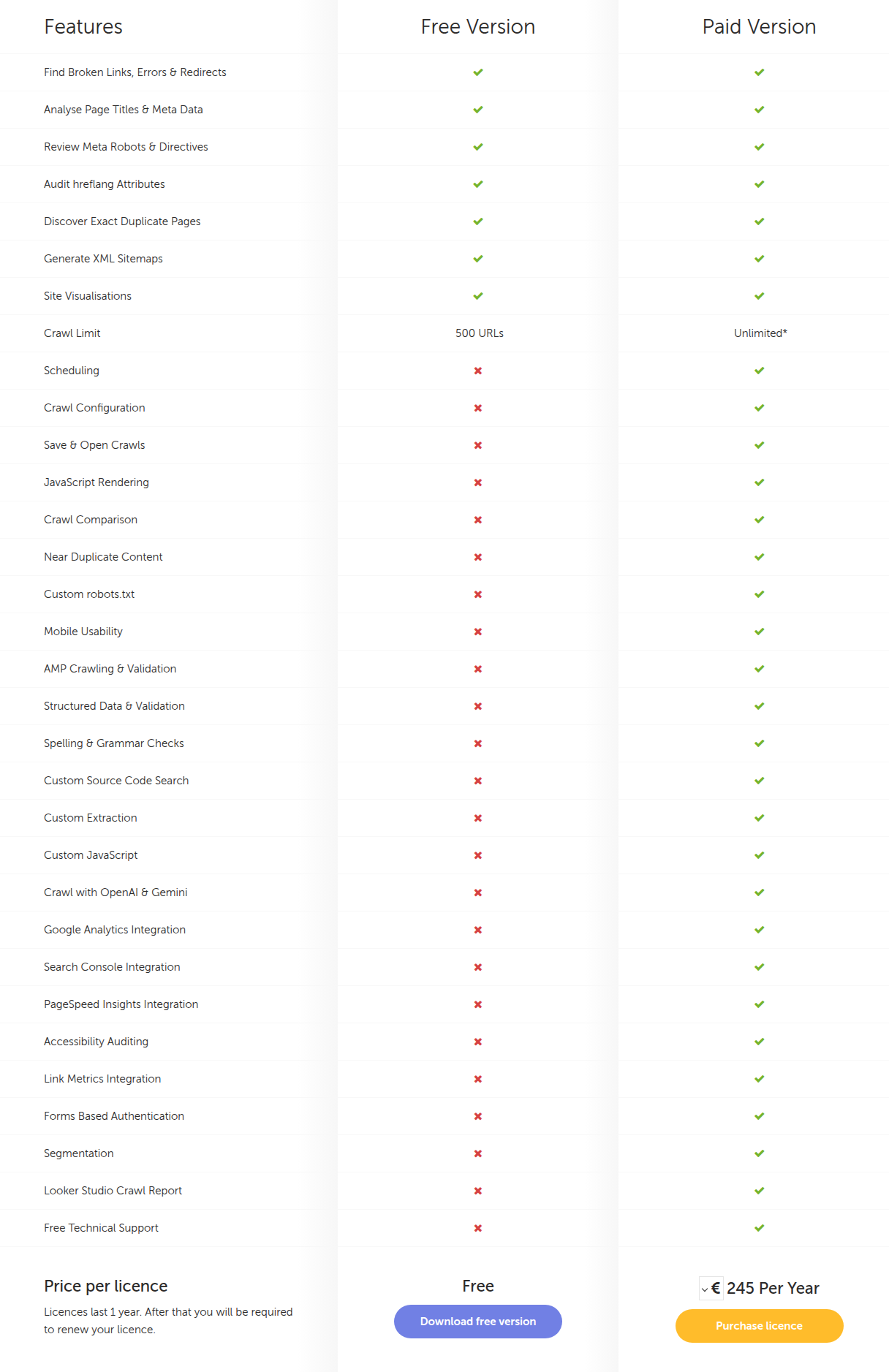
Screaming Frog’s pricing is an annual per-user license:
| Plan | Price | URL limit | Key inclusions |
|---|---|---|---|
| Free | €0 | 500 URLs | Basic crawling, broken links, title/meta analysis, hreflang, duplicate content, XML sitemaps |
| Paid (1-4 licenses) | €245/yr per user | Unlimited | All free features plus JS rendering, custom extraction, scheduling, AI integration, GSC/GA/PSI integration, crawl comparison |
| Paid (5-9 licenses) | €235/yr per user | Unlimited | Volume discount |
| Paid (10-19 licenses) | €219/yr per user | Unlimited | Volume discount |
| Paid (20+ licenses) | €209/yr per user | Unlimited | Maximum volume discount |
Screaming Frog also sells a separate Log File Analyser product: $139/yr per licence (1-4 licences), dropping to $125, $115, and $99 per licence at higher volume tiers. The free version caps out at 1,000 log lines and one project.
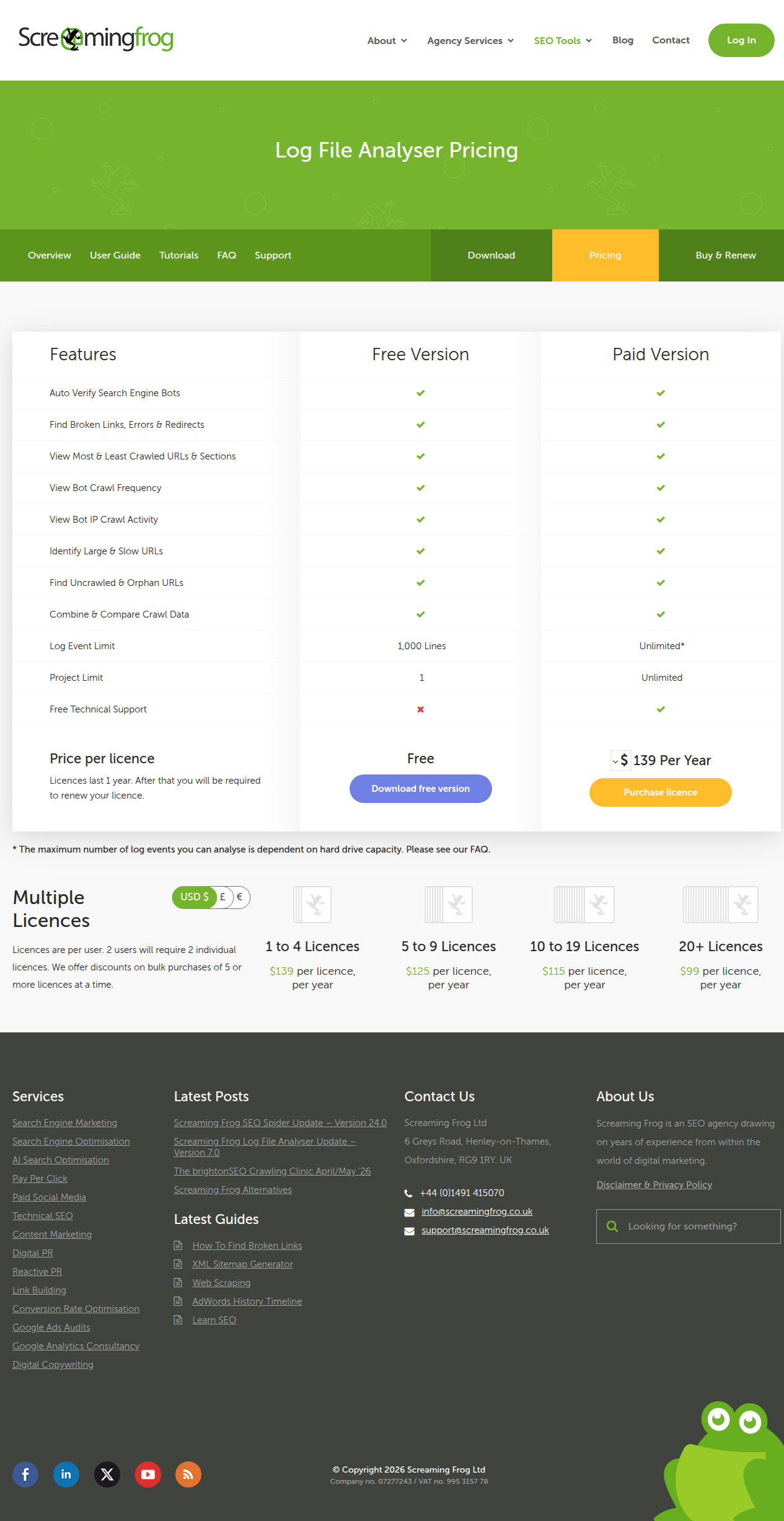
Prices accurate as of July 2026; check the vendor’s site for current rates.
Price comparison summary
For a solo SEO or freelancer: CrawlRaven’s lifetime deal ($49-$99 one-time) vs Screaming Frog’s €245/yr annual license. Over three years, that’s $99 vs €735.
For a 5-person agency: CrawlRaven at $99 one-time (shared cloud dashboard) vs Screaming Frog at €1,175/yr (5 x €235). Even if CrawlRaven moves to a $29/mo subscription, the annual cost is $348 vs €1,175.
But price isn’t the whole story. Screaming Frog’s unlimited URL crawling and raw data access make it indispensable for certain jobs, regardless of cost.
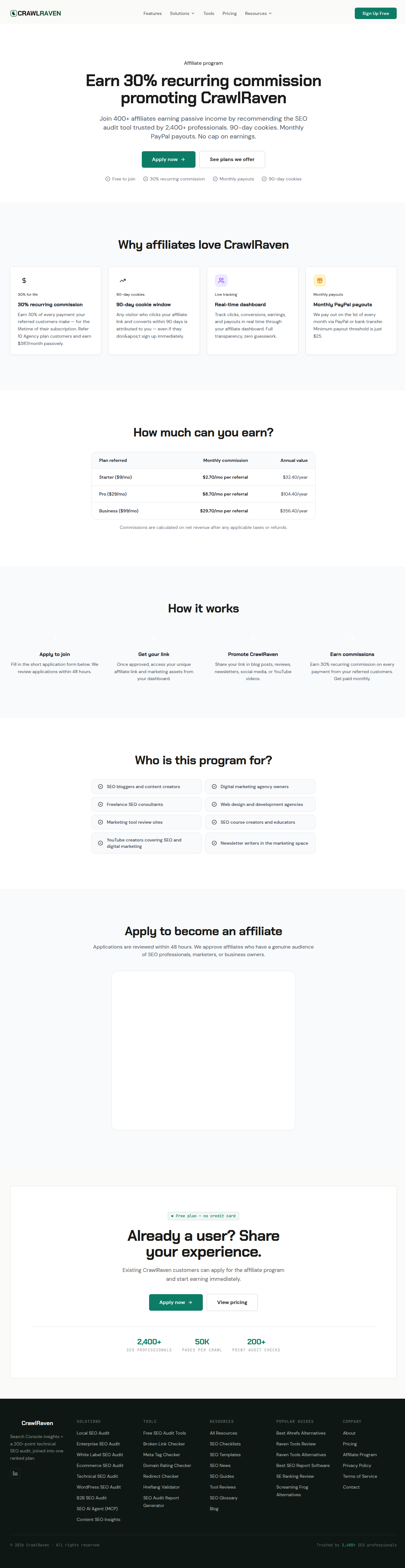
If you write about SEO tools for a living, it’s also worth knowing that CrawlRaven runs a public affiliate program: 30% recurring commission, a 90-day cookie window, and monthly PayPal payouts with a $25 minimum threshold. Screaming Frog doesn’t publicly offer an affiliate or referral program at all.
Where Screaming Frog loses
No prioritization. This is the single biggest complaint from Screaming Frog users. A 300-item spreadsheet with no ranking, no impact scores, and no “start here” signal means hours of manual triage before any work begins. For week-to-week monitoring, this is exhausting.
No white-label reports. Agencies using Screaming Frog spend significant time each month exporting data and rebuilding client-facing reports from scratch. CrawlRaven, Sitebulb, and even cheaper tools like Netpeak Spider all include reporting. Screaming Frog doesn’t.
Desktop-only architecture. No cloud option, no shared dashboard, no team access. Your machine must stay on during crawls. Large crawls consume significant RAM. If your laptop dies mid-crawl, you start over.
Steep learning curve. The interface has been described as “functional but ugly” and “looks like 2005.” New hires typically need 2-6 weeks to become productive. The sheer density of tabs, filters, regex config, and rendering settings is overwhelming for anyone who isn’t a dedicated technical SEO.
No content or keyword tools. Screaming Frog is a pure crawler. It doesn’t do keyword research, rank tracking, content scoring, or content gap analysis (except through AI API integration, which you configure and pay for separately). If you want a tool that connects crawl data to content strategy, Screaming Frog doesn’t do that natively.
Where CrawlRaven loses
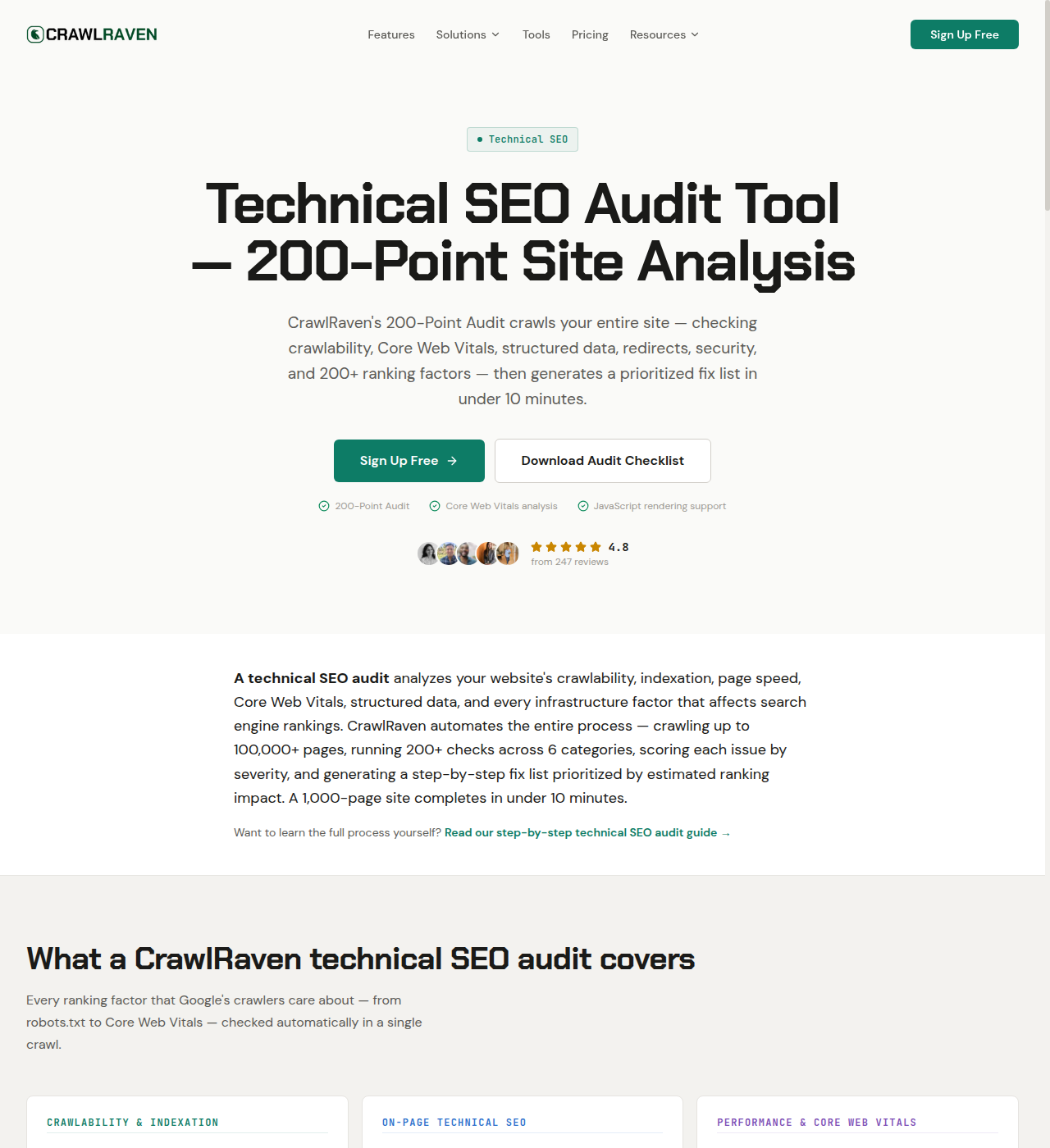
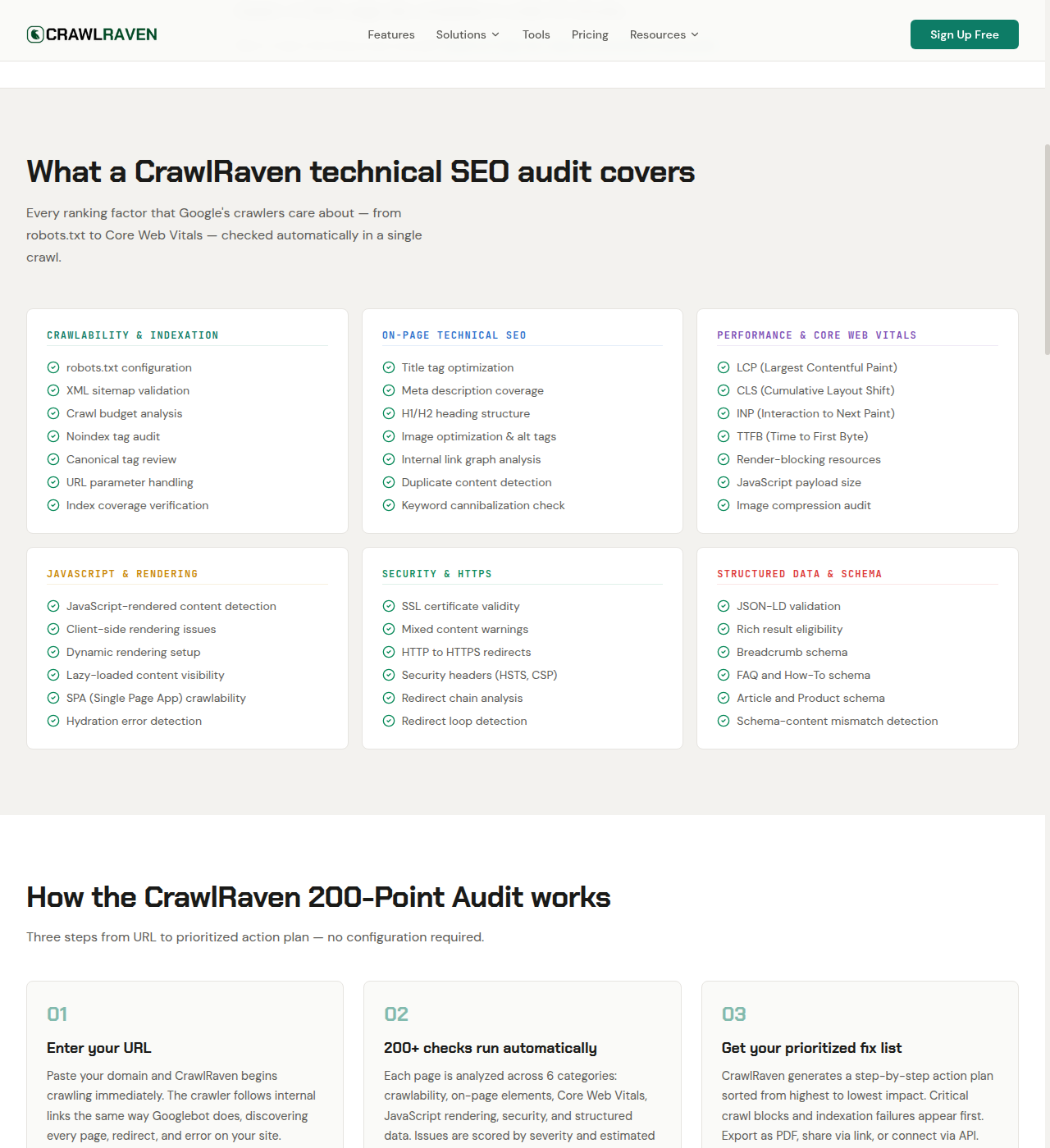
Crawl depth and configurability. Screaming Frog checks 300+ issues with fine-grained control over every setting. CrawlRaven’s 200-point audit is less comprehensive, and the technical SEO audit is still labeled “coming soon” on current lifetime plans as of July 2026. If you need to audit every redirect hop, analyze raw HTTP headers, or configure custom crawl rules, Screaming Frog is the better tool.
No raw data access. CrawlRaven is opinionated by design — it shows you what matters, not every column. There’s no “export every HTTP header and redirect chain” mode. Custom extraction is template-driven, not full XPath/regex. If your workflow requires raw, unfiltered crawl data for custom analysis, you’ll hit CrawlRaven’s ceiling fast.
Per-crawl URL limits. CrawlRaven doesn’t break out URL limits by plan tier anywhere on its site. It does advertise overall crawl capacity, but inconsistently: a stat block elsewhere on the site says “50K pages per crawl,” while the technical SEO audit page says it crawls “up to 100,000+ pages.” Screaming Frog’s paid license has no URL limit at all, and the number is the same regardless of which page you read. If you need to crawl 50K+ pages without caps, that consistency alone makes Screaming Frog the safer pick.
No offline mode. Cloud-only means you need an internet connection. No crawling on flights, in secure environments, or during network outages.
JavaScript rendering exists on paper, not yet in the live product. Screaming Frog gives you fine-grained Chromium control for JS-heavy sites today — render vs raw comparison, custom wait times, rendering configuration. CrawlRaven’s technical SEO audit page lists a full “JavaScript & Rendering” check category (headless Chromium, SPA crawlability, hydration error detection), but that entire audit is still labeled “coming soon” on both lifetime tiers. If your site relies on client-side rendering, Screaming Frog is the only one of the two that can actually run that check for you right now.
Maturity. CrawlRaven launched in 2026 and has approximately 2,400 users. Screaming Frog has been the industry standard since 2010 and is used by Apple, Google, Disney, Amazon, and NASA. For enterprise procurement teams, Screaming Frog’s track record matters.
The final verdict
Pick CrawlRaven if:
- You do weekly or monthly site monitoring and need a prioritized fix list, not a data dump.
- You serve clients and need white-label reports without rebuilding them from scratch.
- You want GSC data, keyword research, and crawl findings in one view — without stitching three exports together.
- You work on a team that needs shared cloud access.
- Budget matters: the lifetime deal is a fraction of Screaming Frog’s annual cost.
Pick Screaming Frog if:
- You run deep forensic audits where every HTTP header, redirect hop, and canonical signal matters.
- You do site migrations and need crawl comparison (before vs after) at the URL level.
- You need custom extraction via XPath, CSS, or regex for large-scale data scraping.
- You crawl JavaScript-heavy sites and need render-vs-raw comparison.
- You work offline or in secure environments where cloud tools aren’t an option.
- You crawl large sites (50K+ URLs) and need zero URL limits.
Run both if: This is the honest answer for many SEO teams. Use Screaming Frog for quarterly deep-dive audits, migration projects, and custom scraping. Use CrawlRaven for weekly monitoring, client reporting, and turning crawl data into actual work your team ships. The tools don’t compete on every dimension — they complement each other. The lifetime deal makes the “both” option surprisingly affordable. If the Ahrefs subscription feeding those CSV imports is the line item you actually want to cut, our OpenSEO vs Ahrefs comparison weighs a $10/mo open-source option against the full backlink index. For more tool comparisons like this one, see all our reviews.