25 July 2026 · Comparison
Synthesia vs HeyGen (2026): Which AI Video Tool Wins?
The short answer
Synthesia wins on enterprise compliance and collaboration. HeyGen wins on price, avatar speed and 4K export. Who should pick which in 2026.
Affiliate disclosure: SaaSpicious is reader-supported. When you buy through links on our site, we may earn a commission. This post compares Synthesia and HeyGen honestly. We have an affiliate relationship with Synthesia only. HeyGen’s partner program is restricted to social video creators and does not support blog-based promotion. We disclose this because it affects which tool pays us, but not which tool we recommend.
The Verdict in 100 Words
Pick Synthesia if you are a team at a company of 20+ people, especially in a regulated industry. It has SOC 2 Type II and ISO 42001 certifications, live multi-user collaboration, and an end-to-end workflow from creation to analytics. You pay more, but you get a platform that compliance teams and procurement will actually approve.
Pick HeyGen if you are a solo creator, marketer, or small agency that needs fast, affordable avatar videos. HeyGen gives you 30-minute videos and voice cloning at $29/mo, 4K export at $49/mo, and an unmatched range of avatar creation methods (photo-to-avatar in minutes, UGC-style avatars, digital twins). It is the better dollar-for-dollar value at the entry level, and credit rollover means you do not lose what you do not use.
Neither is the wrong tool. This post is about which one is right for your use case.
At a Glance: Synthesia vs HeyGen
| Category | Synthesia | HeyGen |
|---|---|---|
| Starting price (paid) | $29/mo (Starter) | $29/mo (Creator) |
| Annual discount | $18/mo (Starter), $67/mo (Creator) | $24/mo (Creator) |
| Free plan | 10 min/mo, 9 avatars, watermarked | 3 videos/mo, 1 min each, watermarked |
| Video minutes (entry plan) | 10 min/mo | 30 min video max, 600 credits |
| Max export resolution | Up to 1080p (no 4K advertised) | 4K (Pro at $49/mo) |
| Stock avatars | 240+ (Enterprise), 180+ (Creator) | 700+ (all paid plans) |
| Languages | 160+ languages, 1,000+ AI voices | 175+ languages, 1,000+ AI voices |
| Custom avatars | Webcam recording, ~2-day turnaround | Photo (minutes), video recording, UGC |
| Voice cloning | Yes (multilingual, 32 languages) | Yes (unlimited on Creator+) |
| Live collaboration | Yes (Enterprise) | No (commenting only) |
| Credit rollover | No | Yes (1 month for monthly, all year for annual) |
| 4K export | No | Yes (Pro $49/mo+) |
| SOC 2 Type II | Yes | Yes |
| ISO 42001 (AI) | Yes | No |
| GDPR | Yes | Yes |
| SAML/SSO | Enterprise | Business ($149/mo) |
| SCORM export | Enterprise | Business ($149/mo) |
| G2 rating | 4.7/5 (2,000+ reviews) | 4.8/5 (1,900+ reviews, G2 #1 Fastest Growing 2025) |
| Affiliate program | 25% commission, 60-day cookie, blog-OK | Social Creator Program only, 5K+ followers required |
Prices accurate as of July 2026; check the vendor’s site for current rates.
Pricing: What You Actually Pay

Synthesia Pricing
Synthesia uses a credits system shared across all AI features. Every plan gets a monthly credit pool that covers video generation, dubbing, and AI assets.
- Free ($0/mo): 10 minutes of video per month, 9 stock avatars, watermarked output, 1 editor. 1,200 credits/mo. Good for testing the tool, not for business use.
- Starter ($29/mo, $18/mo annually): 10 min/mo, 125+ stock avatars, 3 personal avatars, remove watermark, AI Video Assistant, AI Dubbing, 1 editor + 3 guests. 1,200 credits/mo.
- Creator ($89/mo, $67/mo annually): 30 min/mo, 180+ stock avatars, 5 personal avatars, API access, multiple avatars per scene, branded video pages, interactive videos, priority support, 1 editor + 5 guests. 3,600 credits/mo.
- Enterprise (custom pricing): Unlimited video minutes, 240+ stock avatars, unlimited personal avatars, SAML/SSO, live collaboration, brand kits, SCORM export, 1-click translation (80+ languages), dedicated CSM, tailored onboarding, Academy. Custom credits.
Studio Avatars are a $1,000/year add-on for annual plans and take up to 10 days to process.
HeyGen Pricing
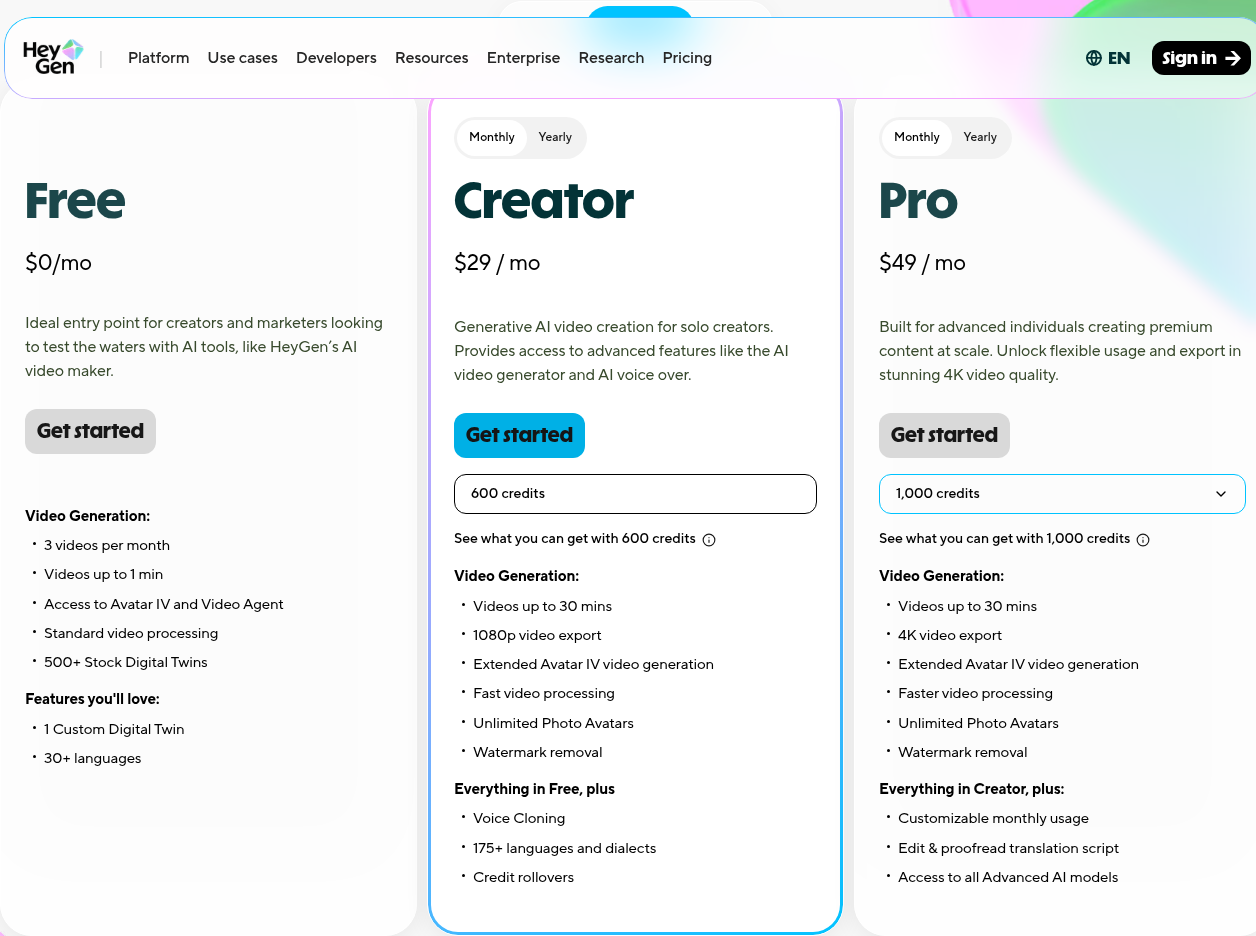
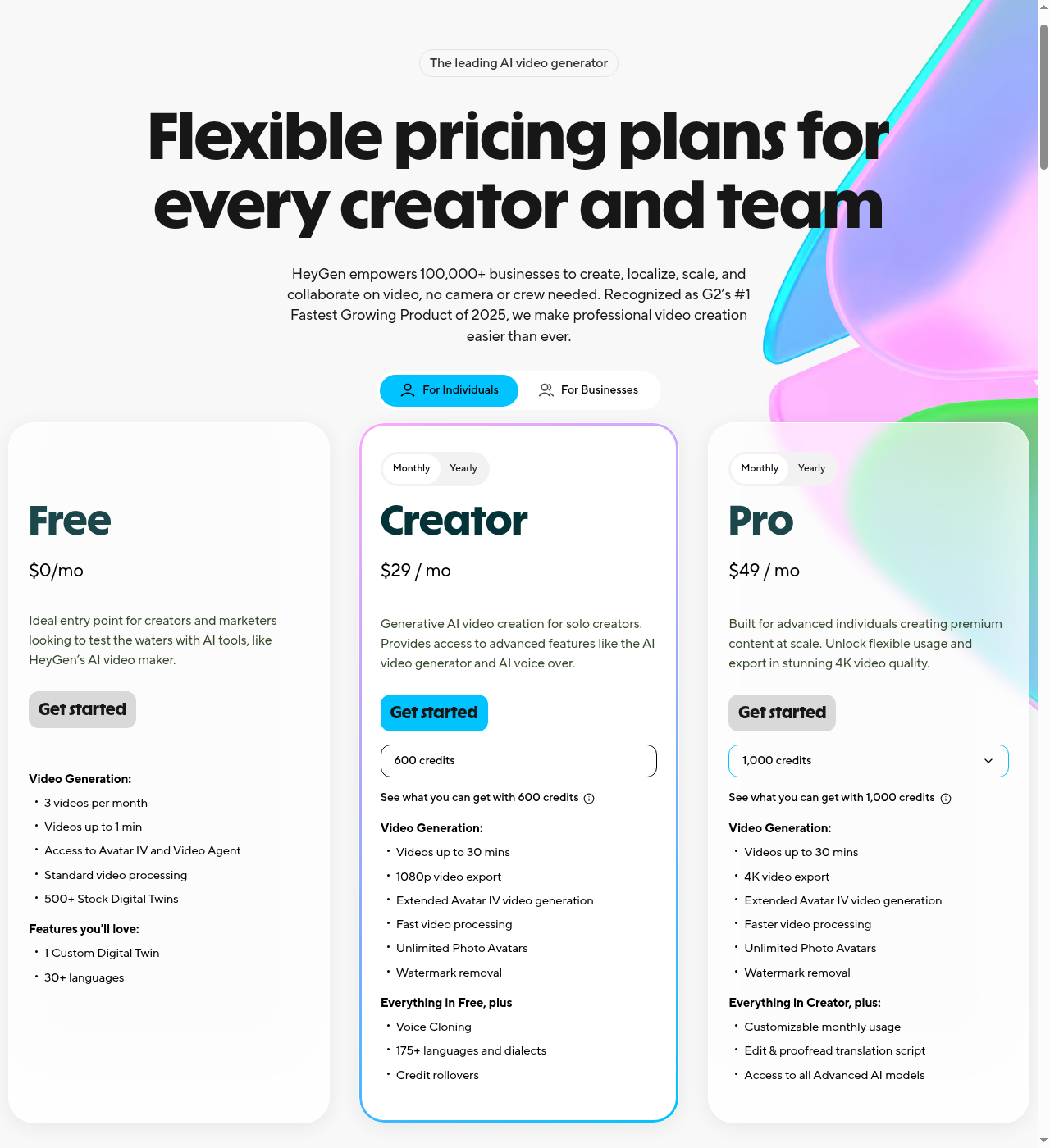
HeyGen also uses a credit-based system. Different feature types consume credits at different rates: Avatar III = 3 credits/min, Avatar IV/V = 20 credits/min, Video Translation = 2-5 credits/min, Video Agent = 20 credits/min.
- Free ($0/mo): 3 videos/mo, 1 min max per video, 500+ stock avatars, 1 custom digital twin, 30+ languages, watermarked.
- Creator ($29/mo, $24/mo annually): 600 credits/mo, videos up to 30 min, 1080p export, 700+ stock avatars, unlimited Photo Avatars, voice cloning, 175+ languages, watermark removal, credit rollover.
- Pro ($49/mo, scales to $4,300/mo for 100K credits): 1,000 credits/mo, videos up to 30 min, 4K export, faster processing, all advanced AI models, customizable monthly usage.
- Business ($149/mo + $20/seat): 1,500 credits/mo, videos up to 60 min, 4K, 5+ custom digital twins, SAML/SSO, workspace collaboration, interactive video, SCORM, LMS integrations, n8n/Make/HubSpot/Zapier.
- Enterprise (custom): Unlimited video duration, 4K, 10+ digital twins, SCIM, MFA, multi-workspace, dedicated CSM, invoice billing.
The credit math matters. HeyGen’s Avatar IV (their flagship photo-to-video model) consumes 20 credits per minute of generated video. On the Creator plan’s 600 credits, that buys you 30 minutes of Avatar IV video. But if you also use Video Translation with lip sync (5 credits/min), those credits split fast. Pro’s 1,000 credits gives more breathing room, and the Business plan’s 1,500 credits plus $20/seat makes team scaling predictable.
Price Comparison: What You Get for Your Dollar
At the $29/mo entry point, HeyGen delivers substantially more: 30-minute videos vs Synthesia’s 10 minutes, 1080p export vs no advertised resolution tier, 700+ avatars vs 125+, unlimited Photo Avatars, and credit rollover. HeyGen is the clear value winner at this tier.
At the mid-tier (Synthesia Creator $89/mo vs HeyGen Pro $49/mo), the comparison gets interesting. Synthesia at $89 gives you 30 min/mo, API access, interactive videos, and branded pages. HeyGen at nearly half the price gives you the same 30 min videos, plus 4K export, faster processing, and all advanced AI models. The price gap widens further if you need more credits (HeyGen Pro scales to $4,300 for 100K credits).
At enterprise scale, pricing becomes custom for both, and the decision shifts to security, compliance, and workflow features rather than raw cost. Synthesia’s edge here is not price, it is that compliance teams will actually let you use it.
Avatars: Enterprise Polish vs Creator Speed
Synthesia: Expressive, Polished, Enterprise-Ready
Synthesia’s Express-2 avatars are the standout. These avatars adapt their gestures to the emotional tone of your script: they wave, point, clap, and change their delivery based on context. It is the closest thing to a human presenter in AI video today.
With 240+ stock avatars on Enterprise (180+ on Creator, 125+ on Starter), Synthesia gives you diverse, professional-looking presenters. Custom avatars are created via webcam recording with about a 2-day turnaround. Studio Avatars (the higher-quality option) cost $1,000/year extra.
Synthesia also supports up to 20 avatars in a single scene (Creator+), and customizable avatars that can be placed in any environment or outfit with prompted actions.
The tradeoff: personal avatars take days, not minutes. There is no equivalent to HeyGen’s Avatar IV (single photo to full video). If you need an avatar of yourself tonight, Synthesia is not the tool.
HeyGen: Fast, Flexible, Creator-First
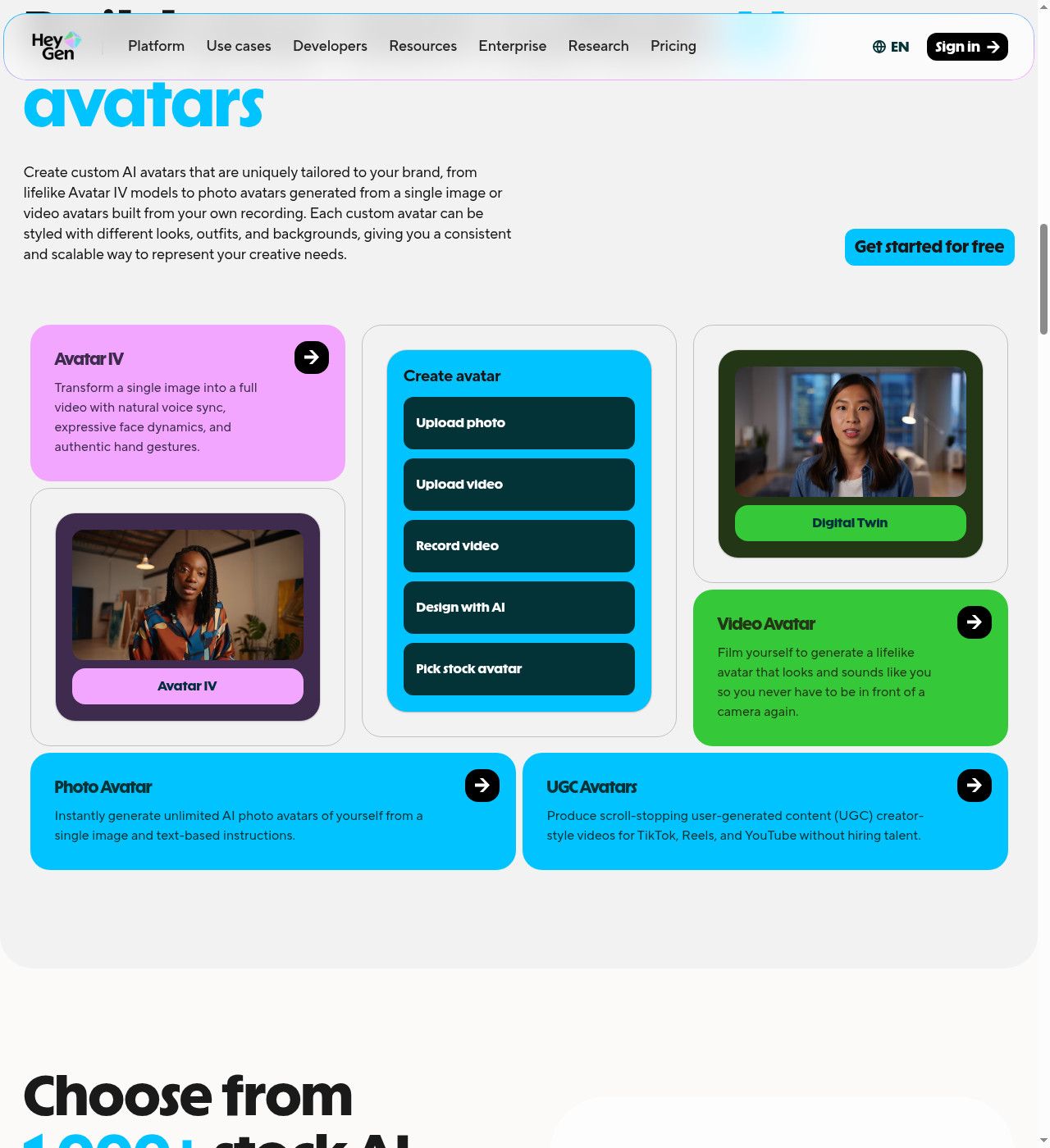
HeyGen’s avatar ecosystem is broader and faster. You can create avatars through:
- Avatar IV: Upload a single photo, get a lifelike talking video in minutes. The flagship feature nobody in the market has matched at this speed.
- Photo Avatars: Generate unlimited photo avatars from a single image with text instructions.
- Video Avatars (Digital Twin): Film yourself once, generate videos on demand.
- UGC Avatars: Creator-style videos for TikTok, Reels, and YouTube without hiring talent.
- LiveAvatar: Real-time interactive avatars for Zoom calls. (Synthesia’s interactive avatars are still in beta.)
With 700+ stock avatars and 500 Look Packs, HeyGen gives you more variety out of the box. The motion and gesture control, plus custom voice emotion, let you fine-tune delivery.
The tradeoff: HeyGen’s stock avatars lack the emotional expressiveness of Synthesia’s Express-2. The gestures are more mechanical, and the avatars do not adapt their body language to your script’s tone. For training videos where presenter credibility matters, the difference is noticeable.
Security & Compliance: The Enterprise Gatekeeper
This is the single biggest differentiator between the two platforms, and for many buyers, it ends the comparison immediately.
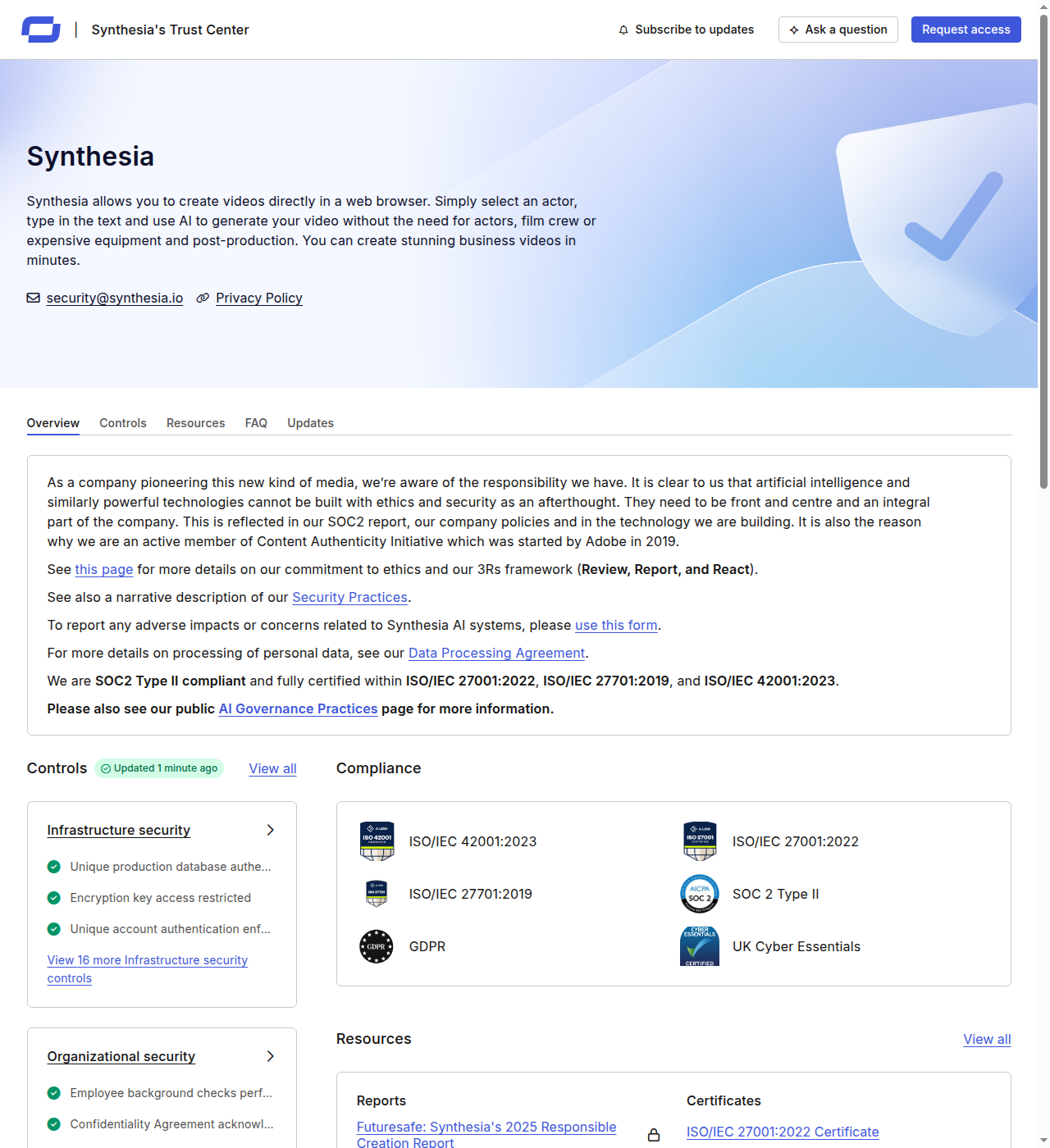
Synthesia holds:
- SOC 2 Type II certification (the gold standard for SaaS security)
- ISO 42001 certification (AI management system standard)
- GDPR compliance
- Content Authenticity Initiative membership
- A dedicated Trust & Safety team
- Human + AI content moderation
- Explicit consent required for all avatars
HeyGen holds:
- GDPR compliance
- SOC 2 Type II certification
- SAML/SSO (Business+, $149/mo)
- SCIM (Enterprise)
- MFA and Team Member 2FA Enforcement (Enterprise)
- Content moderation policies
- Password-protected URLs
- Audit logs (Enterprise)
HeyGen lacks ISO 42001 certification.
What this means in practice: If your company is in finance, healthcare, pharma, government, or any industry with regulatory compliance requirements, your InfoSec team will almost certainly require SOC 2 Type II. Both Synthesia and HeyGen hold it, so the basic compliance gate is met by both. However, HeyGen lacks ISO 42001 (the AI management system standard), which is becoming an emerging requirement for AI procurement in larger organizations.
For startups, agencies, and creator-led teams without formal compliance requirements, this difference may not matter. But if you are buying for an enterprise with strict AI governance policies, check with your security team. Both tools clear SOC 2, but Synthesia’s ISO 42001 gives it an edge for organizations that require it.
Translation & Localization: DeepL vs OpenAI
Both tools offer multilingual video creation, but the engines and workflows differ.
Synthesia uses DeepL for 1-click translation across 80+ languages (140+ on Enterprise for dubbing). DeepL is widely considered the most accurate machine translation engine, especially for European languages. Synthesia also offers custom glossaries, speaker assignment overrides, voice and accent preservation, lip sync dubbing, and a multilingual video player. Dubbing API is available on Enterprise.
HeyGen uses OpenAI-based translation into 175+ languages and dialects with lip sync. You get brand voice (glossary), upload transcription as source, edit and proofread translations, and switch voices. Translation processing speed scales with plan tier (Standard on Free, Fast on Creator, Fastest on Pro+).
Synthesia’s DeepL integration generally produces more accurate translations for business content. HeyGen covers more languages (175+ vs 160+ for Synthesia voices, 80+ for translation). For most buyers, the translation quality difference matters more than the language count difference, unless you need a specific dialect that only one supports.
Where Synthesia Loses
- No 4K export. In 2026, this is a real gap. HeyGen offers 4K at $49/mo.
- Custom avatars take days, not minutes. No photo-to-avatar equivalent to HeyGen’s Avatar IV.
- No credit rollover. Unused credits expire each month. If your video production is uneven, you lose value.
- Starter plan is restrictive. 10 minutes of video per month is barely enough for a single training module.
- No native integrations panel. You rely on API and Zapier, while HeyGen offers direct n8n, Make, HubSpot, and Zapier integrations.
- Studio Avatars cost extra. $1,000/year for higher-quality personal avatars, on top of your plan.
- Pricing is higher across the board. Creator at $89/mo vs HeyGen Pro at $49/mo for similar (and in some ways better) capabilities.
- Enterprise-only gating. Live collaboration, brand kits, 1-click translation, version control, and SSO are all Enterprise-locked. If your team of 5 needs these features, you are paying custom enterprise pricing, not a predictable per-seat rate.
Where HeyGen Loses
- No ISO 42001 certification. HeyGen has SOC 2 Type II (the basic compliance gate is met), but it lacks ISO 42001, the AI governance standard. Enterprises with formal AI procurement policies may require it, and Synthesia is the only one that has it.
- No live collaboration. You can comment on videos, but you cannot co-edit in real time. For training teams iterating on videos together, Synthesia’s live collaboration is a genuine productivity upgrade.
- No version control or smart updates. If you embed a video and need to fix a typo, you re-export and replace the embed. Synthesia’s smart updates propagate changes automatically.
- No AI Screen Recorder. Synthesia’s Chrome extension captures and transcribes screen recordings with AI cleanup. HeyGen has no equivalent.
- No Roleplay Sessions. Synthesia’s interactive conversation practice with scored feedback is a unique training feature. HeyGen has interactive quizzes and branching, but not roleplay.
- Translation quality gap. OpenAI-based translation is good, but DeepL is better for professional business content.
- Geopolitical concerns. Founded in China. Some enterprise buyers and government agencies may have data-sovereignty concerns. This is not a technical issue, but it is a real procurement factor.
- Affiliate program is social-only. If you are a blogger or SEO-driven site, you cannot monetize HeyGen referrals. Their program requires 5K+ followers and original video content.
What You Miss With the Cheaper Pick
If you are a solo creator choosing HeyGen to save money, here is what you do not get that Synthesia teams rely on:
- Express-2 emotional avatars that change their gestures and tone based on your script. HeyGen avatars are competent but less dynamic.
- Live collaboration for real-time co-editing across a team. If you are solo, this does not matter. If you plan to grow a video team, it matters a lot.
- DeepL translation quality for multilingual corporate content.
- Roleplay Sessions if you ever need to create practice-scenario training.
- Smart updates that sync changes across all embedded videos automatically.
If you are an enterprise team choosing Synthesia, here is what you miss that HeyGen delivers for less:
- 4K export at any price point — Synthesia does not offer it.
- Avatar IV (single photo to full video in minutes).
- Unlimited Photo Avatars and UGC-style avatars for social content.
- Credit rollover so uneven production months do not waste your budget.
- Direct integrations with n8n, Make, and HubSpot (Synthesia is API-only).
- Lower per-user cost at any tier below Enterprise.
Affiliate Reality Check
A note on how this comparison is monetized:
- Synthesia has a standard affiliate program: 25% commission on Starter and Creator plans, 60-day cookie, managed through Rewardful. Blog-based content is welcome. This post includes Synthesia affiliate links.
- HeyGen runs a Social Creator Program: 35% recurring for 3 months, 30-day tracking, 60-day verification. It requires 5K+ followers and original video content only. Blog and SEO promotion is explicitly excluded. This post does not monetize HeyGen.
We disclose this because which tool pays us influences which post we write, but it does not influence which tool we recommend. If HeyGen were the right pick for a reader, we would say so regardless. In this case, the right pick depends entirely on your situation.
Bottom Line: Who Should Pick What
Pick Synthesia if:
- You work at a company of 20+ people.
- Your industry has compliance requirements (finance, healthcare, pharma, government).
- You need live collaboration and version control for a video team.
- You are building training content where emotional expressiveness and presenter credibility matter.
- You want an end-to-end platform with analytics, embeds, and smart updates.
Pick HeyGen if:
- You are a solo creator, marketer, or small agency.
- You need fast avatar creation from photos (Avatar IV has no Synthesia equivalent).
- You want 4K export at an affordable price.
- You need credit rollover because your production is not steady month-to-month.
- You are making social media content in UGC/ad format.
Wrong for both: If you are a large enterprise that needs both SOC 2 compliance and 4K export and photo-to-avatar speed, neither tool fully delivers today. You may need to run both (Synthesia for training and compliance content, HeyGen for marketing and social) or evaluate a third option.
Our pick for most readers: If we had to name one tool for the broadest audience, it is Synthesia for team use and HeyGen for solo use. They serve different buyers, and that is the point of this comparison.
If you are evaluating other AI-powered creative tools, check out our comparison of ChatCut and Descript for AI video editing, our ElevenLabs vs Murf AI comparison if the voiceover track is what you actually need, or browse all our SaaS tool comparisons.
Last updated: July 2026. Pricing and features change. Verify on the vendor’s site before buying.