27 July 2026 · Comparison
ElevenLabs vs Murf AI: Which AI Voice Platform Fits You?
The short answer
ElevenLabs wins on creative breadth: voices, music, SFX, video. Murf AI wins on speed and cost for voice agents. Who should pick each.
Verdict: Pick ElevenLabs if you need the broadest creative platform (TTS, voice cloning, music, SFX, video) with 10,000+ voices across 70+ languages. Pick Murf AI if you are deploying high-volume voice agents where latency and per-minute cost are the deciding factors. Murf Falcon delivers 130ms time-to-first-audio at 1 cent per minute, with significantly better numerical accuracy for banking, insurance, and healthcare use cases. Neither tool wins everything, and the “better” platform depends entirely on whether you are building creative content or production voice agents.
Disclosure: Some links in this post are affiliate links. If you click through and make a purchase, we may earn a commission at no extra cost to you. This does not affect our analysis. We check prices against each vendor’s live pricing page and name the downsides on both sides, regardless of affiliate relationships.
The TL;DR
ElevenLabs and Murf AI are two of the most talked-about AI voice platforms in 2026, but they serve different buyers. ElevenLabs is a full AI audio ecosystem: text to speech, speech to text, voice cloning, music generation, sound effects, dubbing, and conversational AI agents, all in one platform. Murf AI is a purpose-built voice platform with a standout ultra-low-latency TTS model (Falcon) that dominates on speed, cost, and accuracy for voice agent use cases.
This comparison breaks down what each tool actually delivers, and where each falls short.
Pricing: Credits vs Cents
ElevenLabs Pricing (ElevenCreative)
ElevenLabs uses a credit system. Credits are shared across all products (TTS, STT, music, SFX, dubbing), and different products consume credits at different rates.
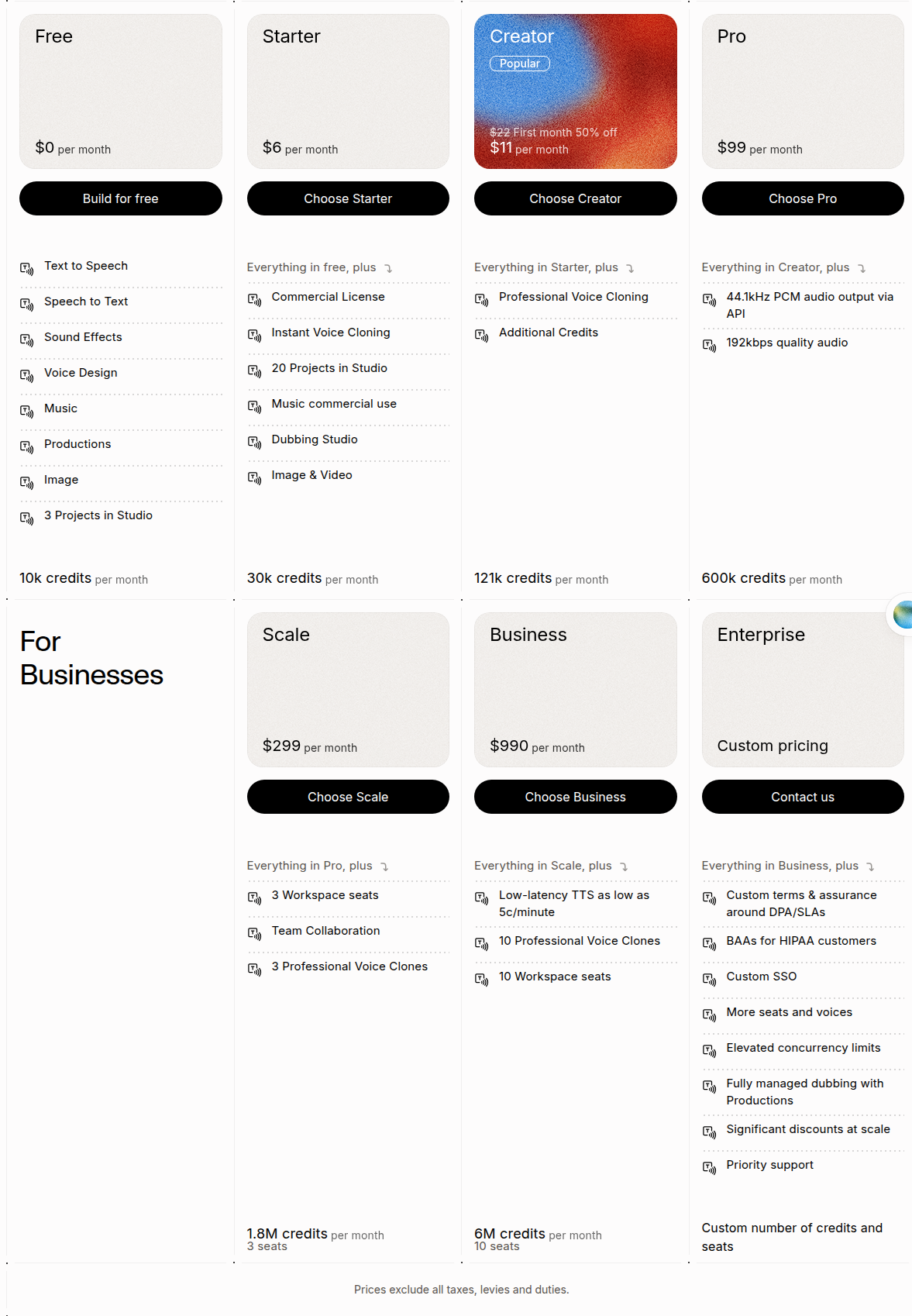
| Plan | Price/mo | Credits | Key Features |
|---|---|---|---|
| Free | $0 | 10K | No commercial license |
| Starter | $6 | 30K | Commercial license, instant voice cloning |
| Creator | $22 ($11 first month) | 121K | Professional voice cloning |
| Pro | $99 | 600K | 44.1kHz PCM, 192kbps audio |
| Scale | $299 | 1.8M | 3 seats, team collaboration |
| Business | $990 | 6M | 10 seats, low-latency TTS as low as $0.05/min |
| Enterprise | Custom | Custom | SSO, HIPAA BAAs, custom terms |
Annual billing saves 2 months (annual price = monthly price x 10). Unused credits roll over up to 2x your monthly quota.
For the API, pay-as-you-go pricing ranges from $0.05/1K characters for Flash/Turbo models to $0.10/1K characters for the more expressive Multilingual v2/v3 models. The Speech Engine for agents costs $0.08/min.
Prices accurate as of July 2026; check the vendor’s site for current rates.
Murf AI Pricing
Murf Falcon charges a flat 1 cent per minute for its streaming TTS API, with no credit calculations, no confusing tiers. Murf Studio (for voiceover creation) uses a subscription model with Free ($0/mo), Creator ($19/mo), Business ($66/mo), and Enterprise (Custom) plans (prices based on annual billing).
For enterprise voice agents, Murf does not publicly list pricing; deployment is handled through enterprise sales. The Murf Falcon streaming TTS API (which powers the voice agents) is priced at 1 cent per minute.
Murf also runs a Startup Incubator program: 50M free API characters for 3 months.
Prices accurate as of July 2026; check the vendor’s site for current rates.
Cost Comparison at Scale
The cost difference is significant for high-volume use. Murf Falcon at 1 cent/min translates to $0.60/hour of generated speech. ElevenLabs’ Speech Engine at $0.08/min is $4.80/hour, and their standard TTS API at 5-10 cents/min ranges from $3.00 to $6.00/hour. For a call center generating 1 million minutes per month:
- Murf Falcon: ~$10,000/month
- ElevenLabs Speech Engine: ~$80,000/month
- ElevenLabs TTS API (Flash): ~$50,000/month
These are API consumption costs; the subscription plans with included credits change the math for lower volumes.
Feature Comparison
| Dimension | ElevenLabs | Murf AI |
|---|---|---|
| Voice library | 10,000+ voices | 200+ voices |
| Languages | 70+ | 35+ (Falcon), 40+ (Dubbing) |
| Voice cloning | Yes (instant + professional) | Yes |
| TTS latency (model) | 75ms (Eleven Flash) | 55ms (Falcon) |
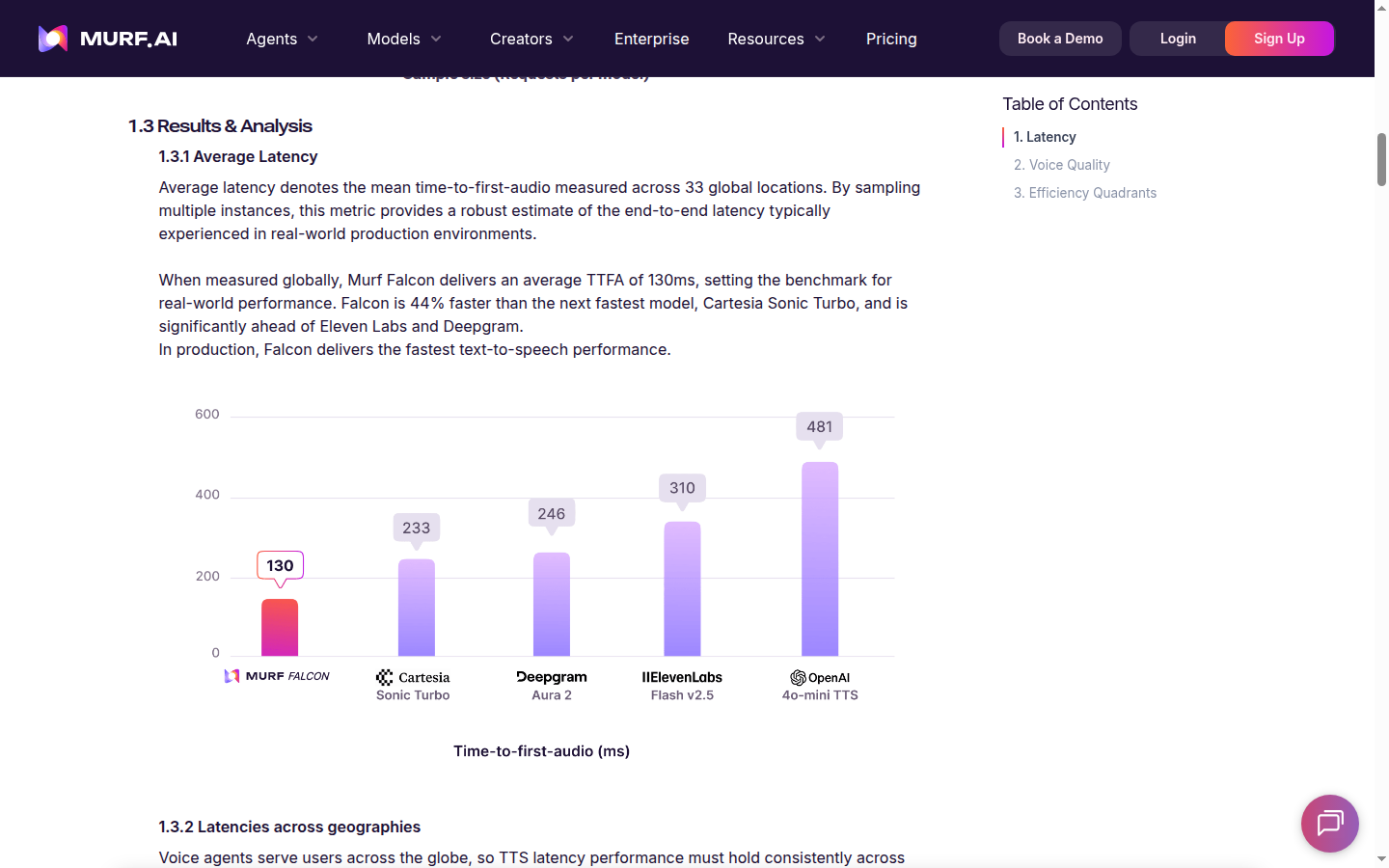
| TTS latency (TTFA, avg) | 310ms (per Murf benchmarks) | 130ms (per Murf benchmarks) |
| TTS API cost | $0.05-$0.10/1K chars | $0.01/min |
| Agent speech cost | $0.08/min | $0.01/min |
| Conversational agents | Omnichannel (phone, chat, WhatsApp, SMS, email) | Phone-centric (receptionist, SDR, cold calling) |
| Agent guardrails/analytics | Yes (guardrails, workflows, simulation, analytics) | Not prominently featured |
| Transcription | Scribe v2 (98% accuracy, 90+ languages) | Voice Editing (basic) |
| Music generation | Yes (Music v2) | No |
| SFX generation | Yes | No |
| Video generation | Yes (integrated with Veo, Wan, Kling) | No |
| Dubbing | Dubbing v2 (emotion-preserving) | AI Dubbing (40+ languages) |
| Enterprise compliance | SOC 2, ISO 27001, ISO 42001, HIPAA, PCI DSS | SOC 2, ISO 27001, GDPR, HIPAA |
| Data residency | US, EU, India | 10+ geographies |
| Concurrent calls | Not publicly available | 10,000 claimed |
| Code-mixing quality | Available (0.58 VQM sub-score per Murf benchmarks) | Best-in-class (0.92 VQM sub-score) |
| Numerical accuracy | Moderate (0.68 VQM sub-score) | Strong (0.80 VQM sub-score) |
| Key integrations | Salesforce, Stripe, Shopify, Zendesk, Twilio, HubSpot, Zapier, Amazon Connect, Genesys | Canva, Google Slides, PowerPoint, Adobe Captivate |
Voice Quality vs Accuracy: Where Each Wins
Voice quality is not one thing. It splits into naturalness (does it sound human?) and accuracy (does it say the right numbers, terms, and words?).
Naturalness: ElevenLabs Leads
ElevenLabs’ Eleven v3 model is positioned as the most expressive TTS model available. Even in Murf’s own benchmarks, ElevenLabs Flash v2.5 edges ahead on the naturalness sub-score: 0.73 vs Falcon’s 0.70. If your use case is audiobooks, creative content, or branded voice experiences where emotional range and expressiveness matter, ElevenLabs has the edge.
Murf’s 200-voice library is also dramatically smaller than ElevenLabs’ 10,000+ voices. For a creator who needs variety (a different voice for each character, each video, each project), ElevenLabs offers 50x more options.
Numerical and Domain Accuracy: Murf Falcon Wins
Murf Falcon significantly outperforms ElevenLabs on reading numbers, currencies, technical terms, and code-mixed speech. This is not a subtle difference. In Murf’s VQM sub-scores:
- Numerical accuracy: 0.80 (Falcon) vs 0.68 (ElevenLabs). Falcon correctly reads prices, phone numbers, dates, and measurements far more reliably.
- Domain accuracy: 0.83 (Falcon) vs 0.72 (ElevenLabs). Falcon pronounces technical terms like “API,” “ECG,” “OTP,” and “IFSC” correctly more often.
- Multilingual code-mixing: 0.92 (Falcon) vs 0.58 (ElevenLabs). Falcon handles mixed-language utterances (common in markets like India) dramatically better.
For a banking IVR reading account balances, an insurance agent confirming policy numbers, or a healthcare bot reading test results, accuracy is more important than expressiveness. In these use cases, Murf Falcon is the stronger choice.
Conversational Agents: Omnichannel vs Phone-Focused
ElevenLabs ElevenAgents
ElevenAgents is a full conversational AI platform. It supports voice, chat, phone, WhatsApp, SMS, and email, with full context preservation across channels. Key features include:
- Guardrails to enforce compliance and block risky actions
- A visual workflow builder for defining agent procedures
- Simulation and testing before deployment
- Built-in analytics (resolution rate, CSAT, language usage)
- Integrations with Salesforce, Stripe, Shopify, Zendesk, Twilio, HubSpot, Zapier, Amazon Connect, and Genesys
- LLM-agnostic, meaning you can bring your own model
- 15 minutes free for new users
ElevenLabs reports 4M+ agents deployed, with enterprise customers including Deutsche Telekom, Klarna (10x reduction in time-to-resolution), and Revolut.
Murf Voice Agents
Murf’s voice agent offering is more phone-centric. The platform targets specific use cases: AI receptionist, AI recruiter, AI call center, AI cold calling, AI SDR, AI sales agent, and consumer lending. Murf claims 10,000 concurrent calls with stable latency, a scale signal that ElevenLabs has not publicly matched.
However, Murf’s agent platform lacks the omnichannel breadth (no WhatsApp, SMS, or email integration visible), the guardrails and simulation tools, and the deep CRM ecosystem that ElevenAgents offers. For an enterprise deploying agents across all customer touchpoints, ElevenLabs is the more mature platform. For a contact center optimizing purely for phone-call cost and latency, Murf Falcon is the more efficient engine.
Where ElevenLabs Loses
Cost at scale. At 5-10 cents per minute for TTS and 8 cents per minute for agent speech, ElevenLabs is 5-8x more expensive than Murf Falcon’s 1 cent/min. For high-volume deployments, this adds up fast.
Latency in production. ElevenLabs claims 75ms model latency for Flash v2.5, but Murf’s independent benchmarks measured ElevenLabs’ average TTFA at 310ms vs Falcon’s 130ms. Independent benchmarks are not vendor claims. They reflect what real users experience across global regions.
Credit system complexity. ElevenLabs’ credit system makes cost prediction harder than Murf’s simple per-minute pricing. Different products consume credits at different rates, and the page of fine print explaining how credits work (1 credit per TTS character, 330 credits per minute of STT, 900 per minute of music, etc.) makes it hard to estimate what a given workload will cost.
Numerical and domain accuracy. If your voice agent needs to read account numbers, policy IDs, or medical dosages, ElevenLabs’ lower accuracy scores (0.68 numerical, 0.72 domain) are a real risk.
Code-mixing. For multilingual markets where conversations mix languages mid-sentence, ElevenLabs underperforms significantly (0.58 vs 0.92).
Focus breadth. Doing everything (TTS, STT, music, video, SFX, agents) means ElevenLabs may not optimize any single piece as aggressively as Murf optimizes Falcon for voice agents.
Where Murf AI Loses
Voice selection. 200 voices vs ElevenLabs’ 10,000+ is a 50x gap. Creators who need variety, character voices, or a specific regional accent will feel the ceiling quickly.
Language coverage. 35 languages in Falcon vs ElevenLabs’ 70+. For global deployments needing broad language support, ElevenLabs covers twice the territory.
No creative suite. Murf is purely a voice platform. If you need music generation, sound effects, or AI video generation, you will need additional tools alongside Murf. ElevenLabs bundles all of these.
Agent platform maturity. Murf’s agent offering is phone-centric and lacks the omnichannel breadth, guardrails, simulation tools, and rich CRM integrations that ElevenAgents provides. For a full-stack conversational AI deployment, Murf is behind.
Smaller enterprise brand and partnership footprint. ElevenLabs has higher-profile enterprise deals. Disney (Fortnite Darth Vader voice), Deutsche Telekom (world’s first network-integrated AI call assistant), Klarna, NVIDIA, Meta, Salesforce. Murf counts Nestle, Oracle, and Honeywell, solid names, but not at the same brand recognition level.
API-first pricing gap for non-developers. Murf Falcon’s 1 cent/min rate is API-only. Non-technical users who want to use the web UI for voiceover creation pay Studio subscription rates instead (Creator at $19/mo, Business at $66/mo). The cheapest entry point to Murf’s best model requires development work.
Weaker transcription. Murf offers basic “Voice Editing” but has no equivalent to ElevenLabs’ Scribe v2 (98% accuracy, real-time transcription, 90+ languages). If transcription is your priority, see our Happy Scribe vs Sonix comparison for dedicated transcription tools.
Latency Benchmarks: What Murf’s Data Shows
Murf published independently verified benchmarks (via apiping.io) comparing Falcon against ElevenLabs Flash v2.5, OpenAI 4o-mini-TTS, Cartesia Sonic Turbo, and Deepgram Aura 2 across 33 global locations.
| Metric | Murf Falcon | ElevenLabs Flash 2.5 | OpenAI 4o-mini | Cartesia Sonic Turbo | Deepgram Aura 2 |
|---|---|---|---|---|---|
| Avg TTFA | 130ms | 310ms | 466ms | 233ms | 273ms |
| Model latency | 55ms | 75ms | n/a | n/a | n/a |
| Latency CoV | 0.17 | n/a | n/a | n/a | n/a |
| VQM score | 0.77 | 0.69 | 0.75 | 0.55 | 0.67 |
| Price/min | $0.01 | ~$0.06 | ~$0.06/min est.* | ~$0.03 (credit-based) | $0.030/1K chars** |
| #1 regions (of 10) | 9 | 0 | 0 | 1 | 0 |
*OpenAI prices realtime audio models per 1M tokens, not per minute; the per-minute estimate reflects typical usage. Murf’s benchmarks against “4o-mini-TTS” show comparable costs to ElevenLabs Flash.
**Deepgram prices TTS at $0.030 per 1,000 characters, not per minute. At ~15 characters per second of generated speech, this translates to roughly $0.027/min for typical spoken output.
Two things matter here: the absolute numbers and who ran the test. These are Murf’s benchmarks, published on Murf’s site. They are from an independent testing platform (apiping.io) and the methodology is documented, but they are still vendor-published. ElevenLabs has not published comparable independent benchmarks. Take the exact numbers as directional rather than gospel, but the pattern (Falcon being faster and cheaper, ElevenLabs being more expressive) is consistent with each tool’s positioning.
Verdict
Pick ElevenLabs if:
- You need a full AI audio platform: TTS, STT, music, SFX, dubbing, and video in one tool.
- Voice quality and expressiveness are your priority. Eleven v3 and the 10,000+ voice library give you creative breadth no competitor matches.
- You are deploying omnichannel conversational agents (phone, chat, WhatsApp, SMS, email) and need guardrails, analytics, and deep CRM integrations.
- You need the broadest language coverage (70+ languages) and want maximum voice variety.
- You have a lower-volume workload where ElevenLabs’ credit-based pricing is manageable.
Pick Murf AI if:
- You are building high-volume voice agents where per-minute cost is the deciding factor (1 cent/min vs 5-10 cents/min).
- Ultra-low latency is critical. Murf Falcon’s 130ms TTFA is substantially faster than ElevenLabs in production benchmarks.
- Your use case involves heavy numerical content (banking, insurance, healthcare) where accuracy on numbers and technical terms matters more than expressiveness.
- You operate in a code-mixing market (e.g., India) where mixed-language conversations are common.
- You want simple per-minute pricing without credit calculations.
- You need on-premise deployment with the broadest data residency coverage (10+ geographies).
Honest gray area: voice quality
Neither tool is universally “better” at voice quality. ElevenLabs wins on naturalness and expressiveness. It sounds more human and emotive. Murf Falcon wins on accuracy. It says the right numbers, technical terms, and mixed-language phrases. The “better” voice depends on your use case. An audiobook narrator needs ElevenLabs. A banking IVR needs Murf Falcon.
Who this comparison is wrong for
- Developers who want the absolute lowest streaming latency: Check Cartesia Sonic (claims 40ms model latency).
- English-only enterprise voiceover teams: WellSaid Labs is purpose-built for that use case with strong ethical positioning and SOC 2 compliance.
- Creators who want a large voice library but not the ElevenLabs price tag: Play.ht offers a large voice library with competitive pricing.
- Teams that need AI video + voice: Synthesia and HeyGen are built for that workflow; ElevenLabs has video but focuses on audio first.