16 September 2026 · Comparison
Profound vs Peec AI: Enterprise Agent vs Lean Tracking
The short answer
if you are an enterprise team that wants an agent to plan, draft, and publish the content that wins AI citations - at custom, sales-led pricing.
if you are a growth team or agency that wants transparent self-serve pricing from €85/mo, unlimited seats, and BI-friendly visibility data.
Verdict: Pick Profound if you run an enterprise marketing org that wants an end-to-end agentic workflow - a system that does not just show where AI answers miss your brand but plans, drafts, and publishes the content that closes the gap, backed by a proprietary consumer-panel demand dataset and certified compliance. Pick Peec AI if you are a growth team, agency, or BI-oriented marketer who wants transparent self-serve pricing, unlimited seats, deep visibility and shopping tracking, and clean export surfaces - without paying enterprise retainers for a content agent you may not use.
Independence disclosure: Neither vendor runs a public content-publisher affiliate program - /affiliates returns 404 on both tryprofound.com and peec.ai (checked September 2026). So there are no affiliate links in this post and SaaSpicious earns nothing from it. That is exactly why we wrote it: every existing “Profound vs Peec” result in the SERP is either vendor-authored (Peec’s own comparison page, Profound’s own article) or written by a vendor-adjacent agency. This assessment is based on the vendors’ live public sites, published pricing, and third-party reviews captured September 2026 - and both tools get their honest downsides below.
At a Glance
| Profound | Peec AI | |
|---|---|---|
| Positioning | ”The AI marketing platform to win in AI search" | "AI search analytics for marketing teams” |
| Core model | Measure + execute: agents plan, draft, publish content | Measure + recommend + report: analytics suite |
| Flagship data | Prompt Volumes - licensed consumer-panel conversation data | High-frequency UI scraping across dedicated infrastructure in 80+ countries + AI-bot crawl logs |
| Pricing model | Trial (limited, free) + Enterprise (custom, sales-led) | Self-serve Starter/Pro/Advanced + custom Enterprise |
| Entry price | Free trial tier | €85/mo |
| Seat pricing | Unlimited seats on public tiers | Unlimited seats on all tiers |
| Engine coverage | Up to 9 answer engines on Enterprise | 3 chosen models on standard plans (of 6); up to 13 on Enterprise |
| Writing/publishing agent | Yes - AI Marketer plans, drafts, publishes with human approval | No - “Peec agent” is a diagnostic and reporting assistant |
| SOC 2 | Stated on Enterprise | Not yet (GDPR claimed; SOC 2 in progress) |
| Funding | $1.8B valuation, $180M Series D (Sep 2026) | $29M total, $21M Series A (Nov 2025) |
Prices accurate as of September 2026; check each vendor’s site for current rates.
The Fundamental Divide: Execution vs Reporting
Profound (tryprofound.com) has stopped being an analytics dashboard. It raised a $180M Series D at a $1.8B valuation in September 2026 and now sells an “AI Marketer” (Aim) - an agent orchestrator that identifies visibility gaps, plans projects, queries reasoning models, and autonomously drafts, optimizes, and stages content into CMS workflows behind human-in-the-loop approvals. Its demand-intelligence layer, Prompt Volumes, is built on double-opt-in consumer panels it says cover billions of real AI conversations. It also runs FactCheck (PR outreach to correct inaccurate AI claims at source publishers) and Ads Studio (sponsored AI-answer campaigns).
Peec AI (peec.ai) is the deliberate counterweight: a lean, Berlin-based analytics suite built around visibility, position, sentiment, share of voice, AI Shopping (SKU-level tracking), an Ads library (sponsored-prompt tracking), and crawlability audits across AI bots. Its “Peec agent” is a diagnostic assistant that generates reports and recommended actions from your data - it does not write or publish content.
That is the whole decision in one line: Profound measures and then does the work. Peec measures and tells your team what to write.
The same enterprise-vs-self-serve tension shows up across adjacent categories. In B2B data, Youkti vs ZoomInfo plays out almost identically: an incumbent charging enterprise-scale contracts versus a challenger giving the core data away and charging only for execution - the buyer question is whether you need the heavy platform or just the intelligence.
Profound: The Agentic Marketing Platform
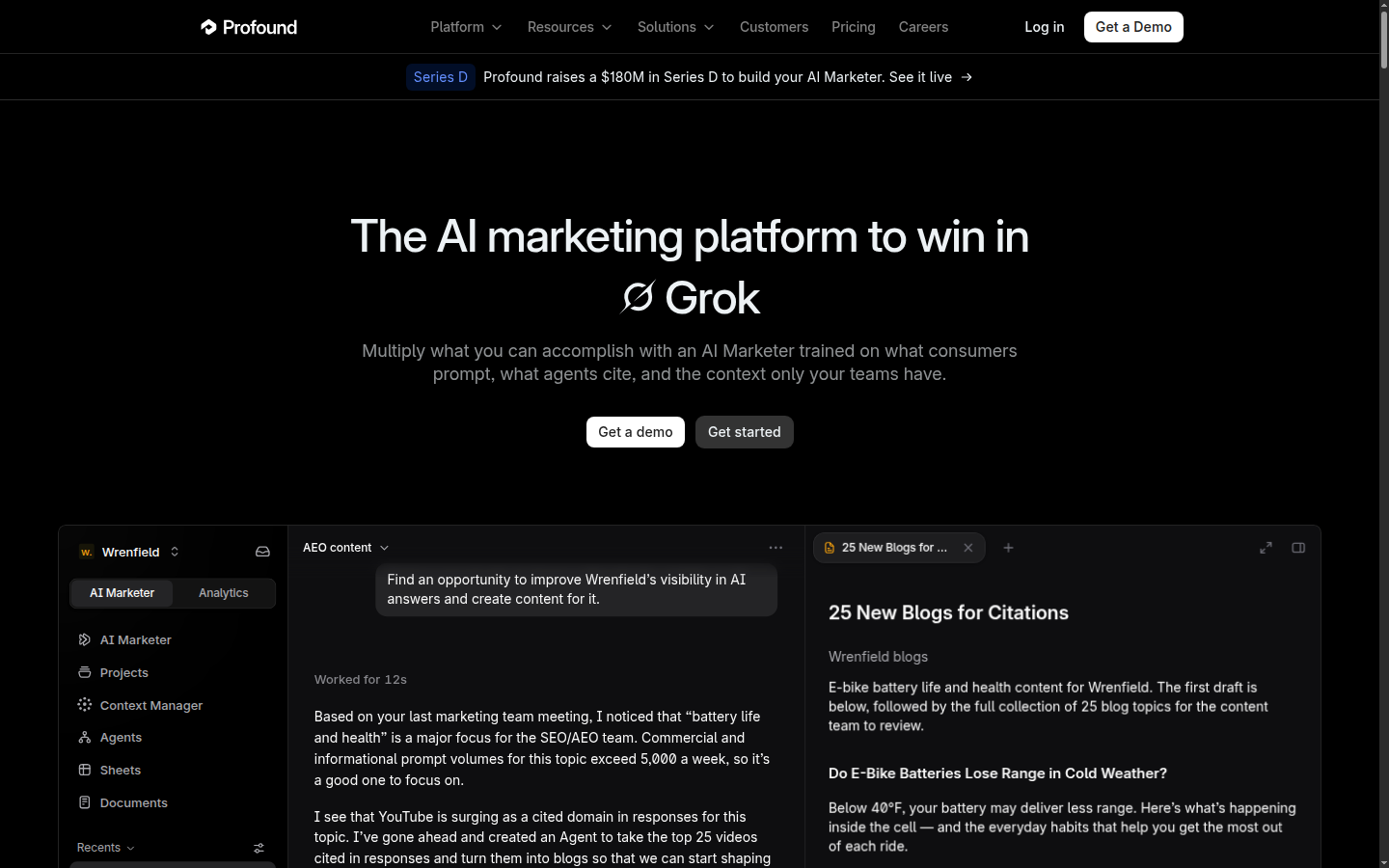
Profound launched two years ago as an AI-search analytics platform and has since expanded up the stack into content creation. The company says it serves more than 1,000 enterprise brands including Comcast, Walmart, and Estée Lauder and that “over one third of the Fortune 100” are customers. Revenue was up 3x in the six months before the Series D per its own release and TechCrunch’s coverage of the round.
The product layers:
- Prompt Volumes - the flagship differentiator: keyword volumes, topic trends, and intent signals from a proprietary, double-opt-in consumer panel of licensed AI conversations (weekly refresh, GDPR/CCPA compliant per Profound).
- AI Marketer (Aim) - surfaces a weekly ranked list of opportunities (visibility gaps, sentiment drops, rising prompt demand), converts accepted ones into Projects, and coordinates sub-agents that draft and stage content. Agents query 16 reasoning models before drafting.
- Agents + Context Manager - no-code workflow builder with prebuilt templates (Content Refresh, AEO FAQ Generation, Competitive Research, Net-New Content) and a knowledge base that carries brand positioning into every draft.
- FactCheck - traces inaccurate AI claims about your brand back to the publishers repeating them and tracks corrections.
- Ads Studio - sponsored-answer campaign management, the paid side of AI visibility.
Profound Pricing
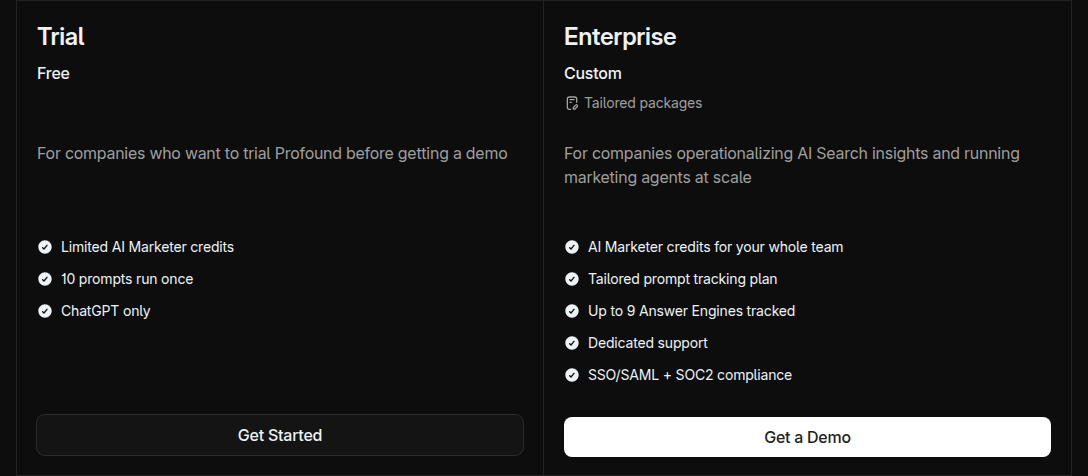
Live public pricing no longer shows a self-serve mid-market tier. As of capture, the page lists two options:
- Trial - Free: limited AI Marketer credits, 10 unique prompts run once, ChatGPT only, 1 language and 1 region, 5 Prompt Volumes searches, unlimited seats, no history, no exports, no API, no SSO.
- Enterprise - Custom: tailored prompt tracking at daily frequency, up to 9 answer engines (ChatGPT, Perplexity, Google AI Mode, Google Gemini, Microsoft Copilot, Grok, DeepSeek, Anthropic Claude, Google AI Overviews), ChatGPT Shopping, all-time history, CSV/JSON exports, API, SSO/SAML and SOC 2.
That Trial-plus-Enterprise structure matters for the comparison: the depth that justifies Profound’s position - full engine coverage, API access, SSO, the panel dataset at scale - all sits behind a custom sales quote.
Where Profound Wins
- It executes, not just tracks. When a citation gap is identified, Profound’s agents draft the response, stage it in your CMS, and wait for approval. Peec stops at the recommendation.
- Prompt Volumes is a genuinely different data class. Licensed consumer-panel conversation streams (weekly refresh) are closer to real demand research than anything Peec’s tracked-data demand score approximates.
- Enterprise governance. Stated SOC 2, SSO/SAML, API, dedicated Slack, and SLA options make procurement sign-off realistic for large orgs.
- Full marketing-work loop. Research, write, publish, measure, correct (FactCheck), and buy (Ads Studio) in one platform - the “earn vs buy” strategy lives in one tool.
- Scale proof points. A 1,000+ enterprise brand list including Comcast, Walmart, Estée Lauder, RBC, Zoom, Ramp and a $1.8B valuation signal category leadership.
Where Profound Loses
- Enterprise gating and opaque pricing. The genuinely deep tier is custom-quoted. There is no transparent mid-market self-serve option on the live site.
- The free trial is a taste, not an evaluation. 10 prompts, run once, on ChatGPT alone - you cannot benchmark coverage across engines or regions without a sales conversation.
- Consumption cost is unpredictable. Agent runs are credit-metered and per-run credit costs are not published; large batches can produce variable bills.
- Learning curve is real. Reviewers describe an analyst-grade tool; some report needing a dedicated operator to run it well (FixAEO review, July 2026).
- Not an all-in-one SEO suite. No classic Google rank tracking, no backlink audits, no legacy technical SEO tooling. If that is your baseline need, you still buy an SEO suite on top. We compare the open-source end of that market in OpenSEO vs Ahrefs, where OpenSEO’s $10/mo tier with native MCP access is the counterpoint to paying enterprise prices for measurement alone.
- Self-reported scale figures conflict. 1.5B vs 2B+ conversations, 1,000+ vs 2,000+ brands, one-third of Fortune 100 vs 16% of Fortune 500.
Peec AI: Transparent, BI-Friendly AI-Search Analytics
Peec is a Berlin-based challenger founded in early 2025. It raised a $21M Series A led by Singular in November 2025 (about $29M total funding) and says it now serves more than 3,000 brands and agencies including n8n, Attio, and ElevenLabs. Its stated positioning is anti-complexity: “Peec avoids the issues we see with other SEO/AEO platforms, where there’s often an overload of features.”
The feature set is broad but stays on the measurement side:
- Discover - prompt volume with a 1-5 demand score, AI prompt suggestions from coverage gaps, intent and brand classification.
- Measure - visibility, position, sentiment, and share of voice tracked daily against competitors; brand insights across models, topics, geographies.
- AI Shopping - upload a catalog from Shopify, CSV, or Google Merchant Center and track SKU-level visibility, position, and win rate across merchants.
- Ads library - tracks prompts where AI answers carry sponsored placements and which advertisers appear.
- Agent analytics - crawlability audit of robots.txt across 40+ AI bots, plus AI-referral attribution.
- Reporting surface for BI teams - Looker Studio connector, API, and MCP (natural-language queries of your visibility data) from day one, CSV exports on all plans.
Peec AI Pricing
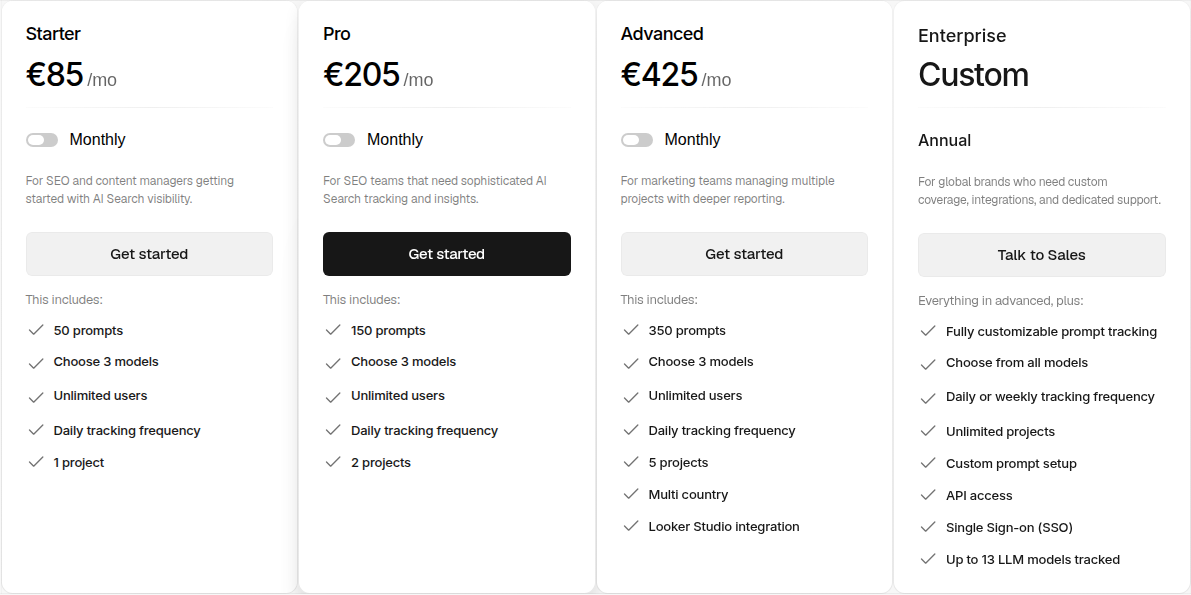
Peec publishes transparent self-serve pricing (monthly billing, EUR):
| Plan | Price/mo | Prompts | Models | Seats | Projects | Monthly AI answers | |---|---|---|---|---|---|---|---| | Starter | €85 | 50 | choose 3 of 6 | Unlimited | 1 | 4,500 | | Pro | €205 | 150 | 3 of 6 | Unlimited | 2 | 13,500 | | Advanced | €425 | 350 | 3 of 6 | Unlimited | 5 | 31,500 | | Enterprise | Custom | Fully customizable | All models - “up to 13” | Unlimited | Unlimited | Custom |
Key pricing mechanics: annual billing gets a 15% discount, extra models are add-ons (€25/mo on Starter, €55 on Pro, €115 on Advanced), and Enterprise quotes used to start “from €499/mo” on Peec’s own January 2026 comparison page but the live pricing page shows no number now. The six standard models are ChatGPT, AI Mode, AI Overviews, Microsoft Copilot, Perplexity, and Gemini; Enterprise adds Claude, GPT-5 Search, Grok, DeepSeek, Qwen, Mistral, and Meta Spark.
Where Peec AI Wins
- Transparent self-serve pricing. €85-€425/mo, published, no sales call to start. Profound’s entry talent sits behind a custom quote.
- Unlimited seats on every tier. A 12-person agency on Starter pays €85, not €85 x 12.
- BI-friendly export surface. Looker Studio connector, API, MCP, and CSV exports included - your team can pull visibility data into the dashboards they already live in.
- Analytics depth at low tiers. Gap analysis, prompt suggestions, exports, and recommended actions are not gated to the top plan.
- The reliability advantage of open infrastructure. Dedicated scraping infrastructure in 80+ countries plus AI-bot crawl logs (per Peec’s own positioning).
- Commerce tracking self-serve. AI Shopping at SKU level and the Ads library are available without an enterprise contract.
Where Peec AI Loses
- No execution layer at all. Peec will show you the citation gap and suggest the prompt you should win; it will not draft, rewrite, or publish the page that wins it. Teams that want the work done need a second tool (or Profound).
- Three-model cap below Enterprise. Standard plans track 3 models of 6; full coverage means monthly add-on fees or an Enterprise contract. Engine coverage is a price category on its own.
- No SOC 2 certification yet. Peec’s own comparison page concedes it is “actively pursuing SOC 2” while Profound states SOC 2 on Enterprise. For security-vetted procurement, that is a real gap; GDPR compliance is asserted but is not the same cert.
- Analytics-based demand score, not a panel. The 1-5 demand score is derived from tracked data; it is useful signal, not a licensed billion-conversation consumer corpus.
- Scale claims are self-reported and volatile. 3,000+ brands (homepage) vs 1,300+ (Series A blog, Nov 2025); G2 rating shows 4.9 in the footer but 4.8 on its own /reviews page. Starter pricing has already moved once (€89 to €85) - check it at purchase time.
Engine Coverage: The Real Price Category
Both vendors gate the interesting stuff behind coverage math. Peec’s standard plans track 3 models of 6; adding the remaining 3 costs €25-€115/mo depending on plan, and the full 13-model set is Enterprise. Profound’s public Trial tracks only ChatGPT (and only 10 prompts, once); the full answer-engine set - up to 9 including Grok, DeepSeek, and Claude - is Enterprise-only. When you price these tools, price the coverage list, not the headline: a ChatGPT-only deployment of either tool is a different product from the multi-engine one.
This coverage math matters for agent builders too. If your team’s real question is which search API to wire into your own AI agents - rather than which vendor dashboard to buy - our AnySearch vs Tavily comparison covers that lane: Tavily when you need priced plans and compliance today, AnySearch when you want the largest free tier and vertical data.
Data Sourcing: Panels vs Scraping
The two vendors attack each other’s data method, and both attacks are slanted. Profound’s Prompt Volumes is licensed consumer-panel data; Peec markets high-frequency UI scraping across dedicated infrastructure plus crawler-log analysis as the authenticity play. Peec’s comparison page alleges Profound “may inject geographic identifiers into prompts” to simulate regions where its proxy infrastructure is limited, that Profound’s sentiment analysis produced thousands of micro-topic data points needing manual sorting in a 150-prompt test, and that Profound’s supplemental terms don’t guarantee article uniqueness for AI-generated content. Those are Peec’s claims about a competitor - we did not verify them independently and do not present them as facts. Treat the honest version: panel data and scraping are different collection methods with different strengths, and neither vendor has published a neutral benchmark against the other.
Who Should Pick Profound?
Pick Profound if your team is measured on outcomes, not dashboards: an SEO director or growth lead with budget whose problem is that content keeps losing citations it should win. The AI Marketer’s weekly opportunity list, drafting agents, CMS staging, and human-approval flow turn AI-visibility data into shipped work - and Prompt Volumes gives the research layer to decide what to write. You need enterprise controls (SSO, SOC 2, SLAs) and a team willing to operate an analyst-grade platform. Be ready for a custom quote and credit-metered agent costs.
Who Should Pick Peec AI?
Pick Peec AI if you are a growth team, agency, or BI-oriented marketer who wants daily visibility, position, sentiment, and share-of-voice data across AI answers at a published price - with unlimited seats and exports your whole team can use. If your stack already includes content writers and a CMS (or an SEO suite), Peec’s gap analysis tells you exactly what to write; the 3-model cap is the main reason to look again, and you should budget add-on fees or Enterprise if you need Claude and DeepSeek alongside ChatGPT. And if what you actually need is brand monitoring across classic social channels rather than AI answers, our Octolens vs Brand24 comparison covers that separate lane.
Bottom Line
This is an execution-versus-measurement decision with a pricing wedge underneath it. Profound is the agentic platform: it plans, drafts, and publishes content to close AI-citation gaps, backed by a consumer-panel demand dataset and enterprise compliance - at custom, sales-led pricing, with credit-metered agent costs and a real learning curve. Peec AI is the transparent analytics suite: self-serve €85-€425/mo, unlimited seats, BI exports, and deep visibility/shopping tracking - but it will never write the page that fixes the gap it finds, and standard plans cap you at three engines.
Profound is wrong for you if: you want published pricing, you have no budget for a sales-led enterprise evaluation, your team is not staffed to run an analyst-grade platform, or you need classic SEO tooling (rank tracking, backlinks) - you would be paying enterprise prices for a product that measures a slice of your visibility.
Peec AI is wrong for you if: your bottleneck is content that never gets written (Peec will not write it), you need Claude/Grok/DeepSeek coverage on a standard plan (3-model cap, add-on fees), or procurement requires SOC 2 today (coming, not here).
For context on the wider market: OtterlyAI owns the budget self-serve lane and Semrush/Ahrefs bundle AI-visibility tracking inside existing suites. But for the exact “Profound vs Peec AI” decision, the rule is simple - buy the execution you will actually use, and pay only for the measurement you need.