1 August 2026 · Comparison
Kartra vs Kajabi (2026): Fees, Courses, and Who Wins
The short answer
if you run funnels, paid traffic, or an agency and want 0% transaction fees, native video hosting, webinars, and a helpdesk under one login at a lower entry price.
if you sell courses and build community first and want the polished learner experience, native community, AI suite, and branded mobile app - and you can absorb percentage-of-revenue fees.
Disclosure: SaaSpicious may earn a commission if you purchase through links in this post. This does not affect our verdict. We recommend tools based on what we find, and we call out downsides for every tool we compare. Kartra runs an affiliate program we participate in; this post does not use a Kajabi affiliate link.
The Short Verdict
If your business runs on funnels, paid traffic, and email sequences - and you care about what percentage of your revenue goes to the platform - pick Kartra. It charges 0% transaction fees from the Starter plan up, costs less than Kajabi at $5,000/mo in revenue, and bundles video hosting, webinars, calendars, a helpdesk, and affiliate management under one login.
If your business runs on courses, community, and coaching - and your buyers stay inside a polished learner experience - pick Kajabi. It is the better knowledge-product platform: cleaner course delivery with certificates and cohorts, a native community on every plan, a far deeper AI suite, and a branded mobile app on Pro. You pay for that with a higher entry price and percentage-of-revenue fees.
The shortest way to say it: Kartra is a marketing and sales engine with courses bolted on. Kajabi is a course and community platform with marketing bolted on. Both are good; they are good at different halves of your business.
At a Glance
| Kartra | Kajabi | |
|---|---|---|
| Cheapest plan | $59/mo (Essentials) | Basic from $179/mo (Starter $89/mo was offered via a separate signup path) |
| Full-featured entry point | $119/mo (Starter) | $179/mo (Basic) |
| Transaction fees | 5% on Essentials; 0% Starter+ | 2.9% + $0.30 processing on Kajabi Payments; 5%-0.5% surcharge with third-party processors |
| Course certificates / cohorts | No | Yes |
| Native community | Limited | Yes, on every plan |
| Native webinars | Yes (comparison table: Starter+; Growth card lists them as a Growth add-on) | No (third-party) |
| Native helpdesk | Yes (Growth+; live chat on Pro) | No |
| AI suite | Copy generation only (30-250 uses) | Cofounder, Backstage, Amplify, Expert Agents |
| Branded mobile app | No | Yes (Pro) |
| Free trial | 14 days (new Free Trial tier, converts to Starter) | 14 days |
Prices accurate as of August 2026; check the vendor’s site for current rates.
Kartra: The Marketing and Sales Engine
Kartra positions itself as the all-in-one platform that “turns your expertise into scalable income.” It replaces what would otherwise be 8-12 separate tools: landing pages, funnels, email and SMS, checkouts, memberships and courses, video hosting, calendars, a helpdesk, affiliate management, surveys, and analytics, all under one login.
Its genuine edges:
- 0% transaction fees from Starter up. Only the $59 Essentials plan charges 5% on sales. Every plan above that is flat-rate with no per-sale cut.
- Native video hosting with behavioral marketing. You can insert lead-capture forms and pop offers inside the video player, with per-second engagement analytics. Kajabi has no equivalent in-player offer layer.
- Native webinars, helpdesk, and calendars. Kajabi covers these with third-party tools or not at all.
- Funnel mapper and simulator, plus DFY campaign templates (100 pre-built campaigns) and guided onboarding with migration support.
- HIPAA compliance at no additional cost, confirmed in Kartra’s FAQ:

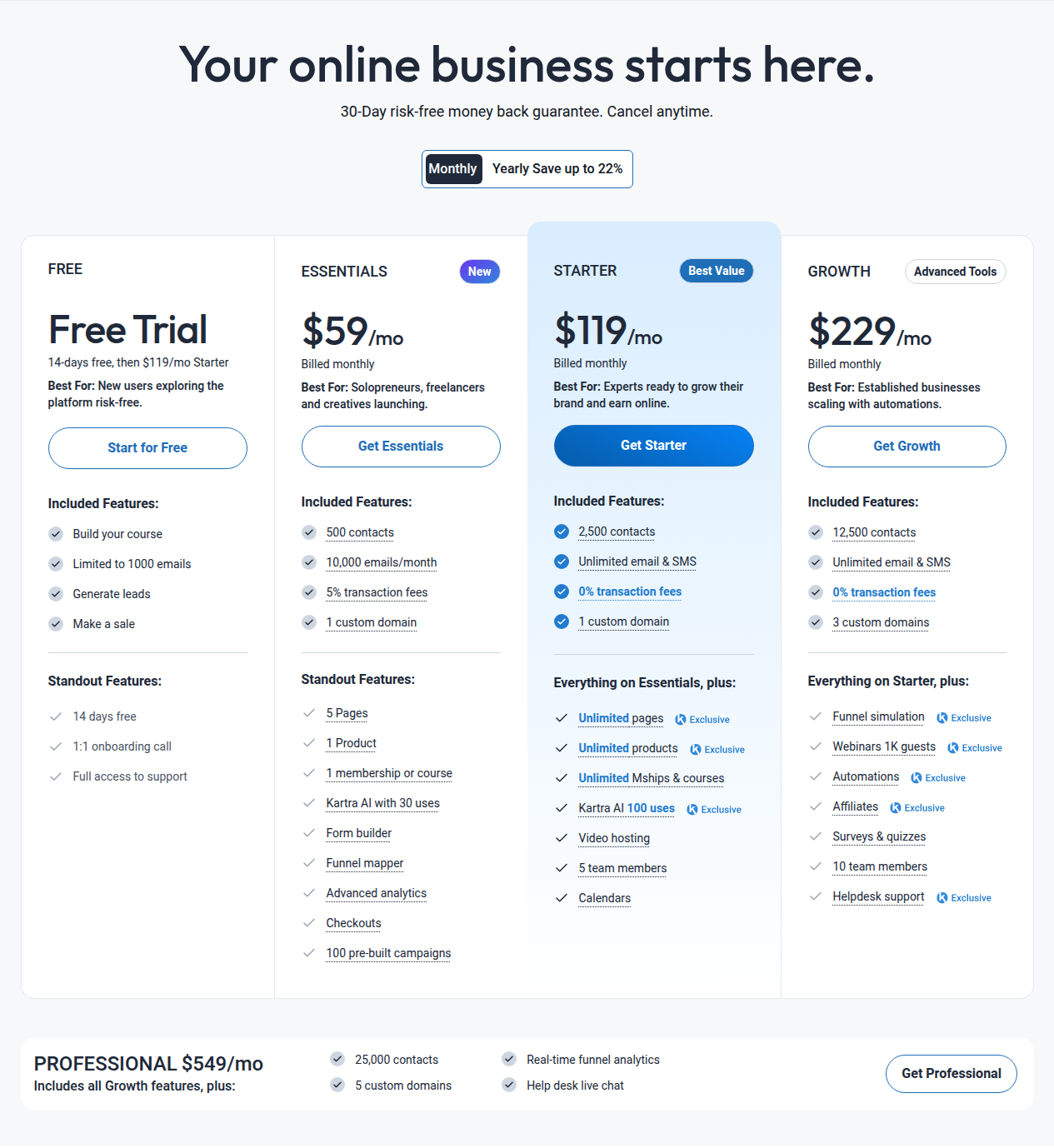
Kartra pricing
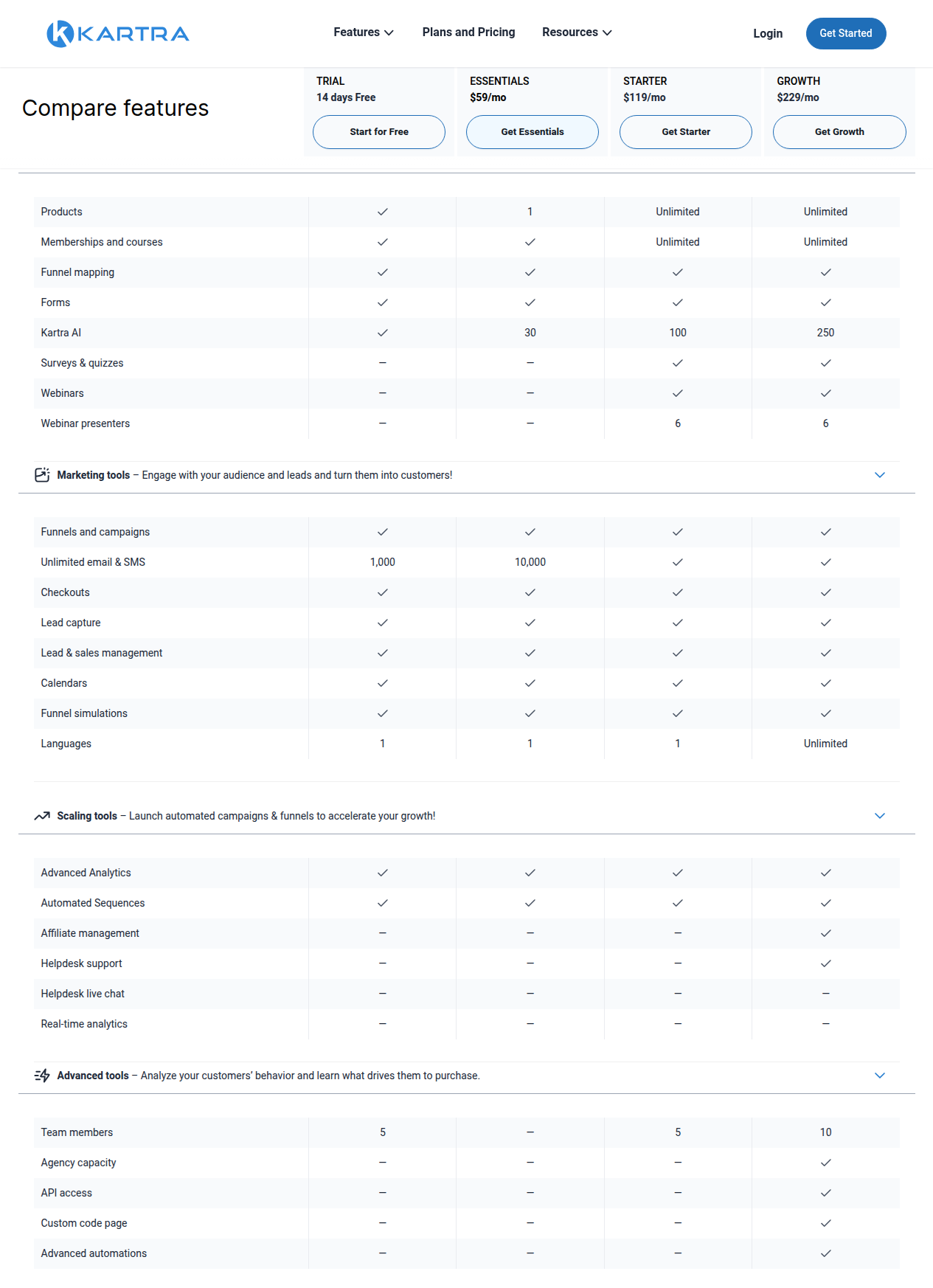
- Free Trial - $0 for 14 days, limited to 1,000 emails, then converts to Starter at $119/mo. Includes a 1:1 onboarding call.
- Essentials - $59/mo ($52/mo annual). 500 contacts, 10K emails/mo, 5% transaction fees, 1 domain, 5 pages, 1 product, 1 membership. A testing tier, not a business tier.
- Starter - $119/mo ($99/mo annual). 2,500 contacts, unlimited email and SMS, 0% transaction fees, unlimited pages/products/memberships, video hosting, calendars, 5 team members. This is where Kartra becomes genuinely useful.
- Growth - $229/mo ($189/mo annual). 12,500 contacts, webinars (1K guests, 6 presenters), advanced automations, affiliate management, surveys and quizzes, helpdesk, API access, custom code page, agency capacity, 10 team members, 250 Kartra AI uses.
- Professional - $549/mo ($429/mo annual). 25,000 contacts, real-time funnel analytics, helpdesk live chat, 5 custom domains.
Two things to know before you price-shop Kartra:
- Webinar gating has flip-flopped on the pricing page. Kartra’s plan cards and its feature comparison table have historically disagreed on whether webinars unlock at Starter or Growth. On the current page the comparison table shows Webinars (1K guests, 6 presenters) on Starter and Growth, while the Growth plan card still lists webinars among its additions - so the card and table are telling you different things. If webinars matter to you, confirm which plan includes them before you commit.
- The jump from Starter to Growth is the big one. Automations, affiliate management, the helpdesk, and API access all unlock at Growth. If you need those, budget $229/mo, not $119/mo.
Where Kartra loses
- The course experience is rougher. Learner-facing course pages, certificates, and cohort features are nowhere near Kajabi’s polish. If your product IS the course, you will feel it.
- No native community worth the name. Kartra’s membership forums are basic. Many Kartra users bolt on Circle or Skool for community, which adds cost and another login.
- No first-class coaching, podcast, or newsletter product types. Kajabi treats these as products; Kartra does not.
- Kartra AI is copy generation only - a writing assistant with per-plan usage caps, not a business-planning AI like Kajabi’s Cofounder.
- No branded mobile app for learners.
Kajabi: The Knowledge-Product Platform

Kajabi calls itself “the operating system for human expertise.” It is built for coaches, educators, and creators whose product is knowledge itself: courses, coaching, communities, memberships, newsletters, podcasts, and digital downloads are all first-class product types.
Its genuine edges:
- Premium course delivery. Modules, lessons, quizzes, drip schedules, completion certificates, and cohort-based courses with a clean learner interface.
- Native community on every plan. Threads, member directory, live events, challenges - no bolt-on needed.
- A deep AI suite. Cofounder, Backstage, Amplify, and Expert Agents versus Kartra’s copy-only AI.
- Branded mobile app for learners on Pro, with push notifications and offline access.
- Native Kajabi Payments with 140+ currencies and automated tax calculation, plus a 14-day free trial.
Kajabi pricing
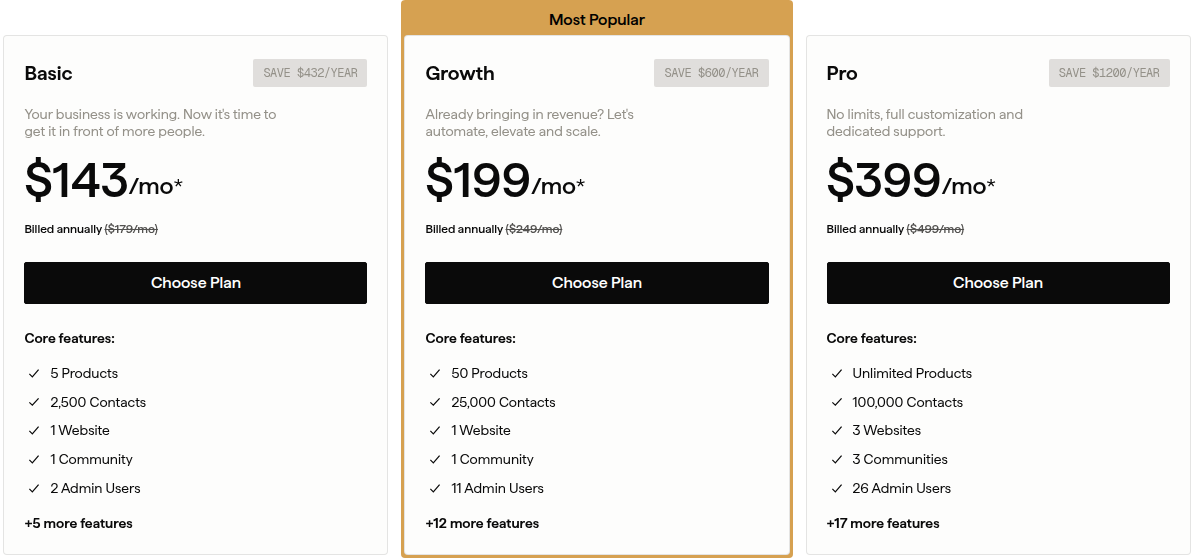
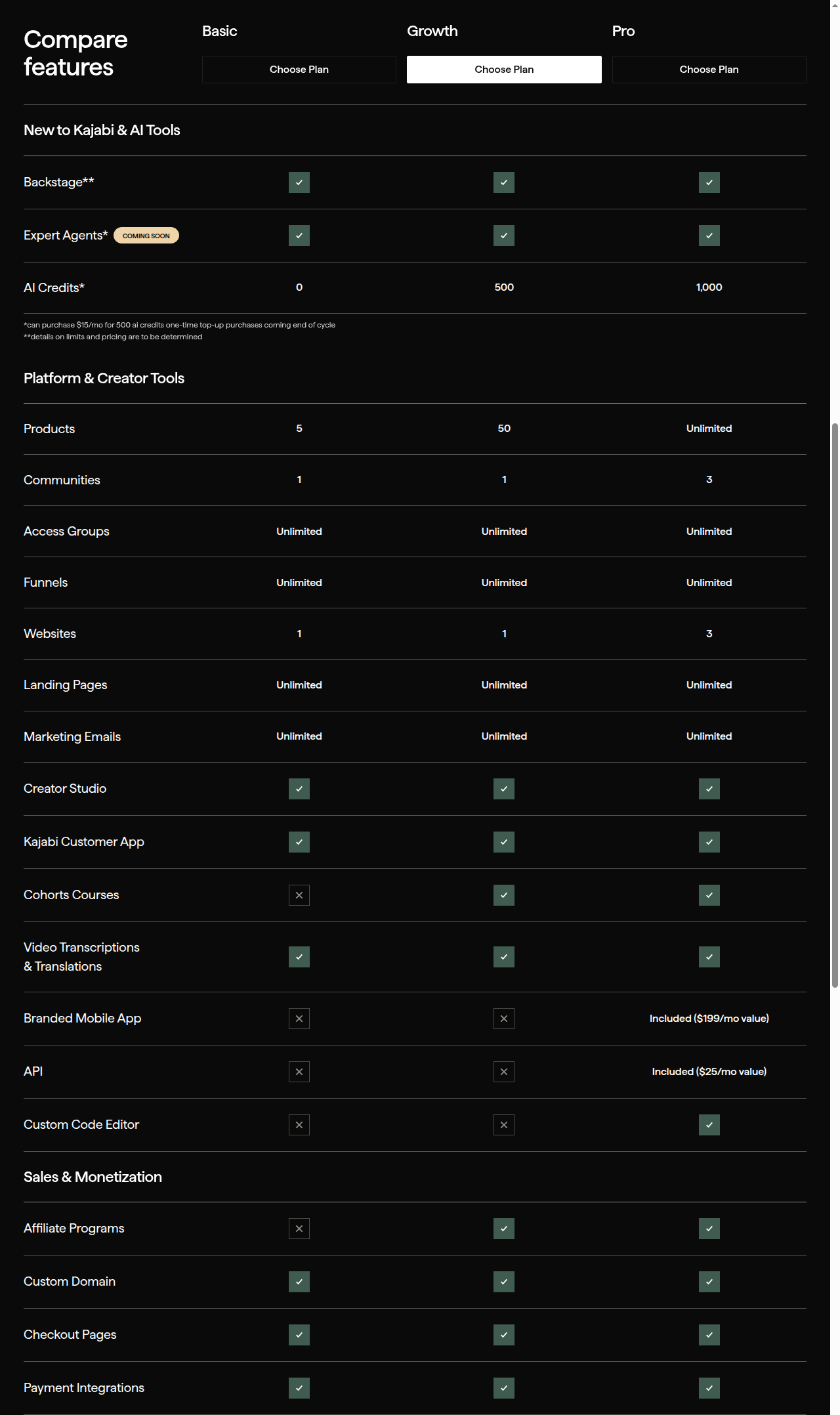
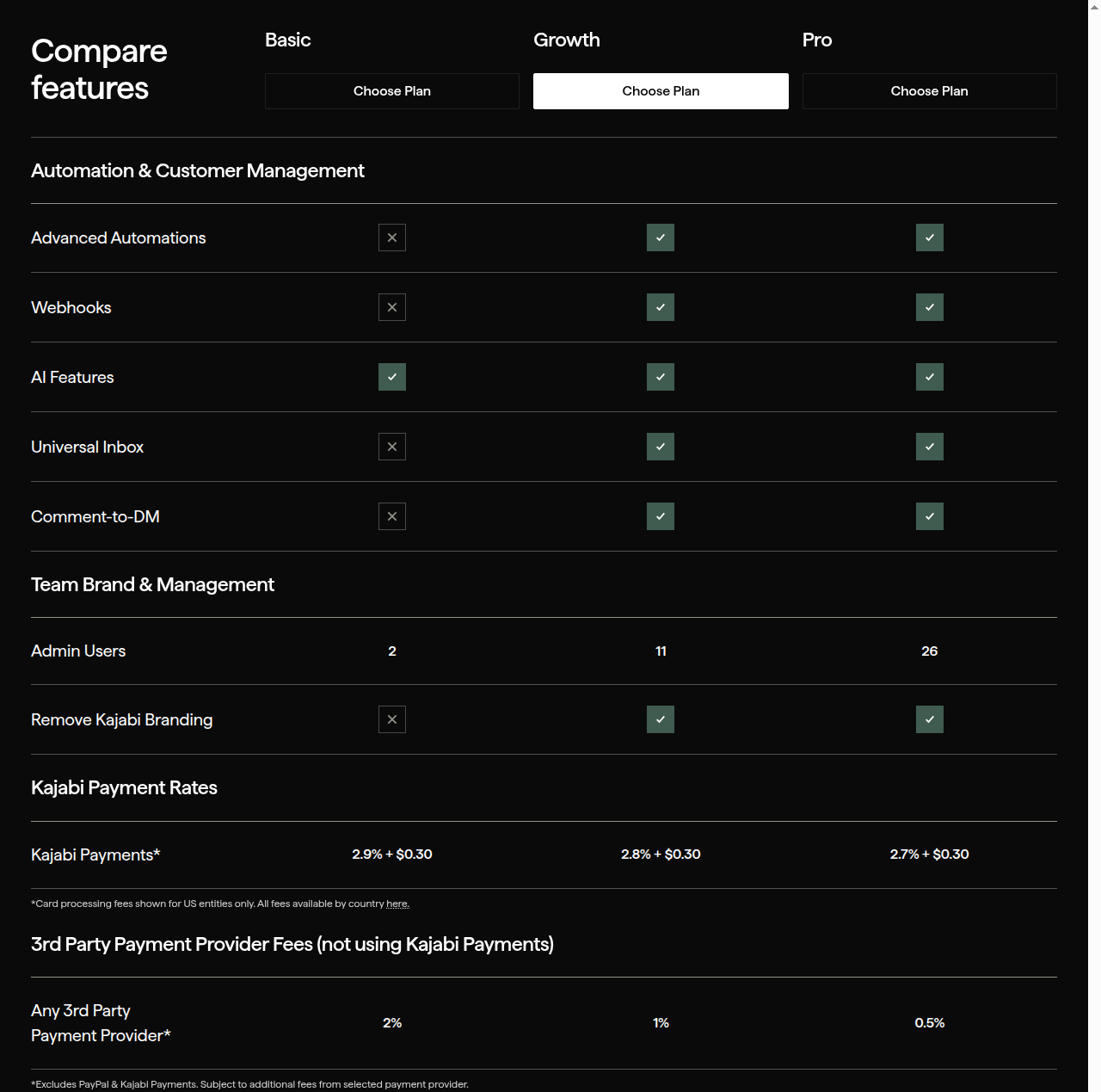
Kajabi’s pricing page currently shows three plans - Basic, Growth, and Pro. A cheaper Starter tier has existed at $89/mo via a separate signup path in the past, but it is not displayed on the current pricing page; confirm it is still offered before you build a plan around it.
- Basic - $179/mo ($143/mo annual). 5 products, 2,500 contacts, 2 admin users, 0 AI credits.
- Growth - $249/mo ($199/mo annual). 50 products, 25,000 contacts, 11 admins, 500 AI credits. Adds Advanced Automations, Webhooks, Affiliate Programs, Universal Inbox, Comment-to-DM, and removes Kajabi branding.
- Pro - $499/mo ($399/mo annual). Unlimited products, 100,000 contacts, 3 communities, 3 websites, 26 admins, 1,000 AI credits. Adds API access ($25/mo value), the Custom Code Editor, and the Branded Mobile App ($199/mo value).
A few gotchas:
- The trial is 14 days and the FAQ says no credit card is required. Kajabi’s landing page says “Free 14-day trial” on its pricing cards.
- Kajabi frequently runs a 50% off promo (“Save 50% for 6 months”). The discount was live as of early August 2026. If it is active when you read this, Kajabi’s price gap versus Kartra shrinks dramatically.
- AI credits are gated by plan. The current pricing table shows 0 credits on the entry plan, 500 on the middle plan, and 1,000 on the top plan. You can buy 500 more credits for $15/mo. Expert Agents is listed as “coming soon.”
Where Kajabi loses
- Percentage-of-revenue fees. With Kajabi Payments you pay 2.9% + $0.30 per transaction (2.7-2.8% on higher plans). With Stripe or PayPal instead, Kajabi adds a surcharge of 5% (Starter), 2% (Basic), 1% (Growth), or 0.5% (Pro) on top of the processor’s own fees. Kartra’s 0% from Starter up is a structural cost advantage.
- No native webinars or helpdesk. You are bringing your own Zoom/WebinarJam and support tooling.
- No funnel mapper or funnel simulation, and the visual funnel builder (“Pipelines”) is solid but less of a selling point than Kartra’s automation breadth.
- Third-party processors are penalized. The surcharge structure actively pushes you onto Kajabi Payments - fine if you stay in supported currencies, a real cost if you don’t.
- Entry is expensive. The cheapest plan that supports a real business (Basic at $179/mo) is $60/mo more than Kartra’s Starter at $119/mo, and Kajabi’s own Starter tier (when it is offered) is limited to 1 product and 250 contacts.
The Fee Math: Where the Money Goes
The transaction-fee asymmetry is the single most decision-relevant difference between these two platforms.
- Kartra: 0% transaction fees on Starter, Growth, and Professional. Only the $59 Essentials plan charges 5%.
- Kajabi: 2.9% + $0.30 per transaction with Kajabi Payments (Starter and Basic; slightly lower on Growth and Pro). If you use Stripe or PayPal, add a platform surcharge of 5% / 2% / 1% / 0.5% by plan, on top of the processor’s own ~2.9% + $0.30. Kajabi’s own FAQ frames it as “no revenue sharing or platform transaction fees when using Kajabi Payments - standard processing fees apply,” which is accurate but should be read as: you are still paying the processing fee.
Worked example at $5,000/mo in course revenue, annual billing, processing via a third-party processor at roughly 2.9% + $0.30:
| Kajabi Basic | Kartra Starter | |
|---|---|---|
| Subscription (annual) | $143/mo | $99/mo |
| Platform transaction fee | 2% surcharge = $100 | 0% = $0 |
| Processor fees (~2.9% + $0.30) | ~$175 | ~$175 |
| Total | ~$418/mo | ~$274/mo |
That is roughly $144/mo (~$1,728/yr) in Kartra’s favor at $5,000/mo revenue. If you run on Kajabi Payments instead, the surcharge disappears but the 2.9% + $0.30 processing remains, so Kajabi still costs more than Kartra at this revenue level - the gap is just smaller.
Two honest caveats:
- This math assumes you stay on annual billing and that no promo is active. Kajabi’s recurring 50%-off promo can shift the subscription line substantially.
- The gap narrows at higher revenue because Kajabi’s surcharge tiers drop (1% on Growth, 0.5% on Pro) - but 0% beats 0.5-2% at every level, so Kartra keeps a cost edge for most creators between $2K and $20K/mo.
If Kartra’s pricing structure is what appeals to you but you want to see how it stacks up against other funnel-first platforms, our Kartra vs ClickFunnels comparison covers that matchup, and our roundup of the best Kartra alternatives looks at cheaper and more specialized options.
Where Each Wins
Kartra wins
- Total cost at mid-range revenue - cheaper entry ($59 Essentials vs Kajabi’s Basic at $179, or the $69 Starter if it is still offered) and 0% fees from Starter up.
- Funnels and automation - visual funnel mapper and simulator, IF/THEN behavior triggers, 100 pre-built DFY campaigns.
- Native video hosting with behavioral marketing - in-player offers and lead capture, per-second analytics.
- Native webinars - Kajabi’s are third-party.
- Native helpdesk and calendars - Kajabi has neither natively.
- Affiliate management and agency features - more granular commission workflows; agency capacity unlocks at Growth per the comparison table.
- HIPAA compliance at no extra cost.
- Guided onboarding and migration support, including a 1:1 onboarding call on the free trial.
Kajabi wins
- Course product depth and polish - certificates, cohorts, quizzes, drip, video download protection, a clean learner portal.
- Native community on every plan - threads, member directory, live events, challenges.
- Product-type breadth - coaching, podcasts, newsletters, and digital downloads as first-class products; Kartra has none of these.
- A far deeper AI suite - Cofounder, Backstage, Amplify, and Expert Agents versus Kartra’s copy-only AI.
- Branded mobile app for learners on Pro, with push and offline.
- Kajabi Payments with 140+ currencies and automated tax calculation.
- 14-day free trial versus Kartra’s 14 days, with no credit card required to start.
- Premium template and brand consistency - pages, email, and checkout share one visual system.
Roughly equal
- Landing page builders, checkout features (upsells, order bumps, coupons), email marketing, funnels, memberships, quizzes.
- Migration pain: both require CSV exports and a rebuild of courses and automations. Budget a couple of weekends either way.
Bottom Line
Pick Kartra if you are funnel-first: paid traffic, launches, email sequences, webinars, and agency-style operations, where 0% transaction fees and one login for marketing infrastructure beat a prettier course player. It is also the lower-cost pick at $5,000/mo in revenue - the fee asymmetry is real money.
Pick Kajabi if you are community-first: your product is the course, cohort, coaching, or membership experience itself, and your buyers stay inside a polished platform with a native community, certificates, and (on Pro) your own branded app. The higher price and percentage-of-revenue fees are the cost of that polish. If Kajabi’s course-led model is the draw but you want a cheaper entry point, our Systeme.io vs Kajabi comparison covers a budget alternative.
Who Kartra is wrong for: community-driven course creators who want a premium learner experience and a native community without bolt-ons. Kartra’s course UX and community features will disappoint you.
Who Kajabi is wrong for: paid-traffic funnel operators, anyone scaling fast through upsells and webinars, and anyone who hates giving a platform a percentage of every sale. Kajabi’s fee structure taxes exactly the revenue growth Kartra leaves alone.