19 June 2026 · Comparison
Systeme.io vs Kajabi: Which Course Platform Wins in 2026?
The short answer
Systeme.io wins on price-to-value and breadth for beginners. Kajabi wins on premium features, AI, and brand cachet for established experts.

Verdict
If you’re starting a knowledge business with a small budget and want funnels, courses, email, and affiliates in one tool without transaction fees, pick Systeme.io — its free plan is genuinely usable and its $97/mo Unlimited plan covers everything. If you’re an established expert earning consistent revenue who needs AI tools, course certificates, cohort courses, and a branded mobile app, Kajabi is the better investment despite the steeper price.
Affiliate disclosure: SaaSpicious earns a commission if you sign up for Systeme.io through links in this post. We do not have a Kajabi affiliate relationship. This comparison is based on live pricing pages, public documentation, and hands-on testing. Opinions are our own.
Pricing & Transaction Fees: The Biggest Difference
The single largest gulf between these two platforms is what you pay — both in subscription costs and in transaction fees. Systeme.io starts at $0. Kajabi starts at $89/mo. That’s not the whole story.
Systeme.io Pricing
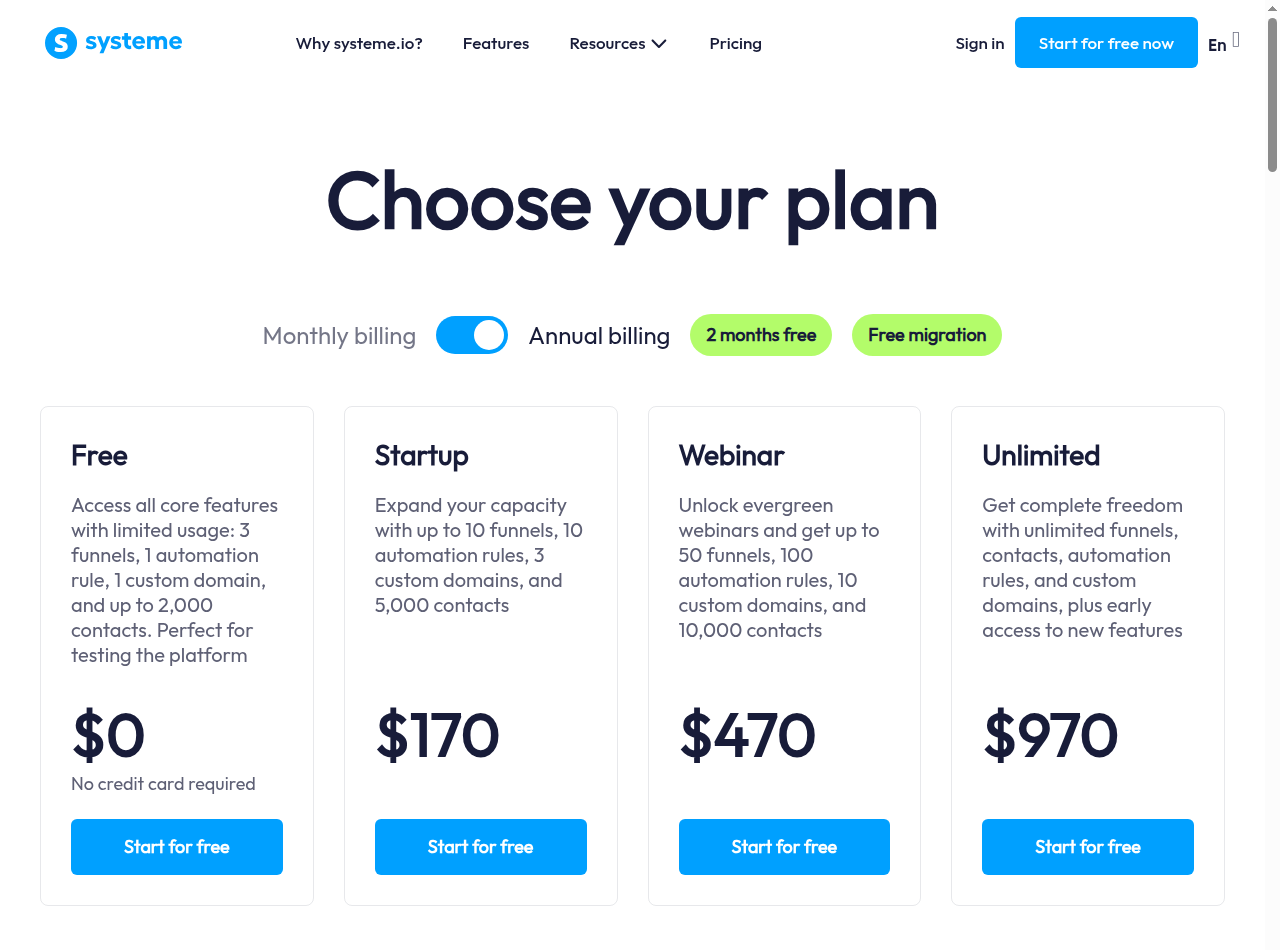
Systeme.io has four plans, and they all include unlimited emails, 0% transaction fees, and the same core toolset. The only things that scale are contact limits, funnel limits, and course limits.
| Plan | Monthly Price | Annual/Mo | Contacts | Funnels | Courses | Communities |
|---|---|---|---|---|---|---|
| Free | $0 | $0 | 2,000 | 3 | 1 | 1 |
| Startup | $17/mo | ~$14/mo ($170/yr) | 5,000 | 10 | 5 | 5 |
| Webinar | $47/mo | ~$39/mo ($470/yr) | 10,000 | 50 | 20 | 20 |
| Unlimited | $97/mo | ~$81/mo ($970/yr) | Unlimited | Unlimited | Unlimited | Unlimited |
Annual billing gets you 2 months free on every paid plan (about a 17% discount versus paying monthly), plus free migration if you’re switching from another platform.
Systeme.io charges 0% transaction fees on all plans — Systeme.io takes zero cut of your sales. You only pay the standard Stripe or PayPal processing fee (roughly 2.9% + $0.30). If you sell a $500 course, you keep ~$485. On Kajabi’s Basic plan with a third-party processor instead of Kajabi Payments, you’d keep roughly $475 after the platform’s surcharge on top of your processor’s cut.
Kajabi Pricing
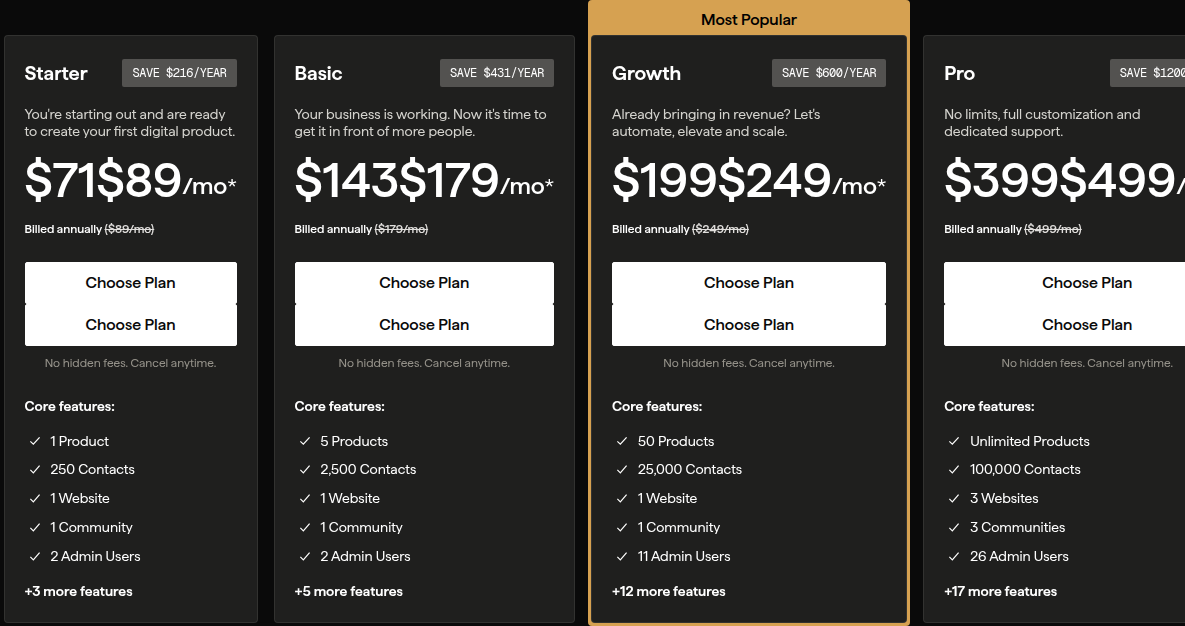
Kajabi has four plans, and the jump from Starter to Basic is steep. The real entry point for most course creators is Basic at $179/mo, because Starter limits you to 1 product and 250 contacts.
| Plan | Monthly Price | Annual/Mo | Products | Contacts | Communities | Admin Users |
|---|---|---|---|---|---|---|
| Starter | $89/mo | $71/mo | 1 | 250 | 1 | 2 |
| Basic | $179/mo | $143/mo | 5 | 2,500 | 1 | 2 |
| Growth | $249/mo | $199/mo | 50 | 25,000 | 1 | 11 |
| Pro | $499/mo | $399/mo | Unlimited | 100,000 | 3 | 26 |
The Transaction Fee Trap
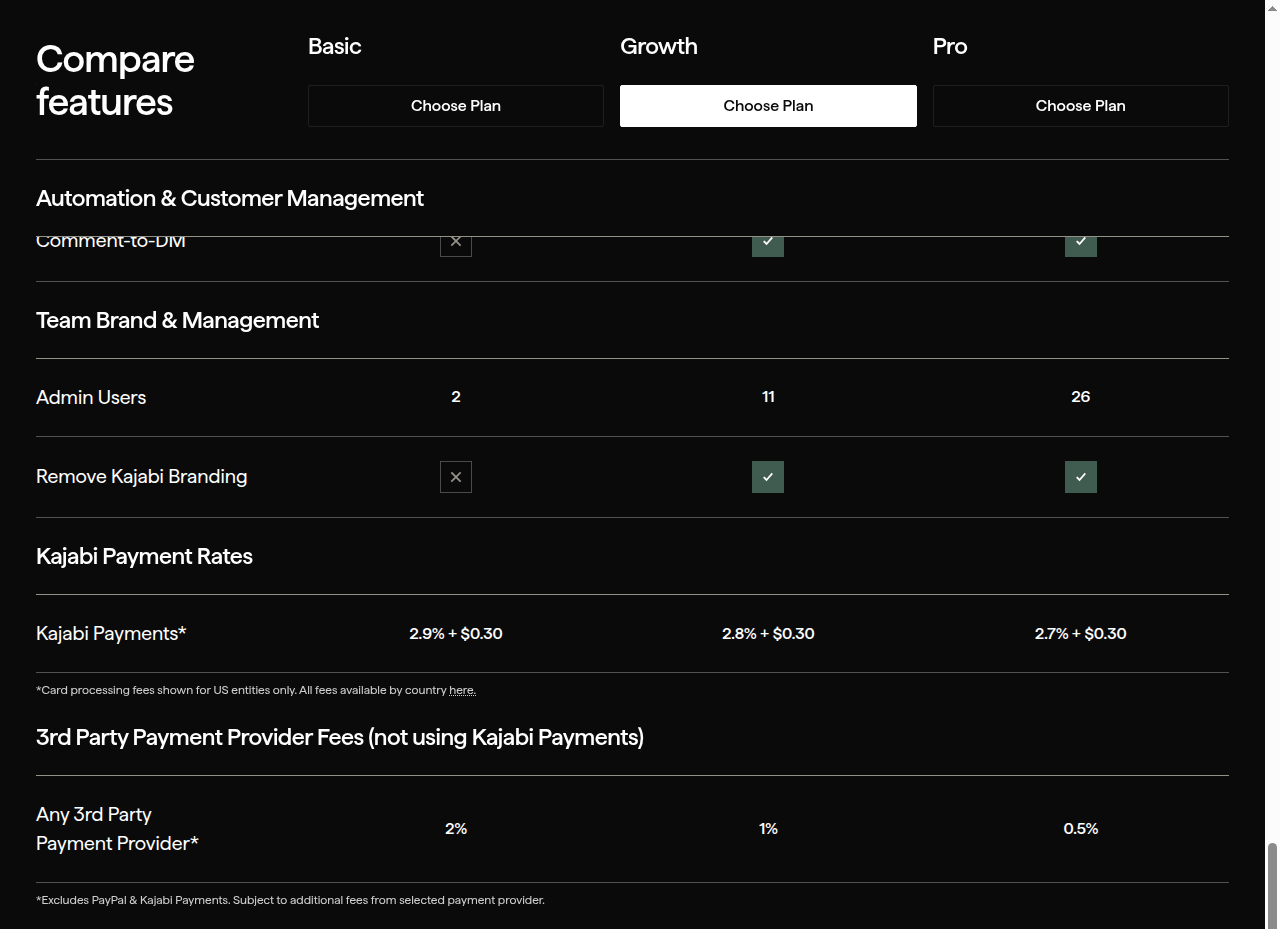
Kajabi charges processing fees on every transaction. If you use Kajabi Payments (the built-in processor), the rates are competitive: 2.9%+$0.30 on Basic, 2.8%+$0.30 on Growth, 2.7%+$0.30 on Pro for US entities. (Kajabi’s public pricing page doesn’t list a Starter-tier rate for this.)
But here’s what Kajabi’s competitors don’t want you to know and what their own sales pages bury: if you use a third-party processor (like your own Stripe account instead of Kajabi Payments), Kajabi tacks on a surcharge on top of it:
- Basic: +2%
- Growth: +1%
- Pro: +0.5%
On Basic, you’d pay your processor’s ~2.9% PLUS Kajabi’s 2% surcharge — an effective rate of roughly 4.9% + $0.30 per transaction. That’s about $25 on a $500 course before you account for the $179/mo subscription.
Kajabi’s pricing page fine print says the surcharge “excludes PayPal & Kajabi Payments,” meaning PayPal transactions are exempt. But if you use Stripe or any other processor, the surcharge applies.
Systeme.io charges 0% across all plans, with no processor surcharge of any kind. You connect Stripe or PayPal and keep what you earn minus the standard processor rate.
Prices accurate as of June 2026; check the vendor’s site for current rates.
Features: Where Systeme.io Wins
Systeme.io’s strength isn’t any single feature — it’s the breadth of features included at every price point, including the free plan.
Genuinely usable free plan. Systeme.io’s free plan is not a trial. It never expires, requires no credit card, and includes 2,000 contacts, unlimited emails, 3 funnels, 1 course, an affiliate program, a booking calendar, and a blog. For someone testing a course idea with a small email list, this is enough to launch and make money before paying for anything.
Affiliate management on every plan. Both platforms have built-in affiliate tools. Systeme.io includes its full affiliate management system on the free plan. Kajabi gates affiliates behind Growth ($249/mo). If you plan to run an affiliate program — and you should if you’re selling courses — Systeme.io saves you at least $249/mo on this feature alone.
Physical products support. Systeme.io handles physical products with variants (size/color), inventory tracking, and shipping management — alongside digital courses and downloads. Kajabi is digital-only. If you sell a book, workbook, merchandise, or any physical item alongside your courses, Kajabi can’t help you.
Built-in CRM pipeline and booking calendar. Systeme.io includes a Kanban-style deal pipeline for tracking leads and a standalone booking calendar (like Calendly) with time slots, confirmation emails, and payment collection. Kajabi has coaching scheduling but no general-purpose booking tool. If you do sales calls or consultations, Systeme.io replaces tools like Calendly and a lightweight CRM.
SMS marketing built in. Systeme.io includes SMS marketing triggered through its automation builder. Kajabi has no native SMS. If text message follow-ups matter to your funnel, Systeme.io delivers this without a separate Twilio subscription.
Sub-accounts for agencies. Systeme.io’s Unlimited plan ($97/mo) includes 5 sub-accounts — isolated workspaces for managing multiple client businesses. Kajabi has no sub-account model. For agencies, coaches managing multiple brands, or anyone with separate business entities, this is a decisive advantage.
Unlimited emails on every plan. Both platforms offer unlimited email sends, but Systeme.io does it from the free plan up. Kajabi also offers unlimited emails on all plans, so this is a wash in practice — but Systeme.io’s entry price is $0.
Features: Where Kajabi Wins
Kajabi’s strengths cluster around premium features that matter at scale: AI, certificates, mobile delivery, and product diversity.

AI tools: Cofounder and Expert Agents. This is Kajabi’s biggest differentiator in 2026. Cofounder is an AI business partner that interviews you, analyzes your expertise, and helps you plan products, write copy, and price offers. It’s trained on what works for expert businesses and learns from your specific account content. Expert Agents (listed as “Coming Soon” on the pricing page) will provide AI-powered student and customer support trained on your course material. Systeme.io has no AI features whatsoever — no course outline generator, no writing assistant, no AI agents. If AI assistance matters to your workflow, this gap is substantial.
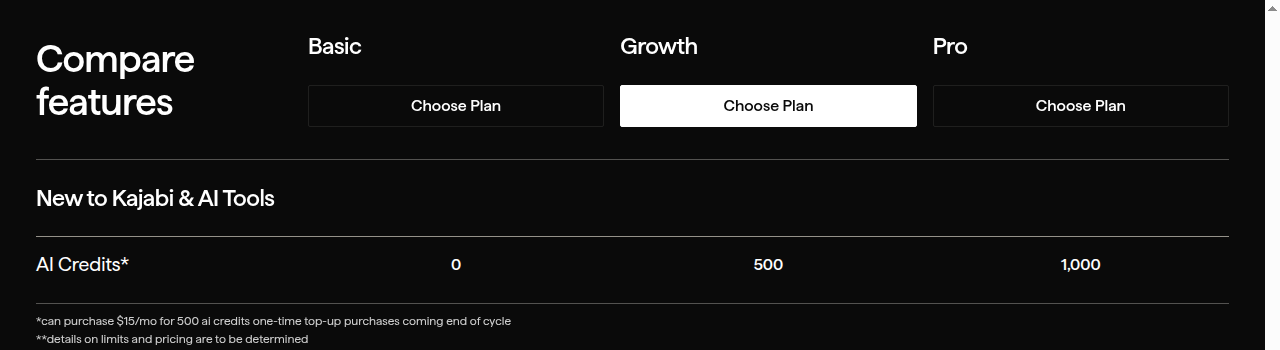
AI credits come included: 0 on Basic, 500 on Growth, 1,000 on Pro (Starter isn’t part of Kajabi’s AI comparison table). A $15/mo subscription adds 500 more credits; one-time top-up purchases are listed on Kajabi’s pricing page as “coming end of cycle,” meaning they aren’t available yet.
Course completion certificates. Kajabi issues certificates automatically when a student finishes a course. Systeme.io’s FAQ explicitly confirms this feature doesn’t exist. For professional development courses, compliance training, or any course where students expect a credential, Kajabi is the only option between the two.
Cohort-based courses. Kajabi supports cohort courses — scheduled group learning with live sessions, shared start/end dates, and community interaction. Systeme.io only supports self-paced (evergreen) courses. If your course model relies on group accountability and live instruction, Systeme.io can’t replicate that experience.
Branded mobile app. Kajabi Pro includes a branded iOS and Android app for your students (listed as a $199/mo value). Students can access your courses, communities, and content under your brand name in the app stores. Systeme.io is browser-only — students access everything through a web browser. For creators who want their brand in the App Store, this is a significant gap.
Native video hosting with download protection. Kajabi hosts your course videos on its own servers with view-only access. Students can’t download your video files. Systeme.io relies on embeds from YouTube, Vimeo, or Wistia, which means your videos exist on those platforms and can potentially be shared or downloaded. For premium courses where video content is the core product, Kajabi’s protection matters.
Podcasts and newsletters as first-class products. Kajabi supports native podcast hosting and paid/subscriber newsletters as distinct product types alongside courses, coaching, and memberships. Systeme.io doesn’t have podcast or newsletter product types. If your business model includes a monetized podcast or newsletter, Kajabi consolidates those into the same platform.
Premium brand and social proof. Kajabi creators have collectively earned $8B+ on the platform. Testimonials feature $10M+ earners like Justin Welsh. Systeme.io’s testimonials are from smaller-scale businesses. For high-ticket courses ($2,000+), Kajabi’s brand name signals quality and credibility to buyers in a way Systeme.io doesn’t match yet.
Where Systeme.io Loses
Systeme.io is not the right pick if any of these are dealbreakers:
No AI features. In 2026, this is a real limitation. Systeme.io has no AI course outline generator, no AI copywriting assistant, no AI student support. Kajabi, Teachable, and Thinkific all have AI tools now. If you want AI to help you build and run your course business, Systeme.io leaves you relying on external tools like ChatGPT.
No course certificates. If your students expect a certificate of completion — whether for professional credentials, compliance, or simply the psychological satisfaction of finishing — Systeme.io can’t issue one. You’d need a manual workaround or a separate tool.
No branded mobile app. Students access everything through a browser. If your audience expects an app experience or you want your brand in the App Store and Google Play, Systeme.io doesn’t support that.
No native video hosting. Your course videos live on YouTube or Vimeo, not on Systeme.io’s servers. Anyone who finds the video URL can share or download it. Kajabi hosts videos natively with protection.
No cohort courses. Only self-paced delivery. If your teaching model involves live sessions, group discussions, and scheduled progress, Systeme.io doesn’t support that structure.
Design flexibility is limited. Systeme.io’s templates and page builder are functional but less polished and flexible than Kajabi’s. If you need pixel-perfect brand control or complex page layouts, Kajabi’s custom code editor (Growth+) gives you more control.
No podcast or newsletter products. If your business includes a monetized podcast or paid newsletter, you’ll need separate tools.
Smaller high-earner community. Kajabi’s creator community includes well-known $10M+ earners. Systeme.io’s testimonials skew toward smaller businesses. If social proof and peer networks matter to your growth, Kajabi’s ecosystem has more established players.
Where Kajabi Loses
Kajabi is the wrong choice if these apply:
The price-to-value gap for beginners. Systeme.io’s free plan gives a beginner 2,000 contacts, 3 funnels, 1 course, unlimited emails, and an affiliate program — at $0. Kajabi Starter at $89/mo gives 250 contacts and 1 product with no affiliate tools. For someone launching their first course, the difference between $0 and $89/mo (plus transaction fees) is the difference between starting now and waiting until they have revenue.
Transaction fees that compound. On Kajabi Basic at $179/mo, if you use Stripe instead of Kajabi Payments, you pay roughly 2.9% + 2% = 4.9% per transaction. On $5,000/mo in course sales, that’s about $245 in platform fees before you count the $179 subscription. Systeme.io takes $0 in fees on the same $5,000. Over a year, that’s a $2,940 difference.
Kajabi Payments isn’t available everywhere. Kajabi Payments (the native processor that avoids the surcharge) is limited to the US, Canada, UK, Australia, UAE, and select EU countries. If you’re based in India, Brazil, Mexico, South Africa, or most of Southeast Asia, you cannot use Kajabi Payments. You’ll be forced to use a third-party processor and pay the surcharge on every sale.
No physical products. Kajabi is digital-only. If you sell books, merchandise, or any physical item alongside your courses, you need a separate ecommerce tool.
No SMS marketing. Kajabi has no native SMS capability. If your funnel uses text message follow-ups, you need a separate tool.
No standalone booking calendar. Kajabi has scheduling within coaching products but not a general-purpose booking tool. If you do free consultations, discovery calls, or any booking outside of a coaching product, you need Calendly or a similar tool.
No sub-accounts. You can’t manage multiple client businesses from one Kajabi dashboard. Agencies and multi-brand operators need separate accounts at full price for each client.
No free plan. Kajabi offers a trial but no permanent free tier. The lowest ongoing cost is $89/mo. If you’re testing an idea or building an audience before monetizing, that’s a monthly expense before you’ve made a dollar.
Which One Should You Pick?
Pick Systeme.io if:
- You’re starting out and want to spend $0 while you validate your course idea.
- You want funnels, email, courses, affiliates, booking, CRM, and SMS in one tool at one price.
- You sell both digital AND physical products.
- You’re an agency or consultant managing multiple client businesses.
- You want to avoid all platform transaction fees.
- You’re price-sensitive and need the maximum feature set per dollar spent.
Pick Kajabi if:
- You’re an established expert earning consistent revenue and $89-499/mo is a reasonable business expense.
- You want AI tools (Cofounder, Expert Agents) to help build, market, and support your courses.
- You need course completion certificates and cohort-based courses.
- You want a branded mobile app for your students.
- You need native video hosting with download protection.
- You’re building a premium-brand business where Kajabi’s name signals quality to buyers.
- You’re in a supported Kajabi Payments region and can use the built-in processor to avoid third-party surcharges.
Bottom Line
Systeme.io and Kajabi don’t directly compete — they serve different stages of the same journey. Systeme.io is the best platform for getting started, scaling lean, and keeping your costs at zero while you build. Kajabi is the best platform for running a premium course business at scale with AI tools, certificates, and branded delivery.
If you’re comparing Systeme.io against other funnel builders, read our Systeme.io vs ClickFunnels comparison for a different angle.
A realistic path: start on Systeme.io’s free plan, build your first course, grow your email list to 2,000+, start generating revenue, then evaluate whether Kajabi’s AI tools, certificates, and mobile app are worth the jump to $179/mo (Basic) or $249/mo (Growth). By then, you’ll know which features you actually need.
If you’re ready to start building without spending a dollar, try Systeme.io’s free plan here.