13 July 2026 · Comparison
Bond vs Superhuman (2026): Which Fixes Your Workflow?
The short answer
Bond tells you what to work on. Superhuman makes you faster at the work itself. They solve different problems and, for many executives, complement each other.
Verdict: Bond tells you what to work on. Superhuman makes you faster at the work itself. They solve different problems and, for many executives, complement each other. Pick Bond if your bottleneck is knowing which of 47 Slack messages, 23 emails, and 6 Notion pages deserves your attention first. Pick Superhuman if your bottleneck is raw email speed and writing quality. If you can afford both, using Superhuman for email and Bond as your cross-tool Chief of Staff is the power-user move nobody talks about.
Affiliate disclosure: Some links to Bond are affiliate links. If you purchase through them, we may earn a commission at no extra cost to you. This comparison reflects our honest assessment based on research and hands-on testing where available.
The Core Distinction
Superhuman makes you faster at individual tasks, mainly email. Bond tells you which task to do first across all your tools.
That is the entire decision in one sentence. But in 2026, both tools have evolved well beyond their original scope, so a honest comparison requires looking at what each actually does today.
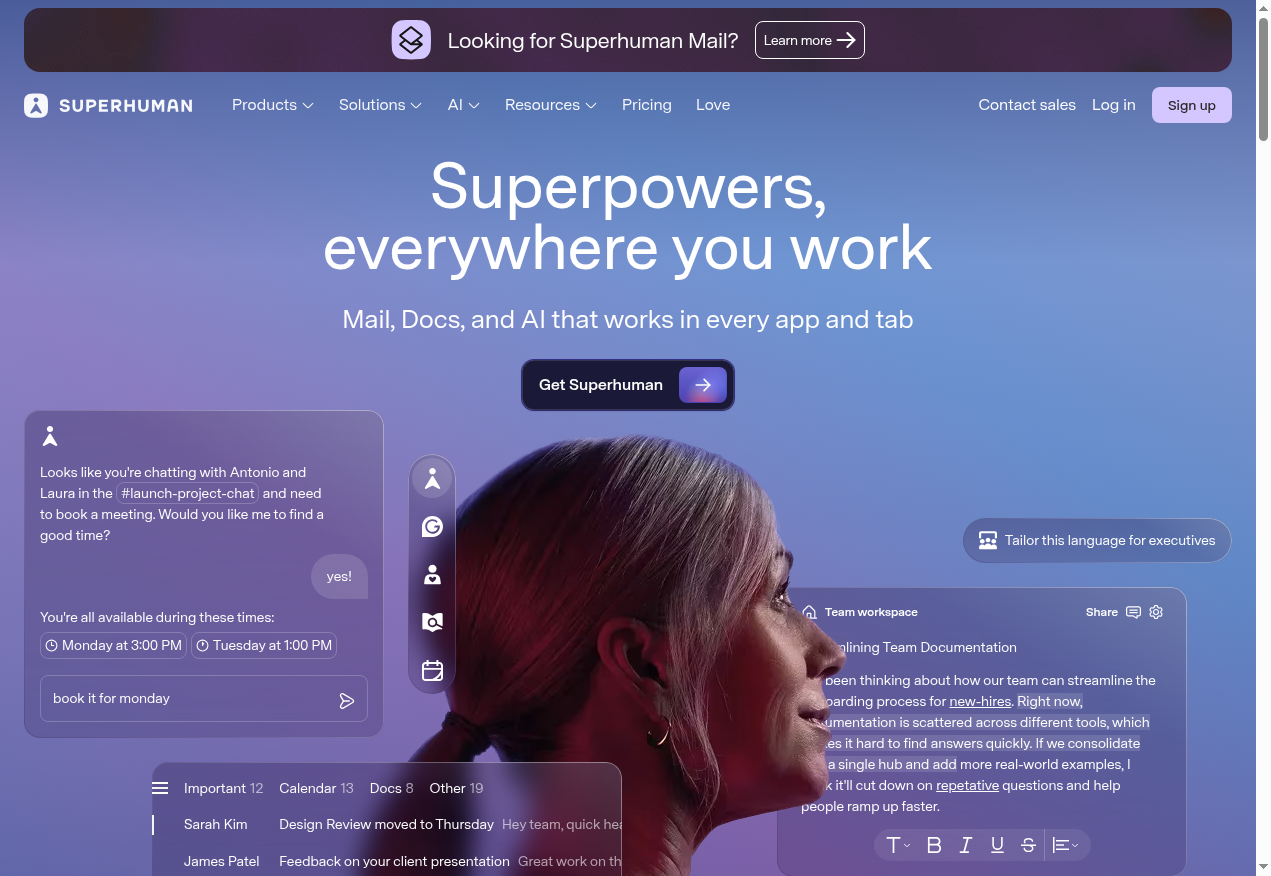
Superhuman is no longer “just email.” The 2026 Superhuman Suite includes Mail, Go (proactive AI assistant), Docs (formerly Coda), Grammarly, Calendar, and Databases. It has browser extensions, an agent store, and MCP support. It is, by any measure, a multi-product platform now — see our Upstream vs Superhuman comparison for a deeper look at how Superhuman Mail alone stacks up against a newer, agent-native inbox.
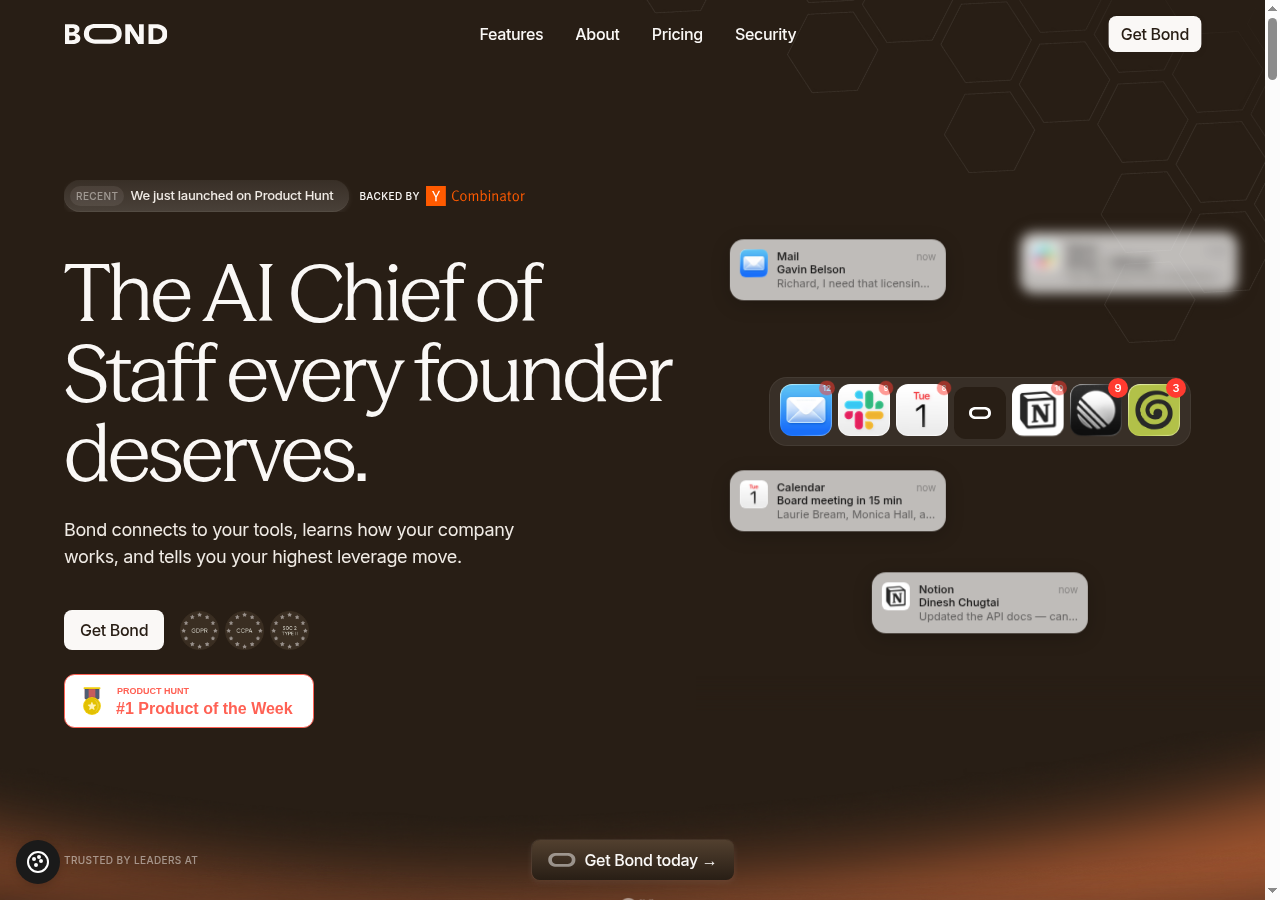
Bond is a new entrant. Launched in June 2026 on Product Hunt, YC-backed (S25), built by a 3-person team. It positions itself as “The AI Chief of Staff every founder deserves.” It lives in Slack, reads every connected tool, builds a company brain, and hands you a prioritized to-do list every morning.
Where they genuinely overlap: both do AI email drafting and triage, both have AI scheduling, both connect to your tools. But the overlap is shallower than it looks. Superhuman Go works in every browser tab and suggests help inline. Bond works cross-tool, surfaces commitments you forgot you made, and tells you what actually matters right now.
Comparison Table
| Bond | Superhuman | |
|---|---|---|
| Core purpose | AI Chief of Staff: cross-tool prioritization | Speed-first email + writing + docs suite |
| Primary interface | Slack DM | Email client + browser extension (Go) |
| Email features | Reads email for priorities, catches commitments | Fly through inbox 2x faster, AI writing, Split Inbox, Snippets |
| AI assistant | Cross-tool: reads all connected apps, builds company brain | Go: proactive suggestions in every browser tab + Grammarly writing partner |
| Prioritization | P0-P3 ranked to-do list built from all tools | Inline suggestions as you work (no consolidated priority list) |
| Commitment tracking | Yes: catches “I’ll get back to you” across all channels | No: email reminders only, no cross-channel tracking |
| Waiting on others | Dashboard of what others owe you | Not available |
| Docs/collaboration | Not applicable (executive task layer) | Full Docs suite (formerly Coda): tables, charts, Kanban, 800+ integrations |
| Tool integrations | 16+ (Gmail, Slack, Notion, Linear, Jira, ClickUp, etc.) | 800+ via Docs/Coda; Mail connects HubSpot, Salesforce, Pipedrive (view and update) |
| Setup time | Under 5 minutes | Under 5 minutes for Mail; Docs/Grammarly similarly fast |
| Security | SOC 2 Type II (Enterprise), ISO 27001 monitored, zero data retention with AI providers | SOC 2 Type 2, ISO/IEC 27001/27017/27018/27701, SAML SSO + BYOK + DLP (Enterprise) |
| Maturity | 1 month old, 3-person team, YC S25 | 10+ years, 40M+ users, 50,000+ teams |
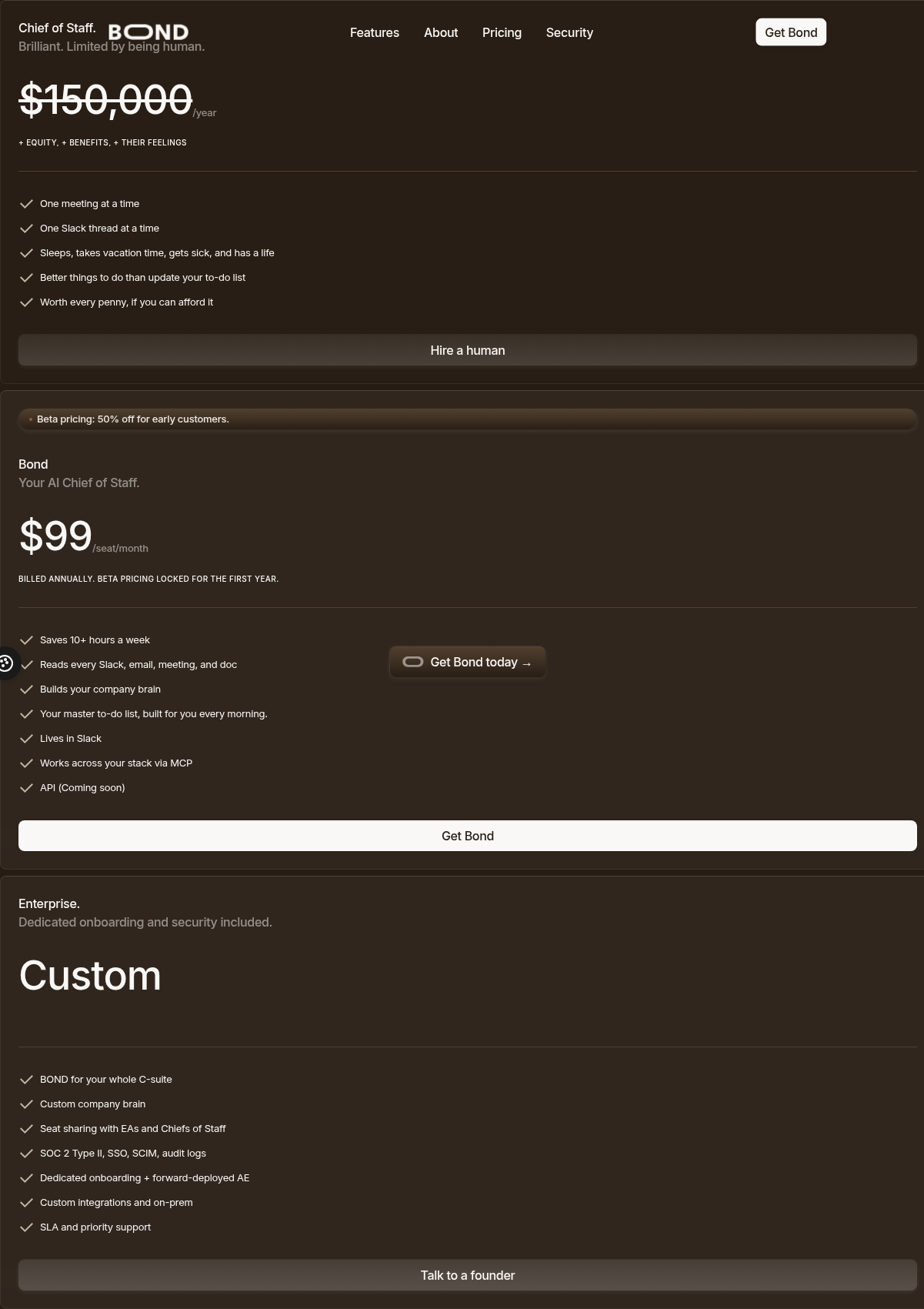
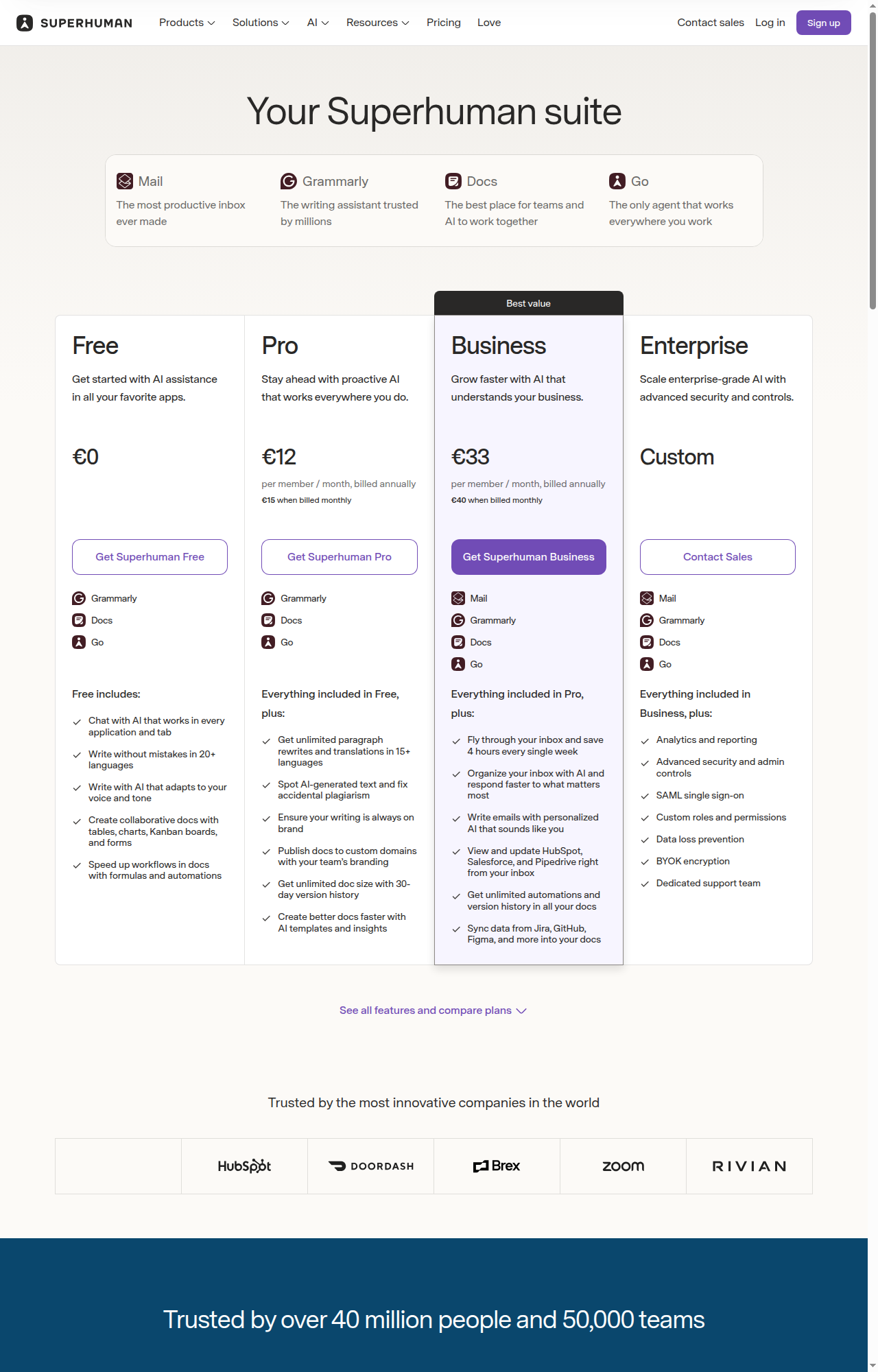
| Pricing | Bond $99/seat/month billed annually, beta 50% off, first month is the trial | Superhuman Business €33/mo annual, €40 monthly; Free €0, Pro €12/mo annual / €15 monthly |
Prices accurate as of July 2026; check the vendor’s site for current rates.
Where Bond Wins
1. Cross-Tool Prioritization
Bond reads every connected tool (Slack, Gmail, Notion, Linear, Jira, Discord, ClickUp, Monday.com, Asana, Trello, and more) and synthesizes them into a single prioritized list. This is the product’s core value: you stop bouncing between tabs trying to figure out what matters.
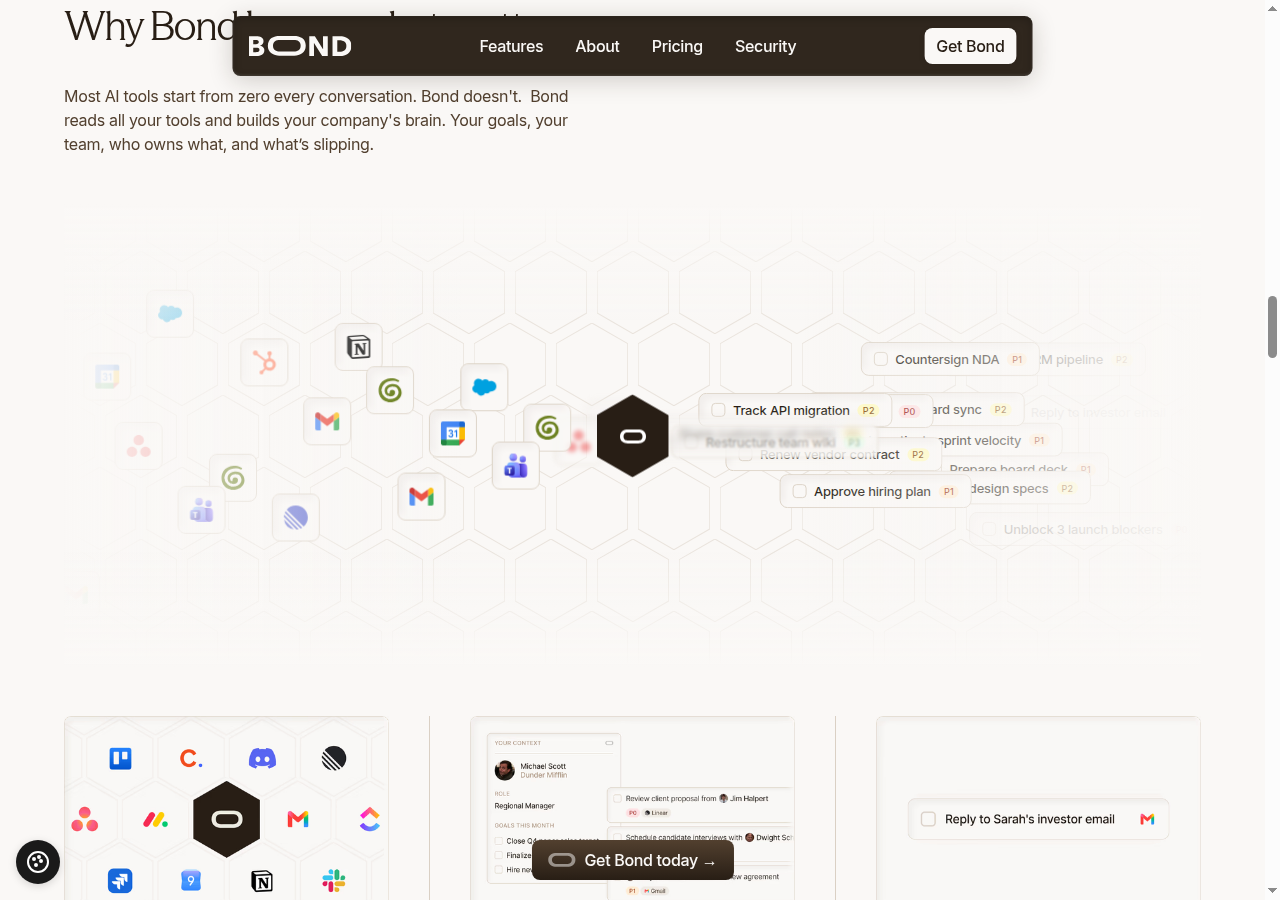
Every morning, Bond gives you a to-do list ranked P0 through P3. It is not guessing. It reads the context: who sent what, which project it ties to, whether a deadline is approaching, and where you are the blocker.
2. Company Brain
Most AI tools start from zero every conversation. Bond does not. It builds a persistent model of your company: who owns which project, what is slipping, what you committed to three Slack threads ago. The longer you use it, the sharper this gets.
This is the feature that makes Bond feel less like a chatbot and more like an actual Chief of Staff. If you have ever forgotten a promise made in a Notion comment or a DM, this alone justifies the price.
3. Commitment Tracking Across Channels
Bond catches “I’ll get back to you” promises in email, Slack, meeting transcripts, and Notion comments. Then it follows up. Politely. You do not need to remember that you owe someone a draft or that someone owes you a sign-off. Bond tracks both directions.
4. “Waiting on Others” Dashboard
Bond shows you what other people owe you: pending replies, open threads, overdue deliverables. This is unique. Most productivity tools track what you need to do. Bond tracks what everyone else needs to do for you.
Where Bond Loses
1. Email Speed
Bond reads email, surfaces it in your priority list, and can draft replies. But it does not make you type emails faster. It has no keyboard shortcuts, no Split Inbox, no Snippets. If you spend 3+ hours a day in your inbox and your main problem is volume, not prioritization, Bond will not fix it.
2. Writing Quality
Bond drafts functional, context-aware messages. But it does not have Grammarly’s voice-matching, tone detection, plagiarism checking, or AI detection agent. If your role requires polished, on-brand writing (executive comms, sales, client-facing), Superhuman’s integrated Grammarly is in a different league.
3. Immaturity Risk
Bond launched in June 2026. It is built by a 3-person team. Bond’s beta pricing of $99/mo is 50% off; the vendor’s own pricing FAQ cites $199/mo as the reference full price once the beta ends. If you are evaluating for an enterprise with compliance requirements, Bond’s Enterprise tier exists but the product is very young. Superhuman has a decade of enterprise track record.
4. Slack-Native Only
Bond’s primary interface is Slack. No Slack, no Bond. Teams on Microsoft Teams or Discord-first communication have no native interface. (Bond does read Discord, but it does not live there.)
5. Narrow Audience
Bond is built for executives, founders, and Chiefs of Staff who manage across multiple teams and tools. An individual contributor who mainly lives in email will not get enough value to justify Bond price $99/month.
Where Superhuman Wins
1. Raw Email Speed
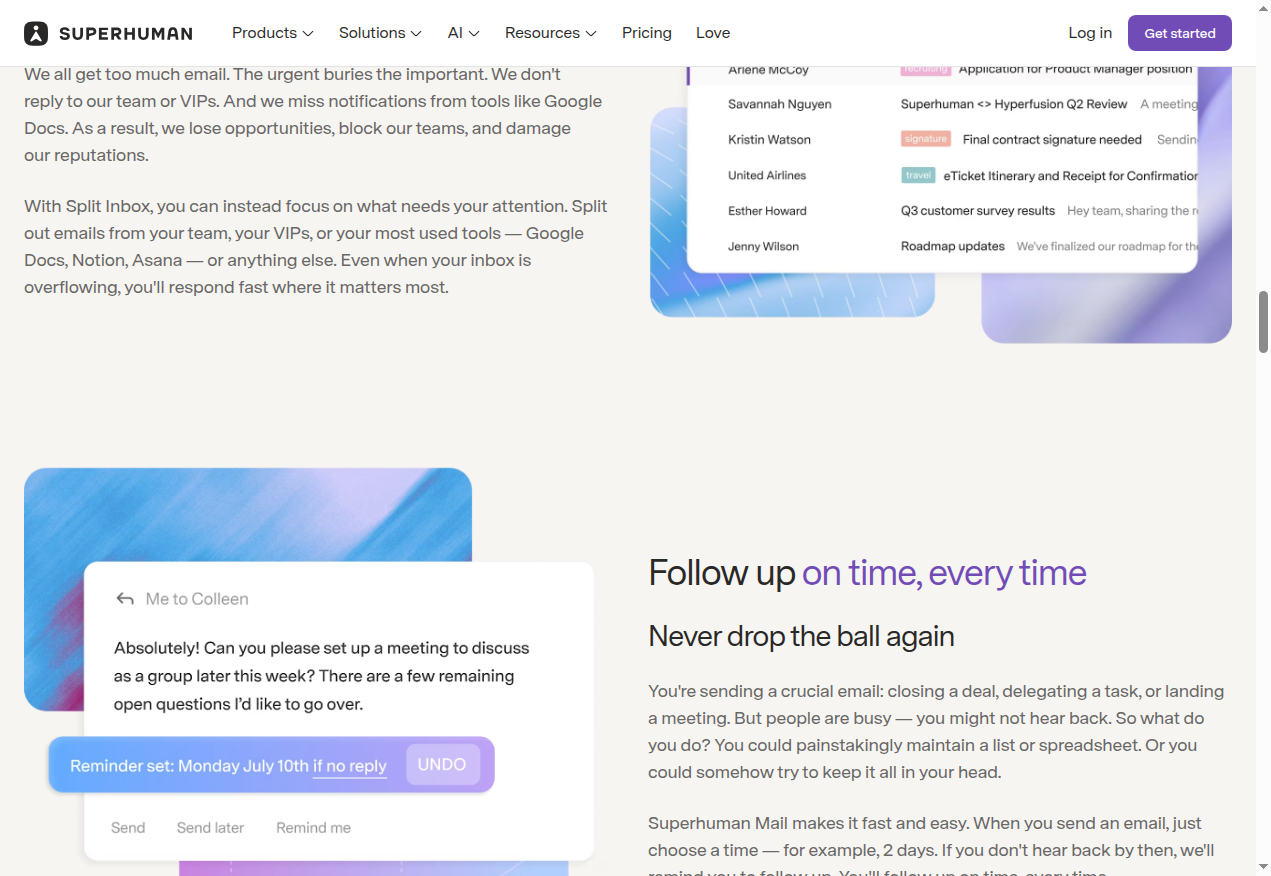
Superhuman Mail is genuinely faster than any other email client. Keyboard shortcuts, Split Inbox (automatic categorization of your inbox into priority streams), Snippets, and AI triage (Auto Drafts, Auto Archive, Auto Labels, Auto Reminders) combine to save a claimed 4 hours per week. Users consistently report clearing a full inbox in minutes with the keyboard-driven workflow.
2. Integrated Writing Suite
Superhuman includes Grammarly across all paid plans. This is not a bolt-on. It is a deeply integrated writing partner: tone and voice matching, paragraph rewrites in 24 languages, translation in 17 languages, plagiarism checking, and an AI detection agent. The Business plan also includes “Write with AI” that voice-matches your emails. If writing quality and consistency matter to your role, this alone justifies the Business tier.
3. Enterprise Maturity
40 million users. 50,000+ teams. SOC 2 Type 2, plus ISO/IEC 27001, 27017, 27018, and 27701 certifications. The Enterprise plan adds SAML SSO, BYOK encryption, data loss prevention, custom roles and permissions, advanced admin controls, and a dedicated support team on top of Business. Superhuman has the compliance and security apparatus that enterprises require. Bond’s Enterprise tier is new and unproven at scale.
4. Full Document Collaboration (Docs/Coda)
Superhuman Docs (the former Coda product) is a full collaborative workspace: tables, charts, Kanban boards, forms, formulas, automations, and 800+ tool integrations. It works with Claude, ChatGPT, and Cursor. This is not a side feature — it is a complete team documentation platform.
5. Go: Cross-App AI Assistant
Superhuman Go is the proactive AI assistant that works in every browser tab, and it’s the newest product in the suite — included free with every Superhuman account, including the Free plan. It connects Gmail, Drive, Jira, and 100+ apps, offers inline suggestions everywhere you type, schedules meetings without leaving conversations, and surfaces relevant context before you ask. It is the feature that most competes with Bond’s cross-tool awareness, though it focuses on augmenting individual work rather than building a consolidated task list.
Where Superhuman Loses
1. No Cross-Tool Prioritization
Superhuman Go suggests things as you work. It does not build a consolidated “here is what to do first” list from all your tools. You still need to decide what deserves your attention across email, Slack, docs, and project management tools. The AI is reactive (helping with what is in front of you) rather than proactive (telling you what should be in front of you).
2. No Commitment Tracking
Superhuman does not catch “I’ll get back to you” promises across channels. Its reminders and follow-ups are email-native. If you make a commitment in a Slack thread or a Notion comment, Superhuman will not surface it. This is a meaningful gap for anyone who works across multiple communication channels.
3. No Company Brain
Superhuman does not build persistent organizational knowledge. Each session starts relatively fresh. It knows your email patterns and can learn your writing voice, but it does not know what projects your team is working on, who owns what, or which deliverables are at risk across tools.
4. Confusing Pricing Tiering
The Free and Pro (€12/mo annual) plans do not include Mail. You need the Business plan (€33/mo annual) for email. This means the “Superhuman experience” most people know (the fast email app) starts at €33/mo, not free. The Free plan is essentially Grammarly lite with AI chat. The tier structure makes the product look cheaper than it is for the use case most buyers want.
5. Go Is the Newest, Least-Proven Product in the Suite
The cross-app AI assistant that competes most directly with Bond’s cross-tool awareness is the newest product in the Superhuman lineup. It shows promise, but it is not yet at the level of Bond’s dedicated cross-tool prioritization engine.
Pricing: Not an Apples-to-Apples Comparison
Bond costs $99/seat/month billed annually, beta pricing 50% off, locked for first year. The first month is the trial, and setup takes under 5 minutes. Bond’s own pricing FAQ cites $199/mo as the reference full price once the beta discount ends.
Superhuman Business costs €33/member/month annual, €40 monthly. This includes Mail, Grammarly, Docs, and Go.
At face value, Bond is roughly 3x more expensive. But this is not an apples-to-apples comparison. Bond reads Slack, Notion, Jira, Linear, ClickUp, Discord, and a dozen other tools, builds a cross-tool brain, and hands you a prioritized action list. Superhuman Business gives you fast email, AI writing, team docs, and a cross-app AI assistant. They solve different problems at different price points.
The honest pricing question: can you justify Bond at $99/mo for a tool that tells you what to work on? If you are an executive managing across 5+ tools and losing an hour a day to context-switching, the answer is probably yes. If your workflow is 90% email and 10% everything else, save your money and get Superhuman.
Verdict on price: Bond is overpriced for email-only users. Superhuman is underpriced for what it delivers in the Business tier. If Bond’s cross-tool prioritization genuinely saves you 10+ hours a week (as claimed), Bond’s $99/mo beta is trivial. If you will only use it as a smarter to-do list, skip it.
The “Use Both” Scenario
Calling this out explicitly because it is the honest answer for many readers: you can use Superhuman for email and Bond for everything else.
Bond reads Gmail and Google Calendar. It surfaces email priorities and commitments alongside Slack messages, Notion pages, and Jira tickets. Superhuman handles the actual email work: fast triage, AI drafting, Split Inbox management. Bond handles the “what matters right now” question across all tools.
This combination is roughly Bond $99 + Superhuman Business ~€33 = ~$132/mo combined. For an executive whose time is worth $100+/hour, the math works if each tool saves even 2 hours per week.
The downside: two subscriptions, two onboarding flows, and the cognitive load of knowing which tool does what. Bond for prioritization, Superhuman for execution. If that distinction feels unnatural, pick one.
Who Should Pick Bond
- Founders and CEOs managing across 5+ tools who lose an hour a day to context-switching
- Chiefs of Staff who need to track commitments, deliverables, and blockers across an organization
- Executives who want a single prioritized list every morning instead of bouncing between Slack, email, and project tools
- Anyone who has ever thought “I know I’m forgetting something important” and was right
- Teams where Slack is the communication hub and email is secondary
Who should NOT pick Bond: Individual contributors whose work lives primarily in one or two tools. Email-heavy roles where raw speed matters more than prioritization. Anyone who does not use Slack as their primary communication platform. Budgets under $100/month for a single productivity tool.
Who Should Pick Superhuman
- Anyone who spends 3+ hours a day in email and feels slow
- Sales, client-facing, and executive comms roles where writing quality directly impacts outcomes
- Teams that need collaborative docs alongside email (the Docs/Coda integration is genuinely useful)
- Enterprises with compliance requirements (SOC 2 Type 2, ISO 27001, SSO) that a young startup cannot match
- People who want AI assistance while they work rather than a separate planning step
Who should NOT pick Superhuman: Executives whose real bottleneck is knowing what to work on, not how fast they can type. People who live in Slack and only check email twice a day. Anyone who needs cross-tool commitment tracking and a consolidated priority list.
Bottom Line
If your workday starts with “what should I do first?” and the answer lives scattered across Slack, email, Notion, and Jira, get Bond. The cross-tool prioritization and commitment tracking are unique, and the beta pricing locks at $99/mo for the first year.
If your workday starts with “I have 200 emails and no time,” get Superhuman Business. The email speed, AI writing, and enterprise maturity are proven at scale, and at €33/mo it is genuinely good value.
If you can afford both, use Superhuman for email + Bond for everything else. It is the combination most executives actually need but rarely hear about because comparison posts want a single winner.
There is not one here.