18 July 2026 · Comparison
Albato vs Zapier (2026): Cheaper at Scale or Safer Bet?
The short answer
Albato's transaction billing and built-in AI undercut Zapier at scale. Zapier's 9,000+ apps and governance stay unmatched. Pick for your stack.
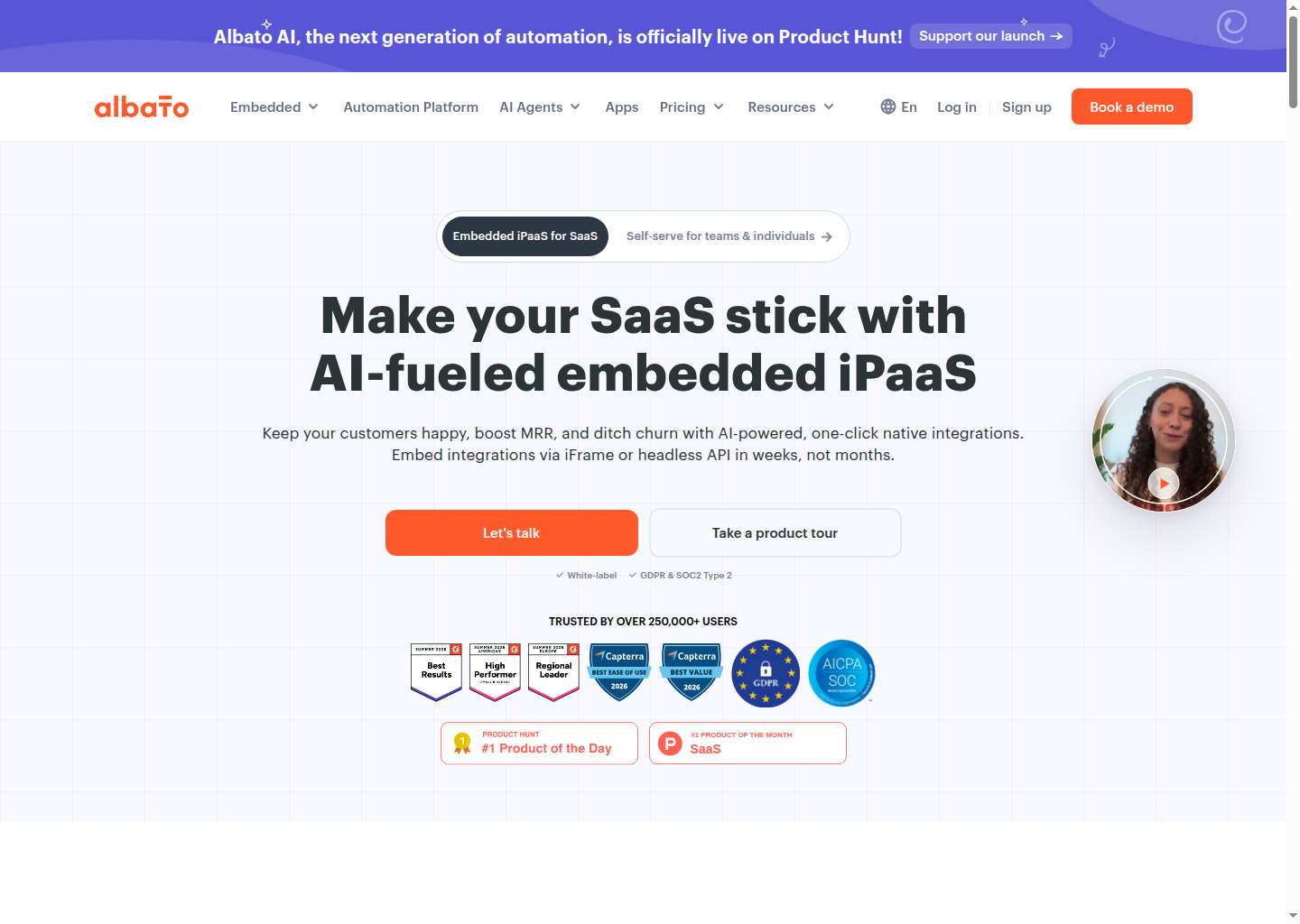
Verdict: Pick Albato if you run high-volume automations and want built-in AI agents without separate price tags. Pick Zapier if your stack includes niche tools only they support, or you need enterprise governance features like SCIM, BYOM, and log streaming. For most marketers and small teams, Albato’s transaction-based billing and native Copilot make it the better value, but Zapier’s 9,000+ app library remains unmatchable.
Disclosure: Some links in this post are affiliate links. If you click through and make a purchase, we may earn a commission at no extra cost to you.
See also: Our comparison of Systeme.io vs Kartra if you’re evaluating all-in-one marketing platforms, and Builderall vs Kartra for another head-to-head on bundled marketing tools. If the question is agent autonomy rather than per-task cost, Agently vs Relay.app covers that corner — Relay.app is shutting down, and whether Agently’s company-brain approach replaces it is the live question.
Pricing: Transaction-Based vs Task-Based
The pricing models are fundamentally different, and that difference compounds at scale.
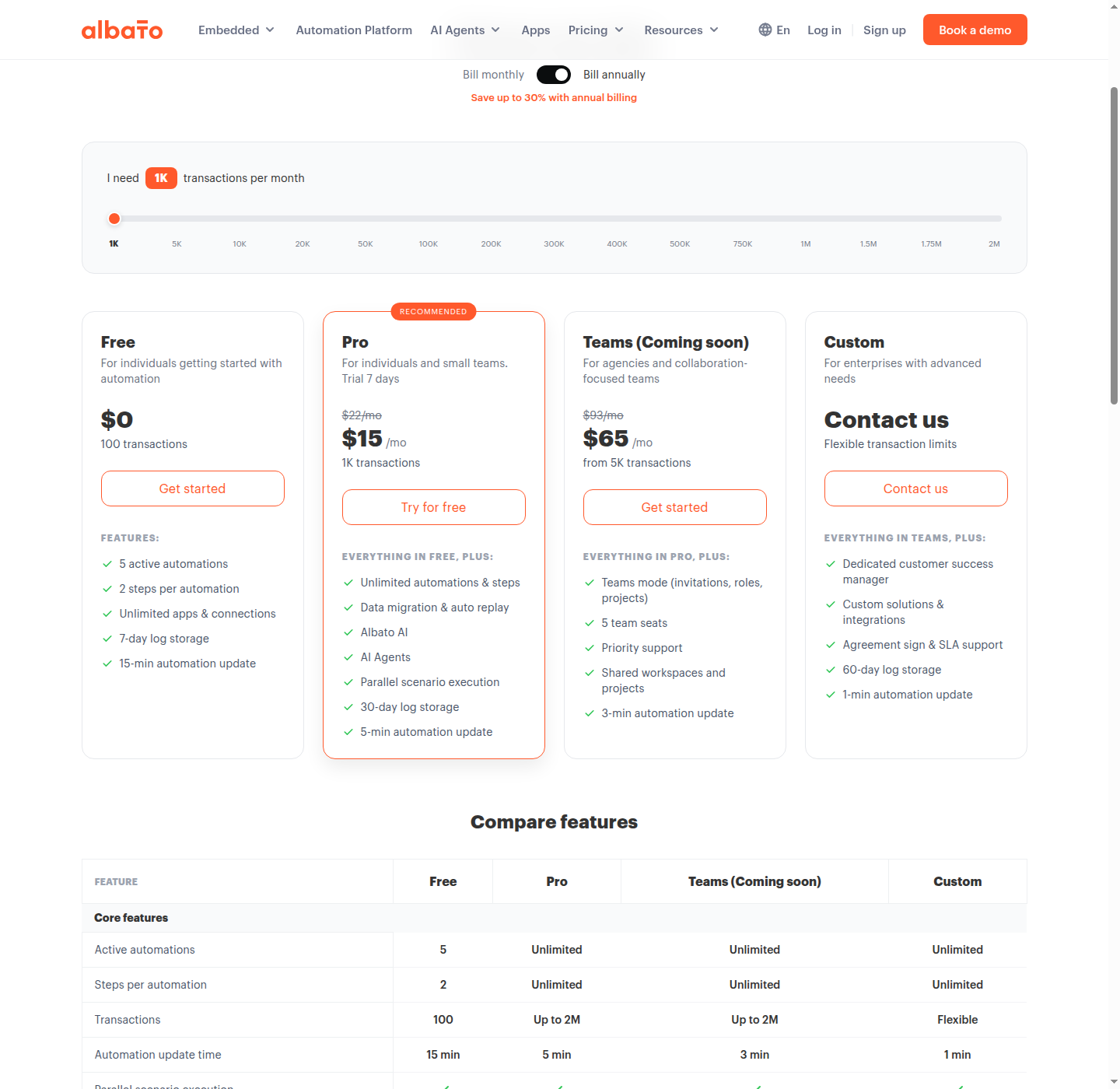
Albato Pricing
Albato charges per transaction: one successfully executed action step. Triggers and polling are free. Albato claims 1 transaction covers what competitors burn 4–5 API calls on.
| Plan | Monthly | Annual (per month) | Transactions | Key Note |
|---|---|---|---|---|
| Free | $0 | - | 100 | 5 automations, 2 steps each, 15-min update, 7-day logs |
| Pro | $22/mo monthly or $15/mo annual | $15/mo annual | From 1K | Unlimited automations/steps, AI Agents, Copilot, 5-min update |
| Teams | $93/mo monthly or $65/mo annual | $65/mo annual | From 5K | 5 seats, priority support, 3-min update, shared workspaces (“Coming soon”) |
| Custom | Contact | - | Flexible | Dedicated CSM, SLA, 60-day logs |
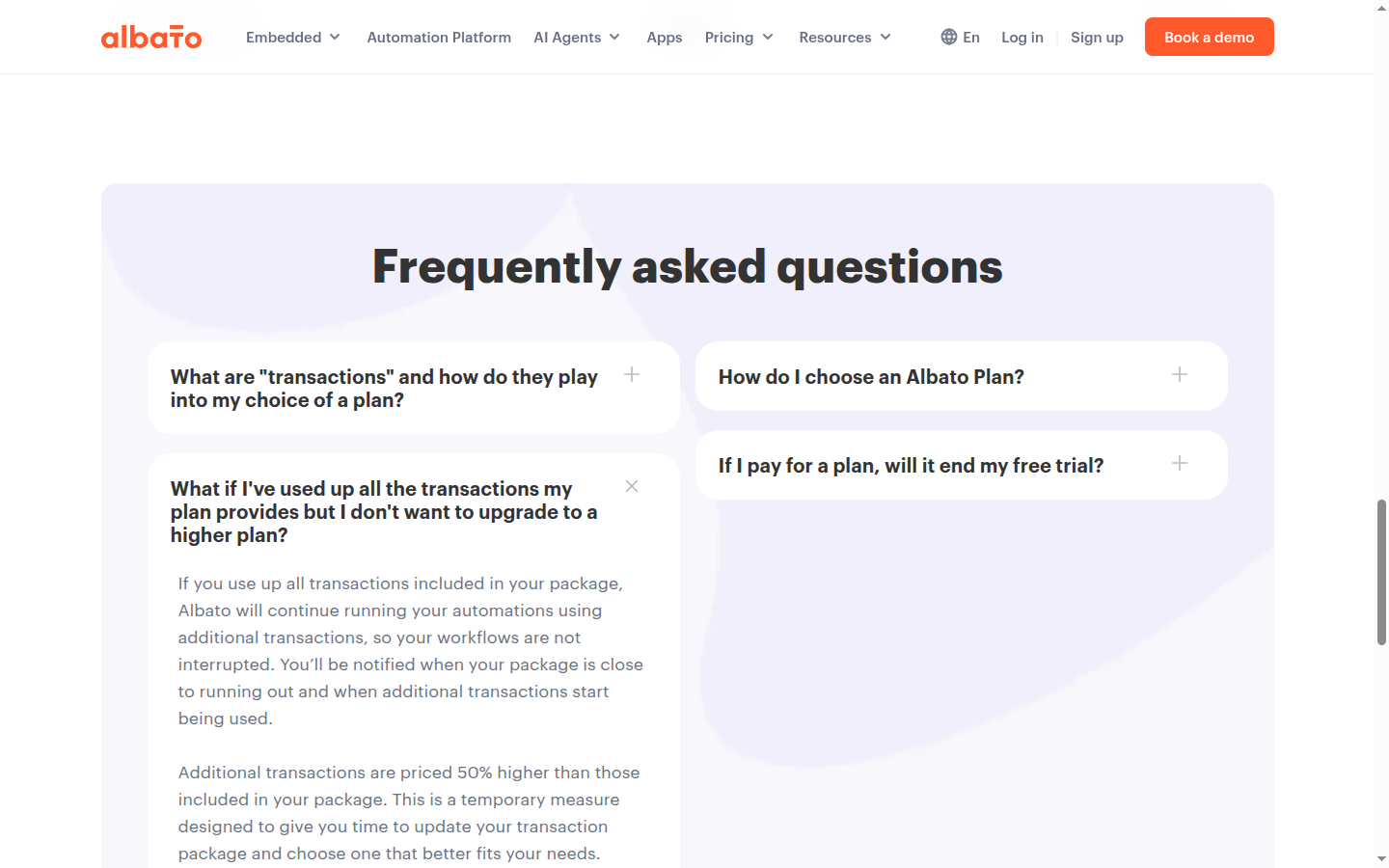
Extra transactions auto-billed at 50% higher rate as a buffer, so your automations don’t hit a hard cutoff if you exceed your plan.
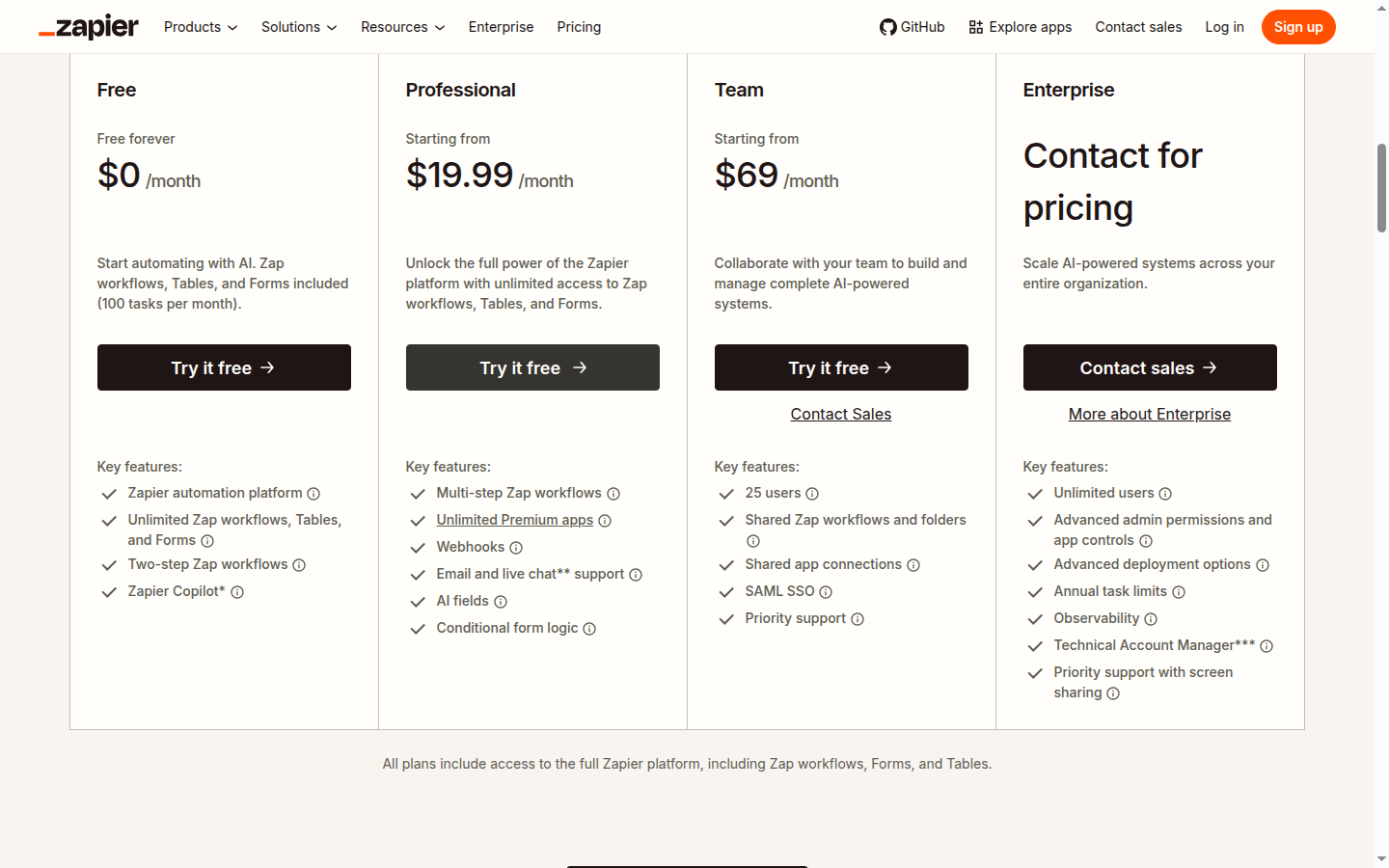
Zapier Pricing
Zapier charges per task: every successful action step counts. Multi-step Zaps burn multiple tasks per run.
| Plan | Monthly (annual billing) | Tasks/Mo | Key Note |
|---|---|---|---|
| Free | $0 | 100 | 2-step Zaps only, 15-min polling |
| Professional | from $19.99/mo | From 750 | Multi-step, Premium apps, webhooks, 2-min polling |
| Team | from $69/mo | From 2K | 25 users, shared workspaces, SSO, 1-min polling |
| Enterprise | Contact | Custom | SCIM, BYOM, action restrictions, log streaming |
Separate add-on costs on Zapier (not included in base plans):
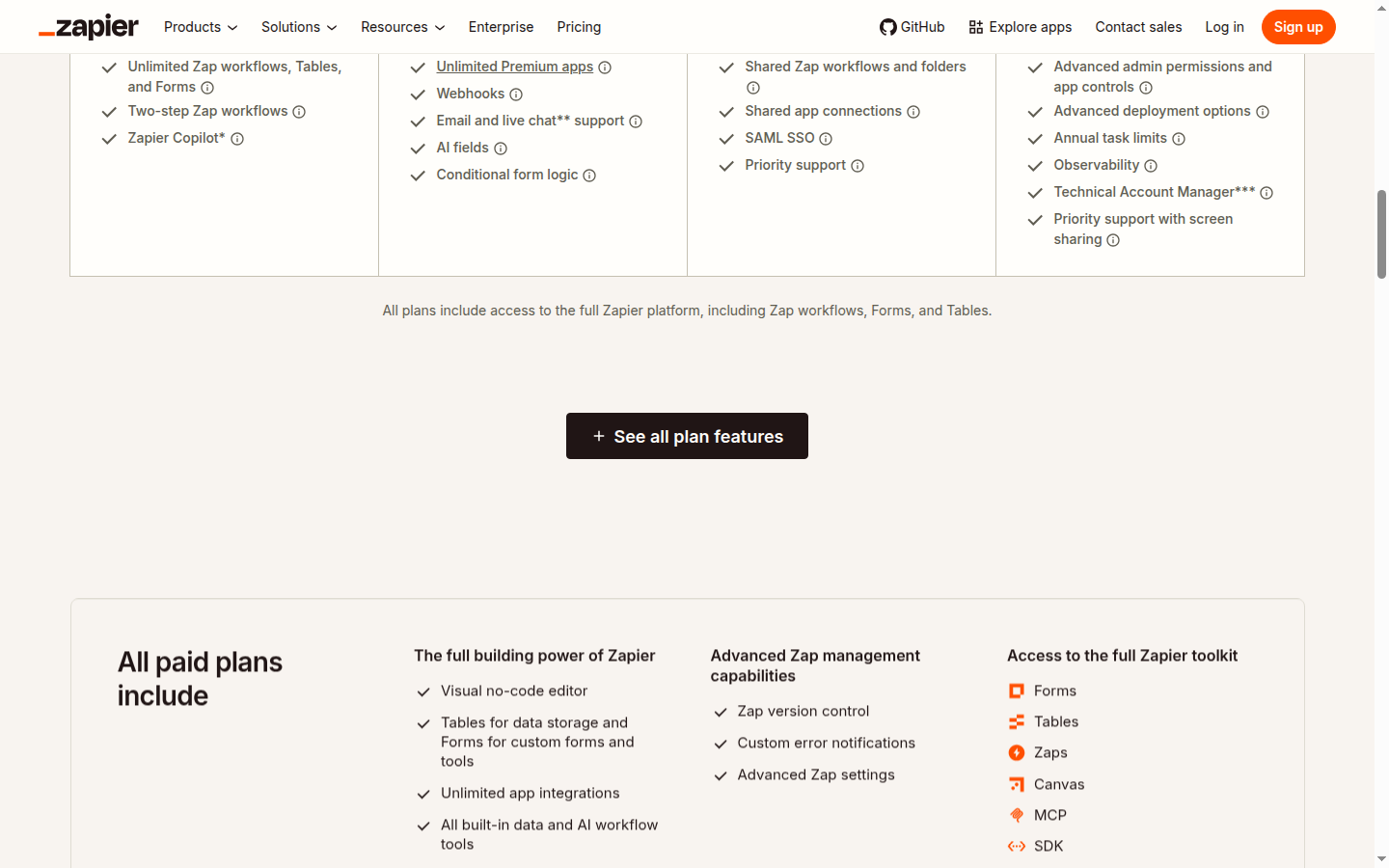
- Agents: Free (400 activities), Pro $400/yr, Enterprise custom
- Chatbots: Free (2 chatbots), Pro $160/yr, Advanced $800/yr
Prices accurate as of July 2026; check the vendor’s site for current rates.
The Billing Model Difference in Practice
Imagine a 5-step automation that runs 1,000 times per month:
- Albato: ~1,000 transactions (triggers/polling free, only successful actions count).
- Zapier: ~5,000 tasks (each of the 5 action steps counts as 1 task).
On Albato’s Pro plan (1K transactions included), you’re covered. On Zapier’s Professional plan (750 tasks included), you’d need to upgrade or pay overages. The gap widens as volume grows.
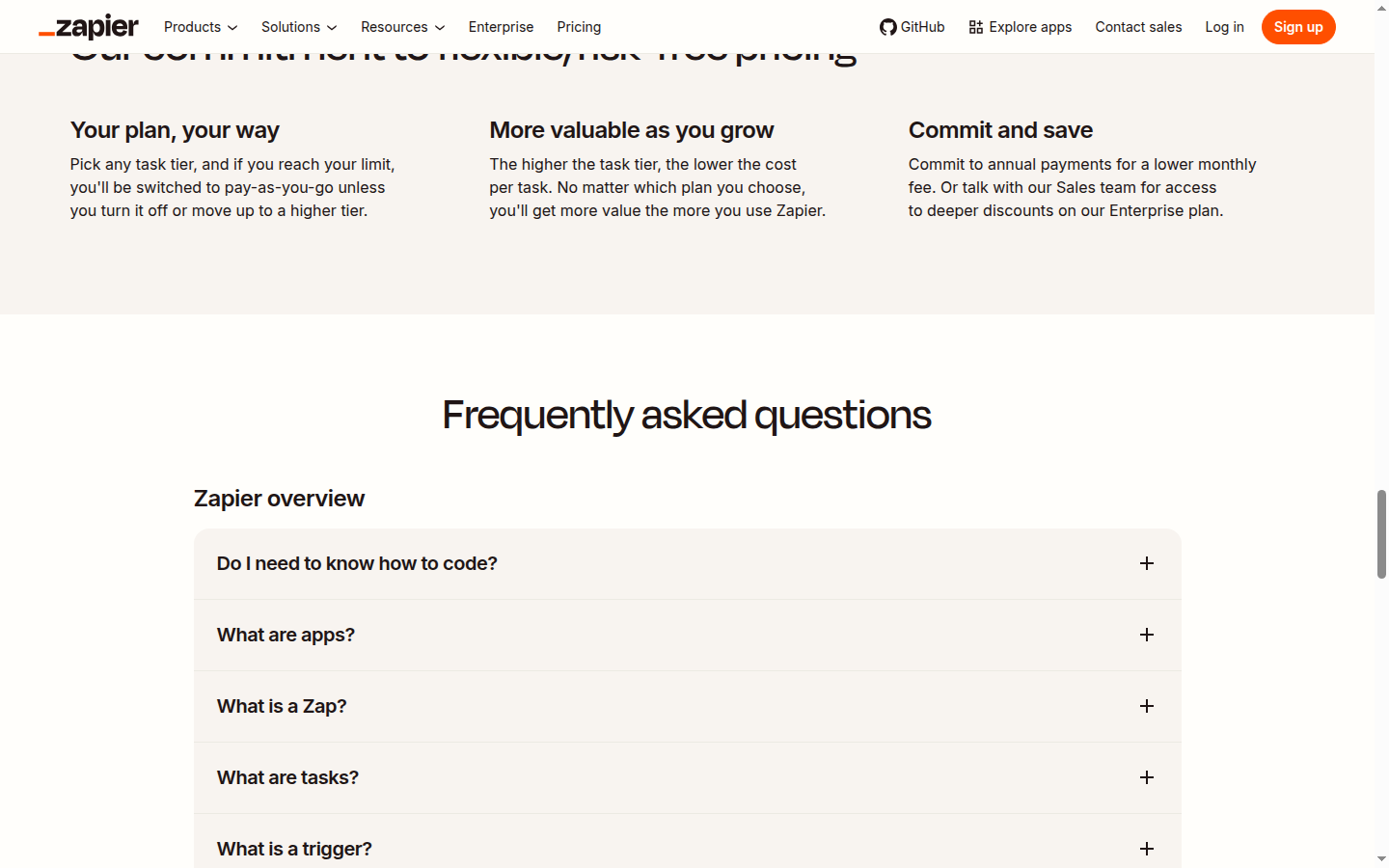
Albato also auto-bills overages at 50% higher as a buffer, so you don’t hit hard cutoffs. Zapier’s overage costs vary by plan, switching to a metered pay-per-task fee when you exceed your task limit.
App Library: 1,000+ vs 9,000+
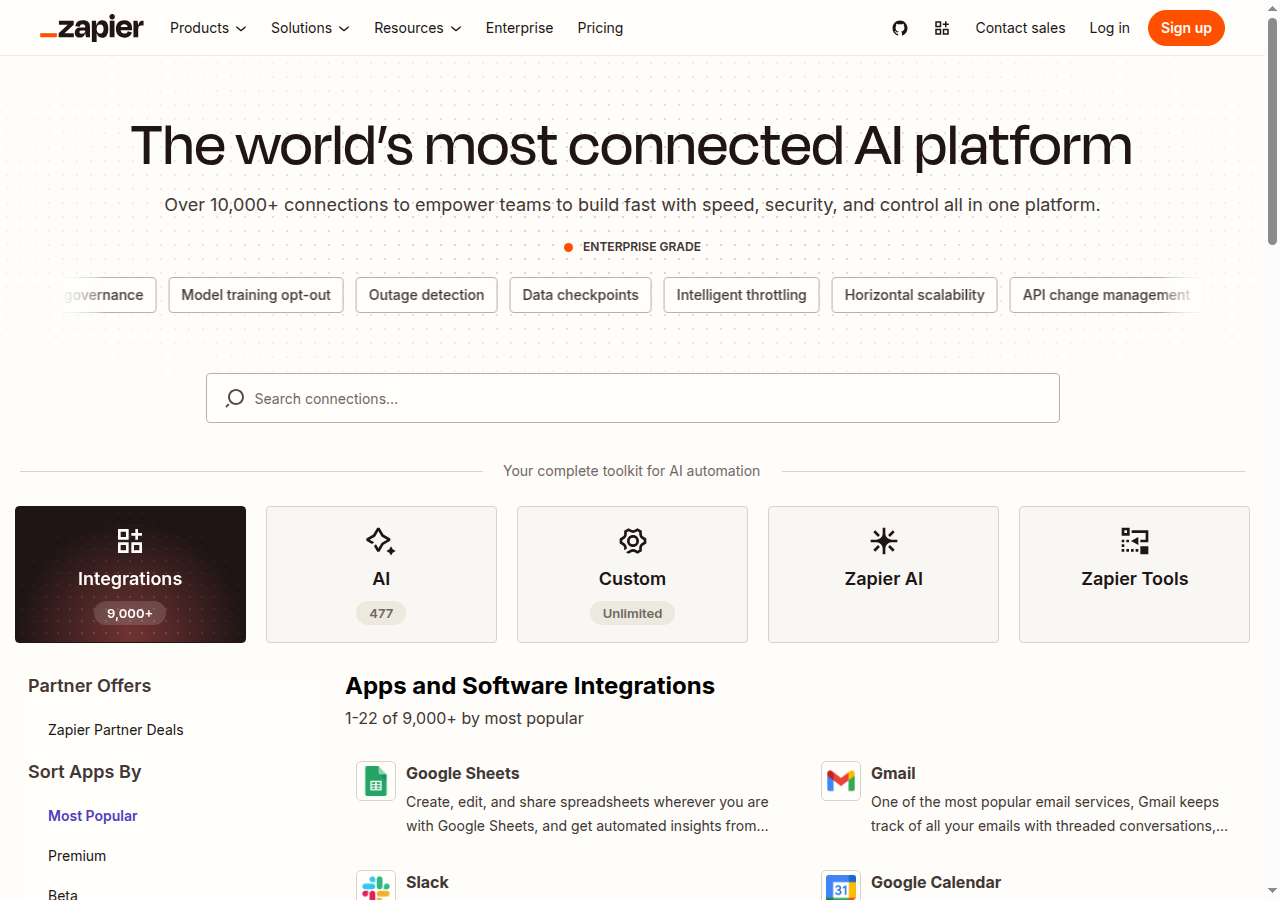
This is Zapier’s moat. With 9,000+ app integrations, it supports essentially everything, including niche vertical SaaS tools, legacy CRMs, and industry-specific platforms. If your stack includes obscure tools, Zapier is the safe bet.
Albato’s 1,000+ integrations cover the mainstream well: Google Workspace, HubSpot, Slack, Salesforce, Shopify, Stripe, Notion, Airtable, and hundreds more. For the typical marketing stack, Albato likely covers your needs. But check their app directory before committing.
If your specific tools are in Albato’s library, you won’t feel the gap. If they aren’t, no amount of pricing advantage matters. You simply can’t use it.
AI Features: Native vs Add-On
This is where Albato’s positioning gets sharp.
Albato’s AI Suite (All Included in Pro)
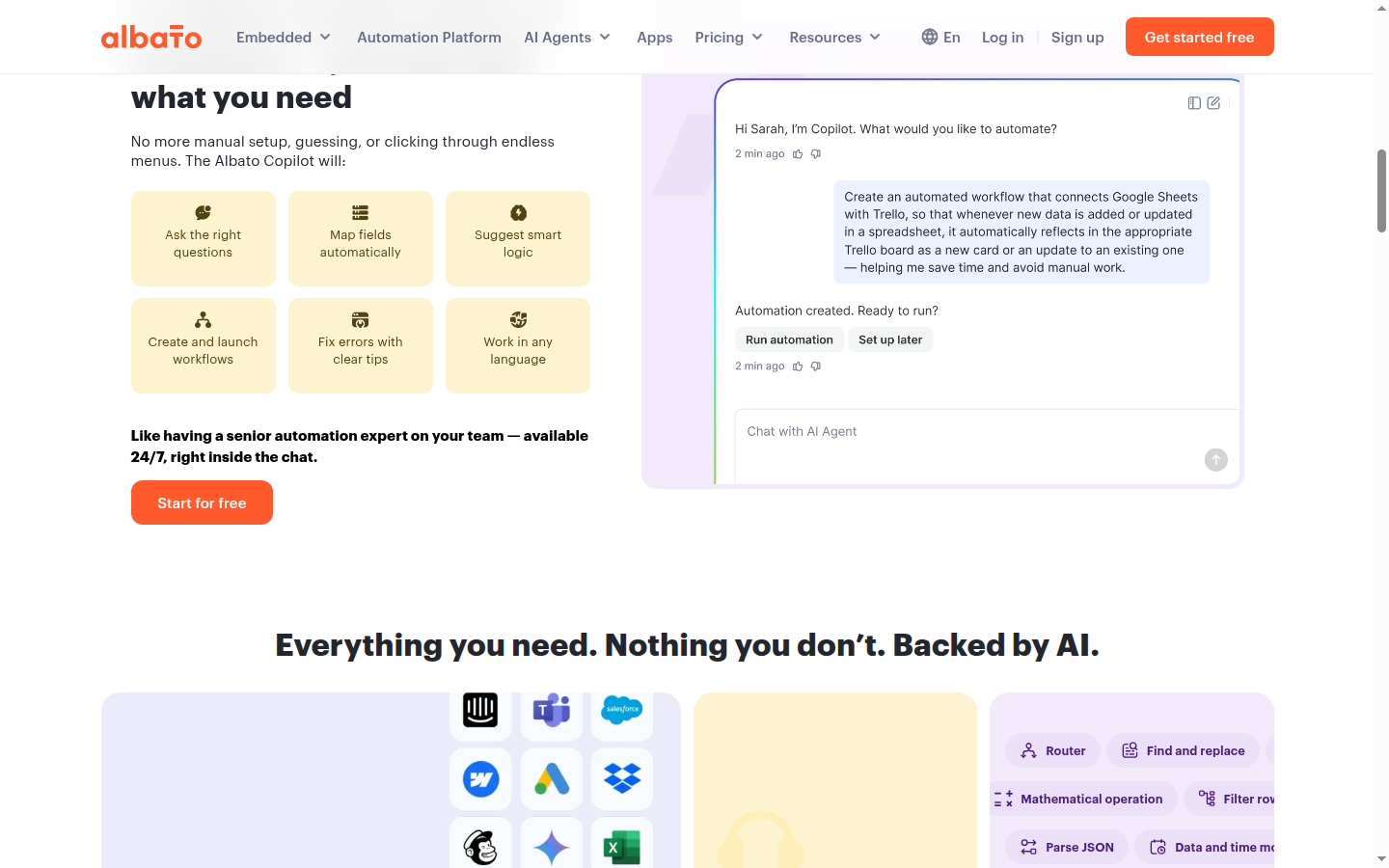
Albato Copilot is an AI workflow builder. You describe what you need in natural language: “When a new HubSpot deal closes, create an invoice in QuickBooks and notify the Slack #sales channel” - and Copilot maps the fields, builds the logic, and launches the workflow. It also helps fix errors with tips.
AI Agents are built-in automation steps that use an LLM (OpenAI, Gemini, DeepSeek, or Albato’s own AI) to make decisions, pull context from previous workflow steps, and act across connected apps. Field-level guardrails let you control exactly what the agent can and can’t touch.
AI Step handles content tasks: rewrite text, summarize feedback, analyze sentiment - directly inside automations.
All of these are included in the Pro plan. No separate subscriptions, no add-on pricing.
Zapier’s AI Suite (Separate Paid Products)
Zapier Copilot appears as a key feature (flagged with an asterisk) on Zapier’s Free plan card. Zapier doesn’t publish a dedicated feature page spelling out what Copilot can do, so it’s hard to compare its depth against Albato’s Copilot from public information alone.
AI Agents is a standalone product (Free 400 activities, Pro $400/yr). It runs as a Chrome extension, browsable web agent with live data sources. Separate from your Zaps.
Chatbots is another standalone product (Free 2 chatbots, Pro $160/yr, Advanced $800/yr). Embeddable AI chatbots with custom knowledge bases and lead collection.
AI by Zapier is the in-Zap AI step for content generation and summarization. This is the closest equivalent to Albato’s AI Step and is included in plans.
The bottom line: Albato bundles its AI tools into the base Pro plan. Zapier separates them into paid add-ons. If you want agents, chatbots, and workflow-building AI, Zapier’s total cost grows significantly beyond the base plan price.
Where Albato Wins
-
Transaction-based billing saves money at volume. When a 10-step automation runs thousands of times, the cost difference is substantial.
-
AI Copilot is genuinely impressive. Describe a workflow in plain English, get a working automation. Zapier lists a Copilot feature too, but publishes no public documentation of what it actually does.
-
AI Agents are native, not a separate product. No extra subscription. Field-level guardrails give fine-grained control over what agents can do.
-
Lower entry price. $15/mo annual vs Zapier’s $19.99/mo annual. The gap widens with volume.
-
Embedded iPaaS is a core product line. SaaS companies wanting white-label integrations get a stronger offering than Zapier Embedded, which requires end users to have their own Zapier accounts.
-
Parallel scenario execution. Multiple automations run simultaneously, no queuing.
Where Albato Loses
-
Smaller app library (1,000+ vs 9,000+). If your tools aren’t supported, Albato is a non-starter. Always check the app directory first.
-
Teams plan is “Coming soon.” Shared workspaces, roles, and team invites aren’t generally available yet. If you need team collaboration today, look elsewhere.
-
No built-in database or forms. Zapier has Tables (no-code database) and Forms. Albato has neither, you’ll need separate tools.
-
No chatbot builder. Zapier Chatbots is a full product line. Albato has no equivalent.
-
Limited enterprise governance. No SCIM, no BYOM, no domain restrictions, no action-level access controls, no log streaming to Datadog/Splunk. Regulated enterprises need Zapier.
-
Smaller company, less brand safety. Albato is younger (est. ~2022), smaller, and less proven. “Nobody got fired for picking Zapier.”
-
Smaller community and ecosystem. Fewer third-party tutorials, experts, and community resources. If you get stuck, there are fewer places to find help.
Where Zapier Wins
-
9,000+ app library. The deepest integration catalog in the industry. No competitor is close.
-
Enterprise governance. SCIM, BYOM, domain restrictions, action-level access controls, log streaming, custom data retention, VPC peering. For regulated companies, Zapier is the only realistic choice.
-
All-in-one platform. Zaps + Tables + Forms + Chatbots + Agents + MCP in one ecosystem. You can build entire internal tools without leaving Zapier.
-
Brand maturity. 14 years in market, 3M+ businesses. Proven stability, security posture, and vendor longevity.
-
MCP (Model Context Protocol). Connect any AI assistant to 9,000+ apps with governed connections. Forward-looking and unique.
-
Chatbots and Agents as full products. While they cost extra, they’re deeper standalone offerings, not just automation steps.
Where Zapier Loses
-
Expensive at scale. Task-based billing punishes high-volume, multi-step automations. A 10-step Zap running 5,000 times = 50,000 tasks. That’s an Enterprise plan.
-
Agents and Chatbots are separate paid products. The “AI automation platform” marketing is misleading when the AI tools double your bill.
-
No transaction-based billing option. Every action step counts. Competitors like Albato and n8n both offer more volume-friendly models.
-
Copilot’s capabilities aren’t publicly documented. Albato’s Copilot has a documented, publicly-visible feature set; Zapier’s Copilot is listed as a pricing-page feature but has no dedicated public page explaining what it can do.
-
Embedded offering is weak. Zapier Embedded requires end users to have Zapier accounts. Albato’s white-label embedded iPaaS is a better fit for SaaS companies.
-
Slower polling on lower plans. Free polls every 15 minutes. Professional polls every 2 minutes (Albato Pro polls every 5 minutes).
Alternatives to Both
If neither Albato nor Zapier fits, consider these:
n8n: The Open-Source Alternative
n8n is fair-code licensed, self-hostable, and uses execution-based billing (pay per full workflow run, not per step). Pricing: Starter €20/mo for 2.5K executions, Pro €50/mo for 10K. Unlimited users on all plans. 400+ integrations. You can write JavaScript or Python directly in workflows via code nodes.
Best for: Technical teams comfortable with self-hosting and code. Not for: Non-technical users who want a no-code builder.
Make: The Visual Alternative
Make (formerly Integromat) offers a drag-and-drop visual scenario builder that’s more intuitive than Zapier’s linear editor. ~2,000+ integrations. Operations-based pricing. Strong European presence (HQ Prague). Visual execution history lets you see exactly what data passed through each step.
Best for: Users who want a visual builder and complex multi-step scenarios.
Pabbly Connect: The Budget Alternative
Flat pricing model (no per-task scaling), smaller app library, less mature but significantly cheaper for high-volume use.
Best for: Budget-conscious users who don’t need niche integrations.
Who Should Pick Which
Pick Albato if:
- You run high-volume automations and want transaction-based billing.
- You want AI agents and a natural language workflow builder without extra subscriptions.
- Your tool stack is covered by Albato’s 1,000+ integrations.
- You’re a SaaS company looking for white-label embedded integrations.
- You want a simpler, less intimidating interface than Zapier.
Pick Zapier if:
- Your stack includes niche tools only Zapier supports.
- You need enterprise governance (SCIM, BYOM, log streaming, action restrictions).
- You want an all-in-one platform (Tables, Forms, Chatbots, Agents) in one ecosystem.
- You’re buying for a compliance-heavy organization where vendor maturity matters.
- You need team collaboration features today, not “coming soon.”
Pick n8n if:
- You want open-source, self-hosted automation.
- Your team is technical and wants code nodes.
- You need unlimited users without enterprise pricing.
Pick Make if:
- You prefer a visual, drag-and-drop builder.
- You’re in Europe and want strong regional support.
Bottom Line
Albato is the smarter buy for most marketers and small teams. The transaction-based billing means you pay for what actually runs, not for every step in every workflow. The native AI Copilot and AI Agents (included, not add-ons) are genuinely useful, not just marketing checkboxes. And the $15/mo entry price undercuts Zapier’s $19.99/mo.
But Zapier’s 9,000+ app library is a moat that matters. If Albato doesn’t support your tools, the pricing advantage is irrelevant. And for enterprise buyers, Zapier’s governance suite (SCIM, BYOM, action restrictions, log streaming) is non-negotiable. Albato simply doesn’t compete there.
For the majority of readers: marketers, small business owners, and indie hackers running mainstream tools at volume, Albato gives you more automation power for less money. Check their app directory before you commit, but if your tools are there, it’s the better deal.