17 July 2026 · Comparison
Agently vs Relay.app: The One That's Still Alive Wins
The short answer
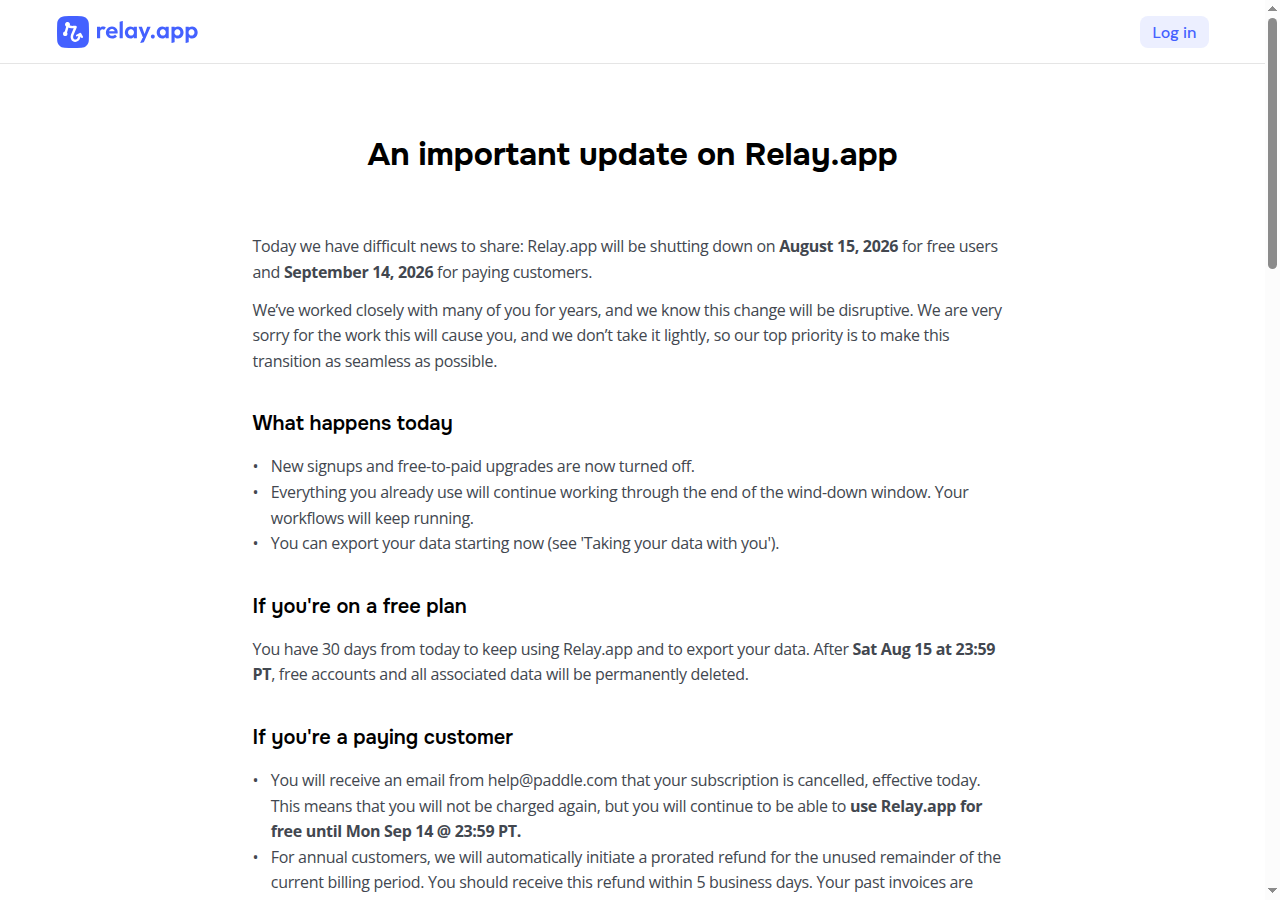
Relay.app is shutting down; Agently launched the same week. The real question is whether Agently's company-brain approach replaces it.

Affiliate disclosure: Some links in this post are affiliate links. If you click through and make a purchase, SaaSpicious may earn a commission at no extra cost to you. This does not affect our verdict — we call it as we see it.
The Verdict
Pick Agently. Not because it’s better at everything Relay.app did (it isn’t — yet), but because Relay.app is shutting down. As of July 16, 2026, new signups are closed, free accounts will be deleted by August 15, and paid accounts by September 14. There is no future to build on.
If you are a Relay.app user right now, your task is migration, not comparison. Export your workflows as JSON, save your AI prompts, and start evaluating alternatives. Agently is the closest conceptual successor — not a workflow builder, but an AI workforce that handles work across your tools. It’s also brand new, untested at scale, and runs on a credit model that’s hard to forecast. You should know all of that before you commit.
Who this verdict is wrong for: developers who need raw flexibility (custom JavaScript, HTTP requests, MCP server creation) and teams who want a mature, SOC 2 certified platform with years of production history. Agently doesn’t do those things today.
What Happened: The Same Week
On July 16, 2026, Relay.app announced it was shutting down. The same week, Agently launched on Product Hunt with 349 upvotes and a #4 daily rank.
Agently is not a drop-in replacement for Relay.app. The products work in opposite ways: one is a trigger-based workflow builder, the other is an autonomous workforce. But if you need to move, Agently is the most relevant destination.
How They Compare
These tools solve the same problem from opposite directions. Relay.app was a trigger-based workflow builder. You set up “when X happens, do Y.” Agently is autonomous: you connect your tools, a company brain builds itself, and Jarvis (the orchestrator) detects what needs doing and spins up agents to handle it.
| Dimension | Agently | Relay.app |
|---|---|---|
| Paradigm | Autonomous AI workforce | Trigger-based workflow builder |
| Setup | Connect tools, brain auto-builds | Build workflows manually or via AI chat |
| Memory | Temporal knowledge graph that understands state changes | Per-workflow knowledge base |
| Orchestration | Jarvis detects what needs doing and spins up agents | Triggers fire, workflows run |
| Output | Real documents (decks, sheets, pages) | Workflow runs, data transforms, API calls |
| Built-in tools | Spaces (Kanban), Pages (docs), Calendar, Messaging | None (relies on external tools) |
| Custom code | No (agents handle it) | JavaScript runner, HTTP requests |
| MCP support | Connect to MCP tools via Composio | Create MCP servers and connect to remote ones |
| Human-in-the-loop | Approval gates on sends, payments, posts | Approval steps, AI output review, data input |
| Governance | Recursive policy controls (changing a policy is itself gated) | Standard permissions/roles |
| Entry price | $29/mo | N/A (shutting down) |
| Maturity | Launched July 2026, SOC 2 in progress | Years in market, SOC 2 certified, 5.0 PH rating |
| Status | Active, early access | Shutting down (final deletion Sep 14, 2026) |
What Relay.app Did Well
Relay.app earned real loyalty. It had a 5.0 rating on Product Hunt with 43 reviews. Users consistently called it better than Zapier and Make. Its strongest features:
Human-in-the-loop that actually worked. You could insert approval steps, AI output reviews, and data-input pauses into any workflow. Real people could inspect, edit, or reject AI work before it went live — the feature that made businesses trust automation with customer-facing actions.
MCP server creation. Relay.app let you turn your workflows into MCP tools that Claude, Cursor, and other AI clients could call directly — bridging no-code automation and developer toolchains in a way no one else had.
Developer flexibility. A built-in JavaScript runner, HTTP request steps, custom webhook responses, and a secret store gave technical users room to build what the visual editor couldn’t handle.
Breadth of connectors. Relay.app offered native app connectors across CRM, email, PM, communication, and finance tools — a broad library that was one of its strongest selling points.
Price. The free tier was genuinely usable and the paid plans were accessible for individuals and small teams alike.
Where Relay.app Lost
The shutdown is the only item on this list that matters now, but the structural limitations were real even before the announcement:
Reactive only. Everything needed a trigger. No trigger, no action. Relay.app couldn’t look across your tools and notice a churning customer, a stale deal, or a blocked PR on its own.
No cross-tool entity resolution. If the same customer appeared in Stripe, Slack, and HubSpot, you had to wire those correlations manually. Relay.app saw siloed events, not a unified picture.
No built-in workspace. You needed Notion for docs, another tool for project management, and yet another for calendar. Relay.app was pure infrastructure — it ran the plumbing but didn’t give you a place to work.
Knowledge stayed per-workflow. Each automation had its own context. There was no company-wide brain that accumulated understanding across everything you connected.
No compounding memory. Workflows were independent. A correction you made in one workflow didn’t teach anything to the next one.
What Agently Does Differently
Agently isn’t a workflow builder. It’s an autonomous company brain. Here’s what that means in practice:
Temporal knowledge graph. Agently’s brain understands state changes. “Acme Corp became a churn risk” replaces “Acme Corp was an active customer.” It doesn’t just stack facts — it tracks what was true, when, and what changed. This is called bi-temporal memory, and it’s the foundation for autonomous action.
Jarvis orchestrator. Instead of building triggers, you connect your tools and Jarvis scans for things that need attention. It detects a failed Stripe charge, checks the Slack thread about that customer, finds the related Linear ticket, and spins up the right agent to draft a save email, update the ticket, and flag the account — all without you writing a single “if this, then that.”
Six specialized agents. Apex (Sales), Nova (Ops), Echo (CS), Pulse (Marketing), Lens (Research), and Nexus (Workspace Guide). Each has role-specific tools and domain expertise. You don’t build workflows; you give an agent a job to run.
Real document outputs. Agents ship actual artifacts: slide decks, spreadsheets, Notion-style pages, HTML landing pages. These are gated, shareable, and auditable. Not chat logs.
Built-in workspace. Spaces (Kanban project management), Pages (block-based document editor), Messaging, Calendar, and Inbox are all inside Agently. You can run the company without leaving the platform.
Compounding value. Every correction, approval, or rejection gets encoded as a durable signal. The brain gets sharper with every interaction. This creates a genuine moat — leaving gets harder over time because you’d lose all that accumulated knowledge.
Where Agently Loses
Agently is promising, but it has real gaps:
Brand new, unproven. Agently launched the week of July 16, 2026. There are no long-term users, no production war stories, and no independent benchmarks on agent reliability. The testimonials on the site are early-adopter quotes from a closed cohort — they’re encouraging but not proof.
Credit model uncertainty. Agently runs on credits that agents consume per task (Starter includes 1,450 credits for $29/mo). The problem: you won’t know your actual monthly cost until you use it. A “save email” might cost 3 credits or 30 — the docs don’t give per-action estimates. This makes budgeting hard.
Less flexible than a workflow builder. No custom JavaScript. No arbitrary HTTP calls. If your workflow needs to hit an internal API or run a transform that isn’t in the agent’s playbook, you’re stuck.
Smaller connector library. Agently connects via Composio but its library is still growing. Missing connectors could be a dealbreaker depending on your stack.
No free tier. From current docs and homepage, there’s no permanent free tier. The entry point is the Starter plan at $29/mo.
Agent quality at scale is unknown. Can six agents handle a team of 50? What happens when Jarvis spins up conflicting tasks? No one outside the beta cohort knows.
Risk of over-automation. Autonomous agents making decisions without step-by-step human review sounds great in theory. In practice, you might not catch a badly-judged customer email until it’s already sent. The approval gates help, but they require you to configure policies carefully — and getting policy wrong is itself a risk.
Agently Pricing Breakdown
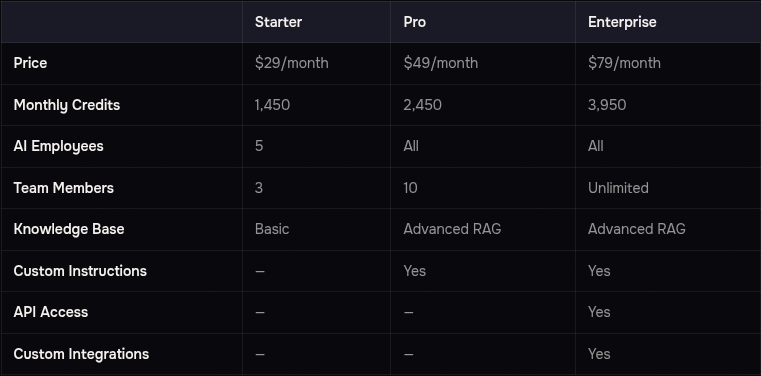
Agently’s pricing is a straightforward monthly subscription, with each tier including a set number of credits that agents consume per task. Here’s what the docs show as of July 2026:
Subscription plans:
| Plan | Price/mo | Credits | Agents | Team Members | Key Extras |
|---|---|---|---|---|---|
| Starter | $29 | 1,450 | 5 of 6 | 3 | Basic knowledge base |
| Pro | $49 | 2,450 | All 6 | 10 | Advanced RAG, custom instructions |
| Enterprise | $79 | 3,950 | All 6 | Unlimited | API access, custom integrations |
Prices accurate as of July 2026; check the vendor’s site for current rates.
Migration Path: Relay.app to Agently
If you’re moving from Relay.app to Agently, here’s the practical path:
-
Export your data now. Relay.app allows exports of workflows, sequences, and MCP servers as JSON plus AI prompts, run history, and tables as CSV. Free accounts have until August 15, 2026; paid accounts until September 14, 2026.
-
Map workflows to agents. Instead of rebuilding every trigger-step chain, identify which Agently agent covers each function. Your customer-success workflows probably map to Echo. Sales ops go to Apex. Content and marketing go to Pulse.
-
Preserve your AI prompts. Relay.app’s export includes AI prompt text. These are portable — you can reuse the prompt logic in Agently’s agent instructions or custom agent configurations.
-
Re-evaluate what needs automation. Relay.app workflows were reactive triggers. Agently is autonomous awareness. Some workflows you won’t need to rebuild because Jarvis catches them on its own. Others may need a different approach entirely.
-
Start with one agent. Don’t try to replicate everything at once. Pick the highest-value function (customer success if you’re support-heavy, sales ops if you’re pipeline-driven) and get one agent running first.
Alternatives Beyond Agently
If Agently’s autonomous-brain model doesn’t fit how you work, here are other platforms to consider:
| Tool | Type | Best For | Price |
|---|---|---|---|
| Zapier | Workflow automation | Largest app library | Free — paid |
| Make | Visual automation | Complex data mapping, visual builder | Free — paid |
| n8n | Open-source automation | Self-hosting, code-friendly, privacy | Free — paid |
| Lindy.ai | AI agents | Single-purpose AI employees for specific tasks | Paid plans |
None of these have a temporal knowledge graph or a Jarvis-like orchestrator. They are all trigger-based or single-agent tools. If you want something closer to Relay.app’s workflow model, Make or n8n are the most direct replacements.
If your automation question is really about cost at scale rather than agent autonomy, Albato vs Zapier covers that pair — Albato’s transaction billing undercuts Zapier as volume grows, while Zapier’s 9,000+ apps and governance stay unmatched.
For more head-to-head SaaS comparisons, browse our full comparison library.
Bottom Line
Relay.app was a great product that’s now gone. Its users have 30-60 days to migrate. Agently is the most ambitious alternative in the same category — it goes further than Relay.app ever did on autonomous awareness and cross-tool intelligence, but it’s brand new and carries significant unknowns.
Pick Agently if you are willing to trade proven reliability for an autonomous brain that compounds over time. Pick Zapier or Make if you need a battle-tested workflow builder with a mature connector library and predictable pricing. Pick n8n if you want full control, self-hosting, and the ability to write custom code.
If you were a Relay.app power user who relied on the JavaScript runner, custom HTTP requests, or MCP server creation, Agently is not for you today. Wait and watch — those capabilities may come, but they’re not here yet.