25 June 2026 · Comparison
Sellfy vs Etsy (2026): Which Wins for Digital Products?
The short answer
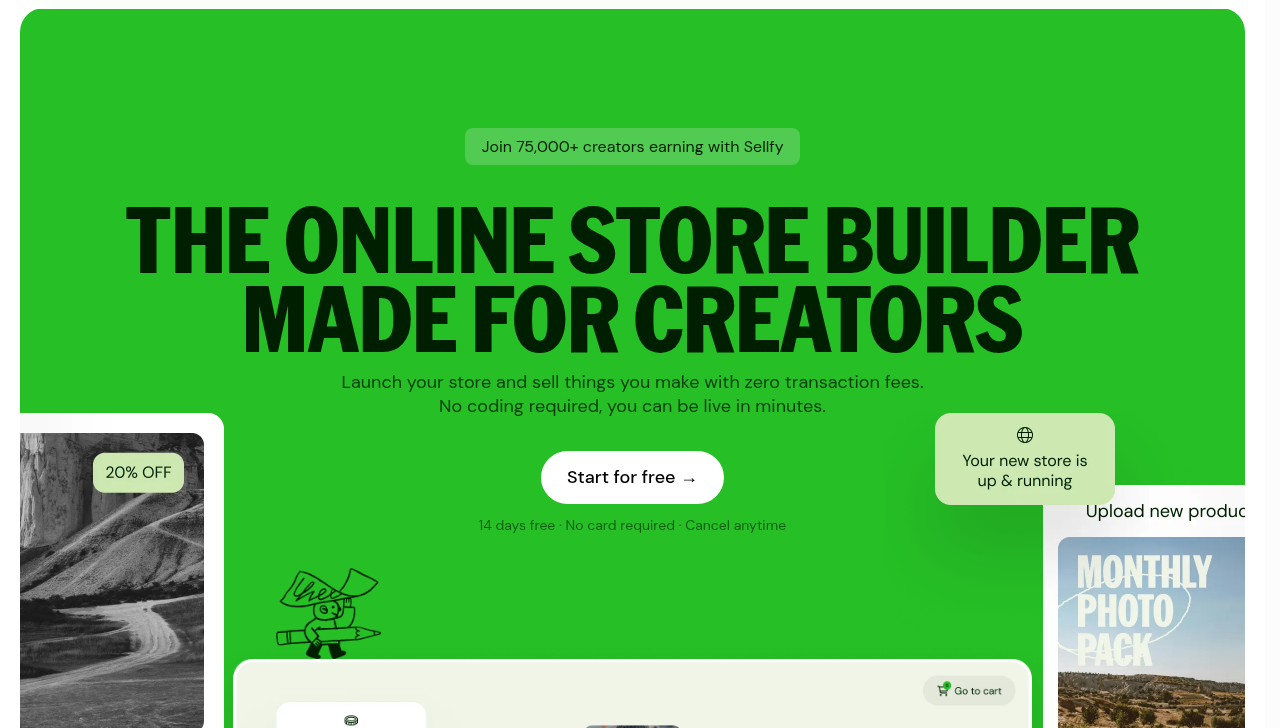
Etsy brings built-in traffic but takes 6.5% per sale plus listing fees. Sellfy charges 0% and gives you a branded store, if you bring the audience.
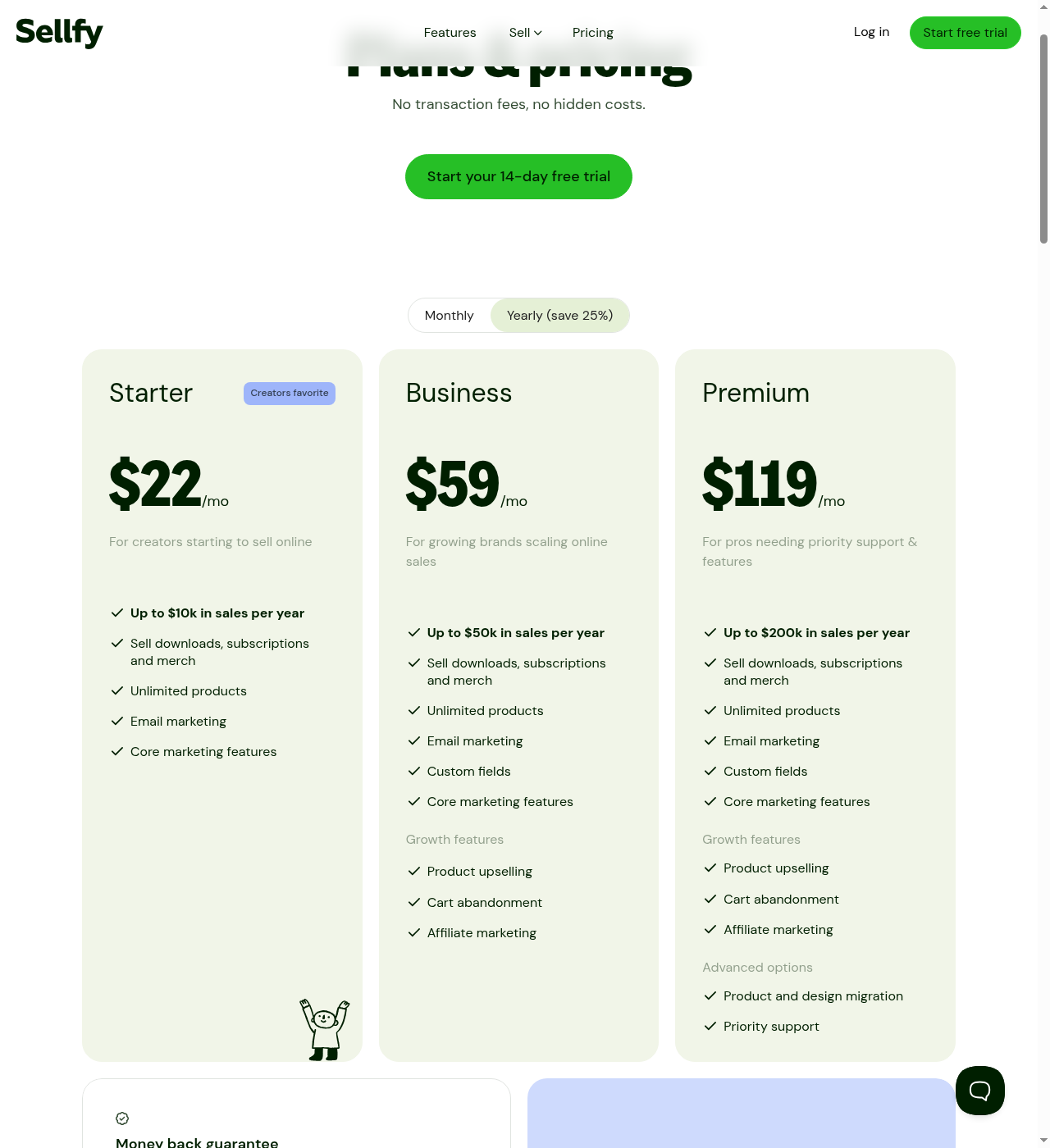
Verdict: Pick Etsy if you have zero audience and need built-in discovery — millions of active buyers who browse the marketplace daily, and it costs nothing to start. Pick Sellfy if you already have traffic from social media, email, or search, and you are tired of paying Etsy’s 6.5% transaction fee plus $0.20 listing fee plus 3% + $0.25 payment processing on every sale. At roughly $3,000/year in sales, the fee math flips: Sellfy’s $22/month Starter plan (billed annually) with 0% transaction fees costs less than what Etsy takes per sale. Many creators run both — Etsy for discovery, Sellfy for direct sales — and that is the strategy this post argues for.
Affiliate disclosure: Some links in this post are affiliate links. If you click through and purchase, SaaSpicious may earn a commission at no extra cost to you.
The Core Trade-Off: Marketplace Traffic vs. Fee-Free Sales
Sellfy and Etsy sit on opposite sides of the creator-sales spectrum. One charges you nothing per month but takes a cut of every sale. The other charges you a flat monthly rate and takes no transaction fees. The right pick depends entirely on where your customers come from.
| Sellfy | Etsy | |
|---|---|---|
| Monthly cost | $29/mo (Starter), $79/mo (Business), $159/mo (Premium) | $0 |
| Annual cost (Starter, billed yearly) | $264/year ($22/mo) | $0 |
| Transaction fee | 0% | 6.5% |
| Payment processing | Stripe/PayPal (approx 2.9% + $0.30) | 3% + $0.25 (US) |
| Listing fees | None | $0.20 per item, renews every 4 months |
| Built-in audience | None — you bring traffic | Millions of active buyers |
| Customer ownership | Full — emails, lists, retargeting | None — Etsy owns the relationship |
| Store branding | Your domain, your brand | etsy.com/shop/YourName, Etsy branding |
| Digital file limits | 10-20GB depending on plan | 20MB |
| Subscriptions | Built-in | Not available |
| Print-on-demand | Built-in (SPOD) | Not available |
| Email marketing | Built-in | Not available |
| Affiliate program | Built-in (Business plan+) | Not available |
| Cart abandonment emails | Built-in (Business plan+) | Not available |
Etsy: The Discovery Engine
Etsy is the world’s largest marketplace for handmade, vintage, and creative goods. It puts your products in front of millions of active buyers who come to the platform specifically to browse and purchase. For a new creator with no following, no email list, and no ad budget, this is irreplaceable.
What Etsy does well
- Zero upfront cost. It costs $0.20 to list an item. There is no monthly subscription, no annual fee, no charge to open a shop. You only pay when you sell.
- Built-in purchase intent. People on Etsy are shopping, not scrolling. They search for “handmade silver necklace” or “digital planner template” with intent to buy.
- Buyer trust and purchase protection. Etsy’s brand, return policies, and Purchase Protection Program give buyers confidence. A brand-new standalone store on a custom domain has none of this.
- Advertising infrastructure. Etsy Ads promote your listings inside the marketplace. Offsite Ads place your listings on Google, Facebook, Instagram, Pinterest, and Bing. No need to figure out ad pixels or campaigns yourself.
- Seller community. Etsy’s active sellers, forums, Teams, and Seller Handbook give new sellers support and education built in.
Where Etsy loses
-
The fee stack is brutal at volume. On a $25 item, Etsy takes roughly $2.83 per sale (about 11.3% total). That includes the $0.20 listing fee, 6.5% transaction fee, and 3% + $0.25 payment processing. If an Offsite Ad triggers at 15%, the total can exceed 20% of the sale price. At 100 sales per month, you are paying Etsy roughly $303/month in fees.
-
You do not own the customer. Etsy prohibits you from adding buyers to your email list, marketing to them, or directing them off-platform. If Etsy changes its search algorithm — and it does — your traffic can vanish overnight. You built a business on rented land.
-
The branding is Etsy’s, not yours. Your shop is an etsy.com subdomain. Every product page shows competing sellers in the sidebar and footer. You cannot build a standalone brand identity inside Etsy’s walls.
-
Digital products are an afterthought. The 20MB file size limit for digital downloads makes Etsy unusable for video courses, large design assets, software, or audio files. No subscriptions, no PDF stamping, no download limits, no video streaming.
-
No marketing tools. Etsy has no email marketing, no affiliate program, no upselling, no cart abandonment recovery, and no coupon stacking. If you want any of these, you need a different platform.
Who Etsy is right for: Creators with no existing audience who sell handmade or vintage physical goods under $50, and anyone doing under roughly $3,000/year in sales where the fee math favours Etsy’s no-monthly-cost model.
Sellfy: The Graduation Platform
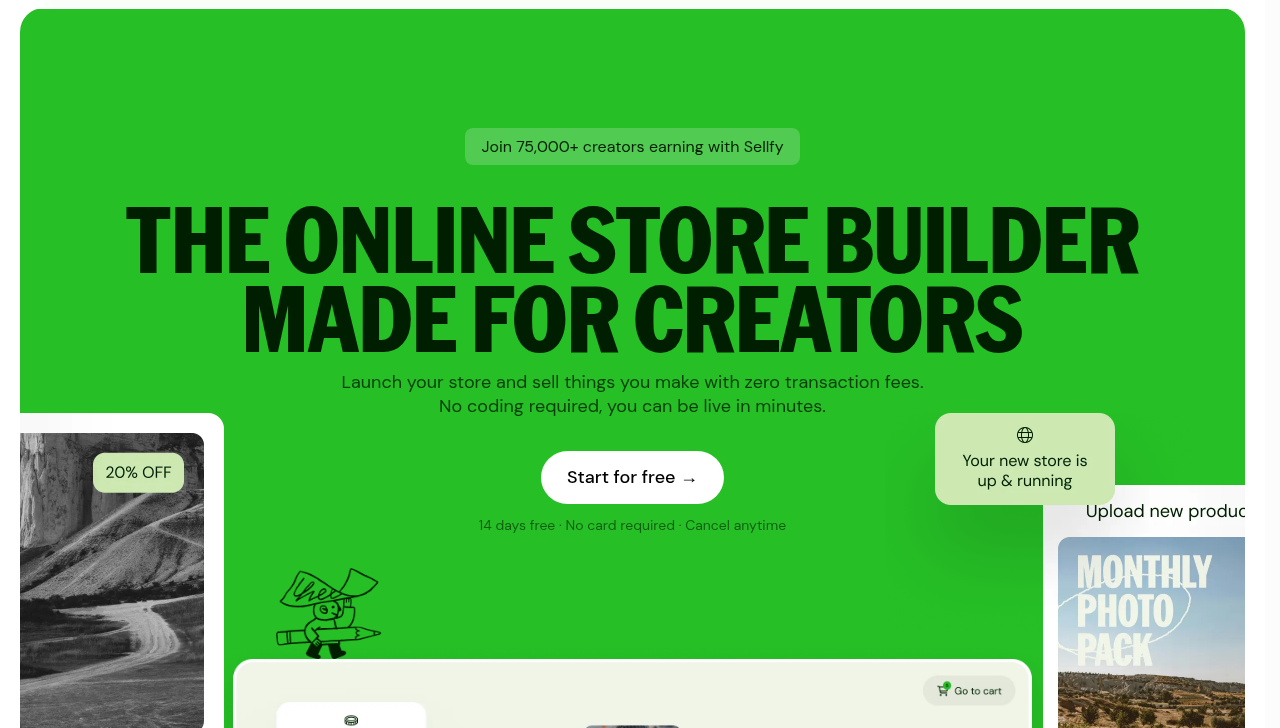
Sellfy is a stand-alone store platform built for creators who sell digital products, physical goods, print-on-demand merchandise, and subscriptions. It charges a flat monthly fee and takes 0% transaction fees on every plan. You own your customer list, your domain, and your brand.
What Sellfy does well
-
0% transaction fees. On Sellfy’s Starter plan at $22/month (billed annually), every dollar of your sale is yours. Payment processing via Stripe (approximately 2.9% + $0.30) and PayPal applies, but Sellfy itself takes nothing. If you sell $5,000/month, that is roughly $300/month in fees you would have paid to Etsy that you now keep.
-
You own the customer relationship. Sellfy gives you buyer emails, lets you build lists, send email marketing, and retarget customers. If a platform changes its rules, your list goes with you.
-
Your domain, your brand. Full custom domain, custom code, drag-and-drop store builder, free templates, and Sellfy branding removal (on Business plan). Customers see your brand, not a marketplace wrapper.
-
All-in-one built-in marketing. Email marketing, upselling, cart abandonment recovery, and affiliate marketing are native to Sellfy — not third-party add-ons.
-
Print-on-demand is built in. Via SPOD. Design a graphic, list the product, and Sellfy handles printing and shipping. Shopify needs Printful. Etsy has no native POD.
-
Huge file support. 10GB file size on Starter, 15GB on Business, 20GB on Premium. Compare to Etsy’s 20MB cap. Sellfy also includes PDF stamping and download limits for anti-piracy.
-
Instant payouts. Money from Stripe and PayPal goes directly to you. No waiting for a marketplace disbursement schedule.
Where Sellfy loses
-
No built-in audience. Sellfy is a tool, not a marketplace. If you have zero traffic, zero email list, and zero social following, Sellfy will not generate sales on its own. Sellfy’s own alternatives page admits this: “Sellfy is NOT for: Those without an audience or a way to bring traffic to their store.”
-
Monthly subscription cost. You pay whether you sell or not. If your sales are under roughly $3,000/year, Etsy’s per-sale fee model costs less than Sellfy’s $264/year minimum (Starter, billed annually).
-
Limited third-party integrations. Sellfy does not have an app store. If you need complex integrations with inventory management, accounting software, or specialized tools, a platform like Shopify with thousands of apps may be a better fit.
-
No marketplace discovery. No one is browsing Sellfy’s site looking for products to buy. Every visitor must come from your marketing efforts — social media, search, email, ads, or word of mouth.
-
Mobile management is web-only. Etsy has a dedicated Seller App. Sellfy is mobile-optimized but does not have a native mobile app for store management.
Who Sellfy is right for: Creators doing $3,000+/year in sales who already have traffic from social media, YouTube, email, or search. Digital product sellers with files over 20MB. Anyone who wants to build a brand on their own domain and own their customer relationships.
The Break-Even Math: When Does Sellfy Win?
The decision between Etsy and Sellfy is a math problem. At what sales volume does Sellfy’s flat monthly fee cost less than Etsy’s per-sale fees?
Here is a realistic scenario based on pricing as of June 2026:
Assumptions:
- Item price: $25
- Monthly sales: 100 items
- Etsy listing fee: $0.20 per item (100 new listings per month = $20/month)
- Etsy transaction fee: 6.5%
- Etsy payment processing (US): 3% + $0.25
- Sellfy Starter (annual billing): $22/month
- Stripe processing: approximately 2.9% + $0.30
- Transaction fees: Sellfy 0%, Etsy 6.5%
Per-sale breakdown (on one $25 item):
| Cost | Etsy | Sellfy Starter |
|---|---|---|
| Platform fee | $1.63 (6.5%) | $0.00 |
| Payment processing | $1.00 (3% + $0.25) | $1.03 (2.9% + $0.30) |
| Listing fee (amortized per sale) | $0.20 | $0.00 |
| Total per sale | ~$2.83 | ~$1.03 |
At 100 sales/month ($2,500/month revenue):
| Etsy | Sellfy Starter | |
|---|---|---|
| Per-sale fees (100 x per-sale total) | ~$283 | ~$103 |
| Monthly subscription | $0 | $22 |
| Listing fees (100 new listings) | $20 | $0 |
| Total monthly cost | ~$303 | ~$125 |
| Annual cost | ~$3,636 | ~$1,500 |
Sellfy saves roughly $178/month ($2,136/year) at this volume.
The break-even point: At approximately $2,500-$3,000/year in sales, Etsy’s cumulative per-sale fees equal Sellfy Starter’s annual subscription cost. Below that line, Etsy costs less. Above it, Sellfy is progressively cheaper — and the gap widens with every additional sale.
At higher volumes, the difference is dramatic:
- At $10,000/month in sales (400 items at $25 each): Etsy costs ~$1,212/month. Sellfy Starter costs ~$434/month. Sellfy saves ~$778/month ($9,336/year).
- If Etsy’s mandatory Offsite Ads (15% fee) trigger on even 10% of sales, Etsy’s fees become even steeper.
Note: If you exceed Sellfy’s annual sales cap ($10K on Starter, $50K on Business, $200K on Premium), a 2% overage fee applies on further sales until you upgrade.
The Dual-Platform Strategy: Run Both
The framing of “Etsy vs Sellfy” suggests you must pick one. You do not. Many successful creators run both platforms simultaneously.
Here is how it works:
-
Etsy is your discovery funnel. List your best products on Etsy. Let the millions of active buyers find you through Etsy search and Offsite Ads. Include a branded insert in every physical order and a thank-you PDF in every digital download — something that points buyers to your standalone site for more products, better prices, or exclusive content.
-
Sellfy is your profit center. Direct your social media followers, YouTube viewers, email subscribers, and repeat Etsy buyers to your Sellfy store. Every sale on Sellfy avoids Etsy’s 6.5% transaction fee and $0.20 listing fee. The margin difference on direct sales alone often justifies the $22/month subscription.
-
Etsy catches new customers. Sellfy keeps them. You own the email list. You own the retargeting. If Etsy changes its algorithm or fees, your Sellfy store and your email list are unaffected.
Etsy Fee Breakdown: What You Actually Pay
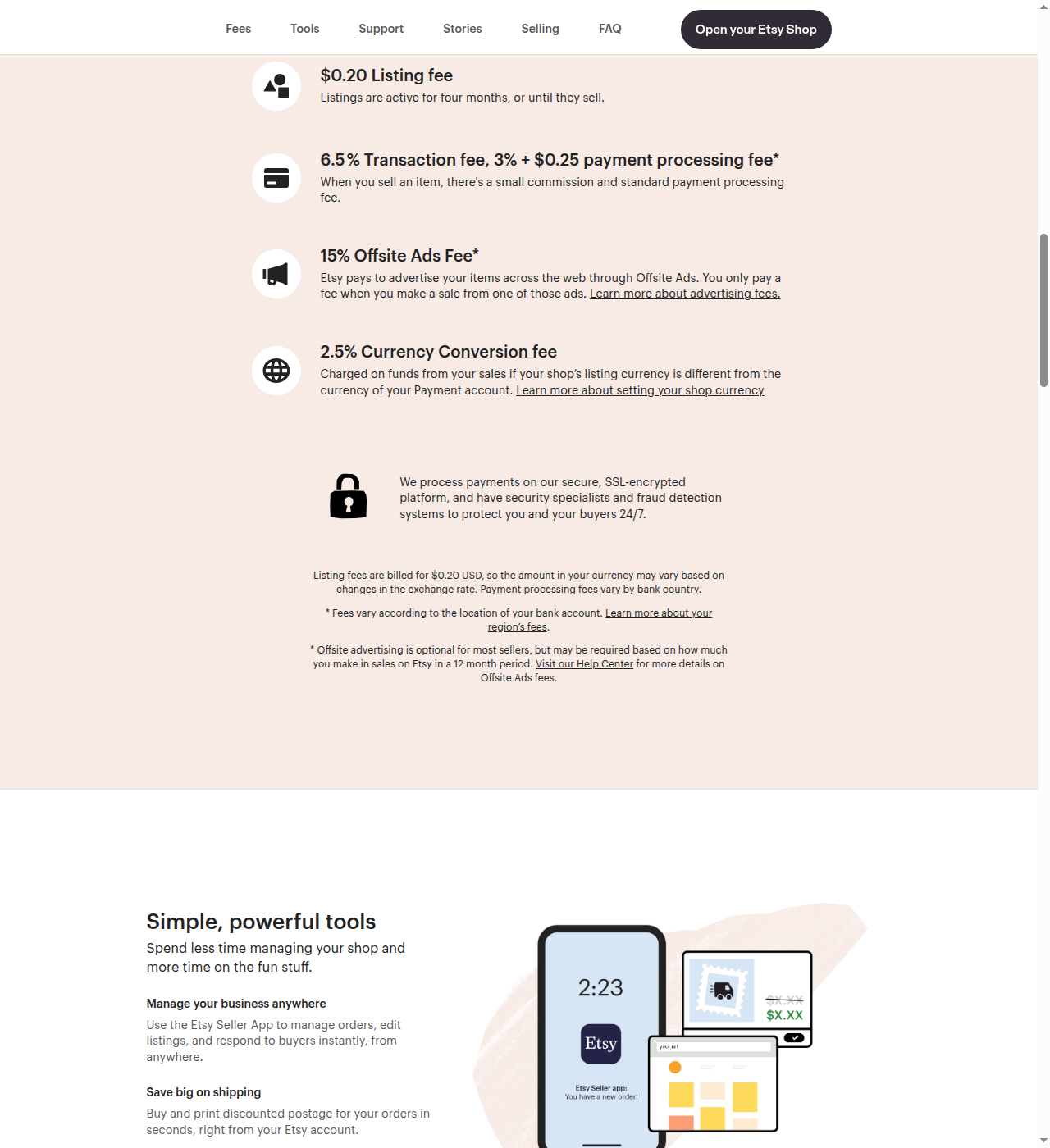
Etsy’s fee structure has multiple layers. Here is the full breakdown for US sellers:
| Fee | Rate | When it applies |
|---|---|---|
| Listing fee | $0.20 USD | Per item, every 4 months or when sold. Auto-renews. |
| Transaction fee | 6.5% | On total sale price including shipping. |
| Payment processing | 3% + $0.25 (US) | Per transaction through Etsy Payments. Varies by country. |
| Offsite Ads fee | 15% (or 12% for shops under $10K in 12-month revenue) | Optional for most sellers; mandatory if you earned $10K+ in 12 months. |
| Currency conversion | 2.5% | If your listing currency differs from your payment account currency. |
Etsy does not charge a monthly subscription. It costs nothing to open a shop (a one-time setup fee may apply in some cases).
Where Each Platform Genuinely Loses
Every comparison post should tell you where each tool is wrong — not just where it is right. Here are the honest downsides of both.
Sellfy loses when:
- You have no audience. Sellfy is a store builder, not a traffic source. If nobody knows you exist, nobody will find your Sellfy store. Etsy’s built-in discovery is irreplaceable at this stage.
- You sell exclusively handmade physical goods in low volume. Etsy’s category intent and buyer trust for handmade goods is unmatched. If you sell under $3,000/year, Etsy’s per-sale fees cost less than Sellfy’s subscription.
- You need complex integrations. Sellfy has no app store. If your business requires inventory sync with a physical warehouse, specialized accounting integrations, or a custom checkout flow, Shopify (or a platform with an app ecosystem) is a better fit.
- You are a vintage seller. Etsy has built its reputation and buyer base around vintage goods. Sellfy’s audience (which does not exist built-in) is not searching for vintage items.
Etsy loses when:
- You have built your own audience and Etsy is taxing traffic you generated. Every time you share your Etsy link on Instagram, Etsy takes 6.5% of the sale you drove. Once you have a following, that fee is a tax on your own marketing.
- You sell digital products over 20MB. Etsy physically cannot host files larger than 20MB. If you sell video courses, software, large design bundles, or high-resolution audio, Etsy is not an option.
- You want customer ownership. Etsy prohibits you from emailing buyers, building lists, or retargeting. Your business lives entirely inside a platform you do not control.
- You want built-in marketing tools. Email marketing, affiliate programs, upselling, cart abandonment recovery — none of these exist on Etsy. You need separate tools or a different platform entirely.
- Your sales exceed ~$3,000/year. The fee math flips. Above this threshold, Sellfy’s flat monthly fee costs less than what Etsy takes per sale.
Competition Snapshot: Other Tools to Consider
Sellfy and Etsy are not the only options. Here are the credible alternatives, depending on what matters most to you.
If you want both a marketplace and a store: Gumroad offers a free tier with a Discover marketplace but takes a percentage on the free plan. Their paid plan removes the marketplace fee. We have a full Sellfy vs Gumroad comparison for creators choosing between these two.
If you want the lowest-cost standalone store: Payhip and Ko-fi both offer free plans with transaction fees, and paid plans that remove them at competitive monthly rates.
If you also sell courses and memberships: Podia bundles courses, downloads, and community with 0% transaction fees.
If you sell on social media: Stan Store is mobile-first, designed for TikTok and Instagram creators.
If you need a full e-commerce engine: Shopify has thousands of apps but you will need paid apps for features Sellfy includes natively (digital delivery, email marketing, upselling).
If you sell on Amazon Handmade: Amazon’s referral fee is higher than Etsy’s, with massive traffic but the highest per-sale cost in this comparison.
Bottom Line: Who Should Pick What
Pick Etsy if: You are a new creator with no audience selling handmade, vintage, or small digital goods. Etsy’s millions of built-in buyers and zero upfront cost make it the best starting point. The fees are the price of discovery. Pay them until you outgrow them.
Pick Sellfy if: You have traffic — from social media, YouTube, search, or an existing customer base — and you are doing $3,000+/year in sales. At that point, Sellfy’s flat $22/month subscription (billed annually) with 0% transaction fees costs less than Etsy’s fee stack. You also get email marketing, customer ownership, huge file support, subscriptions, and print-on-demand — features Etsy simply does not offer.
Do both if: You can handle the logistics of two storefronts. Use Etsy as your discovery engine and Sellfy as your profit center. The margin difference on direct sales alone typically covers Sellfy’s subscription many times over.
Prices, fees, and limits in this post are accurate as of June 2026. Check each platform’s website for current rates.