1 August 2026 · Comparison
netcup Object Storage vs Hetzner: The S3 Question, Answered
The short answer
if you only need raw block storage attached to a VPS, will store under ~500 GB, and are willing to run MinIO yourself for S3 compatibility at a lower monthly cost.
if you want true native S3: a real S3 API, bucket management, and integration with the whole AWS tooling ecosystem, from €6.49/mo net for 1 TB including 1 TB egress.
The one-sentence verdict: Pick Hetzner if you need S3 - and if you searched “netcup S3”, that’s what you actually need. Hetzner runs a genuine S3-compatible Object Storage product from €6.49 per month net, 1 TB storage and 1 TB egress included. Pick netcup if you only need raw block storage bolted onto a VPS at under ~500 GB, and you’ll run MinIO yourself when you want an S3 API. netcup sells no S3-compatible object storage at all - that is the entire comparison in one line.
Affiliate disclosure: Some links in this post may be affiliate links. If you click through and make a purchase, SaaSpicious may earn a commission at no extra cost to you. We check prices against each vendor’s live pricing page and name the downsides on both sides regardless.
Why compare these two at all?
Because Google is full of people typing “netcup s3” and “netcup object storage” - and the honest answer is that the product they’re looking for doesn’t exist. Our full netcup vs Hetzner comparison covers the VPS spec battle (netcup wins on hardware per euro, Hetzner wins on ecosystem), and our best cheaper Hetzner alternatives roundup puts netcup up against the rest of the budget field, including providers that also skip object storage. This post is the storage-only cut of that argument: what each company will actually sell you when you ask for “storage”, what it costs per TB, and what you have to build yourself to close the gap.
The core difference, up front: Hetzner has a first-party, S3-compatible object storage product with buckets, lifecycle policies, versioning, and an API that AWS CLI and the AWS SDKs speak natively. netcup has no object storage product - its storage options are raw block storage (attached disks on a VM) and an NFS-based “Storage Space” for servers. Neither is S3. If your backup tool, application, or Terraform setup expects an S3 endpoint, only one of these providers gives it to you out of the box.
Hetzner Object Storage: the actual S3 product
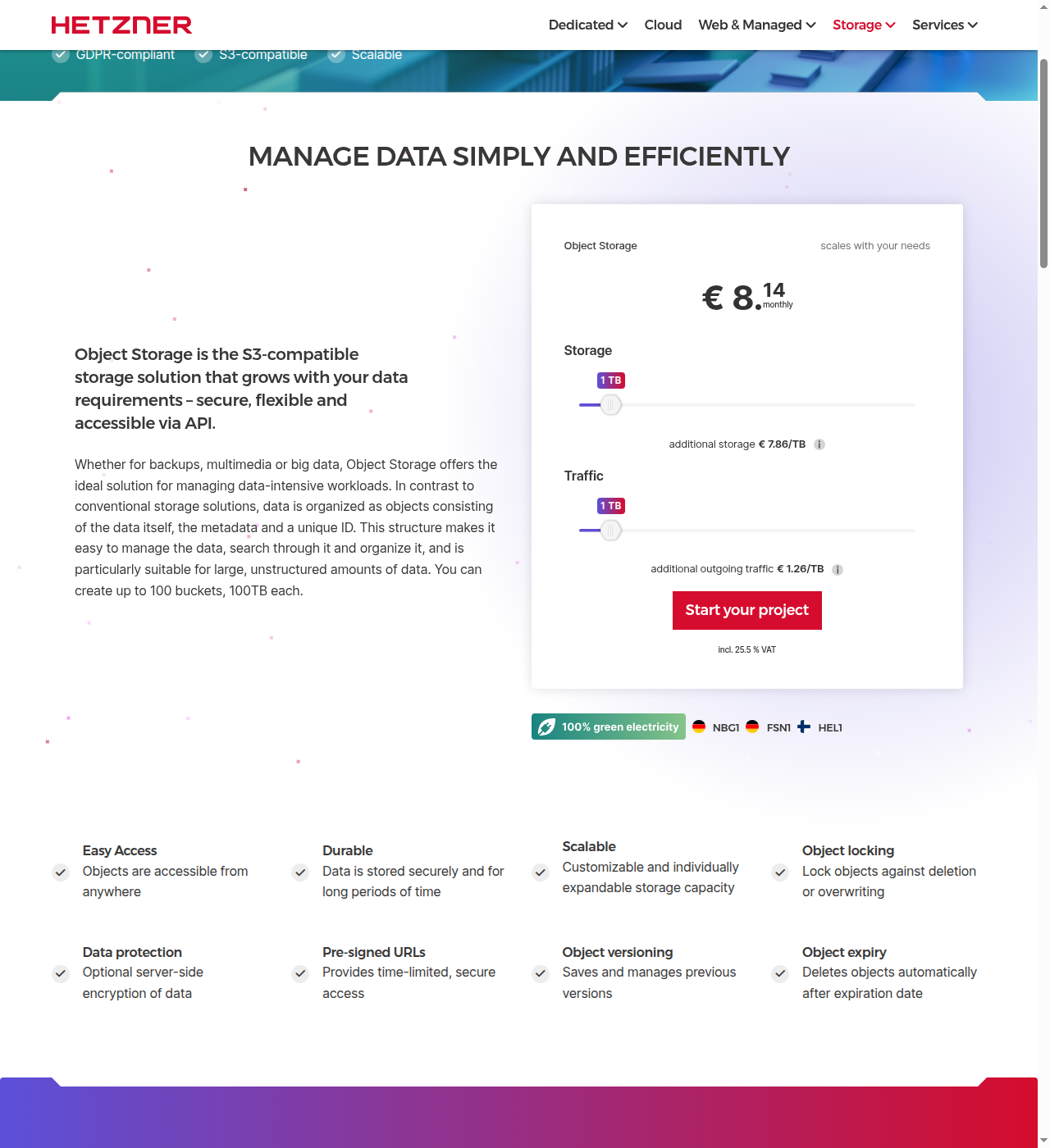
Hetzner’s Object Storage is a standalone product in the Hetzner Cloud console. You create buckets, get S3 credentials, and talk to it over the standard S3 API. The pricing model is a monthly base price that includes a quota, plus pay-as-you-go on top:
| Item | Price (net) | Notes |
|---|---|---|
| Base price | €6.49 per month | Includes 1 TB storage + 1 TB egress. Billed hourly, capped at the monthly price. Charged for every hour you have at least one active bucket, even an empty one. |
| Additional storage | €6.26 per TB per month | Billed per TB-hour, beyond the included 1 TB. |
| Additional egress | €1.00 per TB | Beyond the included 1 TB. Ingress (uploads) is free, and S3 API calls are free. |
Prices accurate as of August 2026; check the vendors’ sites for current rates. Hetzner’s site displays prices including your local VAT rate at view time (the screenshot above shows 25.5% VAT as served to one EU region); the table above is net.
What you get for that base price:
- A real S3 API: AWS Signature V4, and the AWS CLI plus the AWS SDKs for Python, Go, and .NET work against it directly.
- Bucket tooling: up to 100 buckets, each holding up to 100 TB and 50 million objects. Object locking, object versioning, lifecycle/expiry policies, pre-signed URLs, and server-side encryption with customer keys (SSE-C).
- Three EU locations: Falkenstein (FSN1), Nuremberg (NBG1), and Helsinki (HEL1).
- Ransomware-resistant backups: object locking means locked objects can’t be deleted or overwritten - the classic backup-target play.
- Honest architecture caveats from Hetzner’s own docs: it’s a standard-tier, HDD-backed store. Great for backups, archives, and write-once-read-many workloads; explicitly wrong for databases, high-frequency small reads, or serving hot content to thousands of users (that’s CDN territory, and Hetzner tells you to put a CDN in front).
If you’re already a Hetzner Cloud customer, the appeal is obvious: S3 storage on the same account and invoice as your servers, with traffic inside the eu-central zone free.
netcup’s storage options: no S3, by design
netcup’s product line is servers, not storage services. The two storage products it does sell are both add-ons to a server you already rent:
Storage Space (NFS) - the closest thing to a storage service
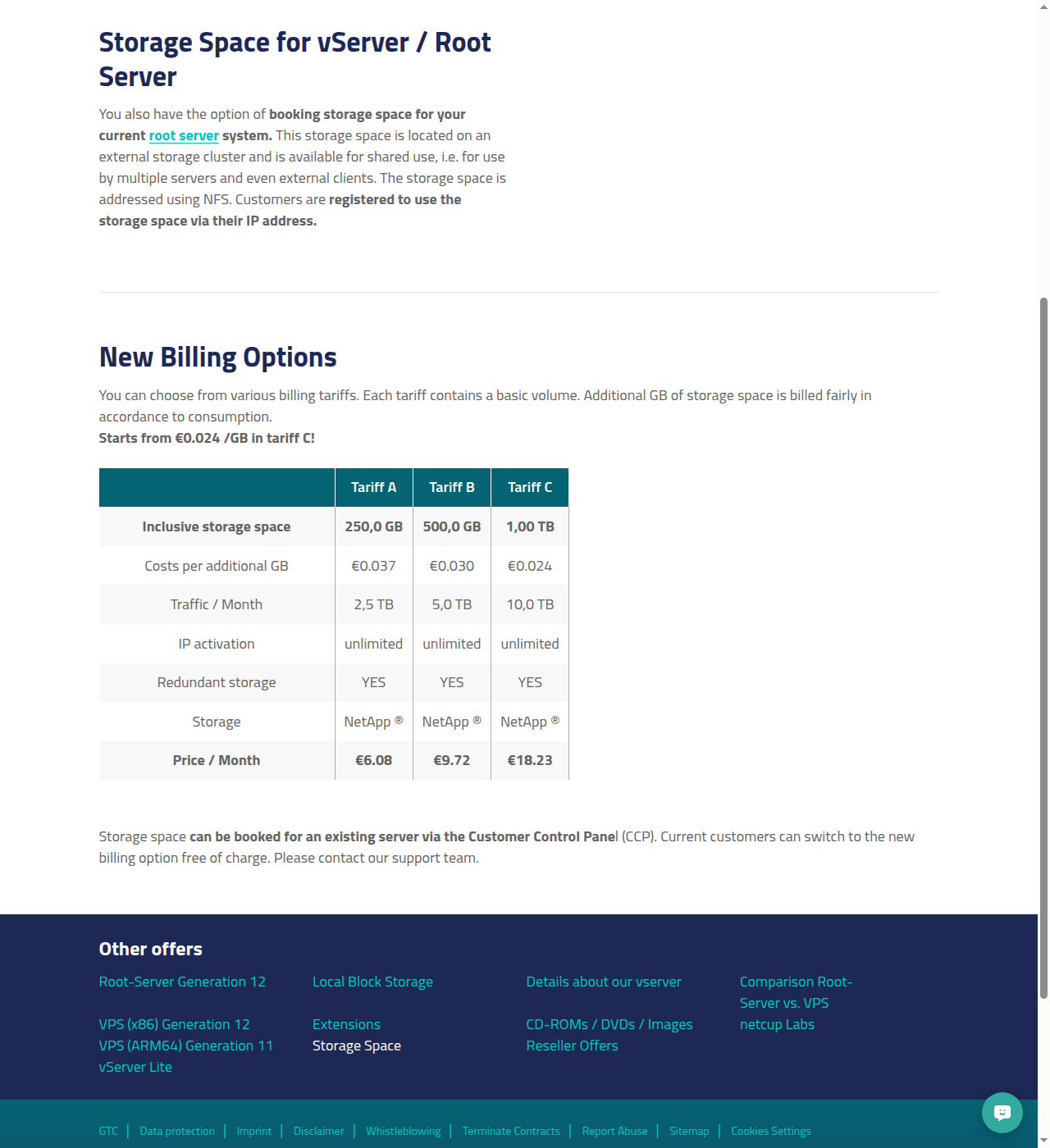
Storage Space is an external, shared storage cluster you attach to an existing root server or vServer. It’s addressed over NFS and registered by IP address - not an internet-facing object store, not S3, and not even a file protocol you can use from arbitrary machines without an IP allowlist.
| Tariff | Included storage | Extra per GB | Traffic / month | Price / month |
|---|---|---|---|---|
| A | 250 GB | €0.037 | 2.5 TB | €6.08 |
| B | 500 GB | €0.030 | 5 TB | €9.72 |
| C | 1 TB | €0.024 | 10 TB | €18.23 |
Netcup’s site displays these prices including 19% VAT. All three tariffs run on redundant NetApp storage, and you can activate unlimited IPs. You book it through the Customer Control Panel for a server you already own - it’s not a standalone product.
Local Block Storage - raw disks for a VPS or root server
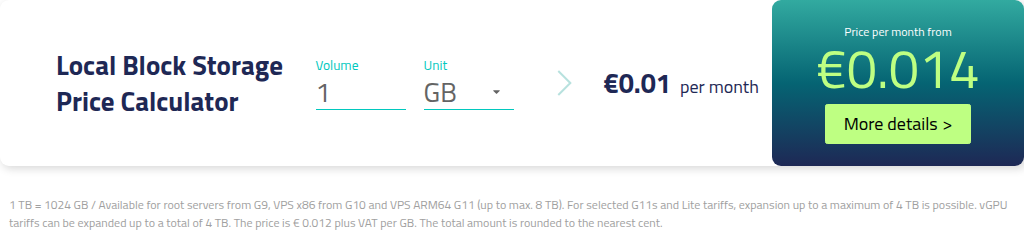
This is plain attached disk: block storage from 1 GB up to 8 TB total, depending on the server generation (root servers from G9, VPS x86 from G10/G11, ARM64 G11, vGPU). The price is €0.012 per GB per month (plus VAT), billed every 30 days, no minimum contract term. There are no file-system restrictions - you format the disk however you like. You can only grow it, never shrink it: reducing capacity means ordering a new smaller unit and copying the data over.
The math that matters: at 1 TB (netcup counts 1024 GB to a TB), Local Block Storage runs to about €12.29 per month net - roughly €14.62 including 19% VAT. That’s a raw disk. There’s no API, no buckets, no versioning, no access from outside the server.
Price per TB, head to head
Let’s put the realistic choices side by side at the sizes people actually shop for:
| Hetzner Object Storage | netcup Local Block Storage | netcup Storage Space | |
|---|---|---|---|
| S3 API | Native (AWS CLI/SDKs) | None (raw disk) | None (NFS) |
| Base fee | €6.49/mo (1 TB incl.) | None - pure per-GB | From €6.08/mo (250 GB) |
| ~250 GB | €6.49/mo (base, 1 TB incl.) | ~€3.00/mo net | €6.08/mo (incl. VAT) |
| ~1 TB | €6.49/mo net (1 TB incl.) | ~€12.29/mo net (1024 GB) | €18.23/mo (incl. VAT) |
| Egress/traffic | 1 TB incl., then €1.00/TB | Free (inside your server) | 2.5-10 TB/mo included |
| Access | HTTPS API from anywhere | Attached disk only | NFS via IP allowlist |
| Buckets, versioning, lifecycle | Yes | No | No |
| Locations | FSN1, NBG1, HEL1 (EU) | Your server’s location | External netcup cluster |
Three things jump out of that table.
First, Hetzner is cheaper per TB than netcup’s raw disk at 1 TB. €6.49 net buys you a managed S3 service with 1 TB included; 1024 GB of netcup block storage costs about €12.29 net and it’s just a disk. Below roughly 540 GB the positions flip - Hetzner’s base fee is flat, so small buckets on netcup block storage are cheaper. Netcup’s “cheap storage” reputation is real, but it’s a small-volume or attached-disk story, not a per-TB-object-storage story.
Second, netcup’s cheapest S3-compatible path is not a netcup product. There is no “netcup S3”. The cheapest way to get an S3 API on netcup hardware is to run MinIO on one of its VPSes, pointed at block storage (see below). You’re renting the metal and doing the ops.
Third, the VAT trap in the tables. Hetzner quotes net prices and adds your local VAT at display time (the widget in the screenshot shows 25.5% for one EU region). netcup’s published prices already include 19% VAT. When comparing, use the net figures or you’ll overpay Hetzner by ~20% in your mental math.
The MinIO play: S3 on netcup, if you want to build it
This is the option neither vendor’s marketing page will show you. MinIO is an open-source, S3-compatible object storage server that runs from a single Docker container on any Linux VPS. Point it at a netcup block storage volume (or the server’s own disk), and you get a working S3 endpoint: buckets, keys, and an API that rclone, Restic, and the AWS SDKs will happily talk to.
That’s how “netcup S3” gets built in practice, and it can be genuinely cheap: a small VPS plus block storage under ~500 GB costs less than Hetzner’s flat base fee at the same size. But you are now the operator. You handle updates, data integrity, backups of the bucket data, uptime, and, critically, you’ve traded Hetzner’s erasure-coded, object-locked, versioned bucket for a single-node MinIO install that you must keep healthy yourself. For a homelab, a personal backup target, or a dev environment, that trade is often worth it. For production data you’d rather not lose, Hetzner’s managed version costs less than your own engineering time.
Where Hetzner loses
1. You pay the base fee even if you use almost nothing. Hetzner charges from the hour you create a bucket, empty or not. If you only need 200 GB of attached disk for a single VPS, you’re paying for a whole TB of S3 quota you don’t use, on HDD-backed storage with API latency - the wrong tool twice over.
2. Not for anything latency-sensitive. HDD-backed, standard tier only, no cold/archive tier, and Hetzner’s own docs tell you it’s wrong for databases, high-frequency small reads, and direct-to-user content at scale. A raw NVMe block volume (Hetzner’s own Cloud Volumes, or netcup block storage) is faster and cheaper for those jobs.
3. Egress is metered. 1 TB of egress is included, then it’s €1.00 per TB. Data-heavy workloads that serve files to users will hit that overage; a CDN in front (which Hetzner recommends) adds its own bill.
4. EU-only, one region per bucket. No US or Asia locations for Object Storage. If you need object storage close to non-European users, Hetzner Object Storage isn’t the answer.
Where netcup loses
1. There is no S3 product, full stop. No buckets, no S3 credentials, no S3 API, no AWS CLI compatibility. Every tool that expects an S3 endpoint (Terraform backends, Restic, Borg, Duplicati, Synology Hyper Backup, most SaaS connectors) cannot talk to netcup storage directly. The search term “netcup s3” is a search for a product that doesn’t exist.
2. Storage Space is NFS with training wheels off. IP-allowlist registration, no encryption at rest mentioned on the product page, no object semantics, no lifecycle, no versioning, no API. It’s a network share, and it’s priced as one: the 1 TB tariff runs to about €18.23/mo including VAT - more than Hetzner’s managed S3 with 1 TB included.
3. Block storage is dumb disk. Attached to exactly one server, no concurrent access from other machines, no snapshots at the storage level (netcup’s VPS snapshots cover the system disk, not your added volume), and you can’t shrink it. Scaling means copying data off and re-ordering.
4. You’re the S3 vendor. The MinIO path works, but it’s a self-hosted service: updates, integrity checks, uptime, and backup-of-the-backup are all yours. If that sounds fine for a homelab and terrifying for production, you’ve found the honest boundary of this comparison.
Bottom line
Pick Hetzner Object Storage if you need S3 - which, if you’re reading a post about “netcup S3”, is the actual job. One managed product, a real S3 API, bucket locking and versioning, three EU locations, and 1 TB with 1 TB egress for €6.49 net per month. It’s the cheapest native S3 on a European budget host that we’ve found at this size.
Pick netcup if your need is really “more disk on this VPS” - Local Block Storage at €0.012 per GB per month with no base fee wins for volumes under ~500 GB, and the flexibility of a raw disk is fine for a single server. If you want S3 on top of it, budget for the MinIO container and your own operating hours.
And the honest caveat: this post is wrong for you if you picked netcup for storage under 1 TB and expected a vendor-managed S3 API - that combination does not exist at any price on netcup, and no amount of VPS-spec value changes that. For the VPS side of the argument, see the full netcup vs Hetzner comparison.
FAQ
Does netcup offer S3 object storage?
No. netcup’s product line includes vServers, root servers, web hosting, Local Block Storage (raw attached disks), and an NFS-based Storage Space for servers - no S3-compatible object storage. To get an S3 API on netcup hardware you self-host MinIO on a VPS and point it at block storage.
Is Hetzner Object Storage S3-compatible?
Yes. It exposes a standard S3 API (AWS Signature V4) that works with the AWS CLI and the AWS SDKs for Python, Go, and .NET, plus ecosystem tools like rclone and Restic. Buckets, lifecycle policies, object versioning, and pre-signed URLs are all supported.
Which is cheaper per TB?
At 1 TB, Hetzner wins: its €6.49 net base price includes 1 TB of storage and 1 TB of egress, versus roughly €12.29 net for 1024 GB of netcup raw block storage or €18.23/mo (incl. VAT) for netcup’s 1 TB NFS Storage Space. Below ~500 GB, netcup’s per-GB block pricing without a base fee is cheaper - but you get a raw disk, not an S3 service.
Can I use Restic, Rclone, or Terraform with these?
With Hetzner Object Storage, yes - all three work against the S3 endpoint out of the box (Terraform via its S3 backend). With netcup, no: block storage is a disk, Storage Space is NFS, and neither speaks S3. rclone does support NFS-ish backends, but you’d be wiring up a network share, not an S3 bucket.