25 August 2026 · Comparison
Cherry Servers vs OVHcloud: Which Bare Metal Wins?
The short answer
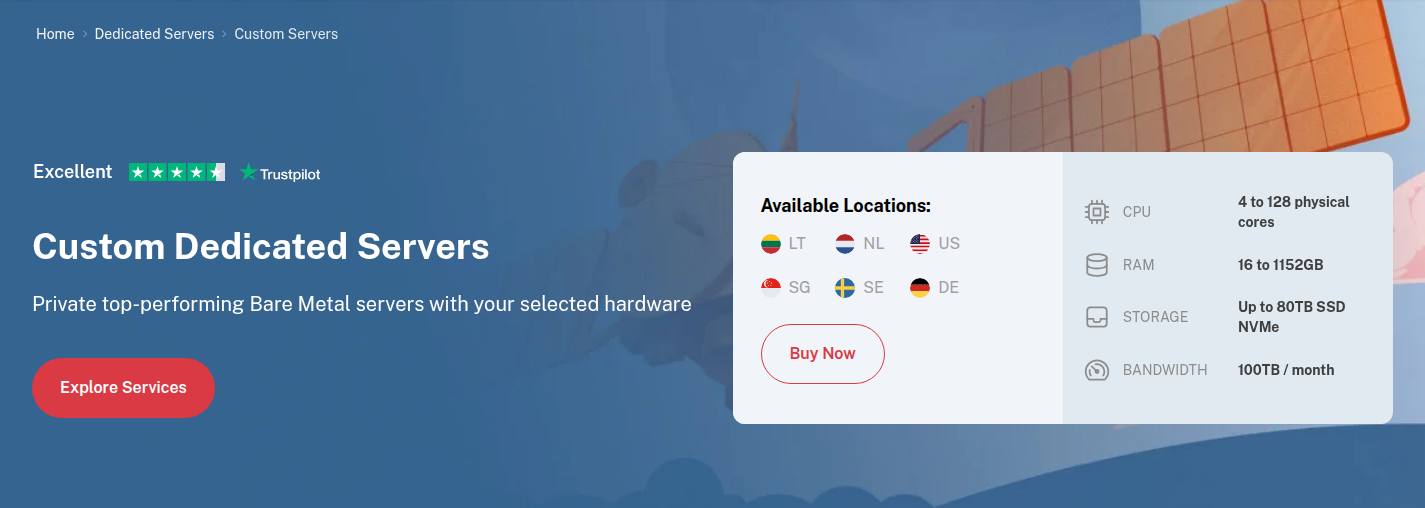
if you want component-level hardware choice (up to 128 cores, 1152GB RAM), a personal account manager on every plan, crypto billing, and a real bare-metal GPU catalog.
if you need 46 data centers, a 99.99% uptime SLA, redundant hot-swap power, and a full one-vendor enterprise ecosystem.
Verdict: Pick OVHcloud for enterprise scale, a 99.99% uptime SLA, redundant hot-swap power, and a one-vendor ecosystem. Pick Cherry Servers for component-level hardware choice, human 24/7 support with a personal account manager on every plan, crypto billing, and a genuinely broader bare-metal GPU catalog. Both are EU-based and both sell serious bare metal. They are not really fighting over the same buyer.
Disclosure: SaaSpicious has an affiliate relationship with Cherry Servers. If you sign up through our links, we earn a commission at no extra cost to you. We do not have a financial relationship with OVHcloud.
The Two-Minute Decision
These are two different answers to the same question (“where do I rent a physical server?”).
Cherry Servers is the relationship pick: a Lithuanian bare-metal specialist (founded 2001, 7 locations) that lets you pick your exact CPU, RAM, and disk, gives every customer a free personal account manager, answers live chat in about 15 seconds, accepts 20+ payment methods including crypto, and runs a real bare-metal GPU catalog. It is not trying to be AWS.
OVHcloud is the scale pick: one of Europe’s largest hosting companies, with 46 owned data centers across 4 continents, a 99.99% SLA on its top dedicated ranges, dual hot-swap power supplies, hot-swap disks, up to 200 Gbps private networking via Link Aggregation, a 3-AZ bare-metal region in Paris, and a one-vendor stack that spans bare metal, VPS, Public Cloud, managed Kubernetes, and object storage.
If you are a small or mid-size team, a Web3/crypto-native project, or a buyer who wants to talk to an engineer and pay in USDC, Cherry Servers wins. If you are an enterprise that needs guaranteed uptime, global reach, redundant infrastructure, and one invoice for everything, OVHcloud wins.
Hardware Customization: Cherry Servers Wins Big
Cherry Servers’ Custom Servers are ordered the way you’d expect from a specialist: you pick the components. The current range runs 4 to 128 physical cores, 16 to 1152GB RAM, up to 80TB of SSD NVMe storage, and up to 10 disks.
A note on RAM: Cherry’s pricing-page FAQ advertises “up to 2304GB”, but the Custom Servers product page - the page you actually configure from - states 16 to 1152GB. We’re going with the product page figure. If your workload genuinely needs more than 1.1TB of RAM on one box, ask Cherry directly; component requests outside the published ranges are handled by the account manager.
The Custom range tops out at 128 physical cores. Example builds start at €143.65/mo for an AMD EPYC 7443P (24 cores, up to 1024GB), €419/mo for an EPYC 9354P (32 cores, up to 1152GB), and €840.65/mo for an EPYC 9375F (32 cores, up to 1152GB, 8 disks).
That flexibility is exactly what OVHcloud does not sell. OVHcloud’s dedicated servers come in fixed range tiers - Advance, Scale, High Grade - where you pick a range and a model number, not individual components. The Scale range does let you spec storage and RAM up to a ceiling - though OVHcloud’s own site disagrees with itself on where that ceiling sits: the marketing page says up to 3TB of DDR5 ECC, the FAQ says 128GB to 1TB - but you are choosing from a catalog, not building a machine.
If your buying criteria include “I want to choose my own RAM config,” that alone settles the comparison.
Global Scale: OVHcloud Wins, Decisively
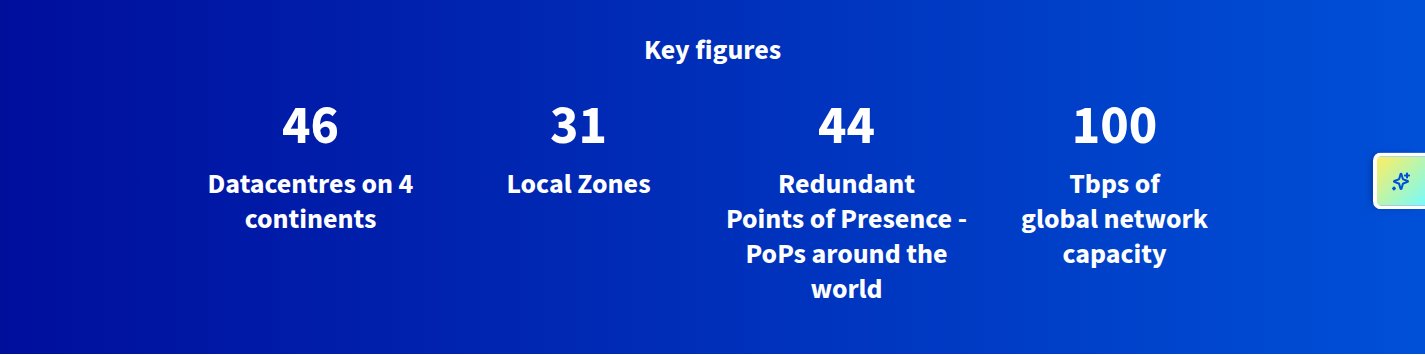
OVHcloud’s footprint is the counterweight to everything Cherry does well. The live infrastructure page shows 46 data centers on 4 continents, 31 Local Zones (a network of 150 mini-data centers targeted by end of 2027), 44 redundant Points of Presence, and 100 Tbps of global network capacity.
Cherry Servers runs 7 locations: Lithuania, Netherlands, Germany, Sweden, USA (Chicago), Singapore, and Japan (Tokyo). For a European buyer that is plenty. For a business with customers on three continents that wants data residency options everywhere, it is not.
There is also no Cherry equivalent of OVHcloud’s 3-AZ bare-metal region in Paris - three independent availability zones for multi-AZ resilience, offered on both the Scale and High Grade ranges. If your architecture plan says “multi-AZ bare metal,” OVHcloud is one of the few providers that can actually sell you that today.
Price Reality Check
Neither of these is a race to the bottom.
Cherry Servers’ hourly dedicated rates start around $0.091/hr (about €0.08/hr), with entry monthly configs around the €135-160 mark depending on region. You also get flexible billing most dedicated providers don’t offer: hourly, fixed-term (monthly, quarterly, semi-annual, annual with savings up to 50%), and spot servers.
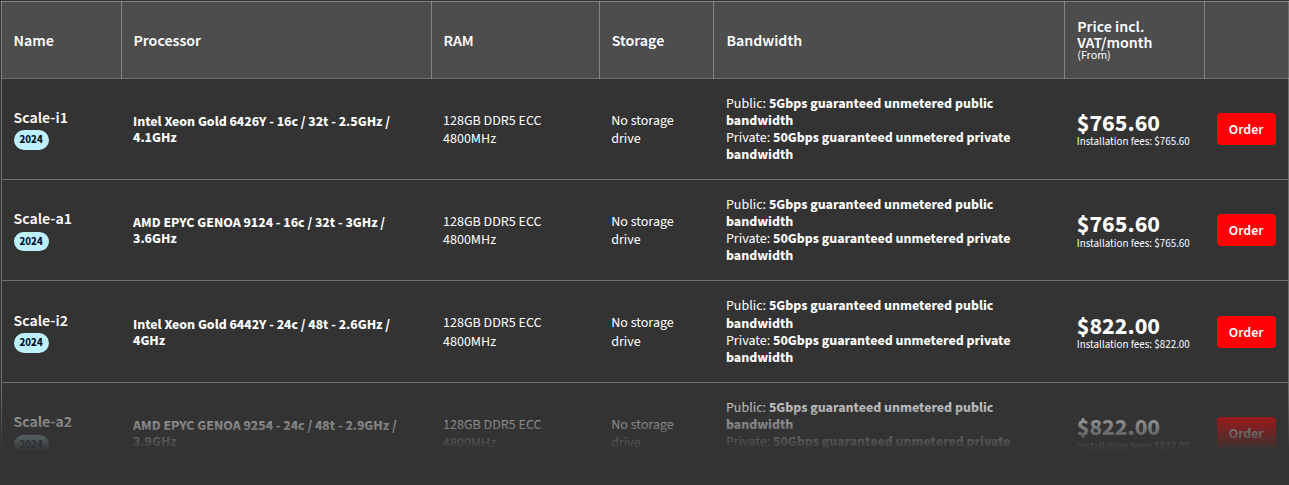
OVHcloud’s entry ranges are cheaper on paper - RISE-S starts around $77/mo and the Advance range from around $136/mo - but the pricier reliability story starts at the Scale tier. On OVHcloud’s World site (USD, incl. VAT), the Scale-i12024 with a Xeon Gold 6426Y, 128GB DDR5 ECC, 5 Gbps public / 50 Gbps private bandwidth runs $765.60/mo - with a $765.60 installation fee. That installation fee is a real shock for anyone used to Cherry’s no-setup-fee approach.
High Grade, OVHcloud’s premium range, starts around $1,777 (HGR-SAP-1, 16c/32t, 192GB, free setup).
Prices accurate as of August 2026; check the vendor’s site for current rates.
Reliability: The SLA and Redundancy Gap
If uptime guarantees matter, OVHcloud is the honest answer. Its Scale and High Grade ranges come with a 99.99% uptime SLA - the same tier AWS and Azure sell. It backs that with hardware you can maintain without downtime: dual redundant hot-swap power supplies and hot-swap disks on Scale and High Grade, 4x25 Gbps network ports, and OVHcloud Link Aggregation (OLA) that can push up to 200 Gbps of private bandwidth on High Grade.
Cherry Servers publishes a 99.97% uptime SLA - high, but not the 99.99% that compliance teams and uptime-sensitive buyers look for - and does not advertise redundant hot-swap PSUs as a headline feature. Its egress allowance is generous (100TB/month on most dedicated servers) but it is a cap, not unlimited like OVHcloud’s unmetered 5-10 Gbps public ports.
Hands-on honesty: 99.97% versus 99.99% is 2.6 hours versus 53 minutes of allowed downtime per year. For most workloads the difference is theoretical. For a regulated business it is contractual, and OVHcloud has the contract.
The GPU Story Is Nuanced - and It Favors Cherry on Bare Metal
This is the most interesting part of the comparison, and it is genuinely counterintuitive.
OVHcloud is the bigger AI player - its Public Cloud offers Nvidia H200, H100, L40S, and L4 GPU instances. But on bare metal dedicated servers, the GPU line is thin: only the L4 on the Scale range (Scale-GPU-1/2/3, from about $1,145-1,216/mo) and the L40S on High Grade (HGR-AI-2, about $4,355/mo). No H100 or A100 on dedicated - if you want the big cards on OVHcloud, you rent Public Cloud instances, not bare metal.
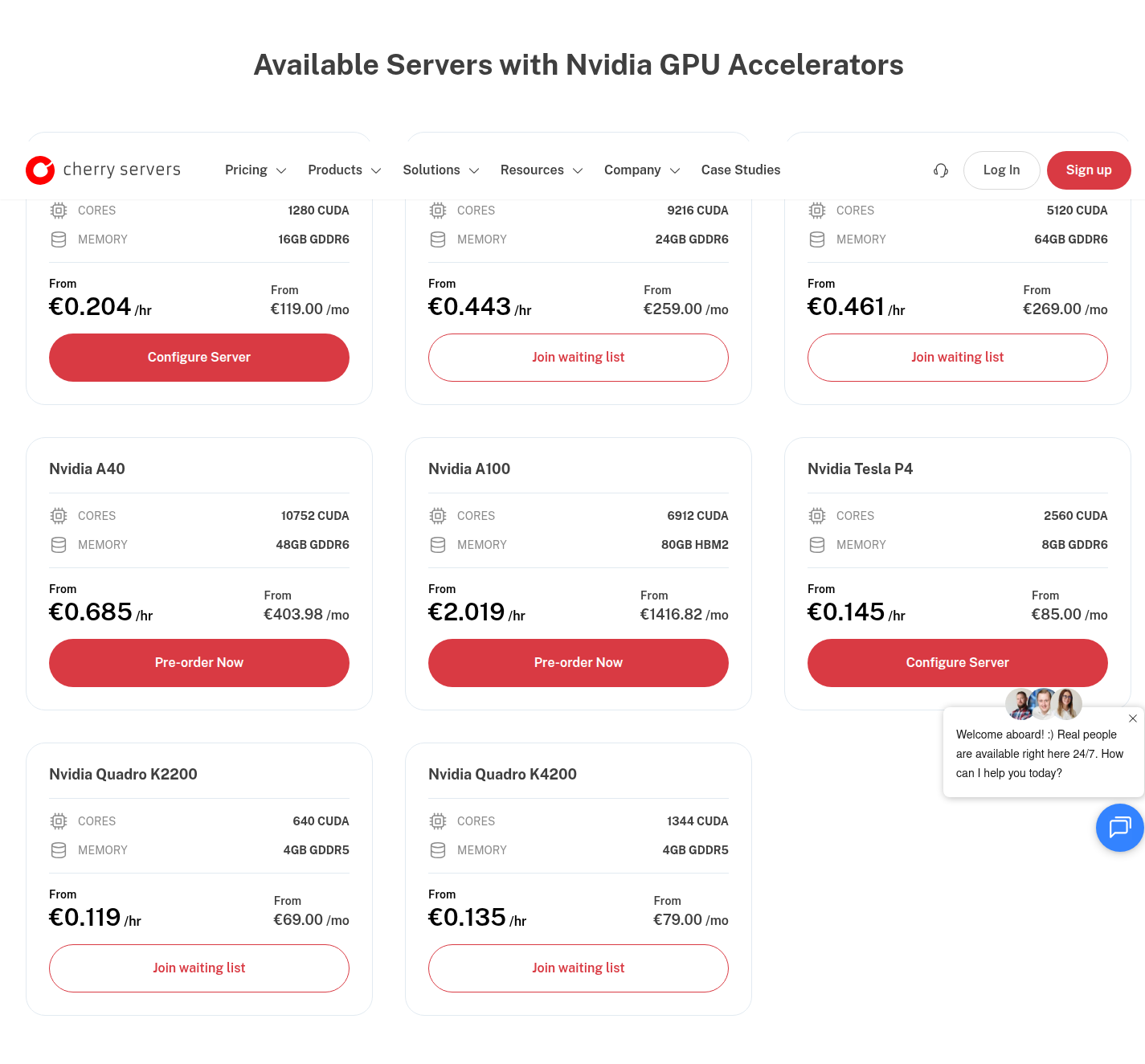
Cherry Servers, by contrast, sells a real bare-metal accelerator catalog: Nvidia A2, A10, A16, A40, A100 (80GB HBM2, from €1,416.82/mo), Tesla P4, and Quadro K2200/K4200, with GPU servers starting around €135/mo plus your chosen card.
The honest catch on Cherry’s side: its GPU lineup is older-gen (the A100 is a 2020 card), and GPU deploys take 24-72 hours, same as custom CPU builds. If you want the newest silicon (H100/H200), OVHcloud Public Cloud instances are the newer hardware - just not on bare metal.
Support and Relationship: Cherry’s Second Big Win
Cherry Servers assigns a personal account manager to every customer at no extra cost, its live chat averages a 15-second response, the 24/7 support is staffed by humans rather than a chatbot-first system, and there are no paid support tiers. That is an unusual posture for bare metal, and it’s why its customers describe the company as a partner rather than a rental counter.
OVHcloud’s support is functional and competent - and it is not that. Its own support-levels page confirms Account Managers are attached only to the paid Business and Enterprise support tiers, not the Standard or Premium levels most dedicated-server customers are on (“we recommend signing up to the Business or Enterprise level of support in order to get a proactive, targeted service… Account Managers… are on hand”).
Crypto and Web3 Billing: Cherry Is the Only Answer
Cherry Servers accepts 20+ payment methods including cards, PayPal, SEPA, bank transfer, Alipay - and 20+ cryptocurrencies (BTC, USDC, ETH, SOL, and more) via CoinGate and BVNK. It also runs Web3-native infrastructure plays (Solana validator nodes, DoubleZero network integration) and case studies full of blockchain companies. If your company pays in crypto, this is one of the few bare-metal providers where that is a native option.
OVHcloud’s own payment methods page lists exactly three options - credit/debit cards (Visa, Mastercard, Maestro), PayPal, and a prepaid points account - with no mention of Bitcoin or any other cryptocurrency. It historically accepted bitcoin around 2018, but as of August 2026 that option is gone: OVHcloud does not take crypto.
Where Cherry Servers Loses
Cherry Servers is not right for everyone. Concrete downsides:
- Footprint. 7 locations versus OVHcloud’s 46 data centers and 4 continents. No South America, no Africa, no Australia.
- No 99.99% SLA. Best published figure is 99.97%, and there is no 3-AZ bare-metal region.
- Slow custom and GPU deploys. 24-72 hours for custom/GPU builds. The famous 12-minute deploy applies to pre-built Instant Servers only.
- Older-gen GPUs. The A100 generation is not the newest silicon; bleeding-edge AI buyers will hit the ceiling.
- No redundant hot-swap power headline. Maintenance windows are not the zero-downtime affair OVHcloud sells on Scale/High Grade.
- Entry price is not the cheapest in Europe. OVHcloud’s Kimsufi/Rise budget lines undercut it on raw dollars, and Cherry’s premium support is priced in.
Where OVHcloud Loses
OVHcloud’s weaknesses are just as real:
- Thin bare-metal GPU catalog. L4 and L40S only on dedicated servers; H100/A100 require Public Cloud instances instead.
- No personal account manager on standard or Premium support - Account Managers are reserved for the paid Business and Enterprise tiers.
- No crypto billing. Its payment methods page lists cards, PayPal, and prepaid points only.
- Reliability features cost more. Dual PSU, hot-swap disks, and the 99.99% SLA live on Scale and High Grade - $765+/mo with installation fees, not on the cheap ranges.
- No 15-day money-back guarantee advertised the way Cherry does it.
Comparison Table
| Dimension | Cherry Servers | OVHcloud | Edge |
|---|---|---|---|
| Global footprint | 7 locations (EU/US/SG/JP) | 46 DCs, 4 continents + Local Zones | OVHcloud |
| Hardware customization | Component-level (4-128 cores, 16-1152GB RAM, 80TB NVMe) | Fixed range tiers (Advance/Scale/High Grade) | Cherry |
| Uptime SLA | 99.97% | 99.99% (Scale/High Grade) | OVHcloud |
| Bare-metal GPU catalog | A2/A10/A16/A40/A100/P4/Quadro | L4 (Scale) + L40S (High Grade) only | Cherry |
| GPU deploy speed | 24-72 hrs | Not published for custom builds | - |
| Personal account manager | Free, every plan | None on standard ranges | Cherry |
| 24/7 human support | Avg 15s live chat, no paid tiers | Functional; premium tiers paid | Cherry |
| Crypto billing | 20+ coins via CoinGate/BVNK | None (cards, PayPal, prepaid only) | Cherry |
| Redundant hot-swap PSU | Not a headline feature | Yes, Scale/High Grade | OVHcloud |
| Private networking | 100TB egress incl.; floating IPs/subnets/LB | Up to 200 Gbps via OLA; 25-100 Gbps vRack | OVHcloud |
| 3-AZ bare metal | No | Yes (Paris 3-AZ) | OVHcloud |
| Money-back guarantee | 15 days | Not advertised | Cherry |
| Compliance/enterprise stack | ISO-certified DCs; specialist | Broad compliance + SecNumCloud, VMware, Nutanix, SAP | OVHcloud |
| Ecosystem | Dedicated + VPS + storage + network | Bare metal + VPS + Public Cloud + K8s + object storage | OVHcloud |
Bottom Line
Choose Cherry Servers if you want to spec your own hardware, talk to a human who answers in seconds, get a personal account manager for free, pay in crypto, or need GPUs on bare metal (up to A100). The trade is a smaller footprint, no 99.99% SLA, and slower custom deploys. It is the right pick for SMBs, Web3/blockchain teams, and anyone who treats their host as a partner rather than a utility.
Choose OVHcloud if you need 46 data centers, a contractual 99.99% SLA, redundant hot-swap power, 200 Gbps private networking, a 3-AZ bare-metal region, deep compliance, or one vendor for bare metal plus the rest of your cloud stack. The trade is a thin bare-metal GPU line, no personal account manager outside the paid support tiers, and premium reliability that only arrives at the pricier tiers.
Who each is wrong for: Cherry Servers is wrong for enterprises that need multi-continent data residency, a 99.99% contract, or the newest-generation AI silicon. OVHcloud is wrong for small teams that want to choose their RAM, be assigned a human, pay in crypto, or rent an A100 on a physical box. And price-alone shoppers should look at the budget ranges on either side before committing - see our best cheaper Hetzner alternatives roundup and the Cherry Servers vs Hetzner comparison for the value end of the market.
If you are deciding between these two for a real workload, the shortcut is: relationship + flexibility + crypto = Cherry Servers; scale + SLA + enterprise ecosystem = OVHcloud.