7 September 2026 · Comparison
Articos vs Wynter: Which Wins in 2026?
The short answer
if you need rapid directional validation for high-volume ad and copy variants.
if you need board-level confidence or named human respondents.
Verdict: pick Articos if you are an agency or demand-gen team shipping high-volume ad and copy variants and need fast, cheap directional validation - under 30 minutes per study, from about $8 a research. Pick Wynter if you need board-level confidence, longitudinal brand tracking, or deliverables that require named human respondents - the verified panel is the only thing that carries that weight. The two tools sit at opposite ends of the same problem: Wynter built the strongest verified human B2B panel in the market, and Articos built that panel’s nemesis - synthetic personas that cost a rounding error on Wynter’s credit math. Both vendors already concede the other’s use case exists, which is rare and makes this an unusually clean call.
Disclosure: This is a comparison for independent buyers. We checked both Articos’ and Wynter’s pricing-page footers for a public affiliate or partner program and found none as of September 7, 2026, so this post earns nothing from either and carries no affiliate links. Prices below were checked against the live vendor pricing pages the same day and are subject to change.
The classic research dilemma, rendered as two products
User research has always had a price problem. A traditional study from an agency or panel firm runs $5,000-$15,000 and takes 4-8 weeks, so the honest reality is most decisions get zero research. Wynter and Articos both exist to fix that, but they fix it in opposite directions.
Wynter is the established panel player (launched around 2020). You pay for verified human B2B professionals who read your message and answer the four Message Layers questions (Clarity, Relevance, Value, Differentiation). It is real people, real titles, double-verified by corporate email and LinkedIn, and explicitly anti-AI for paid research. The cost and the 12-48 hour turnaround mean it only makes sense for decisions big enough to justify them.
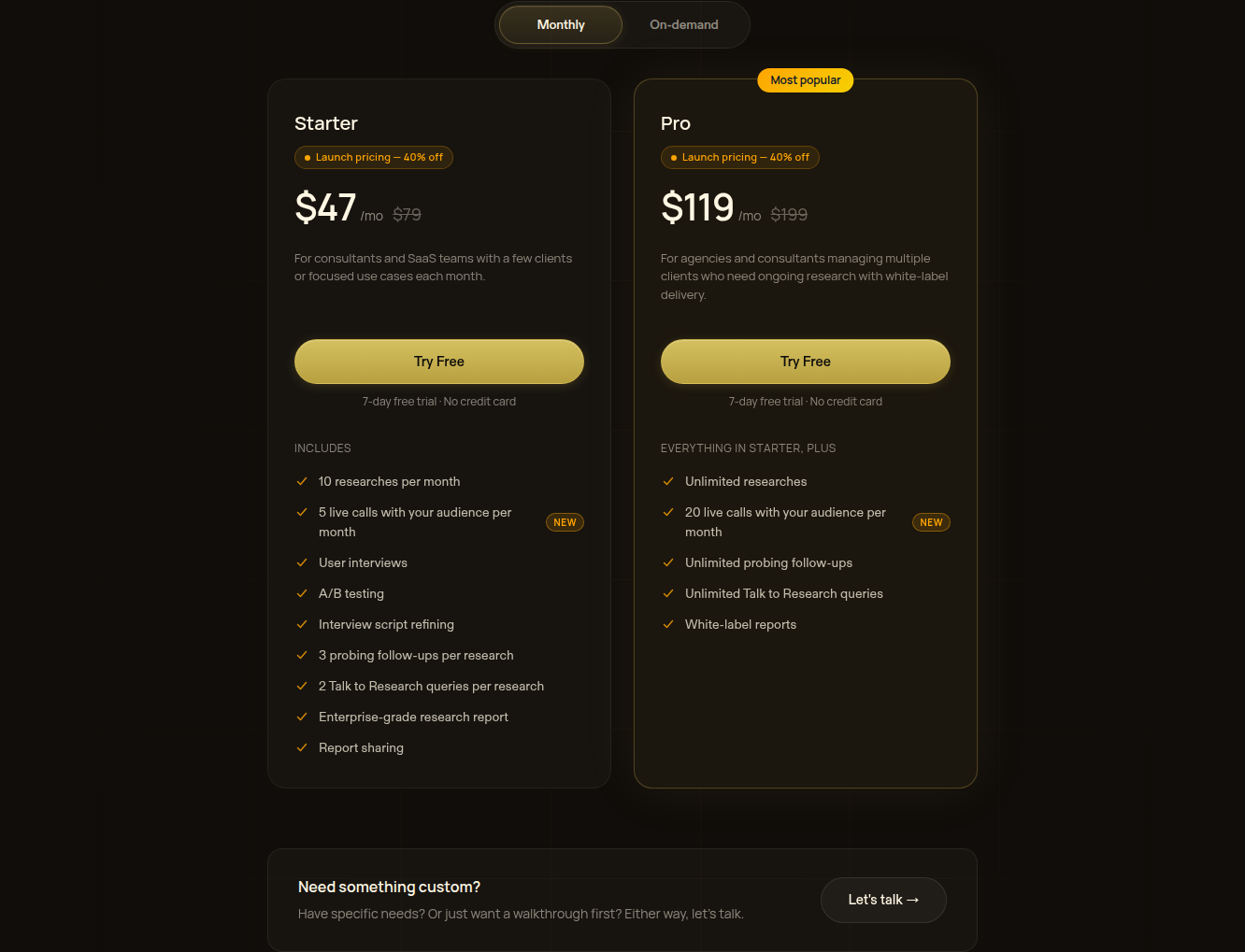
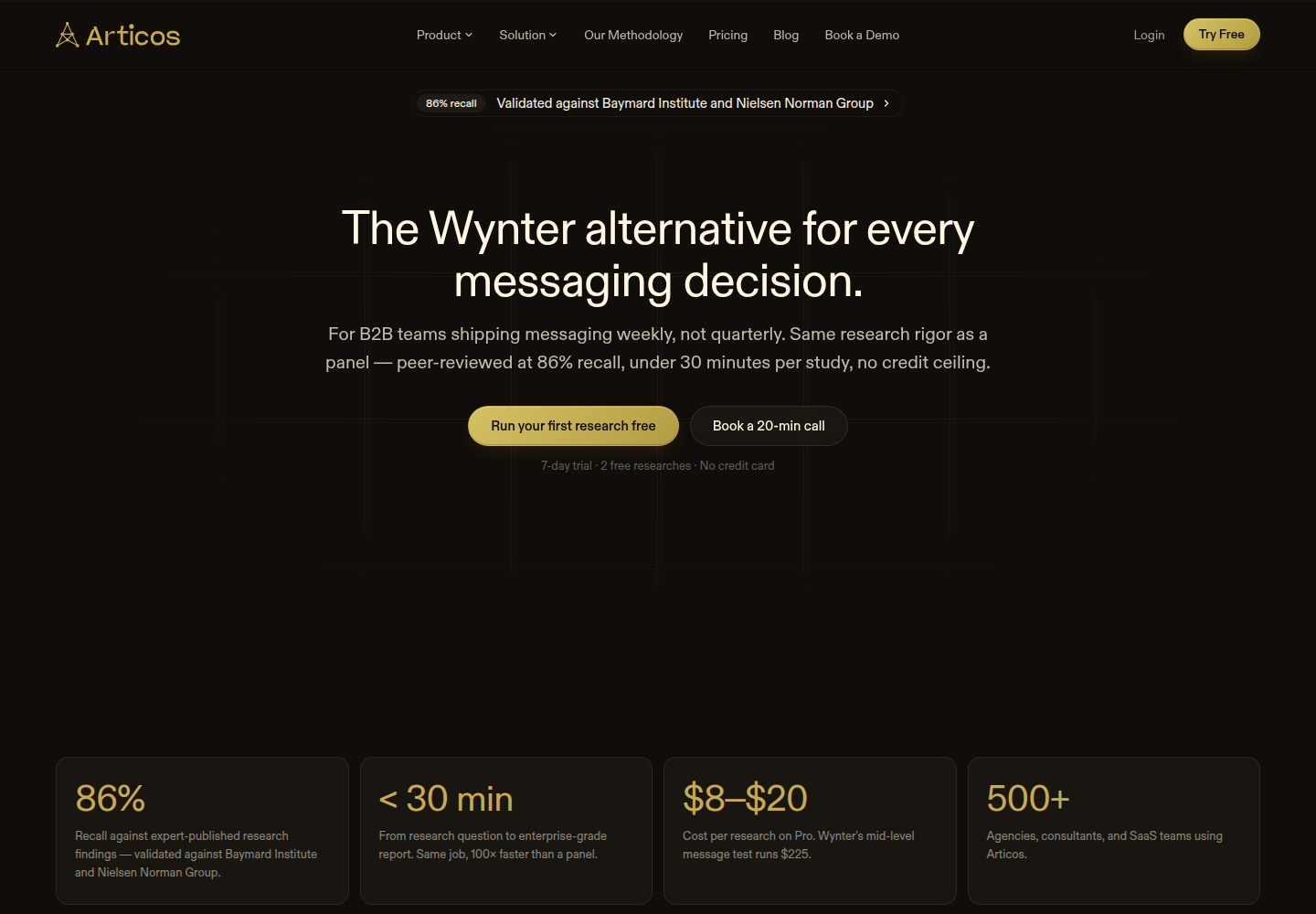
Articos is the synthetic challenger, launched on Product Hunt in early September 2026. Instead of recruiting humans, it generates up to 50 behaviorally-diverse synthetic personas and interviews them, hypothesis-blind, in isolation. The headline claim is 86% “research fidelity” against published Baymard Institute and Nielsen Norman Group findings, in under 30 minutes, from $8 per research on a monthly plan, or $14.50 on an on-demand pack. It is built for teams that want to research every decision, not just the budgeted ones.
Where Wynter’s moat actually is: verified humans, and the jobs only they can do
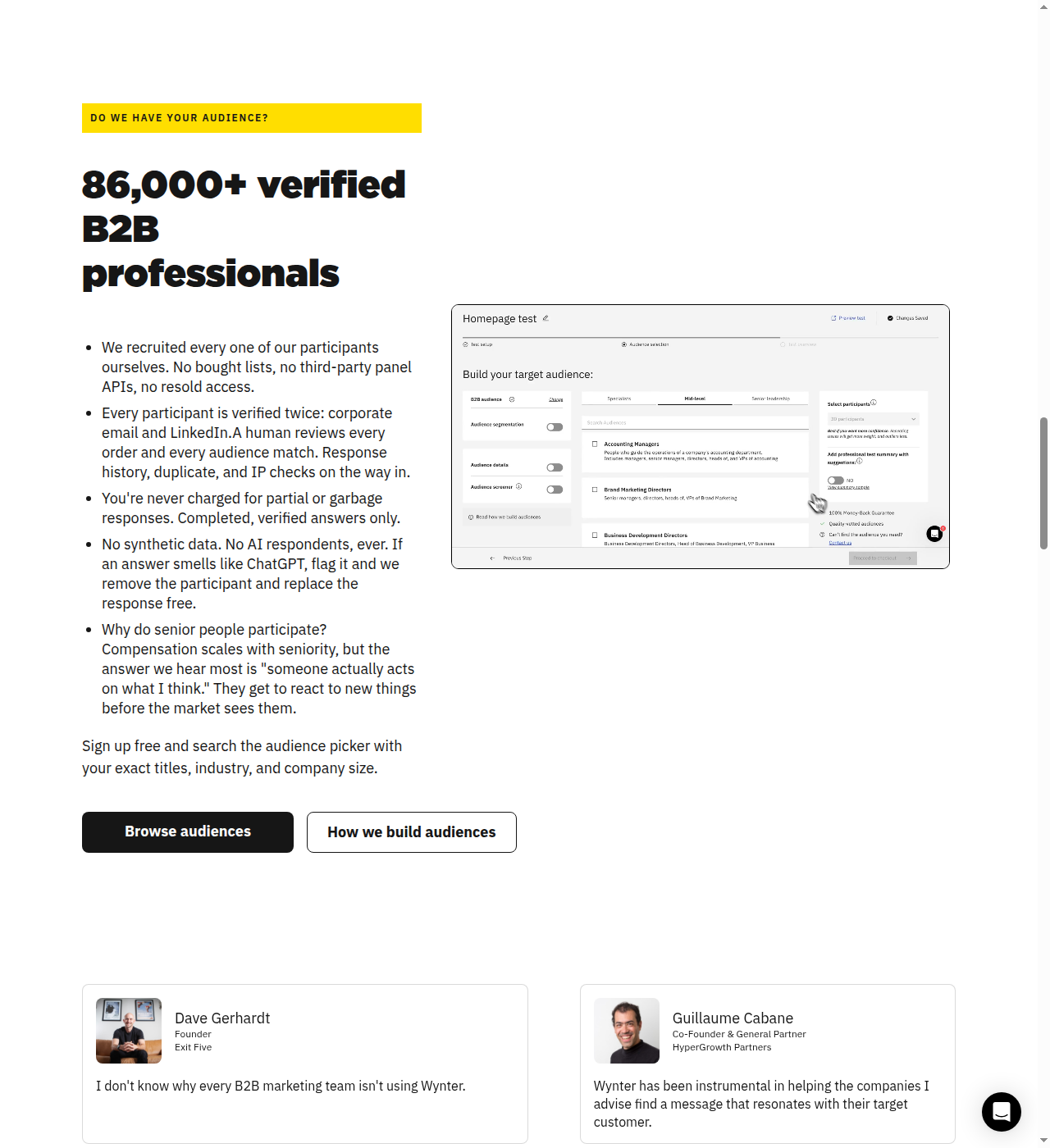
Wynter’s core asset is the panel - roughly 86,000+ verified B2B professionals. The precise figure wobbles between pages (86,015+ in some places, 86K+ on the homepage, 80K+ on the grader page), but the qualitative claim is consistent across every page: every participant is recruited in-house, verified twice (corporate email + LinkedIn), reviewed manually for every order and audience match, and “you’re never charged for partial or garbage responses.” Their stated hard line on paid research: “No synthetic data. No AI respondents, ever.” If an answer smells like ChatGPT, they flag and remove the participant and replace the response free.
For two specific jobs, only a verified human panel passes the bar, and Wynter’s own marketing plus Articos’ own comparison page both agree on this:
- Longitudinal brand tracking. Quarterly awareness, consideration, and preference measured from the same panel over a year. Synthetic research simply is not designed for that pattern. Articos itself says on its Wynter comparison page that brand tracking is “not a fit” and “that’s a Wynter job.”
- Deliverables that require named human respondents. Board decks, procurement, or regulated environments that need a specific human’s name on the cover sheet cannot use synthetic data. Articos concedes this directly: “Synthetic data won’t pass that bar - and shouldn’t be asked to.”
If your work lives in either of those lanes, the decision ends here: choose Wynter and do not look back.
Where Wynter loses: the credit math, the wait, and the coverage gaps
The honest flip side is that Wynter’s model has real structural weaknesses, and they are exactly the ones Articos attacks.
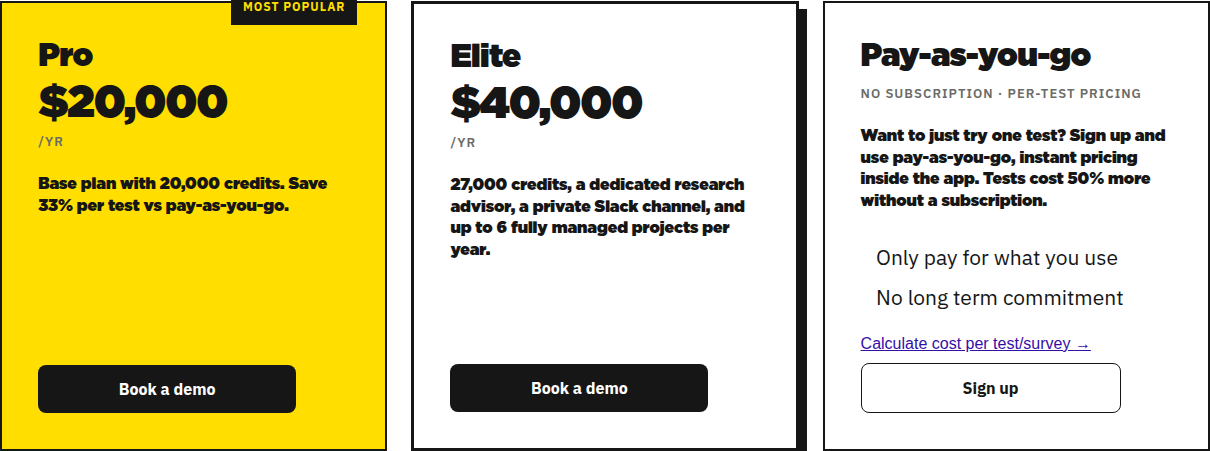
The unit economics are rough for high-volume work. Pro is $20,000/year for 20,000 credits (1 credit = $1) on a 1-year pre-paid contract. Elite is $40,000/year, and Wynter Black (research-as-a-service) is $100,000/year. A typical message test runs around $1,000-$2,000 on Wynter’s own homepage framing, which means a decision has to be worth thousands before it earns a test. Most small decisions never get tested, which is precisely the gap Articos was built to fill.
The 12-48 hour turnaround gates same-day decisions. For an ad sprint that launches Friday or a Monday-brief-Friday-pitch agency engagement, a 48-hour wait means the research arrives after you have already shipped. That is a cadence mismatch, not a quality failure.
The panel has real but unevenly documented coverage limits. Wynter’s own site splits its panel into a “core depth” list of roles (CTOs, CIOs, CISOs, CMOs, engineering managers, CEOs, HR/L&D, product marketing) and geographies (US, Canada, UK, EU), versus a longer, unranked “also covered” bucket (sales, RevOps, founders, design, and more) it does not quantify by depth. If your buyer sits in that second bucket, or outside those four core regions, audience match becomes a real question rather than a guarantee, and you may end up manually confirming coverage before you commit to a test.
Where Articos’ wedge cuts: speed, volume, and near-zero marginal cost
Articos is built for everything Wynter is not built for: the marketer running an ad sprint Tuesday, an LP test Thursday, and an ABM sequence Friday. The whole pitch is that you can research every decision because each one costs a rounding error - the same volume logic that’s pushed teams toward generation tools like the ones in our Adomate vs AdCreative.ai comparison for the creative side of that same ad sprint.
- Speed: under 30 minutes from research question to a structured, evidence-traced report.
- Volume: on Pro, researches are unlimited. On Starter you get 10 researches per month. No credit meter, no audience pricing by seniority.
- Cost: from $8 per research on a monthly plan, $14.50 on an on-demand pack. On Pro the effective per-research cost falls well below Wynter’s $200-$2,000 range.
- Coverage that a panel cannot give: any role, any industry, instant. Their own pages disagree on how many countries this covers - 69 on the pricing and alternatives pages, 93 in the homepage FAQ.
Where Articos loses: the honesty problem no synthetic tool has solved
This is the part you need to weigh hardest, because a synthetic research tool that overclaims its fidelity is a much bigger risk than a slow expensive one.
The 86% figure is a vendor benchmark, not independent verification. Articos’ “86% research fidelity” comes from its own pre-print study, “Grounded Simulation” / “Articos Research (2026)”, validated against Baymard and NNg published findings. That is not the same as a peer-reviewed, independent replication. Treat 86% as a directional figure from the vendor, not a verified fact.
Synthetic personas are weakest where the evidence has to be legally or observationally airtight. Articos’ own FAQ names the limit directly: “Synthetic research should not be your sole source of evidence where real human subjects are legally required - formal clinical trials, regulatory or compliance filings, and other legally defensible claims - or where observational data from real-world user behavior (not self-report) is critical, or for exact market sizing used in financial modeling.” Its recommended workflow concedes the same thing in softer terms: “use Articos for rapid directional validation - quickly testing hypotheses, refining concepts, and narrowing down options - and then use traditional real-user research to confirm the most important findings before major investment decisions.”
There are no real participants, recordings, or verbatims anywhere in the core loop. This is the deepest structural gap versus a human panel, and it has real consequences for anything customer-facing.
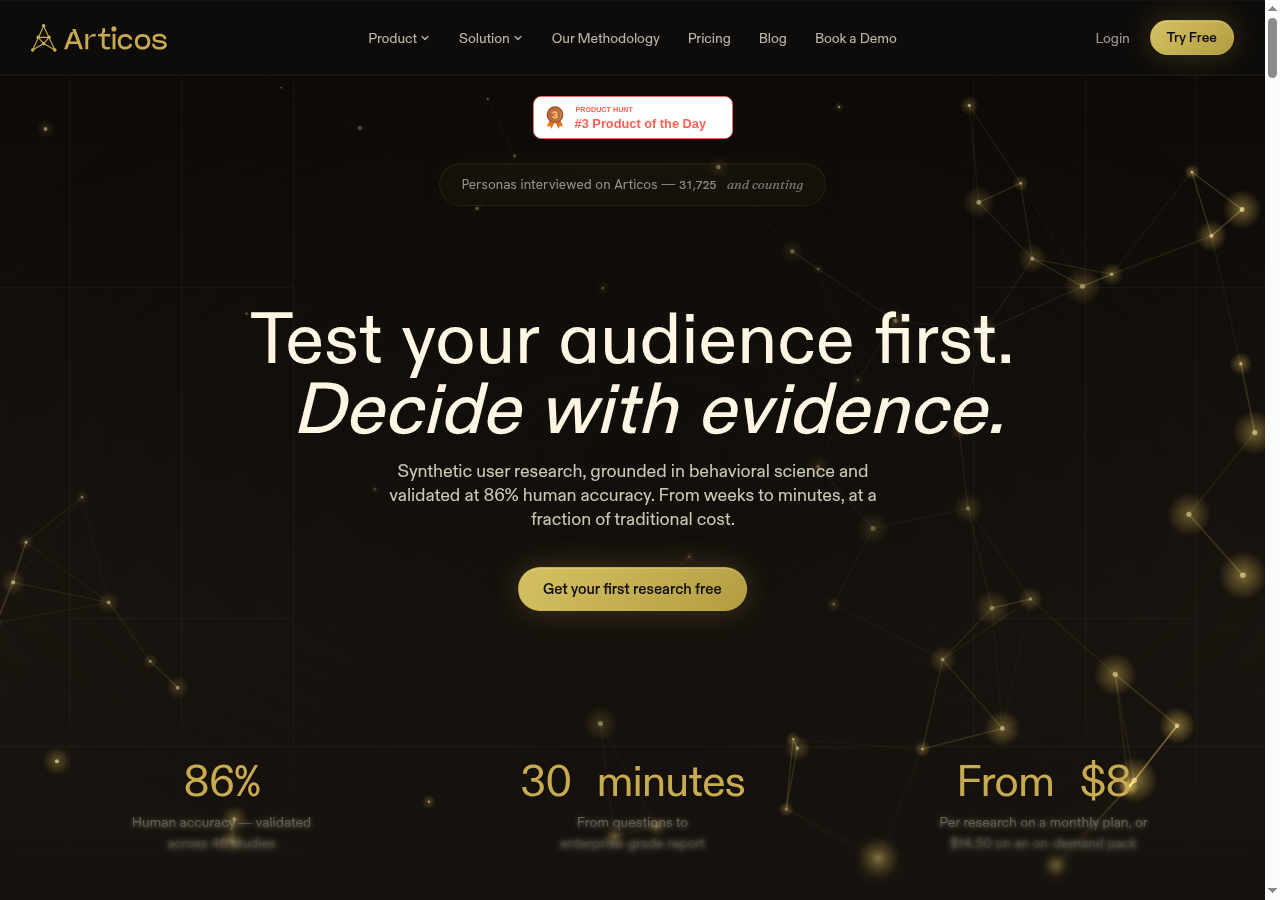
It is a days-old company, and it can’t even get its own launch badge straight. Articos launched on Product Hunt in early September 2026. Its homepage embeds Product Hunt’s own “top post” badge widget - and that single image is a small case study in the overclaiming problem: the alt text baked into the page reads “#1 Product of the Day on Product Hunt,” but the actual badge graphic, pulled live from Product Hunt’s own badge API, visibly renders “#3 Product of the Day.” Nobody needs to track anything externally to catch this - it is a live, self-inflicted contradiction on Articos’ own homepage. Its “500+ agencies and SaaS teams using Articos” claim deserves the same scrutiny from a vendor with no track record yet.
The trial terms contradict themselves. Every plan advertises a “7-day free trial, 2 free researches, no credit card,” but the FAQ says access continues only until “3 days or 2 researches (whichever comes first)” before you must pick a plan. You should not rely on a full 7 days.
The AI nuance that keeps this from being a clean fight
The “synthetic vs human” binary is too simple, because Wynter is also moving into AI - and it is doing it with a proprietary advantage Articos cannot easily copy.
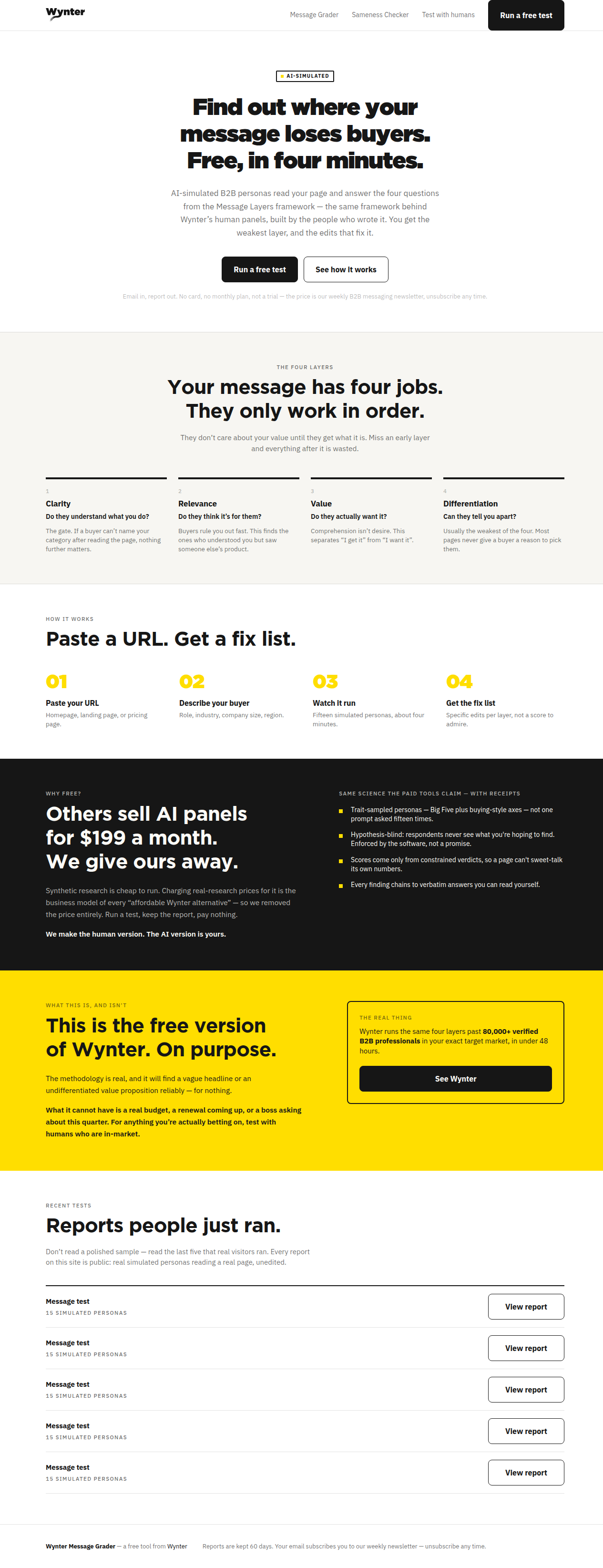
Wynter runs a free AI Message Grader (grader.wynter.com) that uses 15 simulated B2B personas to score your page on the four Message Layers in about four minutes. Its copy is an explicit barb at Articos’ category: “Others sell AI panels for $199 a month. We give ours away.” - a direct reference to Articos’ Pro list price. And Wynter’s own /synthetic-research page concedes “synthetic research is coming, it’s here to stay” and announces a planned synthetic product “trained on constantly refreshed human-sourced data” from its own panel, though that page’s own copy (“launch is a couple of months away”) is stale enough that whether it has actually shipped is unconfirmed - the free Message Grader, unlike the paid synthetic product, is live today.
The honest 2026 framing is therefore not “AI panels vs human panels.” It is AI trained on generic public data (Articos’ personas) vs AI trained on proprietary, fresh, human-sourced data (Wynter’s eventual product, and its free grader today). That is a real moat, because model quality on your niche buyer is gated by the data it was trained on, and Wynter owns the fresher, more native B2B dataset.
The side-by-side
| Capability | Wynter | Articos |
|---|---|---|
| Signal source | Verified human B2B panel (86K+) | Synthetic AI personas (up to 50) |
| Time to results | 12-48 hours | Under 30 minutes |
| Messaging testing | Yes (flagship) | Yes |
| Brand tracking | Yes | Not a fit |
| Named human respondents | Yes | No |
| Niche / non-US roles | Audience must exist | Instant, any role |
| White-label reports | Not a focus | Built-in on Pro (and Research Pack) |
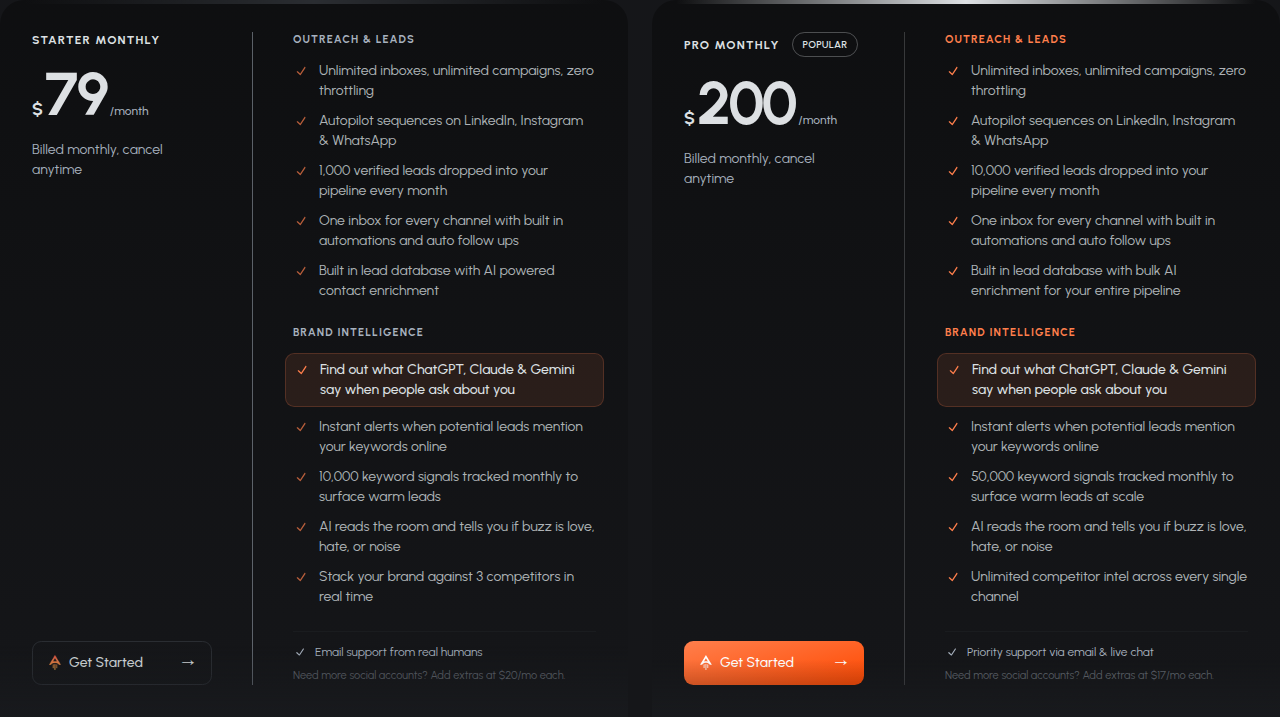
| Entry price | PAYG; Pro $20K/yr pre-paid | $47/mo Starter, $29 research pack |
| Per-research cost | ~$200-$2,000 | ~$8-$20 on plan |
Prices checked September 7, 2026 against the live vendor pages; verify current rates before buying.
The bottom line
If you are a demand-gen team or agency shipping many messaging decisions a week and you need directional validation fast and cheap, Articos is the honest pick. The 86% claim is unproven beyond a vendor preprint, but for high-volume variant triage the downside of being wrong on one variant is low and you get to test far more decisions than Wynter’s credit math will ever allow. This is what Articos was built for, and on this it wins.
If instead you need a result that will survive a board review, a procurement process, or a regulated deliverable - or you need to track brand perception over quarters - Wynter is the only defensible choice here. Articos’ whole premise is a cheaper, faster version of research; it is deliberately not a more rigorous one. No synthetic persona can hand you a named, verified human respondent, and nothing in this comparison changes that.
Both products already concede the other’s lane exists. That mutual honesty is the cleanest signal of all: buy Articos for the volume of decisions it lets you test, buy Wynter for the weight of the decisions it lets you defend. They are not really competitors at the margin; they are two answers to the same question, and the right answer depends on how big the decision is.
Affiliate note: We checked both vendors’ pricing-page footers on September 7, 2026 and found no public affiliate program for either. If you found this comparison useful, the most helpful thing you can do is test both free tiers - Articos’ 7-day/2-research trial and Wynter’s pay-as-you-go - and judge the output quality yourself before spending anything.
See also: our Robynn AI vs Coframe comparison if the AI decision in front of you is optimizing a page you’ve already shipped, rather than researching what to put on it in the first place.