8 August 2026 · Comparison
Soloop vs Pazi: Approval-First or Momentum-First AI Team?
Prices checked on 8 August 2026 against Soloop and Pazi — each vendor’s own pricing page.
The short answer
if you want a hard approval gate on every post, research run, credit spend, and deploy, and you distrust autonomous credit burn.
if you want agents working 24/7 on scheduled heartbeats, Slack-first collaboration, multi-business management, and value YC pedigree.
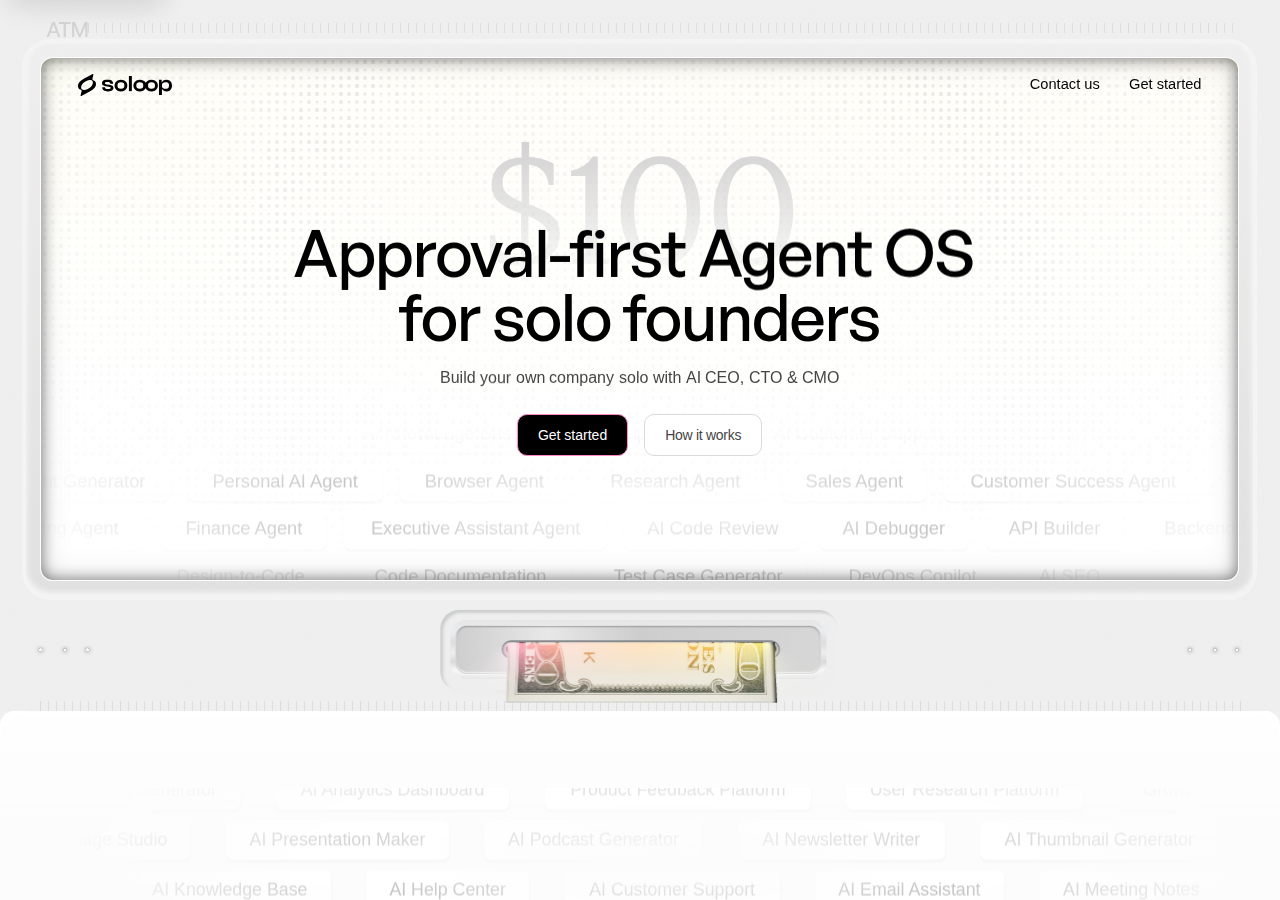
Verdict: pick Soloop if you want a hard approval gate on every external action - a single “next move” card that nothing posts, researches, spends credits on, or deploys without your call. Pick Pazi if you want 24/7 background momentum where agents execute overnight on scheduled heartbeats and only stop for a full strategy change. The two flagship “AI team for solo founders” products of summer 2026 are philosophically opposite, and neither is proven - both launched within the last month. Soloop (August 7, 2026) bets that founder judgment is the core asset worth protecting; Pazi (July 14, 2026, Y Combinator) bets that continuous forward motion is what actually gets a business off the ground. Choose based on how much you trust an autonomous agent with your brand, your code, and your wallet.
Disclosure: Neither Soloop nor Pazi currently runs a public affiliate program, so this comparison earns nothing from either product. It is editorially independent, and every claim below was verified against the live sites and public documentation on August 8, 2026.
The Core Philosophical Split: Approval-First vs Momentum-First
This is not a features race. It is a disagreement about where the risk lives.
Soloop’s entire product is built around one loop: the Plan Agent proposes one next move, with one reason, on one card, and nothing happens until you approve it. The about page states it plainly: “Posts, research runs, code changes, and deploys wait for your call.” The agent team cannot publish, execute a research run, spend credits, or change code on its own initiative. Approvals are risk-tiered - low-stakes reversible actions shift to “execute and log,” while high-stakes irreversible ones (capital expenditure, publishing production code, ad spend) require hard sign-off. The design tries to stop approval fatigue with diff-only reviews, batching by default, and a “trust ladder” that relaxes thresholds as confidence metrics grow. The founder’s stated principle: “judgment should be the last thing humans hand over to AI. We believe in one-person companies, not zero-person companies.”
Pazi runs on the opposite premise: “it doesn’t wait for instructions.” The primary agent, the Operating Officer, builds a roadmap of opportunities, delegates to specialist agents, and keeps executing on a schedule. The key mechanism is the Heartbeat: the operating officer wakes on a cadence (including every 24 hours at 4:00 AM in the owner’s timezone), reviews business context, takes or delegates the most useful next action, and emails the owner a concise update. Pazi stops and asks first only when a complete strategy change is involved; sensitive or irreversible actions still require confirmation. The founder frames it as momentum: “I say that Pazi provides momentum - that’s the goal.” Every time you come back, something has moved.
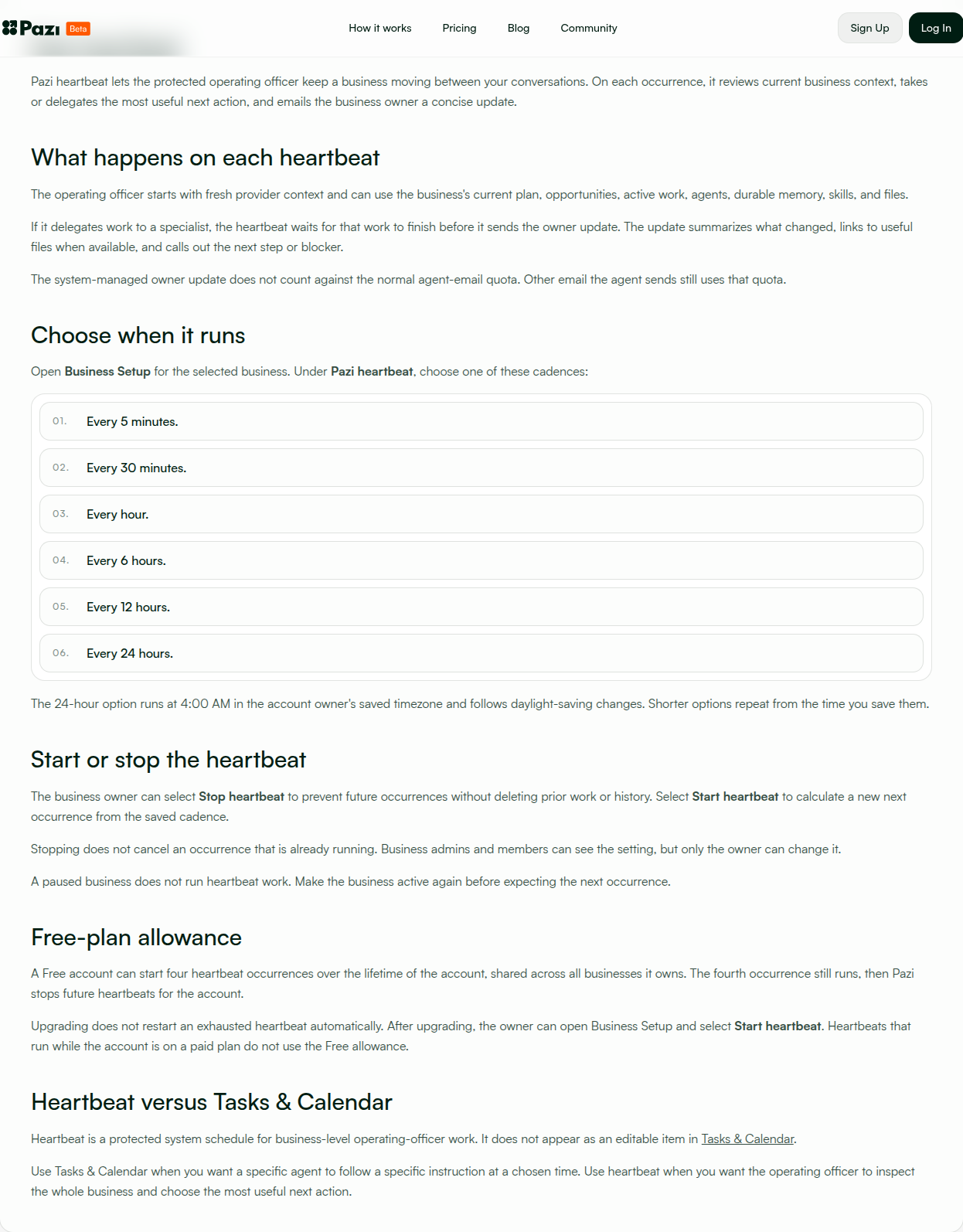
The practical difference: Soloop is a decision tool that delegates execution. Pazi is an execution engine that escalates decisions. If you want to see a diff before it goes live, Soloop. If you want to wake up to progress you didn’t prompt, Pazi.
Agent Roster & Runtime Reality
Both companies talk like they ship a whole org chart. Only one ships what it claims.
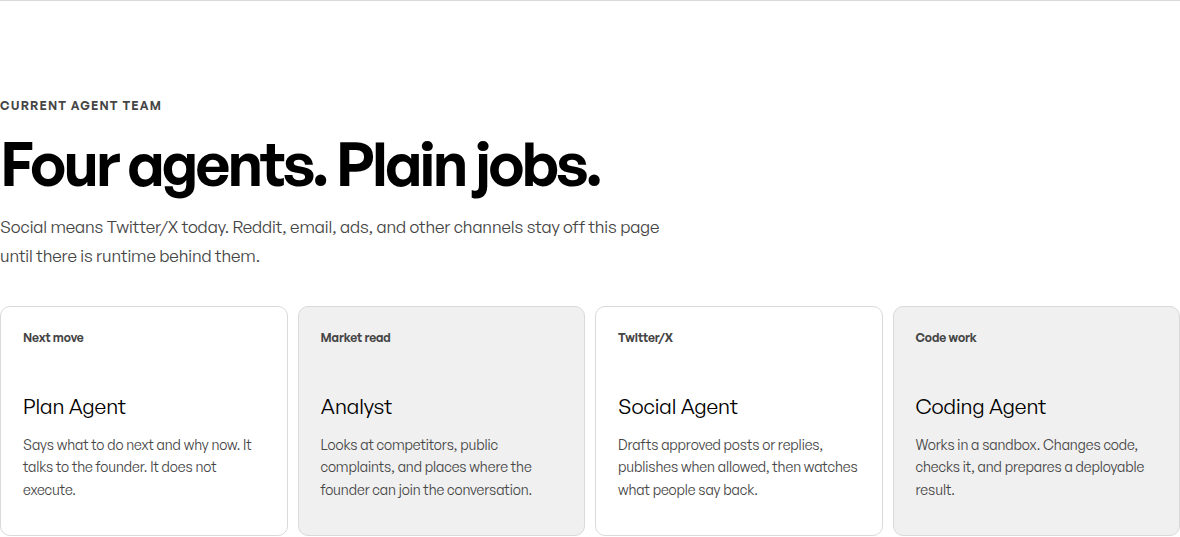
Soloop’s marketing frames the team as an “AI CEO, CTO, and CMO” with an Analyst. Soloop’s shipped runtime (per the live about page) is four agents with plainer jobs:
- Plan Agent - proposes the next move and why now; talks to the founder; does not execute.
- Analyst - market read; looks at competitors, public complaints, and places to join the conversation.
- Social Agent - drafts approved posts or replies, publishes when allowed, watches responses. Twitter/X only today. The page is explicit: “Reddit, email, ads, and other channels stay off this page until there is runtime behind them.”
- Coding Agent - sandbox; changes code, checks it, prepares a deployable result.
That last line is the honest version of the pitch, and it is a real strength: Soloop scopes its social automation to exactly one channel instead of claiming unsupported ones.
Pazi’s structure is an operating officer (a protected primary agent that is created automatically and cannot be deleted) plus specialist agents it delegates to: research, coding, design, QA, growth, and others. Agent capabilities include research, browsing, creating files and reports, writing and testing software, monitoring recurring work, using connected services, collaborating in Slack, and sending and receiving email. The dashboard is built around a Business Pulse (what’s done, in progress, and needs you), an Opportunities roadmap (every business starts with a launch opportunity where a growth agent researches concrete launch venues and you pick one before it writes the plan), and Tasks & Calendar with recurring schedules.
The marketing-vs-runtime gap cuts both ways: Soloop oversells a CEO/CTO/CMO it does not yet ship, while Pazi’s own blog claims agents run “across Slack, Teams, and 22+ channels” - broader than the current public docs, which emphasize Slack. Take both marketing frames with the same grain of salt.
Collaboration, Channels, and Daily UX
These are daily-use products, and daily use looks very different.
Soloop is web-based: you review cards and approve diffs in the browser. The rhythm is deliberately sparse - one card, one decision, on your schedule. There is no always-on agent working in the background; progress happens when you engage with the loop. That is the safety feature, and it is also the ceiling: nothing moves while you sleep.
Pazi is Slack-first. The operating officer and specialist agents collaborate in Slack, and the docs emphasize Slack-native workflows for monitoring and interaction. Under one Pro plan you get multiple businesses, team member invites, and unlimited agents - a setup built for a founder plus contractors or a co-founder. But there are hard operational constraints to know before you buy:
- At most 2 active opportunities can be running concurrently per business.
- Runs must be started on desktop (mobile shows a desktop handoff).
- Per-agent email quotas apply (system heartbeat updates don’t count).
So “24/7 momentum” has a container: two opportunities per business, launched from a desktop, with an email budget per agent.
Pricing & Credit Economics Breakdown
This is where the two products diverge hardest, and where you must read the live pages - both companies churned their pricing within weeks of launch.
Soloop’s pricing tiers are Free (15 credits/mo), Builder ($39/mo for 200 credits), Operator ($99/mo for 600 credits), and Team ($199/mo for 1,500-7,500 credits, with a 75% OFF Product Hunt launch badge). While /start redirects to /login, the tier structure is published on their pricing page.
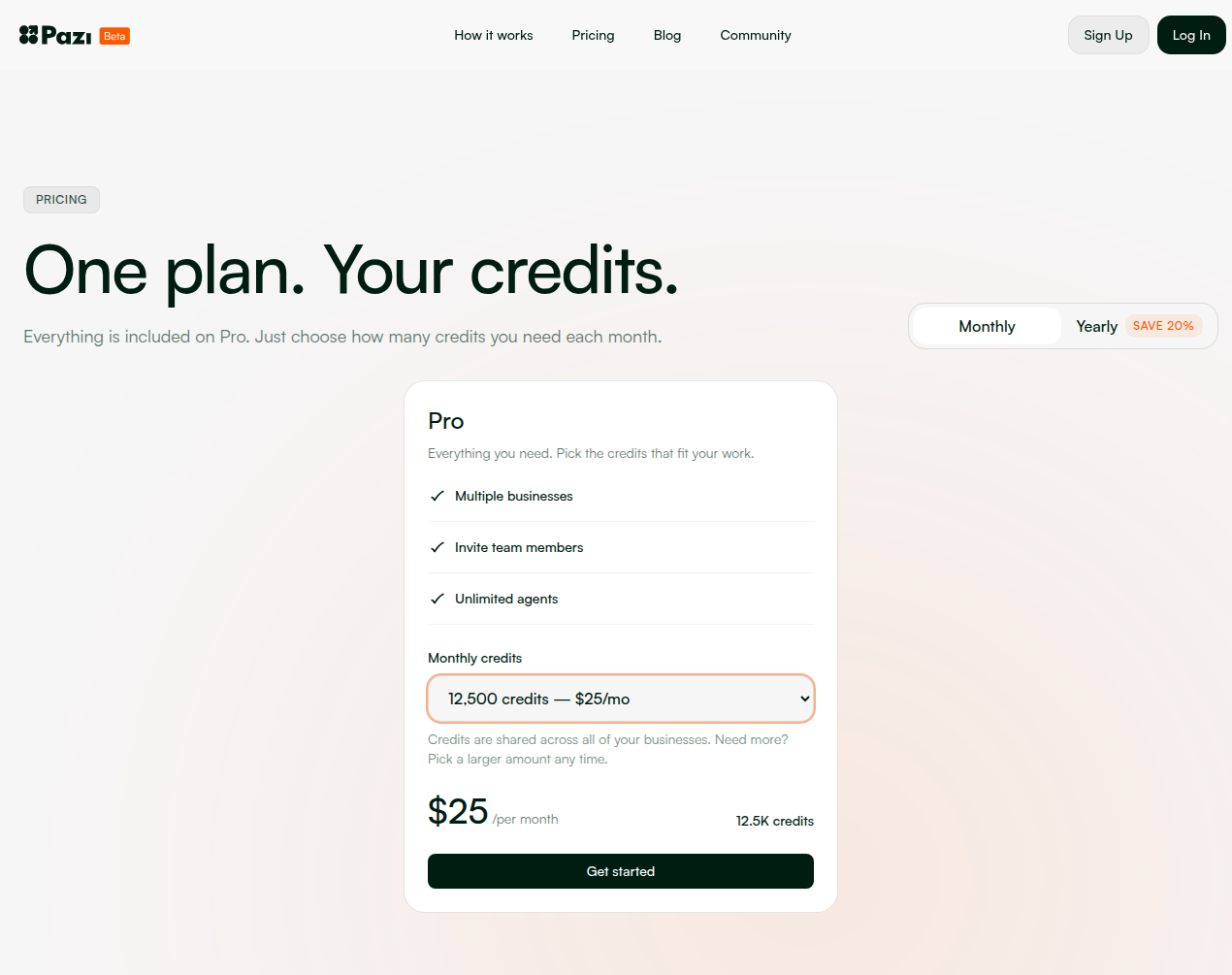
Pazi’s pricing changed completely within a month of launch. The four-tier table (Free/Starter/Advanced/Pro) cited in July reviews is stale. The live page (Pro starts at $25/mo for 12,500 credits, up to $500/mo for 250,000 credits, monthly; yearly billing saves 20%, i.e. $20/mo to $400/mo) now reads “One plan. Your credits.” - everything included, pick your credit volume, with multiple businesses, team invites, and unlimited agents on every tier.
| Tool | Plan | Price | Credits | Notes |
|---|---|---|---|---|
| Soloop | Free | $0 | 15 | Entry trial tier |
| Soloop | Builder | $39/mo | 200 | For 1 founder building & testing demand |
| Soloop | Operator | $99/mo | 600 | Recurring operating runs |
| Soloop | Team | $199/mo | 1,500-7,500 | Starts at $199/mo for 1,500 credits |
| Pazi | Pro 12.5k | $25/mo ($20 yearly) | 12,500 | Entry Pro tier; includes all features |
| Pazi | Pro 250k | $500/mo ($400 yearly) | 250,000 | Max self-serve tier |
Prices accurate as of August 2026; check the vendor sites for current rates.
The bigger question is what a credit actually buys. This is Pazi’s weakest point, and it is documented rather than speculative: Makerstack’s July 14 review scored Pazi 7.0/10 and its core complaint was opaque credit economics - “everything burns credits” and “Pazi doesn’t make it obvious how far a given credit pile actually goes.” Because the largest tiers are where top-ups happen, the incentive structure points toward needing more. Soloop’s credit model has the same opacity problem, but its approval gate at least means you are never surprised by spend: no credits move without your explicit call. Pazi’s free tier is thin (free accounts receive 4 lifetime heartbeat occurrences per the docs, shared across businesses) and it is not even advertised on the pricing page anymore.
Honest Downsides & Real-World Risks
Neither product is a safe bet yet. Both launched within the last month and both have zero user reviews on Product Hunt.
Soloop’s risks:
- One day old. Launched August 7, 2026. Zero editorial coverage and zero user reviews exist. The product may be great; there is no evidence either way.
- Launch-day instability. The founder confirmed roughly an hour of downtime from a traffic spike, and users reported “Get started” button failures and server-load errors on launch day.
- Twitter/X-only social. No email, Reddit, or ad-platform runtime yet, despite marketing that implies a full CMO.
- Marketing vs shipped gap. The homepage sells an AI CEO/CTO/CMO; the runtime is Plan/Analyst/Social/Coding agents. That is a framing gap you will notice the moment you get inside.
- Pricing behind login. The public site cannot tell you what you will pay without creating an account first.
- Templated-looking testimonials. The homepage feedback carousel quotes named executives at companies that do not verify; treat them as unvalidated.
Pazi’s risks:
- Rapid pricing churn. The plan structure changed from four tiers to one credit-tier model within 30 days of launch. If you price-shopped in July, the page you saw no longer exists.
- Opaque credit burn. The Makerstack 7.0/10 verdict: credit costs are opaque and the product was unproven on launch day. No public breakdown tells you how far 12,500 credits goes.
- No confidence grading. A founder publicly admitted Pazi does not yet attach a consistent confidence grade to agent outcomes. You get results without knowing how confident the system was.
- Execution constraints. Two active opportunities max per business, desktop-only run starts, per-agent email quotas.
- Name collision. Searching “Pazi” surfaces toolradar.com/tools/pazi, which is an unrelated AI meeting assistant product - not pazi.ai.
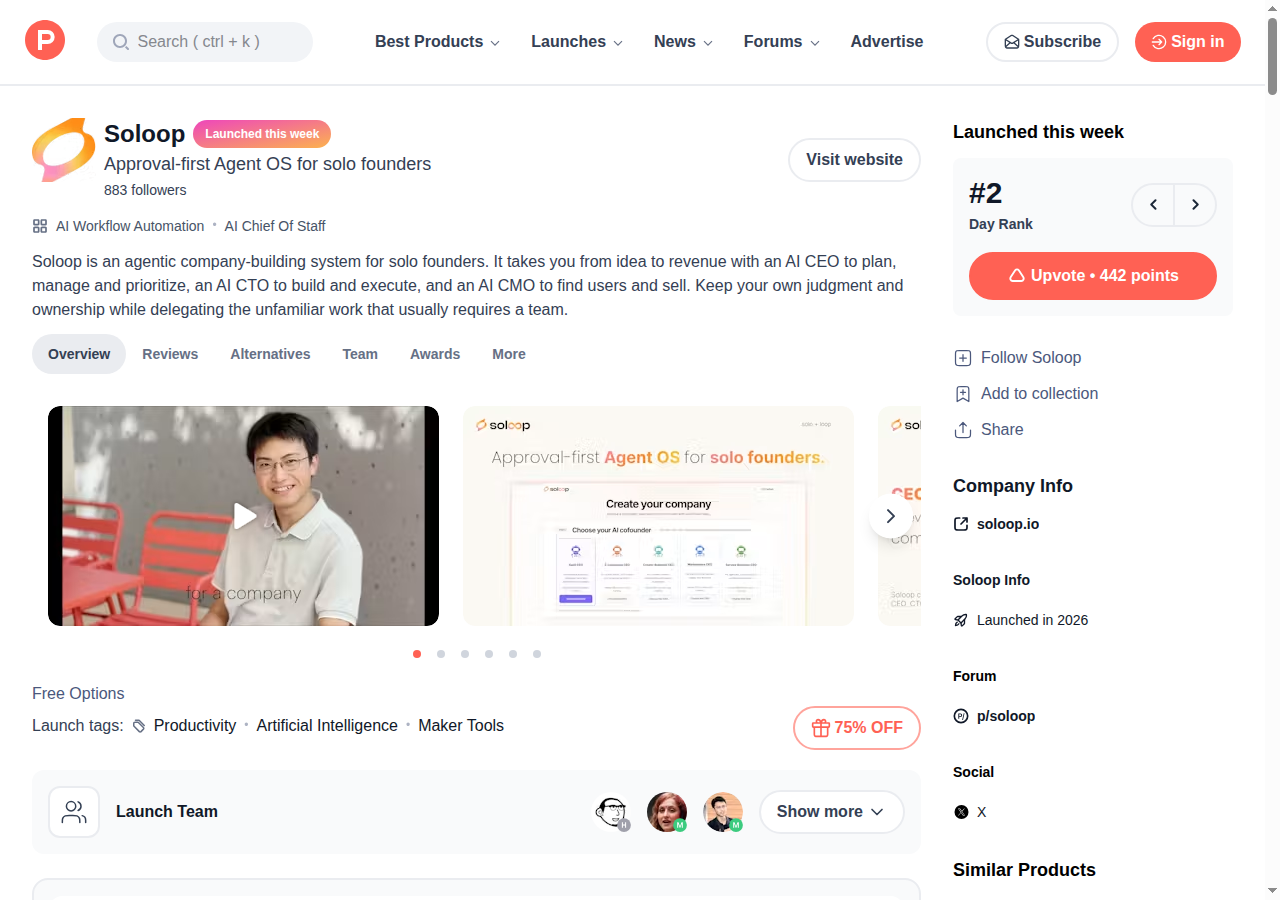
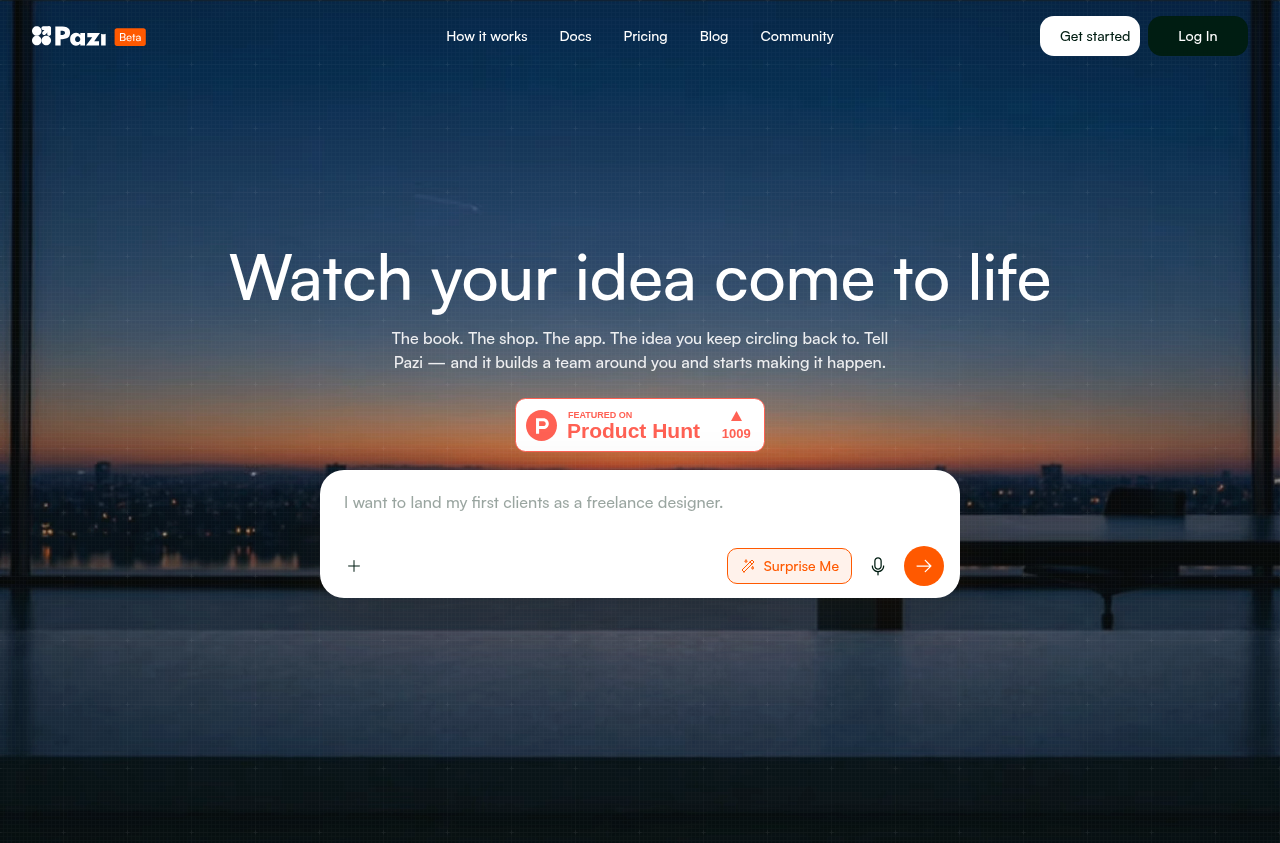
Soloop’s launch numbers are live and moving (#2 Product of the Day on August 7, 2026, roughly 440 upvotes at capture, with “75% OFF” and “Free Options” badges). For contrast, Pazi’s launch was bigger and earlier (#2 Product of the Day July 14, #2 Product of the Month July, 1,009+ upvotes, YC-backed).
Where Each Tool Wins and Loses
Soloop wins when: you want final say on every external action; you prefer one prioritized decision card over a parallel roadmap; you distrust autonomous credit spend; you want the cheapest way to try the category (free 15-credit tier, or $39/mo Builder).
Soloop loses when: you need progress without prompting; you want multi-business management under one plan; you rely on Slack for your work; you want a track record longer than a day.
Pazi wins when: you want overnight grind and scheduled heartbeats; you run multiple businesses; you live in Slack; you weight YC pedigree and a founder who shipped Pythagora/GPT Pilot (33K GitHub stars, roughly 100K users, and #2 Product of the Month July 2026 with 1,009+ upvotes).
Pazi loses when: you want to review and approve every post before it ships; you are allergic to unclear credit economics; you need a real free tier to evaluate the product.
Adjacent Alternatives in the Ecosystem
Before you commit, know what else is in this lane:
- Lindy AI - the personal-assistant incumbent (inbox, calendar, meetings, follow-ups), roughly $50/mo ($49.99/mo Plus plan). Pazi published its own “Pazi vs Lindy AI” post positioning itself as team-wide ops versus Lindy’s single-user assistant. If you want help with your existing work rather than a company built from scratch, Lindy is the foil.
- Pancake - “OpenClaw in Slack that makes your company autonomous.” Closest “autonomous company” challenger to both; a different architecture (open-source agent framework inside Slack).
- Viktor - an AI employee in Slack (and Teams), covered in our Scarlett vs Viktor comparison. If your problem is “I need an extra pair of hands in chat” rather than “I need a company built,” Viktor is the narrower, cheaper option.
Neither Soloop nor Pazi is proven enough to be a safe default. Both are reasonable bets if the philosophy matches how you like to work.
Final Decision & Actionable Recommendation
Choose Soloop if you would rather slow down than be surprised: you want to see the diff, approve the post, and sign off on every credit spend. It costs nothing to start (15 free credits), and $39/mo is the cheapest paid entry into the category. Choose Pazi if you want a machine that moves while you sleep: 24/7 heartbeats, Slack-native ops, multi-business support - and you can tolerate opaque credit burn and a price structure that changed once already.
If you are genuinely undecided, the honest answer is: try the free or cheapest tier of the philosophy you distrust less. Soloop’s approval-first gate protects you from the agent; Pazi’s momentum gets you unstuck. One month in, neither has a track record worth betting a brand on - so pay as little as possible to test which operating style actually moves your business forward, and keep your judgment in the loop either way.