12 July 2026 · Comparison
Datalix vs Hetzner in 2026: Cheaper VPS or Better Cloud?
The short answer
if you want the cheapest server with free backups and DDoS protection, and one location in Frankfurt is enough — stock permitting.
if you want a cloud platform: several locations, firewalls, load balancers, object storage and a proper API.
The one-sentence verdict: Pick Datalix if you need the cheapest available VPS with free backups and DDoS protection included, and you only need one server in Frankfurt. Pick Hetzner if you want a cloud platform: multiple locations, stateful firewalls, load balancers, object storage, and an API that Terraform speaks natively. The catch: almost every Datalix plan you’d actually want is sold out.
Affiliate disclosure: Some links in this post may be affiliate links. If you click through and make a purchase, SaaSpicious may earn a commission at no extra cost to you. We check prices against each vendor’s live pricing page and name the downsides on both sides regardless.
The stock crisis you need to know about
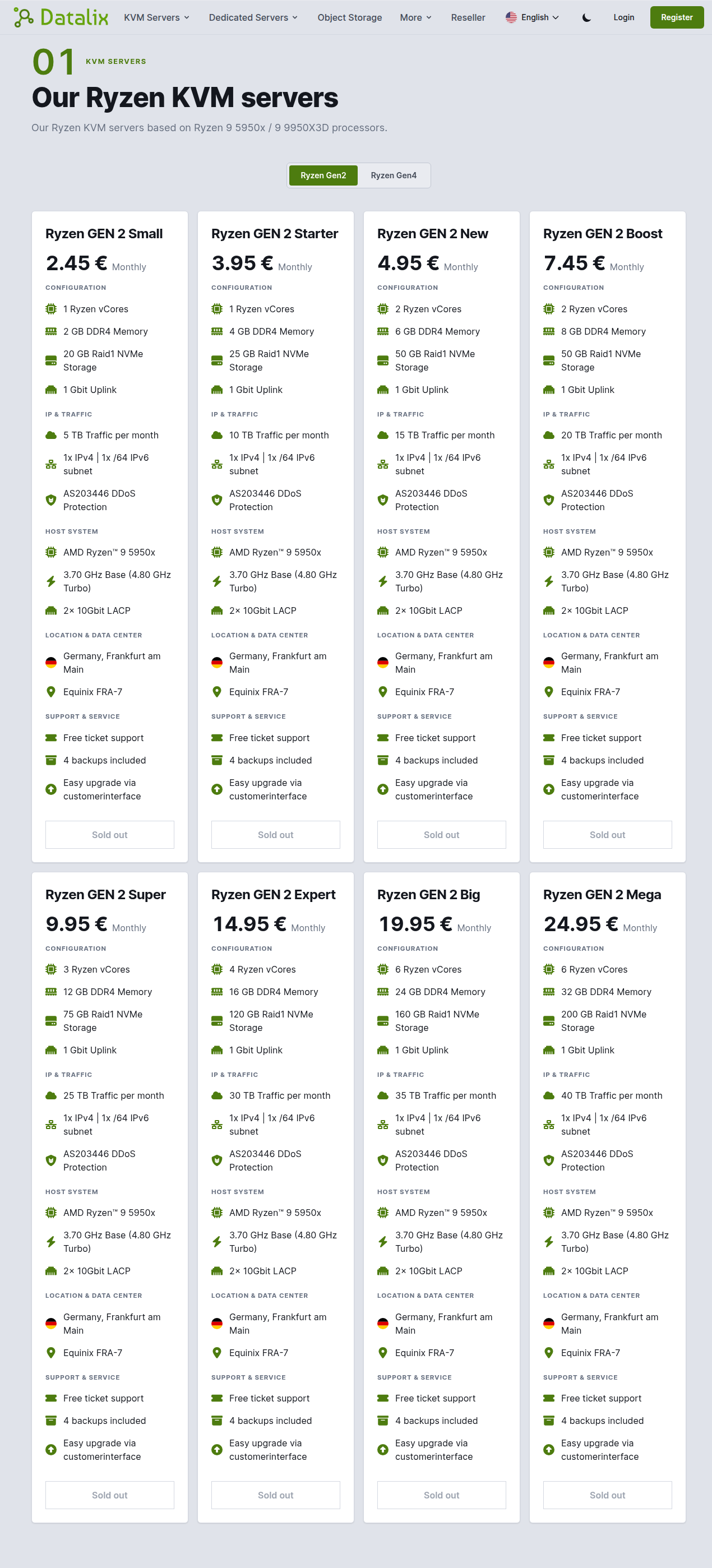
On paper, Datalix looks like a steal. Their Ryzen KVM Gen2 Small plan lists at €2.45/mo for 1 vCore, 2 GB RAM, 20 GB NVMe, and 5 TB of traffic. That undercuts Hetzner’s cheapest cloud server by a lot.
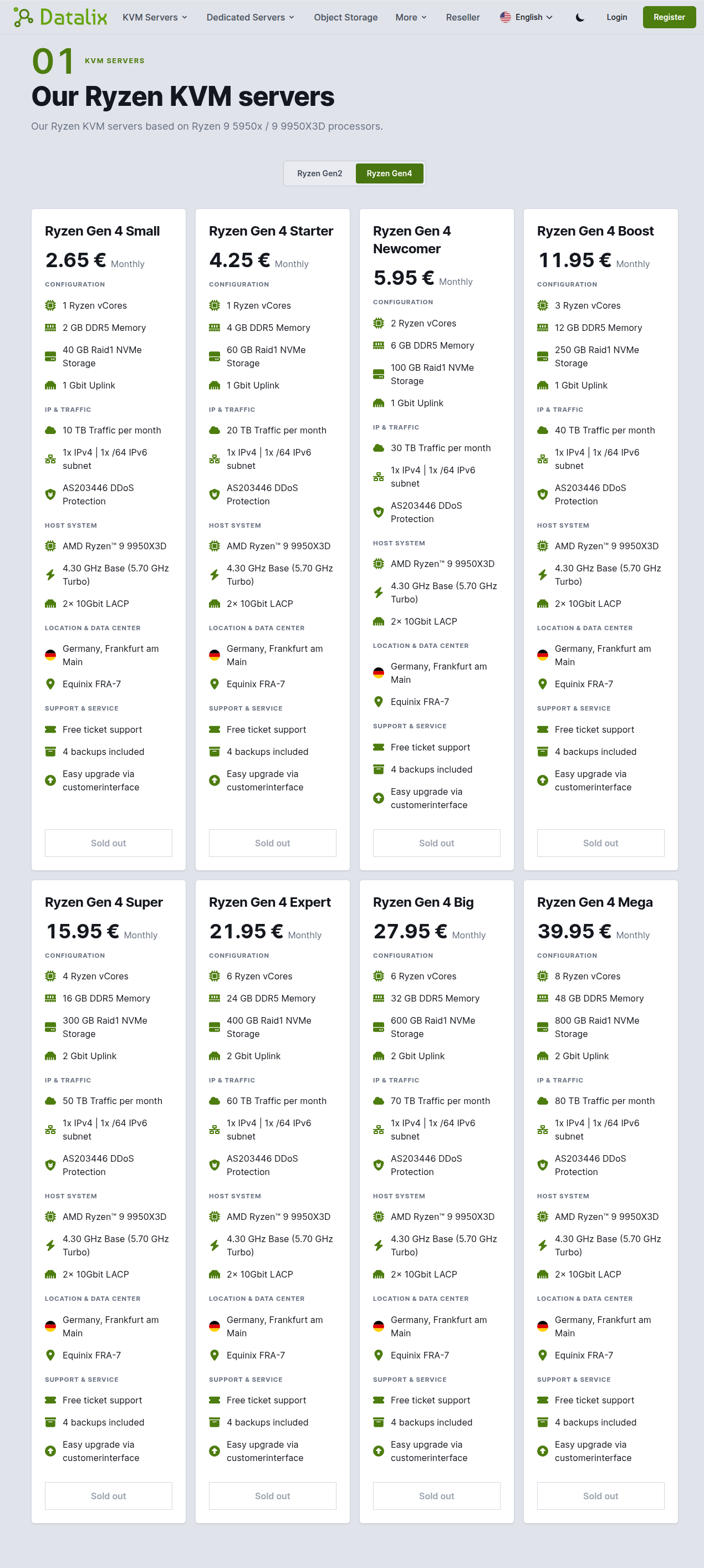
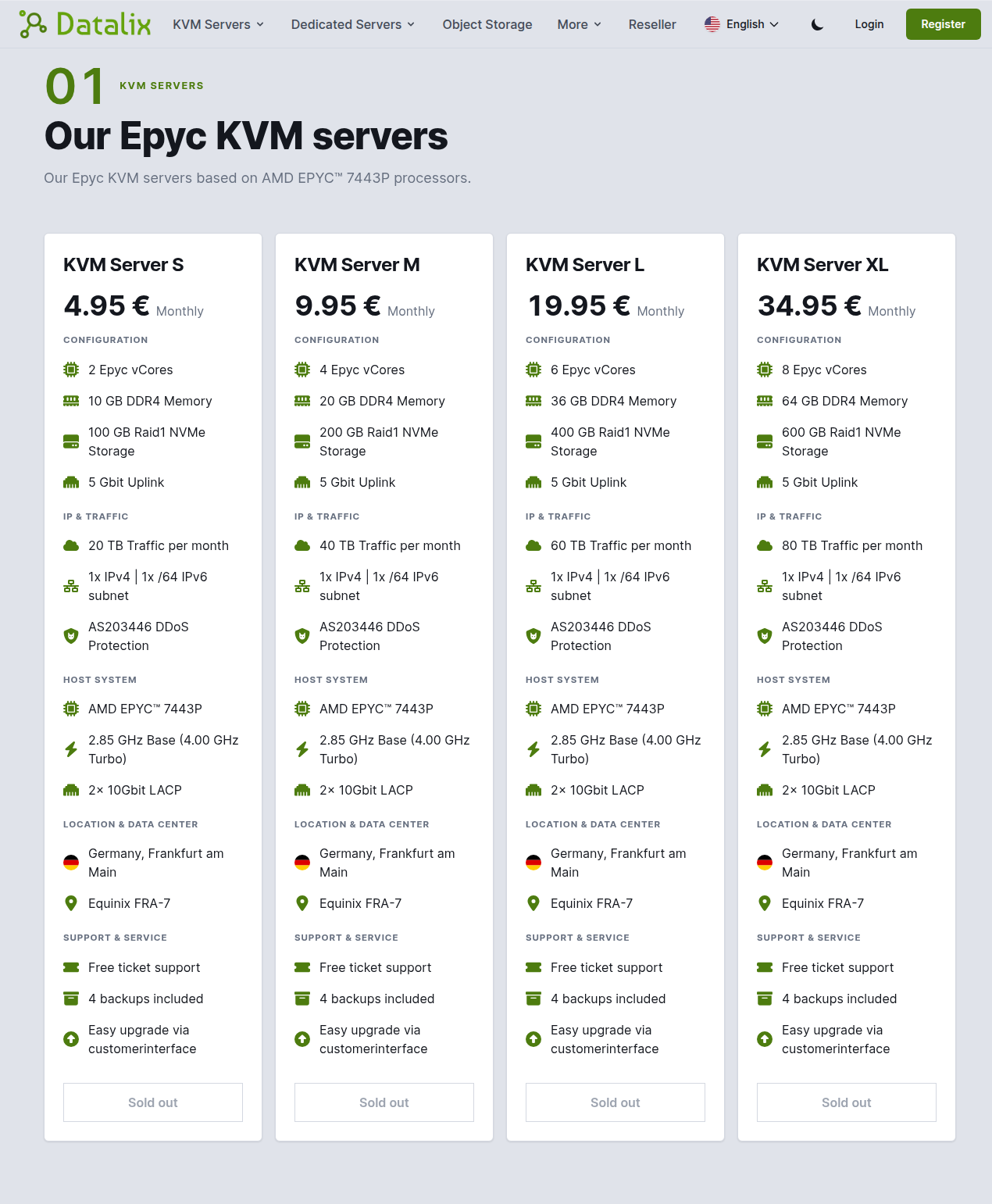
The problem? You cannot buy it. Nor the Ryzen Starter. Nor the Epyc line. Nor most of the Ryzen Gen4 plans.
As of July 2026, here’s the actual availability across Datalix’s KVM VPS lines:
| Product Line | Total Plans Listed | Plans Available (July 2026) | Plans Available (10 Sept 2026) |
|---|---|---|---|
| Ryzen KVM Gen2 | 8 | 0 | 0 — all sold out |
| Ryzen KVM Gen4 | 8 | 0 | 0 — all sold out |
| Epyc KVM | 4 | 0 | 0 — all sold out |
| Xeon KVM | 4 | 4 (S, M, L, XL) | 0 — all sold out |
| IPv6-only KVM | 8 | 8 | 0 — all sold out |
That’s 4 out of 24 IPv4-capable plans available in July, 16.7%. Checked live again on 10 September 2026, it’s zero out of 32 — every single Datalix KVM plan, IPv6-only included, is sold out. The Xeon line, which this whole comparison originally used as “the realistic entry point,” is gone too. The “Datalix is cheaper” argument isn’t theoretical anymore so much as moot: there is currently no Datalix plan you can put money on.
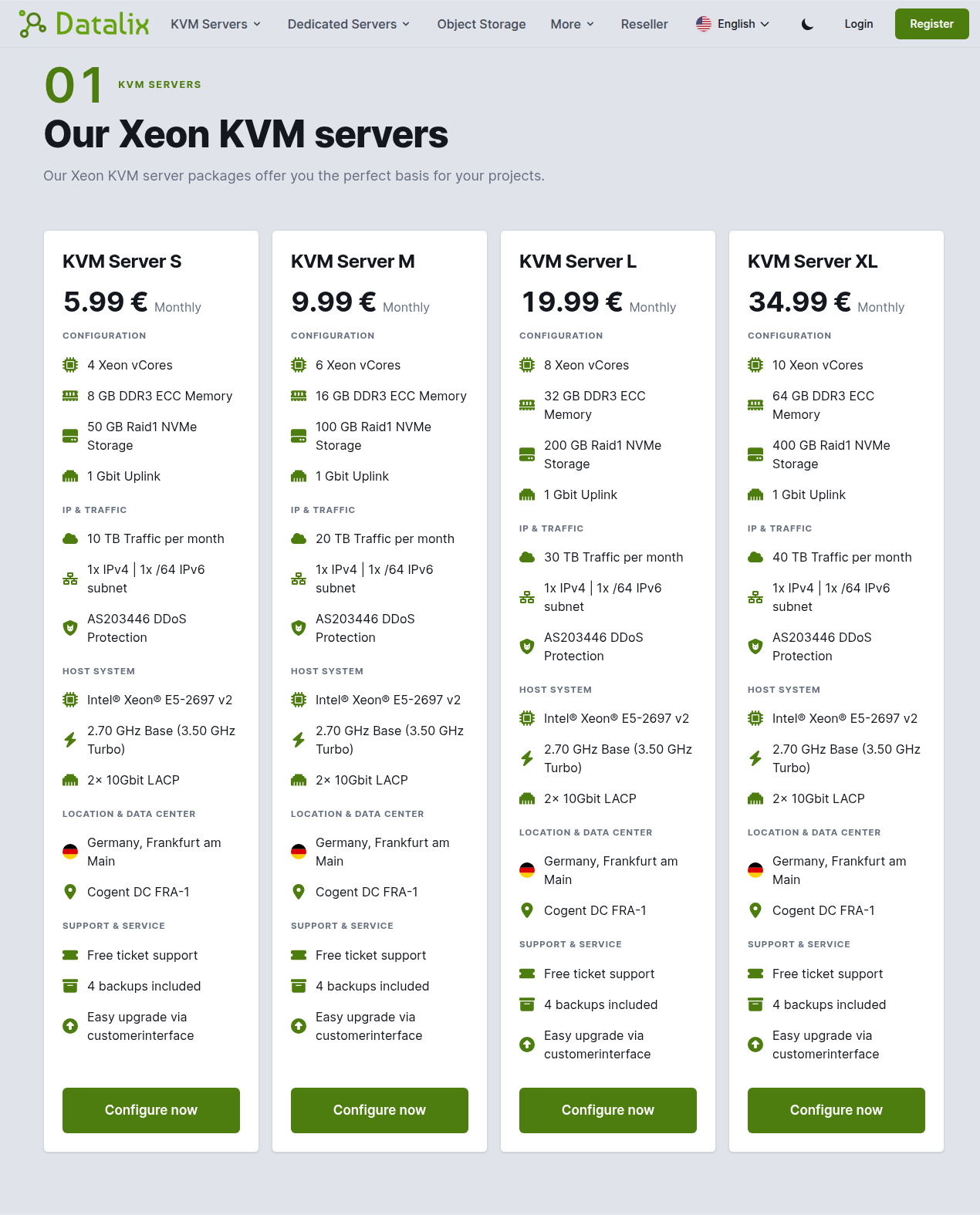
In July 2026, the realistic entry point to Datalix was the Xeon S at €5.99/mo: 4 Xeon vCores, 8 GB DDR3 ECC RAM, 50 GB NVMe RAID1 storage, 10 TB traffic, with 4 free backups, DDoS protection, KVM virtualization, and a 1 Gbit uplink. As of 10 September 2026 that plan is sold out too, along with everything else Datalix sells — so the spec comparison below is what you’d be buying if stock returns, not what’s on the shelf today. If you need a stocked budget VPS right now rather than a plan to wait for, see our netcup vs Hetzner comparison — netcup’s entry VPS has been reliably available throughout.
At that price point, you’re no longer comparing Datalix to a hypothetical €2.45 plan. You’re comparing it to Hetzner’s actual entry-level cloud servers.
Hetzner’s entry pricing vs Datalix’s real price
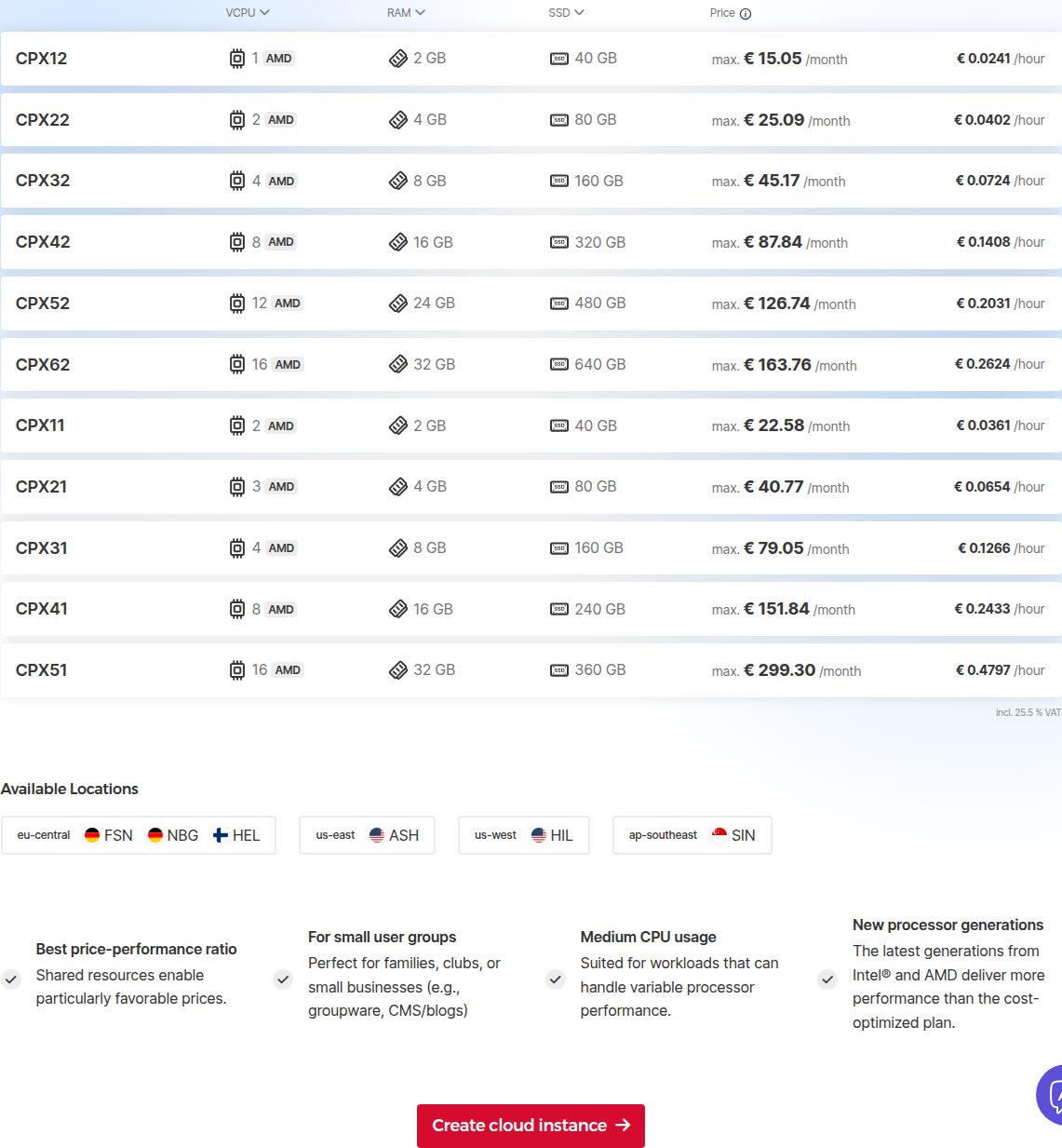
Hetzner’s closest match in price is the Cost-Optimized CX line, followed by the Regular Performance CPX line.
| Datalix Xeon S | Hetzner CX23 | Hetzner CPX11 | |
|---|---|---|---|
| vCPU | 4 Xeon | 2 Intel/AMD | 2 AMD |
| RAM | 8 GB DDR3 ECC | 4 GB | 2 GB |
| Storage | 50 GB NVMe RAID1 | 40 GB SSD | 40 GB |
| Traffic | 10 TB | 20 TB | 20 TB |
| Price | €5.99/mo (incl. VAT) | €7.52/mo | €22.58/mo |
| Backups | 4 free | Paid add-on | Paid add-on |
| DDoS protection | Included (SmartMitigate) | Firewall rules only | Firewall rules only |
| Locations | Frankfurt only | EU (FSN, NBG, HEL) | 5+ locations worldwide |
| Billing | Prepaid, auto-deletes after term | Hourly with monthly cap | Hourly with monthly cap |
| API | Custom (server mgmt + billing) | REST + CLI + Go/Python SDKs | REST + CLI + Go/Python SDKs |
Prices accurate as of July 2026; check the vendors’ sites for current rates. Availability update, 10 September 2026: Hetzner’s own pricing page now marks the whole Cost-Optimized (CX) line, CX23 included, as “Currently not available” — the CPX line is unaffected. Combined with Datalix’s total sellout above, neither of the entry-level rows in this table is something you can actually purchase on the day of writing; both companies’ higher tiers (CPX, CCX) still are.
On raw specs per euro, the Xeon S is competitive. You get double the RAM, double the vCores, free backups, and built-in DDoS protection, all for roughly the same price as Hetzner’s cheapest cloud server. If you only need one server in Frankfurt and don’t need anything beyond a VPS, Datalix gives you more hardware per euro.
If you’re exploring other options beyond these two, we’ve also compared Hetzner against netcup, Cloudify.ro, Cherry Servers, and Datalix in a broader roundup.
But this comparison only works if Datalix has stock. Right now all four Xeon plans are available. If those sell out too (and Ryzen, Epyc, and Gen4 are already gone), there is no Datalix option. The comparison ends.
Features and ecosystem: where the gap widens
Beyond the raw server specs, the two providers exist on different planes.
Datalix: simple VPS with nice defaults
Datalix does one thing: KVM virtual private servers. Every plan includes:
- 4 free backups: no add-on pricing, no per-GB fees
- SmartMitigate DDoS protection: included on all servers
- KVM virtualization with full root access and noVNC console
- 60-second deployment after payment
- Prepaid model: no contracts, no cancellation, server auto-deletes 5 days after term ends
- In-house control panel with live metrics, scheduled actions, rDNS, SSH keys, ISO mount, and traffic monitoring
- API covering server management and billing endpoints
- Windows support via click-to-install
Datalix also sells dedicated servers, game servers (from €0.99/mo), Nextcloud hosting, web hosting, object storage, and colocation. But these are separate products, not a unified platform.
Hetzner: cloud platform with services around the server
Hetzner is a full cloud provider. Around every cloud server you get:
- 6+ locations across Germany, Finland, USA, and Singapore
- Free stateful firewalls: configurable rules, attachable to any number of servers
- Private networks: VXLAN-based, for isolating servers without public IPs
- Load balancers: available as a managed add-on service
- Object Storage: S3-compatible, integrated in the cloud console
- Block Storage: attachable volumes for extra disk space
- 12+ one-click apps: Docker, WordPress, Nextcloud, GitLab, Grafana, WireGuard, Coolify, and more
- REST API + CLI + official SDKs (Go, Python) + Terraform/Ansible/Kubernetes integrations
- Snapshots and Backups: snapshots per GB, backups as a paid add-on (7 slots)
- Hourly billing with monthly cap, delete anytime and stop paying
- ISO 27001 + C5 certifications, 99.9% SLA with contractual credits, 24/7 support
- Server Auction: used dedicated hardware at bid prices
Hetzner is not just a VPS provider. When your project grows beyond a single server - say you add a load balancer, need a private network, or want to automate deployments with Terraform - Hetzner already has those pieces. Datalix doesn’t.
Where Datalix loses
1. Stock availability is the dealbreaker. If you cannot buy a plan, every other comparison is irrelevant. In July 2026, 20 of 24 IPv4 plans were sold out and only the four Xeon plans had stock; checked again on 10 September 2026, all 32 plans across every line — Xeon included — are sold out. This is a persistent, worsening issue, not a blip. Community reports confirm the stock problems stretch back months.
2. Single location. Everything runs out of Frankfurt. No failover region, no geographic distribution, no low-latency option for US or Asian users.
3. No cloud ecosystem. No load balancer, no block storage, no private networking, no stateful firewall beyond DDoS mitigation. You get a server. Everything else you build and manage yourself at the OS level.
4. Limited tooling. Datalix has an API, but there’s no Terraform provider, no official SDKs, no Kubernetes integration. If you automate infrastructure, you’re writing custom scripts against a custom API.
5. No formal SLA. The footer states 99.2% uptime but there is no contractual guarantee with credits. Hetzner offers 99.9% with a credit policy.
6. Support hours. Mon-Sun 9:00-22:00. Hetzner now has 24/7 email support. For production workloads, that gap matters.
7. Smaller company, shorter track record. Datalix started around 2022 with an estimated 6,000 customers and 300+ servers. Hetzner has been running since 1997 with 400,000+ customers and its own data centers.
Where Hetzner loses
1. Backups cost extra. Hetzner’s backup service is a paid add-on per server. Datalix gives you 4 free backups on every plan.
2. Account verification can be rough. New Hetzner signups require identity verification. Non-EU residents are occasionally rejected. This is a real friction point that Datalix (to its credit) doesn’t seem to have.
3. No built-in DDoS protection. Hetzner’s cloud servers rely on configurable firewall rules, not dedicated DDoS mitigation. Datalix includes SmartMitigate on all servers, an advantage for exposed services.
4. No Windows support. Hetzner is Linux-only. You can install Windows manually but it’s unsupported. Datalix offers click-to-install Windows.
5. Cost-Optimized line availability limits. Hetzner’s CX and CAX (ARM) plans have explicit limited availability. They can sell out, especially in non-EU regions. If you need a US or Singapore region, you’re buying from the more expensive CPX or CCX lines.
6. Prices display without VAT. Hetzner shows net prices on the pricing page and adds VAT at checkout. Datalix prices include VAT. EU buyers comparing the two need to account for this. What looks like a €5.49 Hetzner plan becomes €6.89 after VAT for a German buyer.
Bottom line: who picks what
Pick Datalix if: stock returns and you can actually buy a Xeon plan in the size you need, you only need one or two servers in Frankfurt, you want free backups and DDoS protection included, you prefer prepaid billing with no commitment, or you need Windows or IPv6-only on a tight budget.
Datalix is wrong for you if: You need more than a basic VPS (load balancing, block storage, private networking), you need servers outside Frankfurt, you run production workloads that demand an SLA, or, and as of 10 September 2026 this is the only one that matters, every plan is sold out when you check.
Pick Hetzner if: You need a cloud platform, not just a server. You want multiple locations, Terraform integration, load balancers, object storage, and one-click apps. You’re running anything that might grow beyond a single VPS, or you value the 25-year track record and 99.9% SLA. One caveat as of this update: Hetzner’s own cheapest (CX) line is itself showing “Currently not available” right now, so budget buyers on either side of this comparison are temporarily pushed toward Hetzner’s pricier CPX line or a third option like netcup.
Hetzner is wrong for you if: Every euro counts and Datalix has stock at the time you check. You need free backups. You need built-in DDoS protection. You need Windows officially supported. Or you’ve been rejected by Hetzner’s account verification.
Update, 10 September 2026: the “narrow window” this post described in July has closed. All four Xeon plans that were still available then are sold out now, alongside every Ryzen and Epyc plan and even the IPv6-only line — 0 of 32 plans in stock. At the same time, Hetzner’s own CX line is showing unavailable too. Right now, neither company’s cheapest tier is something you can actually buy; if you need a stocked budget VPS today, netcup is the one in this cluster with confirmed stock throughout.