Best Cheaper Hetzner Alternatives in 2026: Datalix, netcup, Cloudify.ro & Cherry Servers
Who picks what, in one sentence: Pick Datalix if absolute rock-bottom price is all that matters and you can tolerate stock shortages. Pick netcup for the best value at the low end (more RAM per euro than Hetzner, hourly billing, and ISO certifications that reassure). Pick Cloudify.ro if you want enterprise OpenStack infrastructure at mid-range VPS prices from Romania. Pick Cherry Servers if you need bare metal, crypto payments, or Solana infrastructure. And stick with Hetzner if you want a proven cloud ecosystem with five regions, one-click apps, and an API that Terraform speaks natively.
Affiliate disclosure: Some links in this post may be affiliate links. If you click through and make a purchase, SaaSpicious may earn a commission at no extra cost to you. We test and compare honestly regardless.
Why look beyond Hetzner?
Hetzner is the reference point for cheap European cloud hosting. It runs its own data centers in Germany, Finland, the US, and Singapore, offers a 99.9% uptime SLA, and gives you 20 TB of included traffic on most cloud plans. Its API has official Go and Python SDKs, and Terraform treats it as a first-class provider.
But it is not the absolute cheapest. Several smaller providers undercut Hetzner on price, and each gives up something in return: geographic redundancy, support hours, interface polish, or stock availability. This comparison lays out exactly what you trade away at each price point.
If you landed here because of Hetzner’s recent US and Singapore price increases specifically, see our companion post on Hetzner Cloud alternatives worth switching to, which weighs mainstream options like OVHcloud, Scaleway, Linode, and DigitalOcean. This post is narrower: it focuses on the cheapest indie and budget providers that beat Hetzner on raw price.
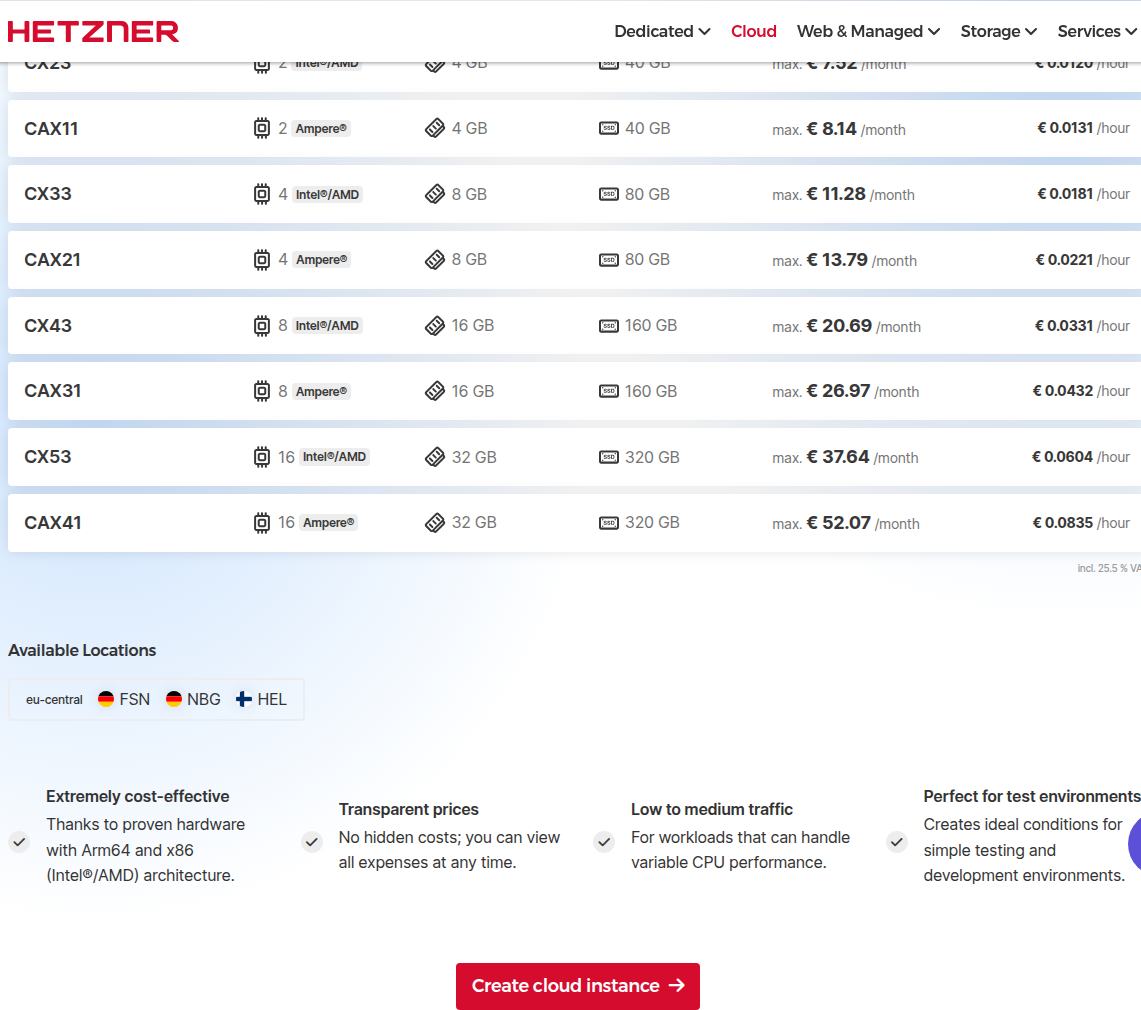
The cheapest Hetzner cloud server you can buy today is the CX23 at €7.52/mo max (€0.0120/hr) on the cost-optimized tier, including 25.5% VAT as shown to non-logged-in visitors. For context, here is what that buys: 2 shared vCPUs (Intel/AMD), 4 GB RAM, and 40 GB SSD. The ARM equivalent (CAX11) starts slightly higher.
Hetzner’s Regular Performance tier (CPX) and General Purpose tier (CCX) scale up from there, with dedicated vCPUs on the CCX line; both start higher than the CX line shown above.
1. Datalix: The absolute cheapest (when in stock)
Starting price: €2.45/mo for the Ryzen KVM “Small” plan (1 vCore, 2 GB DDR4, 20 GB NVMe, 5 TB traffic).
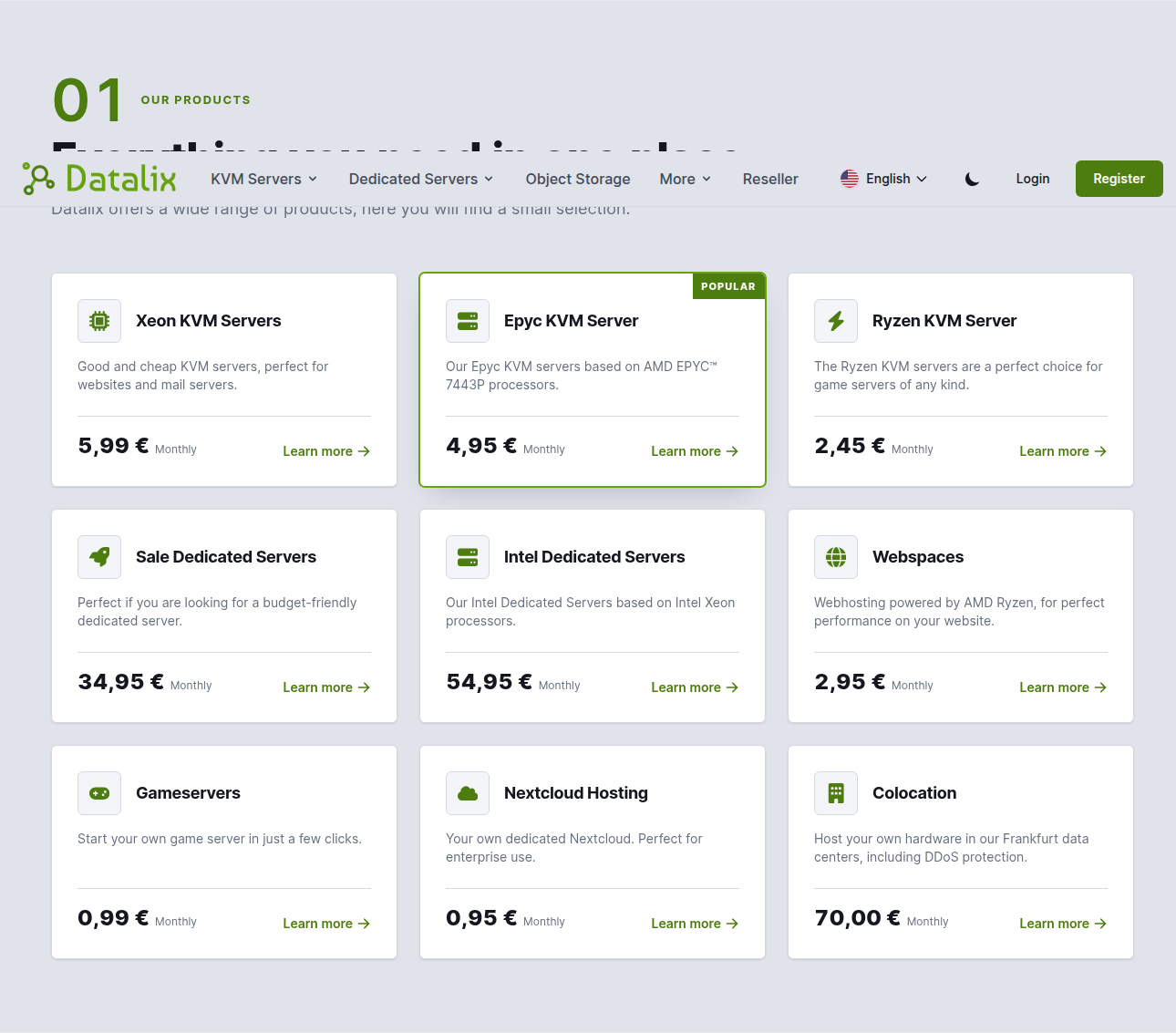
Datalix operates out of Frankfurt data centers, owns its own AS (AS203446), and runs everything on KVM virtualization. It offers three KVM lines: Ryzen (Ryzen 9 5950X for Gen2, Ryzen 9 9950X3D for Gen4), Epyc (AMD EPYC 7443P), and Xeon. Its homepage cards advertise Ryzen KVM from €2.45/mo, Epyc KVM from €4.95/mo, and Xeon KVM from €5.99/mo.
The headline: Datalix’s Ryzen Gen2 Small at €2.45/mo is less than a third of Hetzner’s cheapest cloud instance. That is real money saved if you are running a personal VPN, a tiny static site, or a dev sandbox.
The Ryzen Gen2 line runs from the Small plan up to Expert:
| Plan | vCores | RAM | Storage | Traffic | Price |
|---|---|---|---|---|---|
| Small | 1 | 2 GB | 20 GB NVMe | 5 TB | €2.45/mo |
| Starter | 1 | 4 GB | 25 GB NVMe | 10 TB | €3.95/mo |
| New | 2 | 6 GB | 50 GB NVMe | 15 TB | €4.95/mo |
| Boost | 2 | 8 GB | 50 GB NVMe | 20 TB | €7.45/mo |
| Super | 3 | 12 GB | 75 GB NVMe | 25 TB | €9.95/mo |
| Expert | 4 | 16 GB | 120 GB NVMe | 30 TB | €14.95/mo |
All Ryzen Gen2 plans run on RAID1 NVMe with a 1 Gbit uplink, an IPv4 plus a /64 IPv6 subnet, and DDoS protection. Datalix also supports Windows as a click-to-install option, which Hetzner does not officially support.
Where Datalix loses
The single biggest problem is stock. Datalix is a small operation, and its cheapest and highest-spec plans frequently sell out — Epyc and Gen4 Ryzen tiers are routinely marked “Sold Out.” When the plan you want is unavailable, you cannot buy it, period. There is no waitlist and no auto-provisioning.
Other downsides:
- Single location (Frankfurt only). No geographic redundancy. If the Frankfurt data center has an outage, your server is down.
- No API, no Terraform, no CLI. Everything is done through an in-house web control panel. If you need infrastructure-as-code, Datalix is not the right tool.
- Prepaid model with auto-deletion. You prepay for a term. If you forget to top up your balance, your server is deleted after 5 days. There is no invoice cycle, no grace period negotiation.
- Daytime-only support. Support runs Monday to Sunday, 9:00 to 22:00. No 24/7 coverage. Hetzner offers 24/7 email support.
- Small provider. Long-term viability is not guaranteed the way it is with a company operating since 1997.
- No private networking/VLAN mentioned in the available product documentation.
- No object storage, load balancer, or block storage integrated with the KVM product. A separate Object Storage product exists but is not bundled.
2. netcup: Best value at the low end
Starting price: €5.91/mo (incl. 19% VAT) for the VPS 500 G12 (2 vCore, 4 GB DDR5 ECC, 128 GB NVMe).
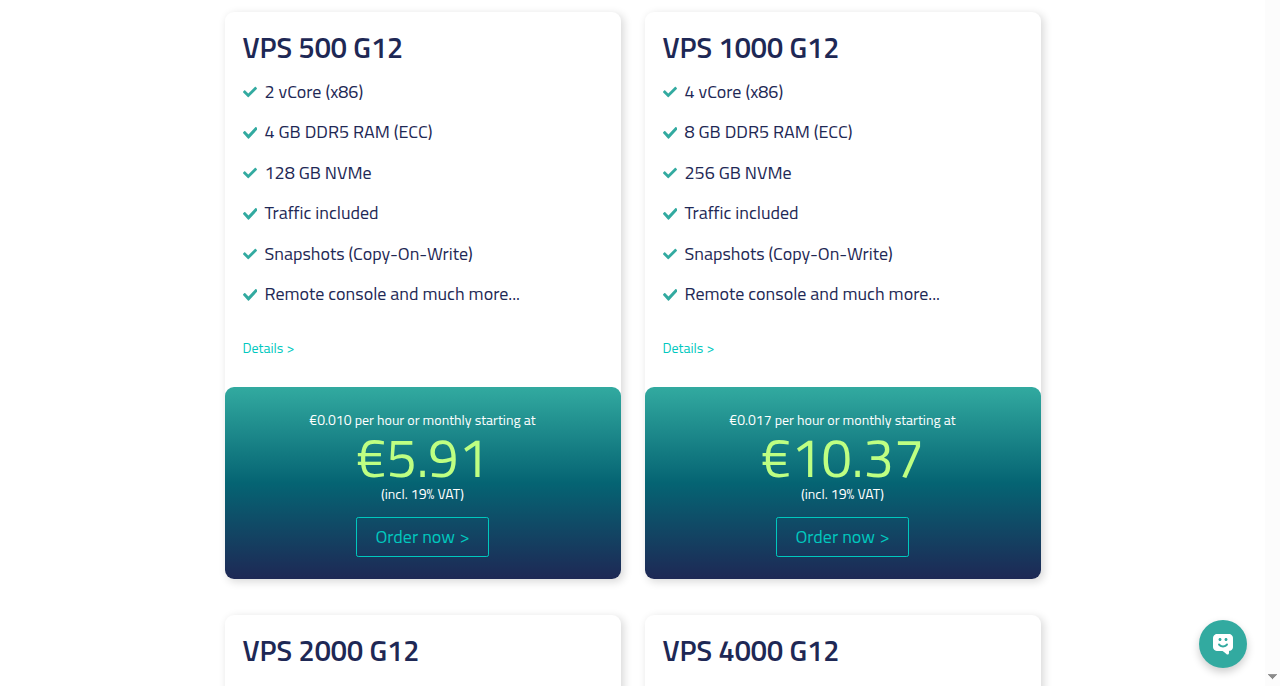
netcup is a German VPS and web hosting provider, a subsidiary of Anexia, headquartered in Karlsruhe. (It earns the value crown here, so we’ve also written a dedicated netcup vs Hetzner head-to-head.) It punches well above its weight for a budget host, holding four ISO certifications (9001, 27001, 27701, 14001), offering hourly billing, and providing Copy-on-Write snapshots included in the price.
The VPS G12 line (x86) from the pricing page:
| Plan | vCores | RAM | Storage | Price (incl. VAT) |
|---|---|---|---|---|
| VPS 500 G12 | 2 | 4 GB DDR5 ECC | 128 GB NVMe | €5.91/mo |
| VPS 1000 G12 | 4 | 8 GB DDR5 ECC | 256 GB NVMe | €10.37/mo |
| VPS 2000 G12 | 8 | 16 GB DDR5 ECC | 512 GB NVMe | €19.25/mo |
| VPS 4000 G12 | 12 | 32 GB DDR5 ECC | 1 TB NVMe | €32.41/mo |
| VPS 8000 G12 | 16 | 64 GB DDR5 ECC | 2 TB NVMe | €47.95/mo |
netcup also offers ARM64 VPS plans (G11 generation) and an even cheaper “vServer Lite” tier (not captured in the screenshot above).
At the entry level, the VPS 500 G12 gives you 4 GB RAM and 128 GB NVMe for €5.91/mo (incl. 19% VAT). Compare that to Hetzner’s CX23: 4 GB RAM, 40 GB storage for €7.52/mo (incl. 25.5% VAT). netcup gives you triple the storage and a lower price. That is a meaningful difference if you are price-sensitive and storage-bound. (The two prices are shown at different VAT rates because each vendor displays VAT for the region it detected at capture time; compare the pre-VAT figures if you want an exact like-for-like.)
netcup operates in five locations: Vienna (AT), Nuremberg (DE), Amsterdam (NL), Manassas (US), and Singapore. That is comparable geographic coverage to Hetzner. DDoS protection is included, and local block storage can be added up to 8 TB at €0.012/GB/mo.
Where netcup loses
- No integrated cloud ecosystem. Unlike Hetzner, netcup has no object storage, no load balancer, no managed databases. You get a VPS, and you build everything else yourself. The only storage add-on is Local Block Storage.
- No one-click app marketplace. Hetzner offers Docker CE, WordPress, Nextcloud, GitLab, Grafana, and a dozen other apps as one-click deployments. netcup has pre-configured images but nothing comparable in breadth.
- No built-in firewall service. You get DDoS protection and must manage your own firewall rules at the OS level. Hetzner includes stateful cloud firewalls for free.
- Windows is a 180-day trial. You can install Windows, but there is no license purchase option. After 180 days, you are on your own.
- Smaller company. Roughly 50 employees versus Hetzner’s much larger operation since 1997. English-language support may be more limited than German.
- Upgrades only within the same generation. Cross-generation upgrades (e.g., G11 to G12) require migration. And server location cannot be changed after setup.
3. Cloudify.ro: Enterprise OpenStack at VPS prices (Romania only)
Starting price: €16/mo for the 4 vCPU dedicated plan (8 GB RAM ECC, 160 GB NVMe HA, 10 TB transfer).
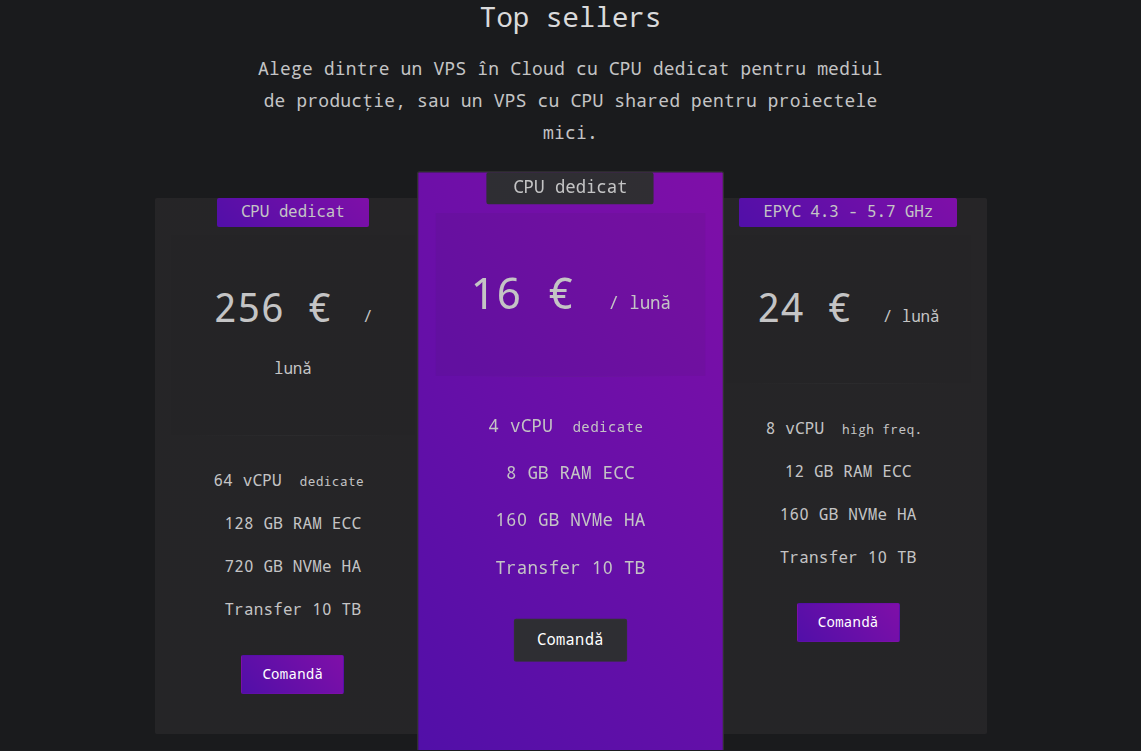
Cloudify.ro is a Romanian cloud VPS provider running OpenStack + Ceph + KVM. The infrastructure is genuinely enterprise-grade: Ceph storage with 3x replication (more resilient than RAID), VXLAN private networks, and a data center with biometric access, UPS N+1, an 800 kVA diesel generator, and inergen fire suppression.
The three “top seller” plans visible on the homepage:
| Plan | vCPUs | RAM | Storage | Transfer | Price |
|---|---|---|---|---|---|
| CPU Dedicat (mid) | 4 dedicated | 8 GB ECC | 160 GB NVMe HA | 10 TB | €16/mo |
| EPYC High Freq | 8 high freq (4.3-5.7 GHz) | 12 GB ECC | 160 GB NVMe HA | 10 TB | €24/mo |
| CPU Dedicat (large) | 64 dedicated | 128 GB ECC | 720 GB NVMe HA | 10 TB | €256/mo |
Cloudify.ro uses a “pay-as-you-grow” billing model: you are charged hourly, capped at 500 hours per month. So a server running 24/7 for a full month costs 500 x the hourly rate, not 720-744 x it. That effectively gives you about 30% off the hourly rate for always-on workloads. There is also a 30-day money-back guarantee, which no other provider on this list matches.
The dedicated CPU plan at €16/mo is a legitimate alternative to Hetzner’s General Purpose (CCX) tier, which uses dedicated vCPUs but starts at a considerably higher price point.
Where Cloudify.ro loses
- Single location: Romania only. If you need servers in Germany, the US, or Asia, Cloudify.ro cannot serve you. This is a non-starter for any multi-region deployment.
- Very small company. Acvile Tech SRL is tiny compared to established hosts. Long-term viability and support consistency are unknown. The blog exists and the dashboard looks modern, but the company’s track record is limited.
- No API or CLI highlighted. OpenStack has standard APIs, but Cloudify.ro does not prominently document or advertise them. If you need Terraform or SDK-driven infrastructure, you may be on your own.
- No one-click apps, snapshots, or backup services advertised. You get raw infrastructure. Everything else is your responsibility.
- No SLA prominently displayed. An uptime page is linked but not quantified on the main site.
- Romanian-first. The English website exists but product depth in English is thinner. Support in English is not guaranteed.
- Only 3 plans visible. The full plan range is unclear; the pricing page redirects back to the homepage. You may need to contact sales to learn about other options.
4. Cherry Servers: Bare metal first, VPS second
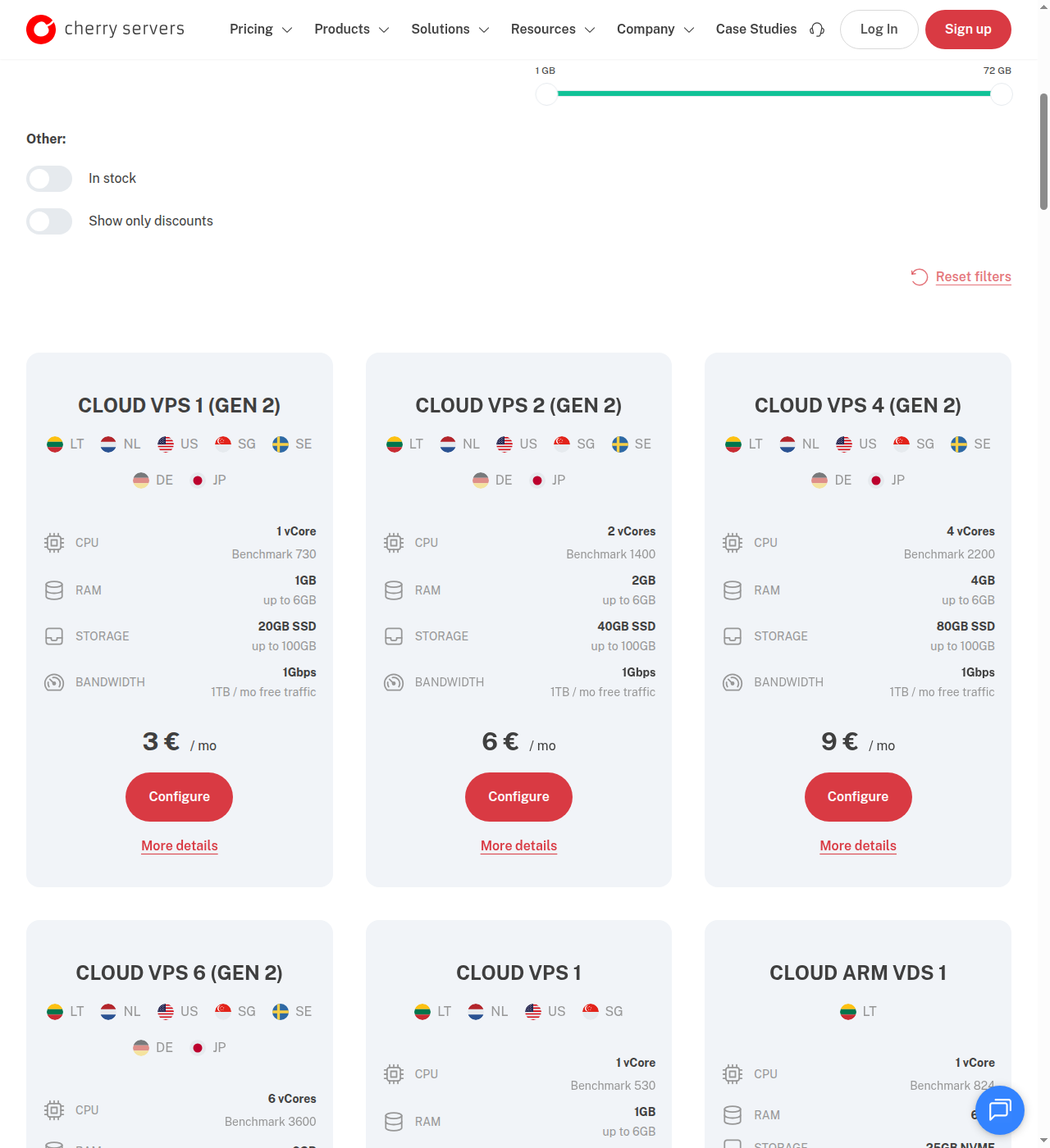
Starting price for virtual servers: €3/mo for Cloud VPS 1 (GEN 2) (1 vCore, 1 GB RAM, 20 GB SSD, 1 TB free traffic).
Cherry Servers is primarily a bare-metal provider (founded 2001, Lithuanian HQ) that also sells KVM-based virtual servers. The virtual server lineup is broad: Cloud VPS (shared resources, Gen 1 and Gen 2), Cloud VDS (dedicated resources), Cloud ARM VDS, Storage VPS, Premium VDS, and Performance VDS. Seven locations are available: Lithuania, Amsterdam, Chicago, Singapore, Stockholm, Frankfurt, and Tokyo.
The entry-level virtual server is the Cloud VPS 1 (Gen 2) at €3/mo for 1 vCore, 1 GB RAM, 20 GB SSD. At the low end of the range visible in the captured screenshot:
| Plan | vCores | RAM | Storage | Price |
|---|---|---|---|---|
| Cloud VPS 1 (Gen 2) | 1 | 1 GB | 20 GB SSD | €3/mo |
| Cloud VPS 2 (Gen 2) | 2 | 2 GB | 40 GB SSD | €6/mo |
| Cloud VPS 4 (Gen 2) | 4 | 4 GB | 80 GB SSD | €9/mo |
| Cloud VPS 6 (Gen 2) | 6 | 6 GB | 100 GB SSD | €13/mo |
Higher-tier plans (Cloud VDS, Premium VDS, Performance VDS) scale up from there with dedicated resources, more RAM, and NVMe storage.
What makes Cherry Servers genuinely different from every other provider on this list:
- Crypto payments. BTC, ETH, SOL, USDC, LTC, MATIC, TRX, XRP, DOGE, BUSD, BNB, DAI are all accepted alongside credit cards, PayPal, and SEPA. This is the only provider here that takes crypto natively.
- Solana/blockchain specialization. Dedicated Solana validator and RPC infrastructure.
- 15-day money-back guarantee. Only Cloudify.ro (30 days) offers anything comparable on this list.
- 24/7 human support with a claimed 45-second response time, plus a personal account manager.
- Full developer tooling: CLI, Python SDK, Go SDK, Ansible, Terraform.
Where Cherry Servers loses
- Not cheaper than Hetzner for comparable virtual servers. The Cloud VPS 1 at €3/mo gives you 1 GB RAM and 20 GB storage, which is less than Hetzner’s cheapest CX23 (4 GB RAM, 40 GB storage at €7.52/mo). Cherry Servers is competitive on the ultra-low end but worse value-per-euro at comparable specs. If cheap VPS is your sole criterion, Cherry Servers is not the answer.
- Virtual servers are not their focus. Cherry Servers is a bare-metal-first company. The VPS lineup feels like a secondary product. If you want a provider that treats VPS as its core business, look at netcup or Hetzner.
- No one-click app marketplace. No WordPress, no Nextcloud, no GitLab one-click deployments. You install everything manually.
- No integrated object storage or load balancer. These are not advertised as bundled cloud services.
- Entry Gen 2 plans have limited free traffic (1 TB/mo). Hetzner gives 20 TB on most plans. If you serve significant traffic, Cherry Servers’ free tier may run out quickly, and overage pricing applies.
- Complex product lineup. The sheer number of plan categories (Cloud VPS Gen 1, Gen 2, Cloud VDS, Premium VDS, Performance VDS, Storage VPS, Cloud ARM VDS) makes it hard to compare and choose. A simple “I need a VPS” buyer will find the navigation confusing.
Comparison table
| Hetzner (CX23) | Datalix (Small) | netcup (VPS 500) | Cloudify.ro (CPU Ded) | Cherry (VPS 1 G2) | |
|---|---|---|---|---|---|
| Entry price | €7.52/mo | €2.45/mo | €5.91/mo | €16/mo | €3/mo |
| vCPUs | 2 shared | 1 shared | 2 shared | 4 dedicated | 1 shared |
| RAM | 4 GB | 2 GB DDR4 | 4 GB DDR5 ECC | 8 GB ECC | 1 GB |
| Storage | 40 GB | 20 GB NVMe | 128 GB NVMe | 160 GB NVMe HA | 20 GB SSD |
| Traffic | 20 TB | 5 TB | Traffic included | 10 TB | 1 TB |
| Locations | 5 regions | 1 (Frankfurt) | 5 locations | 1 (Romania) | 7 locations |
| API/Terraform | Yes | No | Yes (API) | Not advertised | Yes |
| Free backups | No (paid add-on) | Yes (4 included) | Snapshots included | No | No |
| Support | 24/7 email | 9:00-22:00 | Not 24/7 | Unclear | 24/7 human |
| Money-back | No | No | No | 30 days | 15 days |
| Crypto payments | No | No | No | No | Yes |
Prices as of June 2026; check each vendor’s site for current rates. Hetzner prices shown include 25.5% VAT (non-logged-in view). netcup prices include 19% VAT.
Where Hetzner still wins
This is a post about cheaper alternatives, but it only makes sense if we are honest about what Hetzner does better:
-
Cloud ecosystem. Private networks (VXLAN), stateful firewalls (free), load balancers, block storage, S3-compatible object storage, floating IPs, snapshots, backups. All integrated. None of the alternatives here offer the same breadth.
-
One-click app marketplace. Docker CE, WordPress, Nextcloud, GitLab, Grafana, WireGuard, Coolify, Jitsi, Owncast, PhotoPrism, RustDesk, Prometheus. Deploy any of these in minutes with zero configuration. netcup has pre-configured images but nothing this broad. The others have no marketplace at all.
-
Infrastructure maturity. Own data centers (not rented racks), ISO 27001 certified, C5 BSI certified, GDPR-compliant by design. Operated since 1997. Datalix and Cloudify.ro are tiny by comparison. Institutional buyers with compliance requirements will find Hetzner’s certifications hard to match.
-
Generous traffic. 20 TB included on most cloud plans. Datalix plans cap at 5-30 TB depending on tier. Cherry Servers gives only 1 TB on the Gen 2 entry plan. If you serve files, stream media, or run a CDN origin, Hetzner’s traffic allowance is a major cost advantage.
-
Server Auction. Used dedicated servers at bid-based prices, unlimited traffic, 1 Gbit/s. This is a completely different category that none of the alternatives touch.
Bottom line: Who should pick what?
Pick Datalix if you need the absolute lowest price and you only need one server in Frankfurt. Accept the risk that the plan you want may be sold out. Great for personal projects, learning, or tiny production services where downtime is survivable.
Pick netcup if you want the best all-around value under €10/mo. You get more RAM and storage per euro than Hetzner, hourly billing, and ISO certifications that make this safe for business use. This is the recommendation for anyone who would otherwise buy Hetzner’s cheapest cloud plan.
Pick Cloudify.ro if you specifically want enterprise OpenStack infrastructure, dedicated vCPUs at a low price, and a Romanian data center (for latency or jurisdictional reasons). The 30-day money-back guarantee makes it low-risk to try. Not suitable if you need multi-region deployment.
Pick Cherry Servers if you need bare metal, pay with crypto, or run Solana infrastructure. The virtual servers are fine but not the main attraction. For plain VPS hosting at the low end, netcup or Hetzner give better value.
Stick with Hetzner if you need a proven cloud ecosystem with one-click apps, an API that works with Terraform, five geographic regions, and the confidence of a company operating since 1997. You pay more, but you get infrastructure maturity that none of the alternatives match.
This comparison would be wrong for someone who needs: managed services (none of these providers offer managed cloud), Windows with a proper license (only Datalix offers click-to-install Windows, and even then licensing is unclear), or GPU compute (look at Cherry Servers’ bare metal or Cloudify.ro’s AI servers, not covered here).
Hetzner alternatives: FAQ
What is the cheapest alternative to Hetzner?
Datalix, at €2.45/mo for its Ryzen KVM Small plan (1 vCore, 2 GB DDR4, 20 GB NVMe, 5 TB traffic) — less than a third of Hetzner’s cheapest cloud instance, the CX23 at €7.52/mo. The catch: plans frequently sell out with no waitlist, there is only one location (Frankfurt), and there is no API or Terraform support.
Is netcup cheaper than Hetzner?
Yes, and it gives you more for the money — see our full netcup vs Hetzner comparison for the spec-by-spec breakdown. netcup’s VPS 500 G12 costs €5.91/mo (incl. 19% VAT) for 2 vCores, 4 GB DDR5 ECC RAM, and 128 GB NVMe; Hetzner’s CX23 costs €7.52/mo (incl. 25.5% VAT) for 2 vCPUs, 4 GB RAM, and 40 GB SSD. That is triple the storage at a lower price — though Hetzner keeps the edge on cloud ecosystem: free stateful firewalls, load balancers, object storage, and a one-click app marketplace that netcup does not match.
What is the best Hetzner Cloud alternative overall?
For most people who would otherwise buy Hetzner’s cheapest plan, netcup: best RAM and storage per euro under €10/mo, hourly billing, five locations, and four ISO certifications that make it safe for business use. If you want a mainstream provider instead of a budget one, see our companion post on Hetzner Cloud alternatives worth switching to, which covers OVHcloud, Scaleway, Linode, and DigitalOcean.
Which Hetzner alternative accepts crypto payments?
Cherry Servers is the only provider on this list that takes crypto natively — BTC, ETH, SOL, USDC, LTC, and several others, alongside credit cards, PayPal, and SEPA. Hetzner, Datalix, netcup, and Cloudify.ro do not accept crypto.
Do any Hetzner alternatives offer a money-back guarantee?
Two do: Cloudify.ro offers 30 days and Cherry Servers offers 15 days. Hetzner, Datalix, and netcup offer none, though netcup and Cloudify.ro bill hourly, which limits your commitment either way.