6 June 2026 · Comparison
Sellfy vs WooCommerce vs Shopify vs Wix: Which Wins in 2026?
The short answer
Sellfy for creators with built-in POD and 0% fees, Shopify for scaling brands, WooCommerce for control, Wix for design-first simplicity.
Four platforms, four very different bets. The short version: pick Sellfy if you’re a creator selling digital products, print-on-demand, or subscriptions to an audience you already have, and you want everything in one box with 0% transaction fees. Pick Shopify if you’re building something big and want the app ecosystem to grow into. Pick WooCommerce if you want total control, no platform tax, and you’ve got the technical chops (or the budget to rent them). Pick Wix if a beautiful store you can build yourself matters more than raw flexibility.
If you only read one paragraph, that’s it. But the right answer really does depend on who you are, so here’s the quick cheat sheet:
- Sellfy: Creators with an existing audience (social, YouTube, newsletter) who want built-in POD, PDF stamping, email marketing, and 0% transaction fees all in one plan.
- Shopify: Growing brands that need multi-channel selling, POS, a massive app ecosystem, and the best checkout in the business.
- WooCommerce: Developers, agencies, and businesses that want unlimited customization, own their data, and accept the ongoing maintenance trade-off.
- Wix eCommerce: Small-to-medium stores that want a beautiful drag-and-drop store fast, with hosting and marketing bundled.
Affiliate disclosure: Some links in this post are affiliate links. If you click through and make a purchase, we may earn a commission at no extra cost to you. Sellfy is an affiliate partner.
Sellfy: Built for Creators, Not Marketplaces
Sellfy calls itself the all-in-one ecommerce platform for creators, and for once the marketing is roughly honest. If you make digital products, merch, subscriptions, or video content, and you already have people watching you on YouTube, TikTok, Instagram, or in a newsletter, Sellfy does more out of the box than anything else on this list.
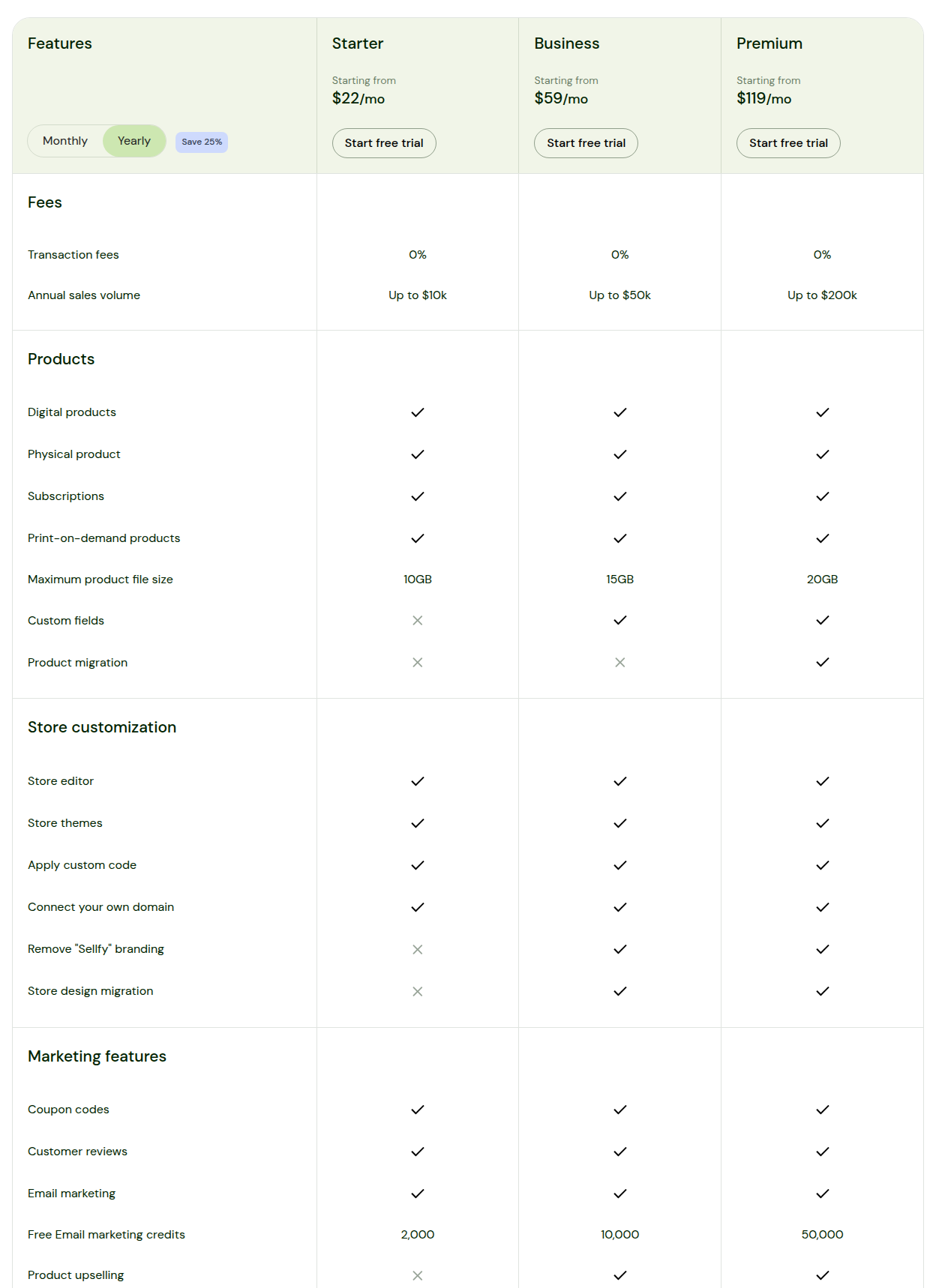
Pricing comes in three tiers. Starter is $29/mo ($22/mo billed annually), Business is $79/mo ($59/mo billed annually), and Premium is $159/mo ($119/mo billed annually) as of June 2026. Crucially, every plan charges 0% transaction fees on top of the standard payment processor cut (usually 2.9% + 30c). You get a 14-day free trial and a 30-day money-back guarantee, so there’s a real window to kick the tires.
Start your Sellfy store free →
Every plan includes the same core kit: digital products (files up to 10GB), physical products, subscriptions, built-in print-on-demand, store themes, custom code, your own domain, PayPal and Stripe, SSL, mobile-optimized checkout, VAT/tax handling, and 24/7 email support. Premium tacks on priority support. Notice what isn’t gated behind the top tier — that’s unusual, and it’s the point.
Where Sellfy Wins
The headline feature is built-in print-on-demand. Design a t-shirt, hoodie, or mug right inside Sellfy and they handle printing and shipping. No Printful, no Printify, no extra integration to babysit. None of the other three do this natively.
Then there’s PDF stamping and download limits — Sellfy watermarks your PDFs with the buyer’s info and lets you cap how many times a purchase can be downloaded. If you sell guides, templates, or e-books, that’s real anti-piracy you’d otherwise be bolting onto Shopify, WooCommerce, or Wix with extra plugins.
The money story is the clincher, though. Those 0% transaction fees mean Sellfy takes no cut of your sales — you pay only the processor (Stripe or PayPal’s ~2.9% + 30c). Compare that to Gumroad’s 10% on the free plan, or Shopify’s 2% penalty for using a third-party gateway on Basic, and the gap adds up fast.
It also folds in email marketing: 2,000 credits on Starter, 10,000 on Business, 50,000 on Premium. Discount codes, upsells, cart-abandonment emails, affiliate marketing — all without a separate Klaviyo or Mailchimp bill. (If email is the part you really care about, our Kit vs Mailchimp comparison goes deeper.) And payouts are instant — money hits your PayPal or Stripe the moment a sale closes, no weekly waiting game.
Where Sellfy Loses
Here’s the catch that nobody on Sellfy’s homepage will highlight: every plan has a sales cap. Starter stops at $10,000/yr in sales, Business at $50,000/yr, Premium at $200,000/yr. Blow past your cap and you either eat a 2% overage fee or upgrade. Shopify, WooCommerce, and Wix have nothing like this. It’s the single biggest structural flaw here — you get penalized for growing.
The other big one: Sellfy brings no traffic. Zero. It’s a storefront, not a marketplace. If you don’t already have followers, subscribers, or some traffic source, you’ll be selling into the void. Etsy, Amazon, and eBay hand you customers; Sellfy assumes you already have them.
A few more rough edges worth knowing before you commit:
- Only two payment gateways — PayPal and Stripe, full stop. No Apple Pay, Google Pay, BNPL, crypto, or regional options. Shopify supports 100+, WooCommerce 140+, Wix 80+.
- No app store. Sellfy talks to Zapier and that’s about it. Shopify has thousands of apps, WooCommerce inherits 60,000+ WordPress plugins, Wix has 300+. If a feature isn’t built in, you’re usually stuck.
- No POS. It’s online-only. Sell at markets, pop-ups, or a physical shop and you’ll want Shopify, Wix, or WooCommerce instead.
- Limited design freedom. The editor is fine, but it’s nowhere near Wix’s drag-and-drop, Shopify’s Liquid templates, or WooCommerce’s anything-goes code access.
- Those email credits run out. Starter’s 2,000/month is thin for an active store, and overages cost extra — whereas on the others you can wire up any email tool you like.
- No blog or content engine. Shopify and Wix include blogging; WooCommerce sits on WordPress, the best content platform there is. Sellfy gives you nothing for SEO traffic, which stings given it already expects you to bring your own.
Shopify: The App Ecosystem Titan
Shopify is the biggest ecommerce platform on earth, and it didn’t get there by accident. It runs millions of stores, from one-person side hustles to billion-dollar brands on Shopify Plus. The checkout converts, the app ecosystem has no rival, and the channels it reaches — online, POS, social, even AI chat — keep multiplying.
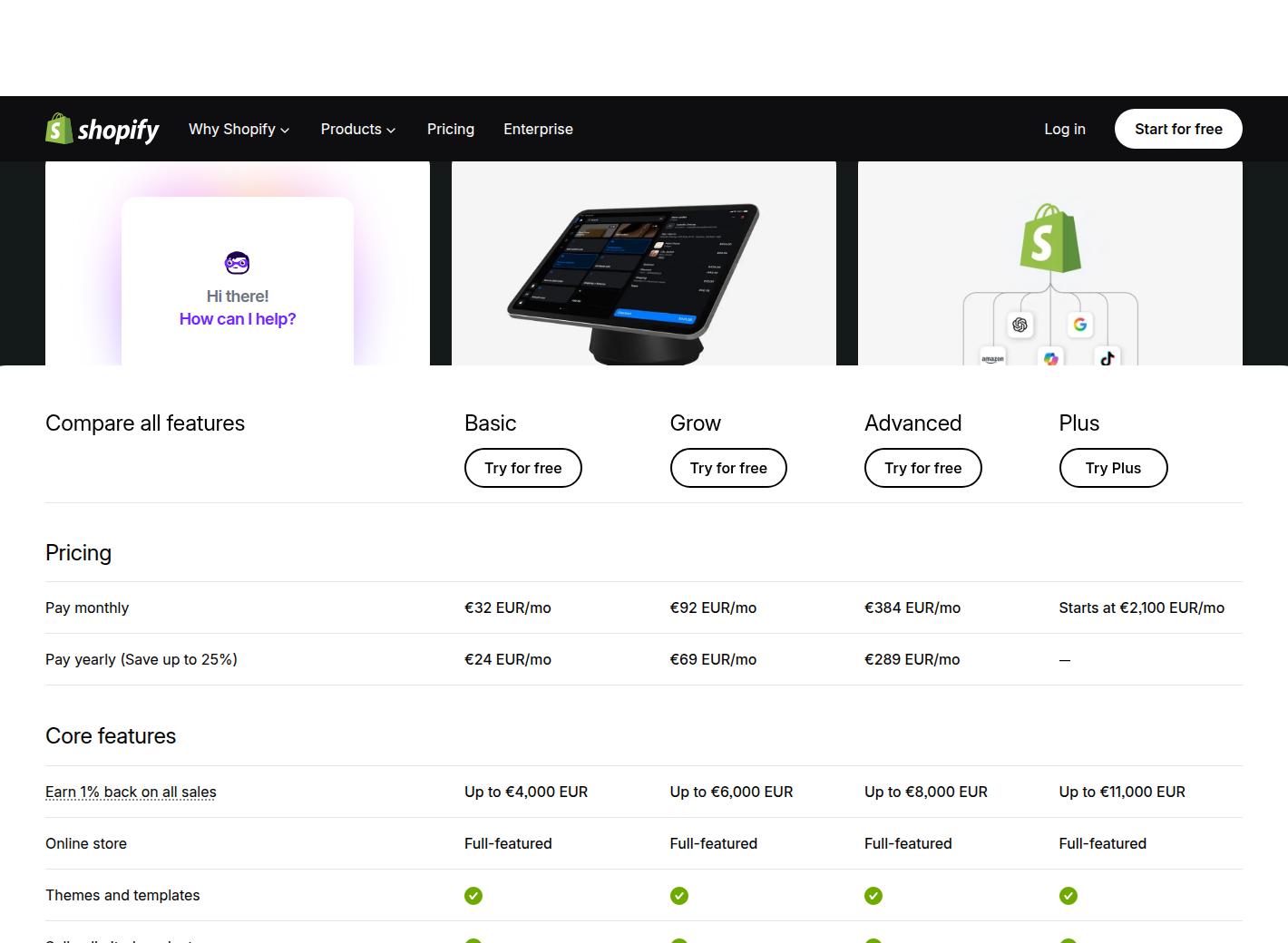
European pricing as of June 2026 looks like this: Basic at €32/mo monthly (€24/mo billed annually), Grow at €92/mo monthly (€69/mo annually), Advanced at €384/mo monthly (€289/mo annually), and Plus starting at €2,100/mo on a 3-year term. You’ll often see the €1/mo-for-3-months promo after a free 3-day trial. US pricing differs, so check shopify.com/pricing for your region.
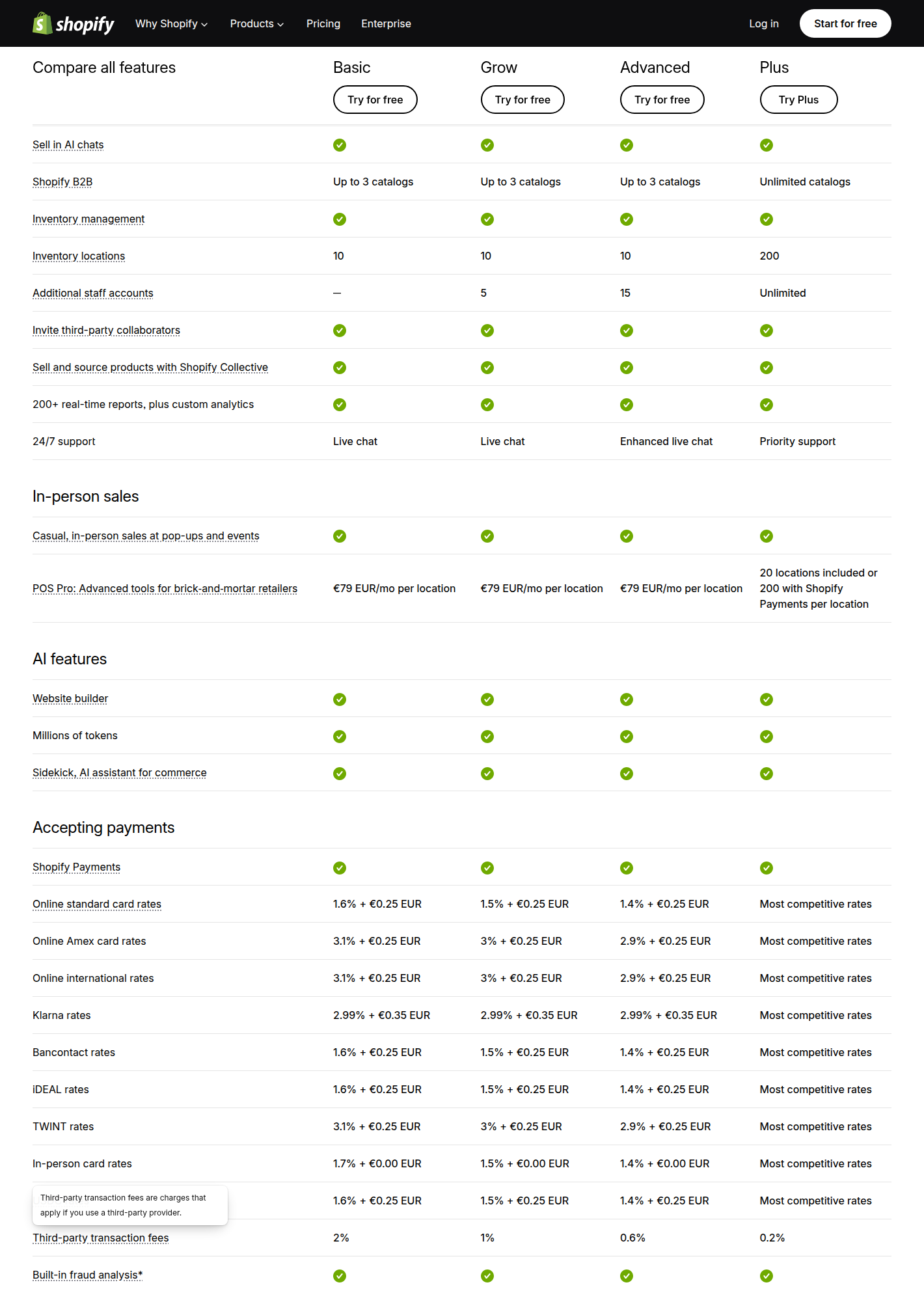
Pay attention to fees here more than anywhere else in this roundup. Shopify Payments card rates in Europe start at 1.6% + €0.25 on Basic and fall to 1.4% + €0.25 on Advanced (US rates run higher, around 2.9% + 30c). Bring your own gateway instead of Shopify Payments and you’ll pay a surcharge on top: 2% on Basic, 1% on Grow, 0.6% on Advanced, 0.2% on Plus.
Where Shopify Wins
Start with the checkout, which is the best in the business. Shopify claims it converts 15% better than other platforms — take the exact figure with a grain of salt, but the experience is genuinely fast, familiar, and trusted, and Shop Pay’s one-click returns are a real edge.
Then the app ecosystem, which is the reason most people stay. Thousands of apps cover email, SEO, reviews, upsells, POD, dropshipping, accounting, shipping — whatever you need probably exists, and if it doesn’t, the API means someone can build it. That reach extends to selling everywhere: your own site, Facebook, Instagram, TikTok, Amazon, eBay, in-person via Shopify POS, and now AI chat surfaces like ChatGPT and Perplexity. Plus adds wholesale/B2B.
A few things competitors simply can’t match:
- A real financial stack — Shopify Balance (banking), Capital (funding), Credit (a business card), and Bill Pay, all built in. Nobody else here is close.
- POS that actually works. POS Pro syncs online and in-person inventory, customers, and analytics — the most polished in-person option in this comparison. It’s €79/mo per location (European pricing).
- 24/7 live chat on every plan, where Sellfy is email-only and WooCommerce support means buying an extension.
- B2B on every plan — even Basic gives you up to 3 wholesale catalogs with custom pricing.
Where Shopify Loses
The recurring theme is that the sticker price is a fiction. Between payment processing, the third-party gateway penalty, and a stack of monthly app subscriptions, what you actually pay each month is usually well north of the plan price.
That third-party payment penalty deserves its own callout, because it’s aggressive. Use PayPal, Stripe, or anything other than Shopify Payments on Basic and you hand over an extra 2% of every transaction — on top of the gateway’s own fees. It’s the hardest vendor lock-in in ecommerce, and it’s deliberate.
The rest of the trade-offs:
- No built-in digital delivery. Selling ebooks, software, music, or courses means a third-party app. Sellfy does delivery, PDF stamping, video streaming, and download limits natively; Shopify does none of it out of the box.
- Variant limits. You’re capped at 100 variants per product and 3 option types in the admin UI (2,048 is the hard system limit). Lots of size/color/material combos and you’ll hit the wall. WooCommerce won’t.
- Pricey at scale. Advanced is €384/mo and Plus starts at €2,100/mo — before apps, themes, or transaction fees. WooCommerce charges nothing at any scale.
- Email is an afterthought. Shopify Email exists but it’s bare-bones; serious marketing means Klaviyo, Mailchimp, or Omnisend as separate subscriptions. Sellfy and Wix both bundle it.
- App costs creep. Real stores routinely spend $50-$300+/mo on apps for things Sellfy includes — abandoned cart, upsells, email, affiliates.
- No native print-on-demand. You’ll need Printful, Printify, or similar. Sellfy bakes it in.
WooCommerce: Maximum Control, Maximum Responsibility
WooCommerce is free, open-source software that turns any WordPress site into a store. No monthly platform fee, no transaction fee, no revenue share. What you actually pay for is hosting, whatever premium extensions you want, and maybe a developer. The catch is right there in the deal: everything is your job.
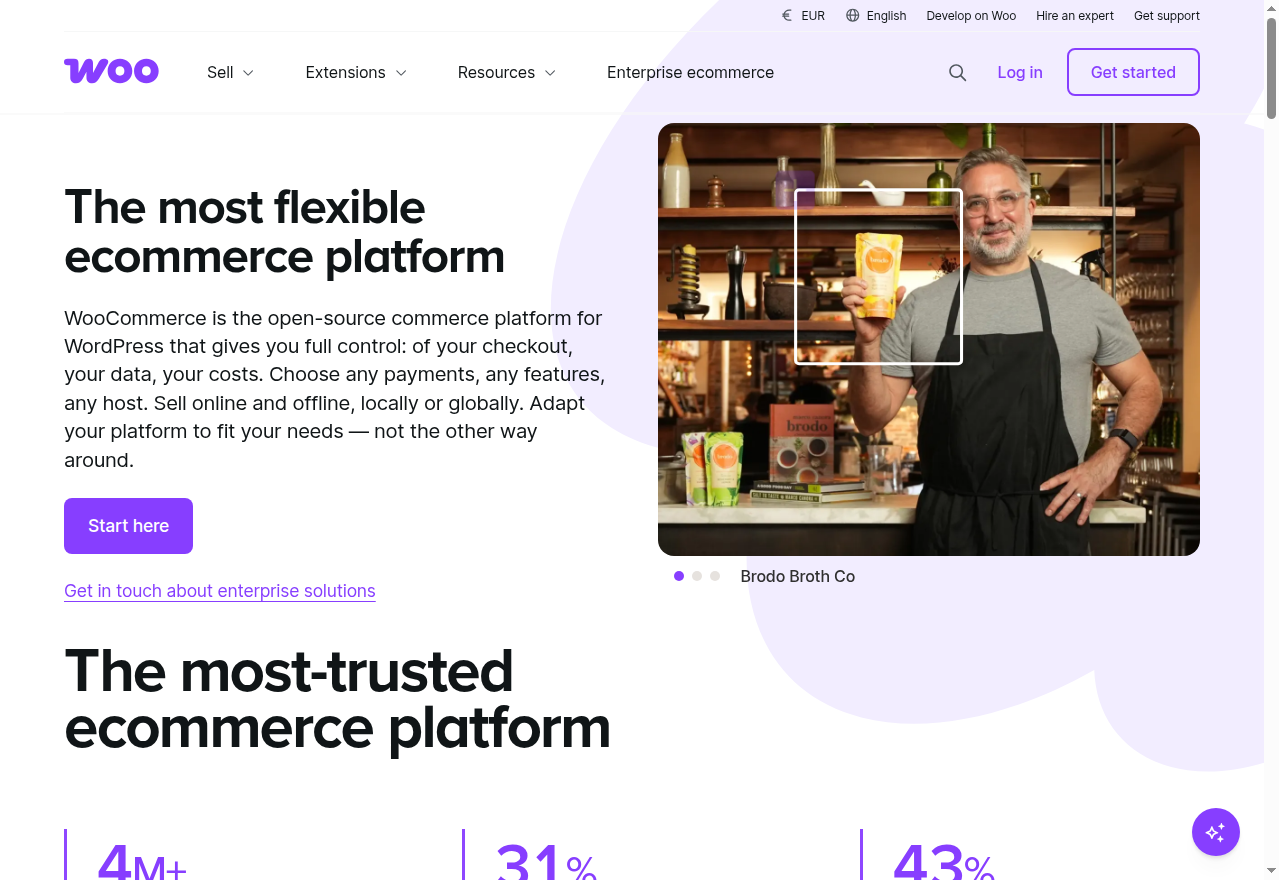
The core is free. Extensions run from free to $299/yr each, though most premium ones land in the $29-$99/yr range. Hosting is the wild card: a small store hums along on $5-$25/mo shared hosting, while a high-traffic store might need $100-$350+/mo of managed WooCommerce hosting. Payment processing through WooPayments is 2.9% + 30c per transaction for US-issued cards (lower for high-volume merchants) — or pick any of 140+ gateways and negotiate your own rates, with no platform penalty for going elsewhere.
Where WooCommerce Wins
The whole pitch comes down to one number: zero. No platform fees, no revenue share, no penalty for your choice of processor. Do $500,000/year in sales and you owe WooCommerce nothing. Shopify would bill hundreds a month in platform fees alone, plus transaction fees. Stretch that over a few years and you’re talking tens of thousands of dollars.
And nothing is artificially capped — products, orders, variants, API calls, SKUs. Shopify stops at 2,048 variants; Wix at 50,000 products. WooCommerce is limited only by your hosting, and hosting scales.
Because it’s open source, you own the store — your data, code, and database. Migrate hosts, swap themes, change developers, and nobody can deplatform you or rewrite your pricing terms overnight. On top of that you inherit the entire WordPress ecosystem: 60,000+ plugins, thousands of themes, the best SEO tooling on the web (Yoast, Rank Math), memberships, LMS, forums. No other platform here has a content engine in the same league.
The rest follows from being open and uncapped:
- Customize anything — REST API, hooks, filters, custom post types, headless frontends. Shopify and Wix have walls; WooCommerce doesn’t.
- Sell globally with no per-market fee. It’s fully translated into 24 languages with multi-currency support. Shopify starts charging after 3 markets.
- Scale without a penalty. One order a day or 100,000 — the platform cost doesn’t move. Shopify and Sellfy both charge you more for growing.
Where WooCommerce Loses
The flip side of “you own everything” is you maintain everything. Hosting, SSL, domain, security, backups, CDN, performance tuning — all yours. Shopify, Wix, and Sellfy bundle the lot. WooCommerce hands you a shopping cart and waves goodbye.
Which is why “free” is a little misleading. The license is genuinely free; the store is not. A modest setup typically needs hosting ($10-$50/mo), a premium theme ($0-$79), a few extensions ($50-$200/yr), and maybe a developer to wire it together. None of that is obvious when you start.
The other costs are time and risk:
- You need technical skill — or someone who has it. WordPress and WooCommerce have a real learning curve around hosting, updates, and plugin compatibility. Sellfy and Wix assume none.
- Maintenance never stops. Core, WooCommerce, themes, plugins, PHP versions, security patches — every update can break something, and staying on top of it is forever.
- Support isn’t included. Docs and forums are free; live help means a paid extension. If the store breaks at midnight, that’s you debugging (or paying a developer emergency rates).
- Performance lives or dies on hosting. Cheap shared hosting will crawl under real traffic. Matching Shopify’s out-of-the-box speed costs money.
- No built-in email marketing — bring Mailchimp, Klaviyo, or similar. Sellfy and Wix include it; Shopify includes a basic version.
- Plugin conflicts are real. More plugins, more chances for incompatibility, vulnerabilities, and slowdowns. Unlike Shopify’s curated store, quality varies wildly across thousands of independent developers.
- No native POD, PDF stamping, or download security — all plugin territory, and some of those plugins are abandoned.
Wix eCommerce: Design-First Simplicity
Wix began life as a drag-and-drop website builder and grew ecommerce on top. It’s aimed squarely at small-to-medium businesses that want a good-looking store quickly, with hosting, SSL, and marketing all rolled into one price.
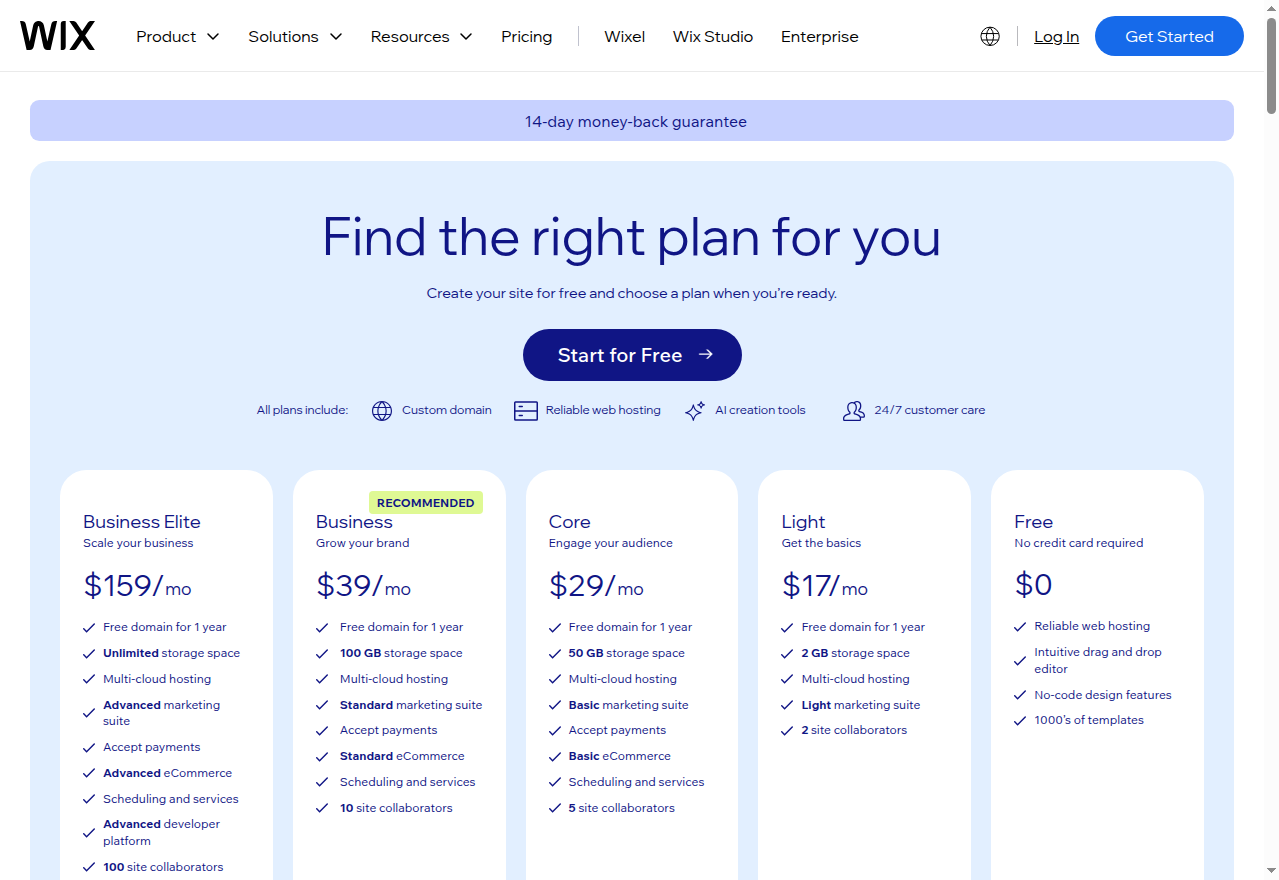
Pricing (billed annually) starts with Light at $17/mo (a basic website, not full ecommerce), Core at $29/mo (basic ecommerce), Business at $39/mo (standard ecommerce), and Business Elite at $159/mo (the full suite). You’ll usually see these behind a roughly 50%-off first-term promo, so check what renewal actually costs before you get attached. On fees, Wix Payments runs at standard rates (2.9% + 30c for US cards) with no extra platform cut, and you’ve got 80+ gateways to choose from including PayPal, Stripe, Square, and BNPL.
Where Wix eCommerce Wins
The reason people choose Wix is design freedom for non-coders. 500+ templates plus a true drag-anywhere editor mean someone with zero design or coding background can build a genuinely polished store faster than on anything else here. And it’s all-in-one — hosting, SSL, a domain (free the first year), CDN, and security are bundled, so there’s no separate hosting bill or SSL setup to fuss with.
The marketing suite is more generous than you’d expect: email campaigns, automations, SEO tools, social posts, Facebook/Instagram ad management, and abandoned-cart recovery, all included — arguably richer than Shopify’s or Sellfy’s at comparable tiers.
A handful of other things land well:
- Subscriptions are native — recurring payments and subscription boxes with no app. WooCommerce charges $199/yr for that; Shopify needs an app.
- A genuinely useful mobile app. The Wix Owner app lets you run products, orders, and live chat from your phone.
- POS is available — Wix hardware and software handle in-person selling synced to your online inventory.
- Multichannel selling across Facebook, Instagram, Google Shopping, eBay, and Amazon.
- 80+ payment gateways, covering most regions and methods.
- Blog and SEO built in. Not WordPress-level, but a world better than Sellfy’s nothing.
Where Wix eCommerce Loses
One word: template lock-in, and it’s brutal. Pick a Wix template, build your site, and you cannot switch templates later without rebuilding from scratch. Nothing else here does this. Choose carefully, because you’re married to it.
The other ceilings show up as you grow:
- A hard 50,000-product limit. Build a big enough catalog and you’ll hit it. Shopify and WooCommerce won’t blink.
- Not built for complex stores. Wix is great from a few dozen to a few hundred products with standard categories and checkout. It lacks the deep customization and API flexibility large stores need — at scale, Shopify or WooCommerce fits better.
- Storage pinches. Core includes 50GB and Business 100GB. Sell large digital files or a media-heavy catalog and those caps start to matter.
- No digital-product security. Wix can deliver files, but there’s no PDF stamping, no watermarking, no real download control like Sellfy’s.
- Email is fine, not serious. Good enough for basics; for advanced segmentation, automation flows, or A/B testing you’ll eventually want a dedicated tool.
- SEO still trails WordPress. Wix has improved a lot, but among SEO pros WordPress/WooCommerce is still the gold standard.
- There’s a scalability ceiling. Wix isn’t the home for a $1M+/year store — the feature set, API limits, and product cap mean you’ll likely outgrow it if things take off.
- Watch the promo pricing. That heavily advertised “50% off” first term makes comparisons misleading. Always check the renewal number.
Head-to-Head Comparison
| Feature | Sellfy | Shopify | WooCommerce | Wix |
|---|---|---|---|---|
| Entry price (annual) | $22/mo | €24/mo (EUR) | Free (+ hosting) | $17/mo (Light) |
| Transaction fee (platform) | 0% | 0.6-2% | 0% | 0% |
| Built-in print-on-demand | Yes | No | No | No |
| Built-in email marketing | Yes (credits) | Basic | No | Yes |
| PDF stamping / anti-piracy | Yes | No | Via plugin | No |
| App/plugin ecosystem | Zapier only | 1,000s | 60,000+ WP | 300+ |
| POS / in-person selling | No | Yes | Via extension | Yes |
| Blog / content engine | No | Basic | WordPress (best) | Yes |
| Payment gateways | 2 | 100+ | 140+ | 80+ |
| Sales cap | Yes | No | No | No |
| Product limit | Unlimited | Unlimited | Unlimited | 50,000 |
| Support | Email 24/7 | Live chat 24/7 | Forum + paid | 24/7 chat |
Prices accurate as of June 2026; check each vendor’s site for current rates.
Final Verdict: Who Should Pick What
Pick Sellfy if you’re a creator with an audience already. You make digital products, merch, or subscriptions, and you’ve got followers on YouTube, TikTok, Instagram, or an email list. Sellfy bundles email, print-on-demand, affiliate management, upsells, cart abandonment, and anti-piracy into one plan at 0% transaction fees. The downsides — sales caps, no marketplace traffic, two gateways — barely register if you drive your own traffic and you’re not doing millions.
Pick Shopify if you’re building a business meant to scale. You want multi-channel selling, in-person POS, the best checkout, and an app for every idea you’ll ever have. You’re fine paying more as you grow in exchange for reliability and reach. For anything aiming at $100K+ that needs to expand channels over time, Shopify is the safe bet.
Pick WooCommerce if you want full control and no platform tax. You (or your team) can handle hosting, updates, and plugin compatibility, and you’d rather own your data than rent it. The long-term economics are the best here for stores doing real volume — as long as you’re honest with yourself about the cost of hosting, extensions, and maintenance.
Pick Wix eCommerce if you want a beautiful store fast with no technical headaches. You need drag-and-drop design, bundled hosting, and built-in marketing, your catalog is under a few thousand products, and you’re not chasing enterprise complexity. Just go in clear-eyed about the template lock-in and product cap.
And a bit of honesty about who this comparison isn’t for:
- No existing audience and you need the traffic to come to you? None of these four is your first move — look at Etsy, Amazon, or eBay.
- Selling a handful of digital products and want the simplest setup imaginable? Gumroad or Payhip probably beats everything here.
- Running an enterprise doing $10M+? You should be weighing Shopify Plus against Adobe Commerce (Magento) against a custom headless build — not Sellfy or Wix.
More SaaS comparisons from SaaSpicious:
- Instapage vs Unbounce — landing page builder face-off
- Notion vs Confluence — project management platform pick
- Browse all comparisons — full archive of tested tool match-ups