Hetzner Cloud Alternatives: 5 Providers Worth Switching To (2026)

Hetzner Cloud Alternatives: 5 Providers Worth Switching To (2026)
Affiliate disclosure: Some links below are affiliate links. If you click and buy, we may earn a commission at no extra cost to you. We only recommend tools we’ve researched or used ourselves.
Verdict: If Hetzner’s higher US/Singapore pricing and reduced traffic allowances outside Europe, or the general move from value king to premium-ish, has you looking elsewhere, you have real options. netcup wins on dedicated cores at shared-VPS prices (4 dedicated EPYC cores, 8GB DDR5 ECC, 256GB NVMe at €13.48/month). OVHcloud wins on unlimited traffic with 22 data centers. Scaleway wins if you need cloud-native features and 60+ locations. Linode and DigitalOcean win on developer experience but lose hard on price.
Hetzner Cloud: The Baseline
Hetzner is the standard most of these alternatives are measured against, and for good reason. Their cloud VPS line runs on AMD EPYC processors in German data centers, includes 20TB of traffic per month on German-located instances, and starts at €7.52/month for the CX23 (2 vCPU, 4GB RAM, 40GB SSD).

Where Hetzner Wins
- Performance-per-euro: Spare Cores benchmarks consistently rank Hetzner first for web serving, Redis, and general compute at their price point.
- 20TB included traffic: German-location instances blow every competitor’s bandwidth allowance out of the water.
- Clean product line: One cloud console, clear instance families (CX, CPX, CCX, CAX), hourly billing with monthly cap.
- Good developer ecosystem: REST API, CLI, Terraform/Ansible/Kubernetes integrations, one-click apps.
- GDPR-native: ISO 27001 certified, C5 BSI certified, German data sovereignty.
Where Hetzner Loses
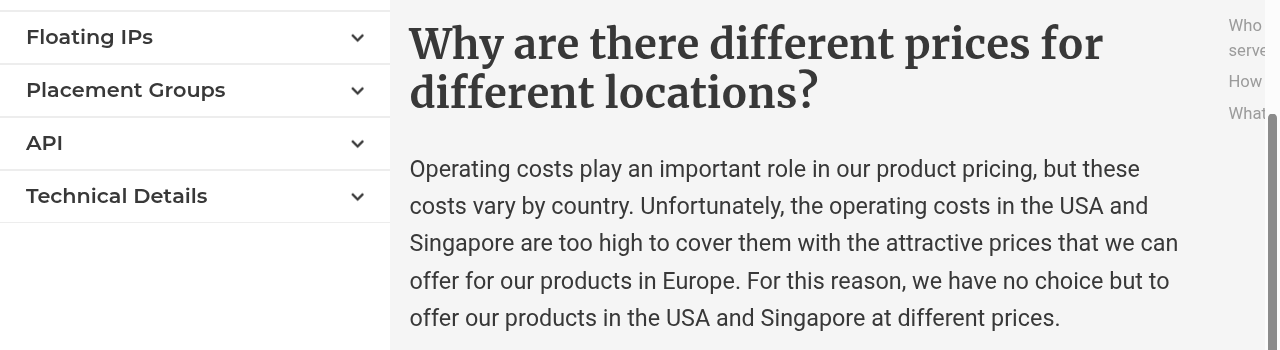
- US and Singapore pricing is higher, by Hetzner’s own admission. Hetzner’s docs state plainly that “operating costs in the USA and Singapore are too high to cover them with the attractive prices that we can offer for our products in Europe,” so Ashburn, Hillsboro, and Singapore instances cost more than the same specs in Falkenstein, Nuremberg, or Helsinki - and traffic allowances outside the EU zones are also smaller. If you’re expanding to US regions, the math changes.
- No managed services. No managed databases, no managed Kubernetes. Everything is DIY.
- Email-only support. No live chat, no phone. If something breaks at 3am, you’re on your own.
- Account verification can be strict. Some users - particularly from outside the EU - report rejections with little explanation.
- No Windows support (Linux only; you can install Windows manually but Hetzner won’t help).
netcup: The Dark Horse With Dedicated Cores
netcup is the most interesting alternative on this list and the least known outside Germany. Their Root Server (RS) line offers dedicated AMD EPYC 9645 cores at prices most competitors charge for shared vCPUs. The RS 1000 G12 gives you 4 dedicated cores, 8GB DDR5 ECC RAM, and 256GB NVMe storage at €13.48/month. That’s dedicated silicon at shared-instance prices.
Promo: New netcup customers can use promo code 36nc17821688730 for a discount.


Where netcup Wins
- Dedicated EPYC cores at shared-VPS prices. The RS line is the killer differentiator. A 4-core dedicated server at €13.48/month is cheaper than Hetzner’s cheapest dedicated instance (CCX13 at €54.58/month).
- DDR5 ECC RAM across the G12 generation - higher quality memory than most VPS providers use.
- NVMe SSD on every plan - no spinning disk tiers to navigate.
- ARM64 options at extremely low prices: 6 cores, 8GB RAM, 256GB NVMe at €8.20/month.
- Hourly billing available on VPS line (though best rates require 12-month commitment).
- ISO 27001, ISO 9001, ISO 14001 certified.
- 2.5 Gbit/s network on Root Server line.
- Traffic included at generous levels - not metered.


Where netcup Loses
- No load balancer. If you need to distribute traffic across instances, you’ll need a third-party solution or build your own.
- No object storage. You get NVMe block storage but no S3-compatible object store.
- Best pricing requires a 12-month contract. Hourly billing is available but at higher rates.
- Smaller community and ecosystem. Fewer tutorials, fewer third-party tools, less StackOverflow presence than Hetzner.
- Control panel feels dated compared to Hetzner’s cloud console.
- Account verification can be strict for non-EU customers.
OVHcloud: Unlimited Traffic, Global Scale
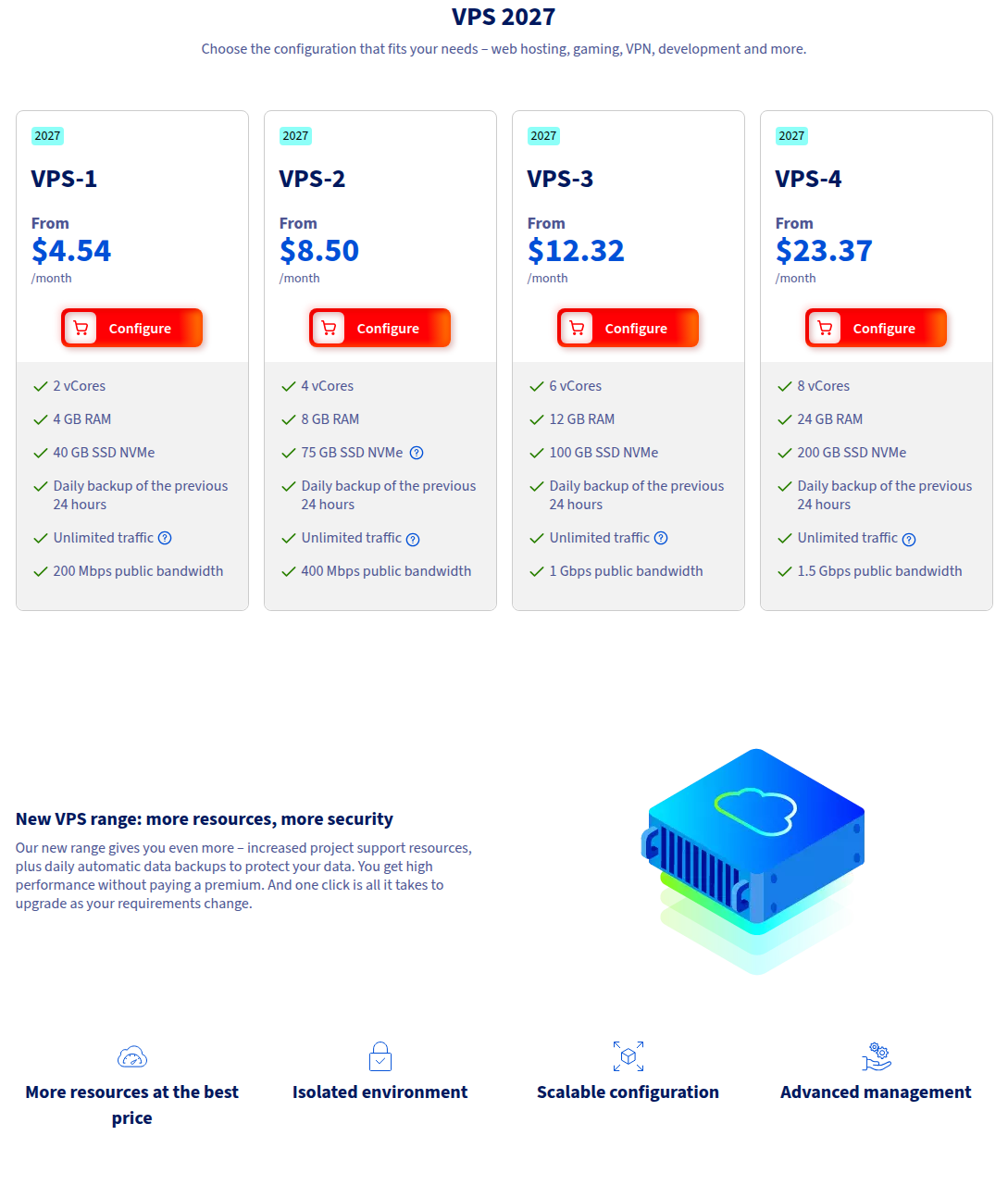
OVHcloud is the scale play. With 22 data centers across 19 countries and unlimited traffic on every VPS plan, it’s the natural choice if you’re deploying globally and bandwidth is your primary cost driver. Their new 2027 VPS range refreshes the lineup with NVMe storage and daily backups included. The entry VPS-1 2027 gives you 2 vCores, 4GB RAM, and 40GB NVMe at $4.54/month with unlimited traffic.
Where OVHcloud Wins
- 22 data centers - the most locations of any competitor on this list.
- Unlimited traffic on every VPS plan. No caps, no metering, no surprises. This alone makes OVHcloud a compelling alternative if Hetzner’s reduced US/Singapore traffic allowances are a dealbreaker.
- Anti-DDoS included by default. OVHcloud’s anti-DDoS infrastructure is industry-renowned (they’ve weathered some of the largest attacks on record).
- Daily automatic backups included in the new 2027 range at no extra cost.
- NVMe storage across all 2027 VPS plans.
- vRack private networking connects all your OVHcloud products across data centers.
- Full cloud ecosystem: Public Cloud compute, hosted private cloud (VMware, Nutanix), managed databases, Kubernetes, object storage, block storage, load balancers.
Where OVHcloud Loses
- Provisioning is slow. VPSBenchmarks records an average of 781 seconds (13 minutes) for instance provisioning vs Hetzner’s 25 seconds. If you need to spin up quickly, this is painful.
- Support reputation is poor. Unmanaged products get minimal help; you’ll be reading docs and forums.
- USD pricing on worldwide site. The live listing uses USD, which may mean currency conversion costs for EUR-based customers comparing against netcup or Hetzner’s EUR pricing.
- Lower specs at entry level. VPS-1 2027 gives 2 vCores and 4GB at $4.54/month, while Hetzner’s CX23 gives the same 2 vCPU/4GB for €7.52/month - close enough that the entry tier isn’t a clear win either way once you factor in currency.
- Fragmented product line. Public Cloud and VPS are separate UIs, separate billing, separate everything. The complexity is real.
- Strasbourg data center fire (2021) left some users wary of disaster recovery planning, though OVHcloud has since improved.
- Bandwidth caps on APAC locations. The fine print notes that Mumbai, Singapore, and Sydney VPS plans have data quotas (500GB-3TB) instead of unlimited traffic.
Scaleway: The Cloud-Native European Alternative
Scaleway is the most feature-rich European cloud on this list. They offer Kubernetes (Kapsule and Kosmos), serverless functions and containers, managed databases, S3-compatible object storage, GPU instances (H100, L40S), and even Apple Mac mini M4 cloud - a genuinely unique offering no competitor has.

Where Scaleway Wins
- 60+ Dedibox VPS locations worldwide - unmatched geographic spread.
- Full cloud-native ecosystem: managed Kubernetes, serverless (Functions, Containers, Jobs), managed databases, S3-compatible object storage with Multi-AZ.
- Mac mini M4/M4 Pro cloud - unique for CI/CD, iOS builds, or macOS-specific workloads.
- GPU instances (H100, L40S, L4) for AI/ML workloads, way beyond Hetzner’s GPU offering.
- Startup program with up to €36,000 in cloud credits.
- European data sovereignty (French-based, GDPR-native).
Where Scaleway Loses
- Bandwidth caps on VPS plans. Dedibox VPS plans range from 200 Mbps to 1 Gbps, vs Hetzner’s shared 10 Gbps line with 20TB included traffic. If you serve bandwidth-heavy content, this is a real constraint.
- Bandwidth-for-price tradeoff, not a flat price loss. The VPS-START-2-L (4 vCPU, 8GB, 100GB NVMe) runs at €23.49/month - actually cheaper than Hetzner’s CPX32 (€45.17/month) and netcup’s RS 1000 (€13.48/month, though with only 4 dedicated cores at 8GB). The real cost is the 500 Mbps bandwidth cap, not the sticker price.
- Two separate product UIs. Core cloud (Scaleway Elements) and Dedibox are different consoles with different billing.
- French-first documentation. English is available but some technical docs are more thorough in French.
- Smaller community than Hetzner for VPS-specific guidance.
Linode (Akamai) and DigitalOcean: The Developer Favorites
Linode and DigitalOcean share a similar position: US-centric clouds with excellent developer experience, strong documentation, and managed service ecosystems - but at prices that make European competitors look like bargains.
Linode (Akamai)
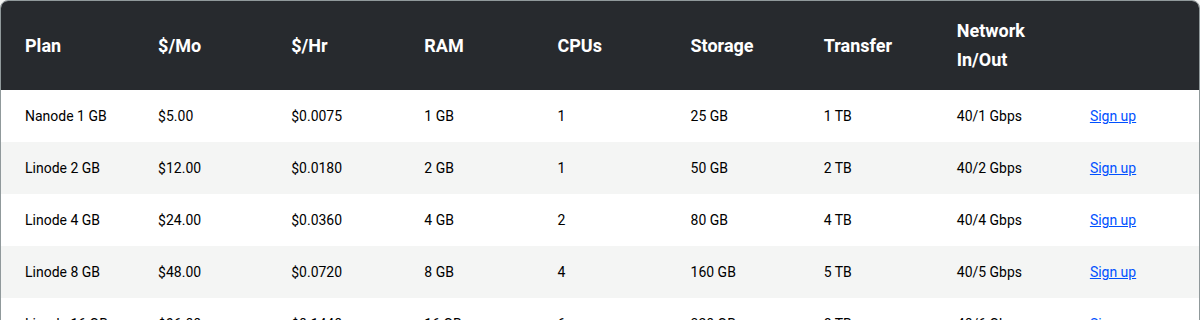
Linode’s Nanode starts at $5/mo for 1GB RAM and 1 vCPU with 1TB transfer. The 4GB plan (2 shared vCPU, 80GB SSD) runs $24/mo with 4TB transfer.
Linode offers managed Kubernetes (LKE at $60/mo for HA), an App Platform (PaaS), managed databases, GPU instances (RTX 4000 Ada, RTX 6000, Blackwell), object storage, block storage, and per-second billing. Akamai’s CDN integration now adds edge delivery capabilities.
Where Linode wins: Best-in-class documentation and tutorials. If your team needs to onboard quickly and wants managed services without the OVHcloud-level complexity, Linode delivers. The $100 free credit for new users lowers the trial barrier.
Where Linode loses: European alternatives deliver more resources for the same price. Hetzner’s CPX32 (4 vCPU, 8GB, 160GB, 20TB traffic) at €45.17/month and netcup’s RS 1000 (4 dedicated cores, 8GB, 256GB) at €13.48/month both undercut Linode’s $24 4GB plan on specs-per-dollar. Traffic allowances are also stingier than Hetzner’s 20TB.
DigitalOcean
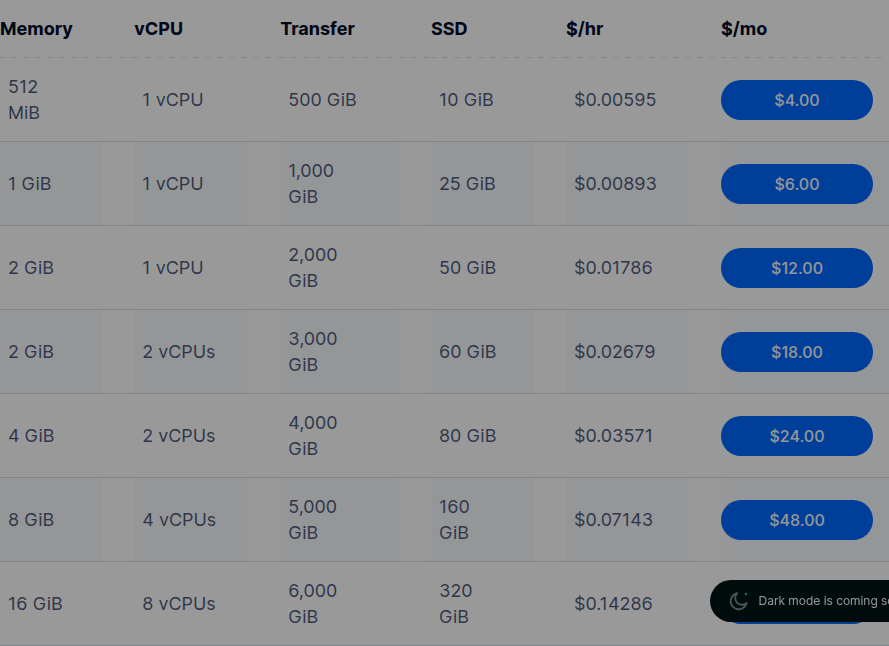
DigitalOcean’s entry Basic Droplet is $4/mo for 512MB RAM and 1 shared vCPU - too small for most workloads. The realistic entry point is $6/mo (1GB RAM) or $12/mo (2GB RAM). At $24/mo you get 4GB RAM and 2 shared vCPUs.
DigitalOcean offers App Platform (PaaS), managed databases, Spaces (S3-compatible object storage), managed Kubernetes, Functions (serverless), GPU Droplets, and per-second billing.
Where DO wins: Massive tutorial ecosystem, strong API, trusted brand, one-click marketplace apps. If developer productivity matters more than infrastructure cost, DO is the polished option.
Where DO loses: The most expensive per-GB-of-RAM among all competitors here. The $4 tier is anemic. Traffic caps are low (500GB on $4 plan). Frankfurt is the only mainland European zone (Amsterdam and London also available but not the same).
Comparison Table
| Provider | Entry Price | 4 vCPU / 8+ GB Price | Traffic | Data Centers | Hourly Billing | Block Storage | LB |
|---|---|---|---|---|---|---|---|
| Hetzner | €7.52/mo (CX23) | €45.17/mo (CPX32) | 20 TB (DE/FI) / reduced outside EU | 6 | Yes | Yes | Yes |
| netcup | €6.23/mo (VPS 500) | €13.48/mo (RS 1000, dedicated) | Unlimited | 5 | Yes (higher rate) | Add-on | No |
| OVHcloud | $4.54/mo (VPS-1) | $8.50/mo (VPS-2, 4 vCore/8GB) | Unlimited | 22 | Mixed | Yes | Yes |
| Scaleway | €4.99/mo (START-2-XS) | €23.49/mo (START-2-L) | 200-500 Mbps cap | 60+ | Yes | Yes | Yes |
| Linode | $5.00/mo (Nanode 1GB) | $24.00/mo (4GB plan) | 4 TB | 11 | Yes | Yes | Yes |
| DigitalOcean | $4.00/mo (512MB Droplet) | $24.00/mo (4GB Droplet) | 4 TB | 9 | Yes | Yes | Yes |
Prices accurate as of June 2026; check the vendor’s site for current rates.
Bottom Line: Who Should Pick What
Pick netcup if you want Hetzner-like value but better specs (dedicated cores, DDR5 ECC RAM) and are comfortable with a smaller ecosystem. The RS line is the standout - dedicated EPYC cores at shared-instance prices. Do not pick netcup if you need a load balancer, object storage, or a large community to lean on.
Pick OVHcloud if you need unlimited traffic and global scale. Their 22 data centers with unmetered bandwidth make them the natural choice for CDN-like workloads, media serving, or any deployment where bandwidth costs would otherwise eat you alive. Do not pick OVHcloud if you need fast provisioning or responsive support.
Pick Scaleway if you need a full cloud-native stack (Kubernetes, serverless, managed DBs, GPU instances) from a European provider, or if you specifically need Mac mini cloud. Do not pick Scaleway for bandwidth-heavy VPS workloads - the caps will bite.
Pick Linode or DigitalOcean if your priority is developer experience, documentation quality, and managed services, and infrastructure cost is secondary. US-based teams with existing Akamai or DO ecosystems will find the integration frictionless. Do not pick either if you’re budget-conscious - the European alternatives above deliver more cores, RAM, and traffic per dollar at the same price points.
Stick with Hetzner if you’re deploying in Europe, value performance-per-euro above all else, and don’t need managed services. Hetzner remains the performance king at its German-location prices. The math only breaks when you expand to the US or need managed databases.
For more honest, hands-on comparisons of SaaS tools and cloud infrastructure, browse our full comparison library.